

Leading the charge to keep prediction markets accessible to everyone. Views are the Coalition's own.
Joined November 2025
- Tweets429
- Following311
- Followers1.5K
- Likes364






Coalition for Prediction Markets retweeted
Regulate polls, not prediction markets. There’s no evidence that betting harms election integrity, but fake surveys have done so this year, write Harry Crane @HarryDCrane and @KolemanStrumpf
on.wsj.com/4i8zIKq

Coalition for Prediction Markets retweeted

Prediction markets are transparent, both in their incentives (people want to make money and avoid losing money) and their method (free markets aggregating millions of opinions).
Polls are not.

Regulate polls, not prediction markets. There’s no evidence that betting harms election integrity, but fake surveys have done so this year, write Harry Crane @HarryDCrane and @KolemanStrumpf
on.wsj.com/4i8zIKq
Coalition for Prediction Markets retweeted

CEO and co-founder of @Kalshi @mansourtarek_ fireside at @CFTC @KState AgCon. “Markets don’t lie”. Prediction market tools complement traditional market structure - to illuminate and hedge risks not captured by the incumbents.

Coalition for Prediction Markets retweeted

Kalshi CEO @mansourtarek_ joins @nickgillespie to discuss why prediction markets are fundamentally different from sportsbooks, why states are trying to regulate them, and how prohibition drives markets offshore on the Reason Interview. reason.com/podcast/2026/10/2…

Coalition for Prediction Markets retweeted

Fraud and manipulation know no borders.
The @CFTC has exclusive jurisdiction over prediction markets for this reason. These exchanges are interstate businesses that match the bids and offers of customers from across the country. Congress equipped the CFTC with the tools needed to enforce uniform standards, surveil and police fraud and manipulation, and protect customer funds across state lines. @LizClaman
Coalition for Prediction Markets retweeted

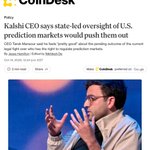
"It's not a choice of state versus federal market. It's a choice of whether prediction markets exist in the U.S. or whether they go offshore," said @mansourtarek_ at #DCFinTech Week. More via @CoinDesk: coindesk.com/policy/2026/10/…

Coalition for Prediction Markets retweeted

U.S. Election Trading
Prediction markets have a much longer history with elections than with sports. The data goes back to 1880.
Now U.S. platforms have handled more than $2 billion in U.S. election trades in 2026 alone. 🧵
Coalition for Prediction Markets retweeted
"1880"
Another reminder that prediction markets have been with us since the 19th century

Are prediction markets biased by white men? Republicans? Young people?
Dartmouth professor Eric Zitzewitz analyzed 145 years of election prediction market data, spanning multiple exchanges and countries. His findings:
• No systematic evidence of political bias across different eras, countries, and offices.
• No systematic evidence of pricing bias based on candidates’ race, gender, or age in the recent elections studied.
• Traders weren’t always representative of the voting population, yet that didn’t translate into systematic bias in election forecasts.
The paper points to a powerful mechanism: people who spot a mispriced outcome have a financial incentive to correct it. Even if some participants trade on personal preferences, informed traders keep prices grounded in reality.
Open competition incentivizes research, challenges consensus, and gives the best ideas a chance to surface. People are rewarded for being right, regardless of their background or preferences.
The paper does find some pricing biases, including slight overpricing of longshots and underpricing of favorites. Its central finding on election markets remains: no systematic evidence of political or demographic bias.
In an increasingly polarized world, these markets give us something valuable: an impartial source of information shaped by people with an incentive to get it right.


Coalition for Prediction Markets retweeted

🚨 @ChairmanSelig is right: Prediction markets are real markets—and the CFTC is the cop on the beat.
“They have an order book. They go through a clearinghouse. They function very much like markets.”
Coalition for Prediction Markets retweeted

The debate over prediction markets isn’t whether they should be regulated. It’s who should regulate them.
Congress created a federal framework for these markets for a reason: one national rulebook provides clarity instead of a patchwork of 50 different state regimes.
North Carolina has never gotten ahead by waiting for other states to understand innovation first. We shouldn’t start now, as I write today in @theobserver:
Coalition for Prediction Markets retweeted

Kalshi's @robertjdenault on why comparing a prediction market to a sportsbook doesn't hold up:
State piecemeal regulations are designed to regulate a casino that chases customer losses.
An exchange is the opposite: users set the price with each other in an open, impartial order book under federal regulation, the same model as Nasdaq, NYSE, and CME.
Coalition for Prediction Markets retweeted
New York intends to make event contract derivatives waste away under its iron curtain of state gaming laws before the courts issue final rulings. The @CFTC is required by law to ensure order in the derivatives markets, and that is what we’ve done today.
Read more: cftc.gov/PressRoom/PressRele…

Coalition for Prediction Markets retweeted

New York misses the mark on prediction markets nydailynews.com/2026/08/11/n…
Coalition for Prediction Markets retweeted
Brian Quintenz: "Federal regulation over federal markets is supreme. It preempts state laws."
And there's a reason for that. Otherwise, you'd have a patchwork of regulations applying to federal markets, and they wouldn't work.
Coalition for Prediction Markets retweeted
Rather than seek reasoned answers from the courts, Letitia James and New York seek to force an unprecedented sudden shutdown of prediction markets nationwide. The @CFTC has already sued to stop this and will continue to defend its jurisdiction.
Coalition for Prediction Markets retweeted
It took only two months for a federal judge to stop Minnesota from enacting this law.
They tried to ban prediction markets, turn users into felons, and criminalize service providers.
The worst part: the rationale used to ban prediction markets could be broadly applied to any financial market with speculation, which means all financial markets.
The upside here is unclear: make the casino lobby happy? The downside is obvious: limit competition, create chaos, and hurt the consumers they’re trying to protect.
States can’t just go around banning things they don’t have jurisdiction over.
If the real concern is about taxes or consumer protection, there are better ways to address that and we’re open to chat.

Coalition for Prediction Markets retweeted
Casinos: "Prediction markets are killing casino & gaming revenue"
Also casinos: "Our revenue is up 9.8% from last year"
Which is it??

Coalition for Prediction Markets retweeted

Maryland gaming regulators urged federal officials last year to crack down on sports prediction markets using a letter drafted by casino lobbyists, according to public records obtained by Spotlight on Maryland. bit.ly/4v1Rdix

Coalition for Prediction Markets retweeted

NEW: Who wrote Maryland's official letter to federal regulators?
Not Maryland regulators.
Public records obtained by Spotlight on Maryland show the letter was drafted by the casino industry's top lobbying group before state officials sent it to Washington under their own name.
The documents raise new questions about whether Maryland's gaming watchdog is operating independently or too closely aligned with the industry it's supposed to regulate.
Watch the new investigation from @PatrickHauf on @FOXBaltimore and @7NewsDC or read the full story tomorrow morning on the @baltimoresun.