

Director, FutureTech research project at MIT Computer Science & A.I. Lab, and PI at the Initiative on the Digital Economy at the MIT Sloan School of Management.
Cambridge, MA
Joined September 2017
- Tweets237
- Following123
- Followers1.6K
- Likes175

Neil Thompson retweeted

Does automation look more like a crashing wave hitting some workers and not others, or a broadly rising tide?
Our latest Substack post from @adamkuzee explains the concepts and data behind a recent MIT FutureTech paper on the shape of AI progress: mitfuturetech.substack.com/p…
@MITSloan
@MIT_CSAIL
@ProfNeilT
#AI #Automation #FutureOfAI #FutureOfWork #AIResearch #MITFutureTech

Neil Thompson retweeted

2/ (Birth) Differentiated portfolios: Major developers often release models in batches, introducing models that are both vertically differentiated (size, capability, and latency) and horizontally differentiated (task specialization, hardware compatibility, and alignment).

Neil Thompson retweeted
New paper with Kazimier Smith and @ProfNeilT at @MITFutureTech and @mit_ide: "Birth, Life, and Death of AI Models." We track the lifecycle of open-weight AI models using a weekly panel of the ~108k most-downloaded models on @huggingface (>53B downloads) papers.ssrn.com/sol3/papers.…

Neil Thompson retweeted

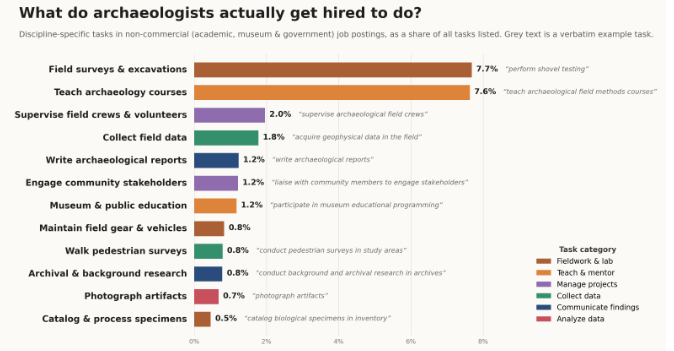
one important parallel contribution here is this cool taxonomy of tasks in science. I had always wanted to work on something similar, but never go around to it --
Joe Emmens, @ProfNeilT and team did a fantastic job building this taxonomy from job postings.
here's an example of tasks in Archaeology for example.
I suspect it will have many uses beyond just this one project. Check it out!
drive.google.com/drive/folde…

Thrilled to release AI in Science: Early Insights into the world. This was a project co-led with the excellent @JMateosGarcia and @m_codreanu and an incredible team of co-authors. This collaboration between @Google and @GoogleDeepMind teams is the first, initial look, representing the beginning of a research agenda for us.
The promise of AI for economic growth and flourishing moves directly through its impact on science, and this paper is the start of a brand new effort in our group on the study of AI's impact on science. Lots of results, lots of insights, lots of questions still to answer.
There is great excitement -but also concerns- about the impacts of AI on science, but so far little data. We provide early insights on this from three complementary data sources: 1) a sample of 15 million Gemini interactions, 2) an inventory of over *2,600* specialized AI models (e.g., AlphaFold) across disciplines, 3) a new survey of over 600 scientists.
But what does this tell us about how scientists actually use AI in their workflow, and is the impact of AI? To answer these questions, we map these data to: a) a new taxonomy of scientific tasks from @ProfNeilT and his lab; b) bibliometric data tracking scientific publications, and citations (including to specialized AI models).
Four main findings emerge.
1) We find broad adoption and coverage: scientists use AI more than most other occupations. Specialized AI models have huge disciplinary coverage and are highly cited. Nearly half of the scientists surveyed report using some form of AI every day.
2) There is evidence that LLMs and specialized models act as *economic complements*: LLMs are used for general analysis, coding, and manuscript preparation, while specialized models push the frontier through domain-specific predictions, data generation and classification. The figure below illustrates this nicely: Each model class reinforces the other in the scientific process.
3) Surveyed scientists report large productivity gains from using AI: a saving of nearly 7 hours per week, time which is primarily reinvested in more research. Scientists also report having better access to interdisciplinary insights and increased capacity for synthesis.
4) But as some stages of scientific research become easier, bottlenecks shift downstream to non-automated tasks. Scientists report an increased backlog of untested hypotheses and substantial time spent on output verification. Half of scientists also report AI is pushing them towards safer, more incremental question, evidence of a potential “streetlight effect”.
What do we make of this? Our findings suggest that AI holds significant potential to increase scientific productivity. However, as with other sectors, its ultimate impact will be governed by complex task interdependencies and investment into eliminating emerging bottlenecks. Investment into infrastructure and the organization of scientific production is necessary to realize AI’s full scientific potential for economic and societal gains.
Finally, this is work in progress. There are many limitations, which we discuss in section 6 of the paper, at length.
Link: ai.google/static/documents/A…

Neil Thompson retweeted

We offer a principle, not a verdict. Report the task, the baseline and the compute budget in the same breath as the performance claim. Otherwise, the number is just a headline.
w/ Emma Fu, @ProfNeilT (@MITFutureTech, @MIT_CSAIL)
arxiv.org/abs/2609.16258
#AIforScience #SciML #AI

Neil Thompson retweeted

Thrilled to release AI in Science: Early Insights into the world. This was a project co-led with the excellent @JMateosGarcia and @m_codreanu and an incredible team of co-authors. This collaboration between @Google and @GoogleDeepMind teams is the first, initial look, representing the beginning of a research agenda for us.
The promise of AI for economic growth and flourishing moves directly through its impact on science, and this paper is the start of a brand new effort in our group on the study of AI's impact on science. Lots of results, lots of insights, lots of questions still to answer.
There is great excitement -but also concerns- about the impacts of AI on science, but so far little data. We provide early insights on this from three complementary data sources: 1) a sample of 15 million Gemini interactions, 2) an inventory of over *2,600* specialized AI models (e.g., AlphaFold) across disciplines, 3) a new survey of over 600 scientists.
But what does this tell us about how scientists actually use AI in their workflow, and is the impact of AI? To answer these questions, we map these data to: a) a new taxonomy of scientific tasks from @ProfNeilT and his lab; b) bibliometric data tracking scientific publications, and citations (including to specialized AI models).
Four main findings emerge.
1) We find broad adoption and coverage: scientists use AI more than most other occupations. Specialized AI models have huge disciplinary coverage and are highly cited. Nearly half of the scientists surveyed report using some form of AI every day.
2) There is evidence that LLMs and specialized models act as *economic complements*: LLMs are used for general analysis, coding, and manuscript preparation, while specialized models push the frontier through domain-specific predictions, data generation and classification. The figure below illustrates this nicely: Each model class reinforces the other in the scientific process.
3) Surveyed scientists report large productivity gains from using AI: a saving of nearly 7 hours per week, time which is primarily reinvested in more research. Scientists also report having better access to interdisciplinary insights and increased capacity for synthesis.
4) But as some stages of scientific research become easier, bottlenecks shift downstream to non-automated tasks. Scientists report an increased backlog of untested hypotheses and substantial time spent on output verification. Half of scientists also report AI is pushing them towards safer, more incremental question, evidence of a potential “streetlight effect”.
What do we make of this? Our findings suggest that AI holds significant potential to increase scientific productivity. However, as with other sectors, its ultimate impact will be governed by complex task interdependencies and investment into eliminating emerging bottlenecks. Investment into infrastructure and the organization of scientific production is necessary to realize AI’s full scientific potential for economic and societal gains.
Finally, this is work in progress. There are many limitations, which we discuss in section 6 of the paper, at length.
Link: ai.google/static/documents/A…
Neil Thompson retweeted

These are the most urgent #AI risks, according to 272 experts
buff.ly/As89T7o
@MITSloan @MITFutureTech @MIT_CSAIL @PeterSlattery1 @ProfNeilT #tech #digital #innovation #disruption #leadership #business #management #governance #cybersecurity #AIrisks #CIO #CDO #CEO #CISO


Neil Thompson retweeted

Will AI lift up low-income Americans—or leave them behind? Our new exclusive covers a @BrookingsInst webinar last week featuring the thoughts of @ProfNeilT. spotlightonpoverty.org/spotl…

Neil Thompson retweeted

Who is most vulnerable to risk from AI? And who is most responsible for addressing them? In our three-round Delphi study with 272 AI experts, we found a clear AI responsibility gap.
Experts judged that AI users and affected stakeholders are often the most vulnerable to AI risks. But they assigned primary responsibility for reducing those risks to general-purpose AI developers and governance actors, including governments, regulators, and standards bodies.
That matters because the people most exposed to AI harms often have the least power to prevent them.
💡 A few other key findings:
1️⃣ Under business as usual, experts assigned a ≥10% probability of catastrophic outcomes to 18 of 24 AI risk domains over the next 5 years.
2️⃣ Even assuming pragmatic mitigations, 5 risks remained above the 10% catastrophic threshold: dangerous AI capabilities, cyberattacks and weapons, environmental harm, inequality, and power centralization.
3️⃣ Information, finance, and national security were rated the sectors most vulnerable to AI risks.
🔗How can you engage? See our (fancy) new webpage for our interactive summaries of the findings and preprint, and please share with anyone working on AI risk, governance, or policy (links in comments).
This research is part of the MIT AI Risk Initiative (@MITAIRisk), which aims to help society understand, prioritize, and manage risks from AI. The initiative includes the MIT AI Risk Repository, a living database of more than 1,700 AI risks, the AI Incident Tracker, a collaboration with the Responsible AI Collaborative, which connects risks to over 1,400 incidents, and the MIT AI Governance Map, which analyzes risk coverage across more than 1,000 laws, standards, policies, and other governance documents curated by the Center for Security and Emerging Technology (CSET).
This work was led by Alexander Saeri, Jess Graham, and Michael Noetel (@mnoetel), with a lot of feedback and support from Neil Thompson (@ProfNeilT) at MIT FutureTech (@MITFutureTech) and MIT Sloan @MITSloan. Thanks to the 272 participants, who very generously contributed their expertise to make the findings possible.
Webpage: airisk.mit.edu/priorities
Paper: cdn.prod.website-files.com/6…

Neil Thompson retweeted

At our recent #EGPresents, experts discussed how the rising adoption of AI may affect the environment, economic growth, and inequality.
Missed the event featuring @CostaSamaras, @HBoushey, @JigarShahDC, and @ProfNeilT?
Check out the full recap here 🔗:
equitablegrowth.org/the-unit…

Neil Thompson retweeted
It was a pleasure to attend the recent National Institute of Standards and Technology (@NIST) and Center for AI Standards and Innovation Workshop on AI Incident Management.
I was especially keen to see Neil Thompson (@ProfNeilT) deliver the keynote, where he discussed some of our recent research on the gaps between expert AI risk prioritization and organizational responses to those risks. (Although my photograph won't do it much justice!)
I’m excited to continue exploring how the MIT AI Risk Initiative can support practical work on AI incident response and risk management.
Many thanks to Sanjay Rekhi, M S Raunak (@msraunak), Peter Cihon (@pcihon), Anita Rao, and others for the invitation and for organizing such a valuable event.
nist.gov/news-events/events/…
@MITFutureTech @MITAIRisk

Neil Thompson retweeted
📢 New paper: Prioritization of Risks from Artificial Intelligence: A Delphi Study of 272 International Experts
AI creates many risks, from discrimination, privacy loss, and fraud to more emerging concerns such as overreliance, dangerous capabilities being misused in weapons or cyberattacks, and AI systems pursuing unintended goals.
But which risks are most severe? Who is most vulnerable? And who is most responsible for addressing them?
To answer these questions, we conducted a three-round expert consultation with 272 AI experts.
💡 Four insights from our findings:
1️⃣ If things continue as they are over the next 5 years, experts assigned ≥10% probability of catastrophic outcomes (e.g., >1 million deaths or >$100 billion in losses) to 18 of 24 risks. Top concerns: cyberattacks and weapons, dangerous AI capabilities, competitive dynamics, power centralization, and disinformation and influence at scale.
2️⃣ Even assuming pragmatic mitigations, 5 risks remained above the 10% catastrophic threshold: dangerous AI capabilities, cyberattacks and weapons, environmental harm, inequality, and power centralization.
3️⃣ Vulnerability is broadly distributed, but responsibility is concentrated. Experts assigned the highest vulnerability to AI users and the general public, while assigning primary responsibility for mitigation to frontier AI developers, governments, regulators, and standards bodies.
4️⃣ Information, finance, and national security were rated the sectors most vulnerable to AI risks.
🔗How can you engage? See our (fancy) new webpage for our interactive summaries of the findings and preprint, and please share with anyone working on AI risk, governance, or policy.
airisk.mit.edu/priorities
This research is part of the MIT AI Risk Initiative (@MITAIRisk), which aims to help society understand, prioritize, and manage risks from AI. The initiative includes the MIT AI Risk Repository, a living database of more than 1,700 AI risks, the AI Incident Tracker, a collaboration with the Responsible AI Collaborative, which connects risks to over 1,400 incidents, and the MIT AI Governance Map, which analyzes risk coverage across more than 1,000 laws, standards, policies, and other governance documents curated by the Center for Security and Emerging Technology (CSET).
#AI #AIrisk #AISafety #AIGovernance #ResponsibleAI #RiskManagement

Neil Thompson retweeted
AI and the energy transition are reshaping the economy. Join EG and experts on June 10 to discuss how these factors influence growth and interact with climate change and regional development.
Feat @CostaSamaras, @HBoushey, @JigarShahDC @ProfNeilT
RSVP➡️
web.cvent.com/event/6a3be4dc…

Neil Thompson retweeted
@ProfNeilT kicks off the #google #MITFuturetech #AIfortheEconomyForum with our findings on AI automation from Thousands of Worker Evaluations of Labor Market Tasks.
Read the full paper:
arxiv.org/abs/2604.01363

Our new substack post: Can Academic Science Keep Up with the AI Frontier? mitfuturetech.substack.com/p…
Neil Thompson retweeted

MIT researchers @ProfNeilT and @davidautor joined the @csail_alliances podcast to talk about why AI’s impact on jobs hinges less on automation and more on how well the technology is designed to work with humans. bit.ly/4rJhlhb

Neil Thompson retweeted

Very interesting new paper AI and Scale: A Quantitative Task-Based Theory of Automation by @DanialLashkari @li_wensu C. Qiu and @ProfNeilT which takes serious the role of scale in driving AI performance and capabilities and, hence, firm adoption.
Applied to the context of computer-vision automation, they find firm-level adoption follows a classic S-curve, rising from under 1% of firms in 2023 to nearly 1/4 by 2035 (>50% if employment-weighted)

Neil Thompson retweeted

Beyond job displacement, this is the real shift.
AI doesn’t just automate work, it reshapes where expertise matters.
As @davidautor and @ProfNeilT note, when machines handle the predictable, value moves to judgment and creativity.
That’s what most “AI-first” strategies miss.
#AI

Beyond Job Displacement: How #AI Could Reshape the Value of Human Expertise
by @davidautor @ProfNeilT digitalistpapers
Learn more: bit.ly/49zCnIs
#ArtificialIntelligence #MachineLearning #ML #DL

Neil Thompson retweeted

Beyond Job Displacement: How AI Could Reshape the Value of Human Expertise
digitalistpapers.com/vol2/au…
✍️ @davidautor @ProfNeilT via "The Digitalist Papers Volume 2" @DigEconLab
👉 "How will transformative AI reshape the world of work? It will not simply eliminate jobs; it will reshape the value of human expertise. This new framework can help us think through very different scenarios, from gradual automation to complete human labor obsolescence—and how we can prepare for them"
💡 “We remain optimistic that humanity is not converging rapidly to the end of labor scarcity, but we recognize that a risky technological and economic transition is already underway—one with vast upside benefits and vast downside risks that will land unevenly on individuals, demographic groups, nations, and generations”
@Corix_JC @jeanyvesgonin @sonu_monika @JagersbergKnut @ahier @sim010101 @maponi @EstelaMandela @Shi4Tech @CEO_Aisoma @SpirosMargaris @dinisguarda @RamonaEid @AstridLavalette @ChuckDBrooks @FernandaKellner @mvollmer1 @PVynckier @JoannMoretti @NeiraOsci @tlloydjones @SusanHayes_ @theomitsa @smoothsale @TarakRindani @FrRonconi @Nicochan33 @mikeflache @Khulood_Almani @TysonLester @CurieuxExplorer @Ym78200 @amalmerzouk @smaksked @sulefati7 @pchamard @Analytics_699 @MaryRich78 @Eli_Krumova @TheAIObserverX @NathaliaLeHen @sminaev2015 @jeancayeux @WillyRayNick @DanielleLargier @RLDI_Lamy
