




Pinned Tweet
780 people bookmarked this prompt in 2 days. almost as many as liked it (833)
i ran the same prompt through opus 5.5 and asked for amsterdam and a guy biking through the rain with a pumpkin for a head
one loop is 120 seconds. 300 loops = the 10 hour video
→ 1 html file, no libraries, no game engine
→ drawn at 480x270 and scaled exactly 4x, so it stays sharp at 1080p
→ every raindrop, spark and puff of smoke is a function of time
→ so the frame at 119.98s lines up with frame 0
→ the pumpkin is a costume. human eyes blink inside the carved holes and he waves at a black cat
→ 2 passes: empty candy bucket on the way in, full on the way back
what broke: the first render turned the canal into gibberish. window frames bent by the waves looked like random glyphs. the fix was drawing each reflection row twice, 2px apart, at lower opacity. his waving hand was also stuck behind his own pumpkin
most "loops for hours" demos never show the seam. i diffed the last frame against the first: the jump is the same size as between any two neighboring frames
add 3 lines to the original prompt:
"render at 480x270, scale 4x, no smoothing"
"every animation must divide a 120s loop, particles are pure functions of time"
"add one character with a tiny story that plays out across the loop"
which city should he ride through next?

Claude Opus 5.5 just coded this entire animated pixel art world from scratch using only TypeScript
No game engine. No static image generators. Just pure code rendering a cozy, rainy world.
Here is the exact prompt:
> "Make me an animated pixel art Halloween diorama, built to be the looping cover for a 10 hour lofi music video. Build the palette on strong warm/cold contrast: a cold, rainy night against warm pockets of firelight and glowing windows. Bring it to life with great effects: rain, fire sparks, drifting smoke and flickering light. It should look crisp full screen at 1080p and loop smoothly for hours."
How it actually works under the hood:
> Written entirely in TypeScript in about 10 minutes
> Renders complex atmospheric loops: rain particles, lightning flashes, smoke, firelight, and a skeleton relaxing under an umbrella
> Can hook into Sprite Fusion API or MCP to generate and animate custom game sprites on demand
Give an LLM TypeScript and a pixel grid, and it stops being a text chatbot
It becomes an ambient studio


Rix retweeted

tracked every click to prove claude code kills our $8k agency
847 → 82
contract dead by monday
under 2 hours
empty canvas → linear-grade page
mouse movements in the video
DESIGN.md + anthropic skills + shadcn
$8k of agency work before dinner
your landing page is still a $400k liability
bookmark before another weekend dies on tailwind


EVERY REROLL IS MONEY YOU ALREADY BURNED.
60k people bookmarked how to stop paying for them. 4m views in a day.
the fix is one rule:
fix it in text, never in video.
→ claude code writes the story, storyboard and every prompt
→ codex draws the first + last frame of each shot
→ seedance only animates between locked frames - ¥0.5-1.5 per second
→ a fresh zero-context agent reviews prompt + both frames before you pay
→ it caught a cup 13% bigger in the last frame. left unchecked, you pay for the shot twice
where it still breaks: music you said no to. strip it in ffmpeg.
everyone posts the one clip that worked. this is the loop that stops you paying for the other four.
ready-to-copy reviewer prompt in the first reply ↓
full article below.
i keep 1 out of 4-5. a 10-sec shot on 2.5 is ¥15 on paper, ¥60-75 for real.
what's your ratio?


this is f*cking insane. you spent 2 hours writing a thread that pulled 40k. a guy with 2k followers pasted one line and hit 200k. he did not write it. claude did
no fine-tuning, no course, no RAG. one folder with your archive and one command that teaches claude how you sound, not what you said
the stack, 4 minutes:
→ export your archive from x. one zip
→ open claude code in an empty folder, drop the zip in
→ one command: "learn how i sound, not what i said"
→ get a style.md, 40kb. your rhythm, your typos, the three words you overuse, the hills you die on
→ paste half a thought → get a thread → edit 3 or 4 lines → post
i ran my own 18 month archive through it. first drafts were 6/10. by day 12 they were 8.5/10. now i edit 15–20% of the text. the rest comes out like i wrote it on my best day, not my average one
the alpha most people miss:
> week 2: it catches the phrasings you never noticed you use. you read a draft and think "i actually do talk like that"
> week 4: drafts are cleaner than 60–70% of what you wrote by hand. not because the model is smarter. because it is not tired at 11pm and does not second-guess itself
> week 6: it starts arguing with you. you wrote something in may that contradicts what you believe today, and it will not let you hit post until you reconcile both
> month 3: the reply the bot writes to your own quote tweet outperforms the original post
the ugly part most will scroll past:
the guy you follow for sharp takes has not written a thread from scratch since mid september. he opens a folder, picks the best draft of the week, changes 2 words and posts it from the gym. you are still writing by hand at 11pm
export your archive tonight. tomorrow morning you open claude and the thread you were going to write is already waiting.


Rix retweeted

REDDIT'S GAMEDEV SUBS DELETED HIS POST BECAUSE HE ADMITTED USING AI.
19 years making games. this one took 5 weeks, and claude opus 5.5 wrote almost all the code while agents worked the night shift. it already has a steam page.
how the night shift runs:
→ every idea and every bug becomes a task card
→ agents take the cards overnight, each on its own branch
→ each card gets checked automatically: build, tests, a test drive
→ in the morning the dev reviews it all and merges
the rest of the stack:
→ unity 6 + mcp lets claude open scenes, change values, take screenshots and play the game
→ concept art goes into tripo p2 for the tractors, machines and props
→ opus cleans the meshes up in blender through mcp before import
the rule that saved the project: never trust the agent's own "done". build it, test it and drive it before you merge.
was reddit right to pull it, or is AI code fair game now?
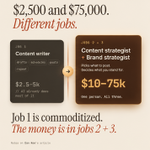
BREAKING: Dan Koe put $2,500 and $75,000 in the same article. almost nobody noticed they're for completely different jobs.
$2,500 → $75,000 a month
$2.5-5k is the first client. $10-75k is once you're good. the gap is 3 jobs:
→ content writer: drafts and schedules posts
→ content strategist: picks the next posts from what's performing
→ brand strategist: positioning, what you stand for and against
his 10 free posts for client #1 sell job 1. the $75k is for one person doing all 3.
most people will stall at job 1: same free prompt, same 10 posts. ai already does most of it. an agency writer in the article: "my entire job nowadays is reviewing and rewriting drafts." 12 hours a day became 4.
job 1 pays $2.5k and ai is taking it. jobs 2 + 3 are the other $72.5k.
which of the 3 are you actually doing? sending ai drafts counts as job 1.



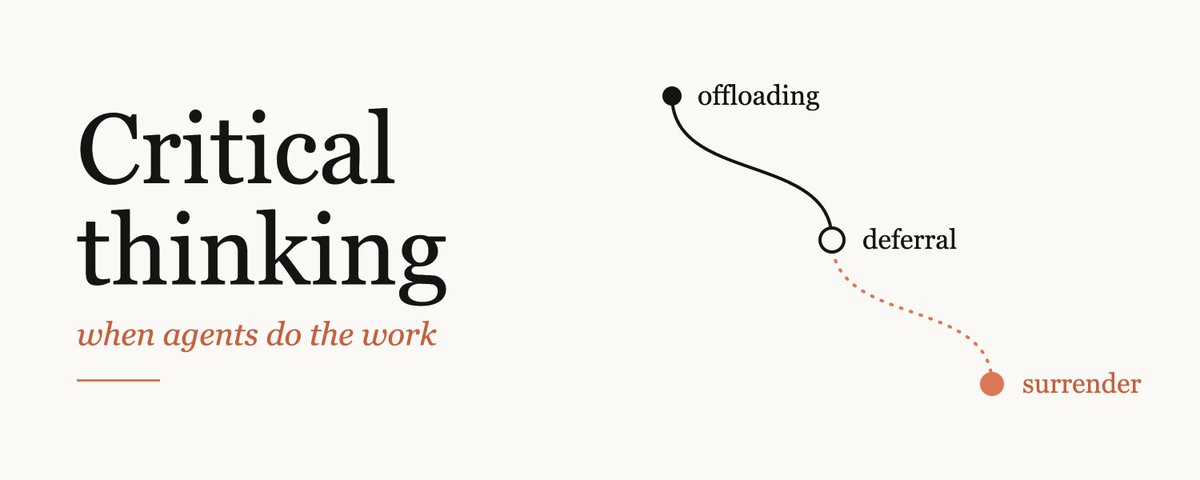
Two tips in this piece break on the exact problem it describes.
The piece is strong. Core idea: the better models get, the less we check them, and you can't feel yourself sliding into "I just trust it."
1.
"At the end, ask: did I miss anything?"
A model will almost always find something. "Nothing" is an answer it rarely gives. Three plausible bullets are easy to mistake for a review.
2.
"Ask several models to argue the other side."
They trained on similar data and fail in similar ways. Three models agreeing count for less than one colleague who disagrees with you.
What I'd add:
Write your hypothesis down, but keep it out of the prompt. The model will agree with it and hand your own opinion back, nicely formatted.
Next to it, write your confidence as a percentage, and once a month count your hits. "I haven't lost it yet" becomes something you can check.
This was described back in 1983, in "Ironies of Automation": the better automation works, the worse people handle the moment it fails. Pilots are encouraged to hand-fly regularly for this reason. Osmani's version: write some code without an agent once a week. I think it's the most underrated tip in the piece.
When did you last write code without an agent?


deepseek tested its own idea against a single agent session with a subagent tool and a neutral prompt.
it delegated 0 times in 5 runs.
→ every new chat message interrupted the work, p95 hit 29.5 min
→ they rewrote the prompt to "prefer handing each piece of work to a subagent"
→ the model listened in 4 runs out of 5
→ in run 5 it decided the job was "small" and did it itself. that run is the long tail
→ their fix is structural: the router session has no bash, it can only talk and dispatch
→ p95 drops to 15.7 min
the catch sits in the same table: ~4x the cache-read tokens (23.2m vs 6.1m)
none of the 30 quotes i read mention this experiment. they all post the router/worker diagram.
how often do your subagents get called without you asking?


everyone's quoting the "claude code found 14,219 photos of my face" post. so i ran the same prompt on my own phones.
android, full adb scan, read only:
→ 3 image files on the entire phone
→ 0 photos of my face
→ the faceunlock cache folder: permission denied. you can't open it without root. neither could he
→ 2 of the 3 files were ad videos cached by a free vpn i forgot i even installed
iphone backup:
→ 949 photos, 1,020 thumbnails. one thumbnail per photo, that's just how ios works
→ no hidden cache of 145,763 deleted pics
those posts got millions of views. the only thing on my phone i didn't know about was a free vpn.
that's the real check. open your app list and delete the free vpn / qr scanner / flashlight you installed in 2022.
the video is the actual scan, not a mockup.

Claude Code found 145,763 photos I permanently deleted from my iPhone.
Three years of deleted photos and videos still sitting in a hidden cache. Any app with file access can read them.
I plugged my iPhone into my MacBook to run a backup. Claude Code was doing the security audit from my last post and flagged a directory I wasn't even looking for.
PhotoData/Thumbnails. Over 146,000 files. Photos, videos, screenshots. Every single one was something I deleted.
Photos from 2023, 2024 and 2025. The ones I deleted the second after taking them. The ones I cleared from Recently Deleted. The ones I deleted three separate times because I wanted to be sure they were gone. All still there.
Passport photo I took for a visa application in 2023.
Screenshots of my bank app with full account numbers visible.
Private photos I sent someone and immediately deleted after a breakup.
Screenshot of my crypto seed phrase I took temporarily in 2022.
Photo of my ID and credit card I took to remember the numbers and deleted 5 seconds later.
Screenshots of my ex's private Instagram stories I saved and permanently deleted in 2023.
Some were full resolution. All organized by date going back to 2021.
When you delete a photo on iPhone, iOS removes it from your camera roll and Recently Deleted. It keeps a compressed copy in a Spotlight search index cache so your phone can find things when you search. Apple never clears it. Not after 30 days. Not after a year. Never.
They told you it was permanently deleted. It wasn't.
I checked which apps on my phone had Files and Folders access. 23 apps. Weather apps. QR code scanners. PDF readers. A flashlight app I downloaded in 2022. Any one of them could have been reading every photo I ever deleted this entire time.
Went from 23 apps to 3 in about two minutes.
Full step by step below. Takes 2 minutes. Save it so you don't lose it and send it to anyone with an iPhone.
Readers added context they thought people might want to know
The video is an old, misappropriated clip from 2023, and the accompanying claims are fabricated.
x.com/HarshithLucky3…
480k views and 2.5k saves on a free claude skill that answers questions with machines instead of paragraphs
a kids' lesson built with it - a pump filling a tyre - pulled 122,818 views
→ it's called anatomy, one html page per machine, a button for every step
→ only the next button is live, nobody skips the part that matters
→ a window cut into the part doing the work
→ every gauge reads from one model of the real thing - 9 bar, 27 s shot, 36 g out
→ 12 machines built so far, same prompt, new brackets
where it went wrong: one frame of the lever blew up into a giant black disc. 95,245 pixels changed where a normal frame changes 900-1,400. a frame-by-frame scan caught it
everyone is making ai explain things. this makes people press a lever and watch
which machine would you build first?


greg isenberg's s-1 breakdown hit 551k views in 5 hours. everyone is quoting revenue. i opened the filing itself
one share. 50.1% of the vote
→ the filing creates a single share of class f stock
→ it goes to an llc of the 7 co-founders, with 50.1% of the total voting power
→ a separate trust, the ltbt, elects a majority of the board through class t stock
→ ticker: ant, nasdaq global select
→ class f and class t carry no economic rights
the catch: the price per share is literally blank. "between $ and $"
everyone is posting the valuation. the actual story is who keeps control after the ipo
would you buy a stock where 50.1% of the vote is already spoken for?

Anthropic has filed an S-1 registration statement with the SEC related to its proposed IPO.
Read more: anthropic.com/news/s1-sec
Legal disclaimer: A registration statement relating to these securities has been filed with the SEC but has not yet become effective. These securities may not be sold, nor may offers to buy be accepted, prior to the time the registration statement becomes effective. This post does not constitute an offer to sell or the solicitation of an offer to buy these securities, nor shall there be any sale of these securities in any state or jurisdiction in which such offer, solicitation or sale would be unlawful prior to registration or qualification under the securities laws of any such state or jurisdiction.

3.8m people saw this course. 28k saved it. here's the one part that actually changes your video - copy it
the one-liner gets you a clip. the loop gets you a film
→ step 1: run the showreel one-liner in claude code on xhigh. save it as v1
→ step 2: paste this before the final render:
before you show me anything:
1. render one frame per beat as a contact sheet and look at it
2. score 1-10: hook in first 2s, readability at phone size, motion, variety, sound sync
3. list the 3 worst problems with timestamps
4. fix them, re-render only those seconds, score again
5. repeat until every score is 8+
banned: centered title on gradient, everything fading in, corner labels
→ step 3: put v1 and v2 side by side
where it breaks: skip step 2 and you get the same reel as everyone else. the watercolor short in the article took 163 model calls, not one
everyone posts the final clip. nobody posts v1
run it and reply with your before/after. which score jumped the most?


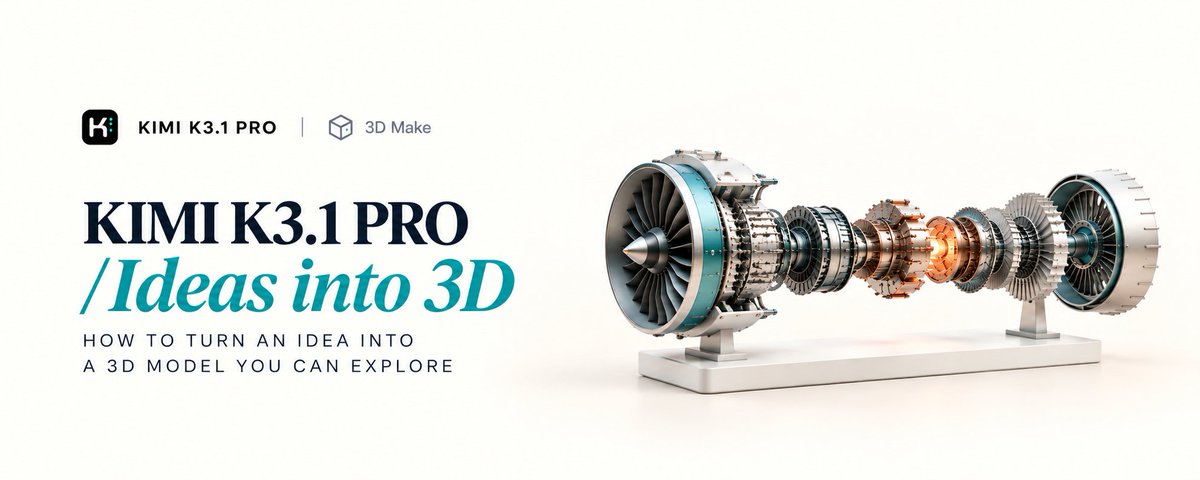
kimi's 3d make built a jet engine with 2,100 solid bodies from one prompt. @elvar_official's guide shows how to make your own.
2,100 parts. zero checks.
so i rebuilt the idea on an rs-style 5-cylinder and added the step the guide skips:
→ first version is a gray box - the guide is right, start there
→ chrome, coil packs, turbo - it looks done
→ tear it down to the bare block, look at the pistons
→ crank phase check: cylinder 3 got 0°, it should be 216°
→ it was firing with cylinder 1. the render looked perfect the whole time
the guide says "rotate the model after each change". rotating catches a bad shape. it doesn't catch a bad phase.
fixed cyl 3, it runs 1-2-4-5-3. watch the chart at the bottom of the video turn red, then green.
everyone is posting the prettiest render. the check is what tells you it works.
what's the one thing you'd test before you trust a model that just looks right?
421k people read @N01ennn's rea guide. most quotes are about the install. i turned the one bug nobody quotes into an engine teardown.
one constant: 0.0 instead of 128.0.
an rs-style 5-cylinder, taken apart part by part:
→ every part gets rebuilt and checked against the original - all green
→ piston 3 fits perfectly. it still passes. watch it in the video
→ the checker compared positions, never the value stored there
→ re-audit of 1,548 floats found 12 more wrong ones in 5 "accepted" functions
→ the fix: plant 3 broken parts the oracle must reject - wrong constant, swapped branch, off-by-one
the engine only runs at the end, firing 1-2-4-5-3, after the checks can fail.
where it goes wrong for most of us: the agent writes the code and the tests in one session, everything is green, and nobody checked if those tests can even fail.
everyone is sharing the rea install. "test the oracle" works on any repo, today. the prompt is on screen at the end.
how many of your agent's green tests would still pass if piston 3 was wrong?
Rix retweeted

this is f*cking insane, an AI agent rebuilt a Touhou game function by function, every one passed an exact byte check, and one bug still got through
REA is the repo behind it, an open-source tool now at 143.7K GitHub stars that lets Claude Code read programs down to the machine code, locally, with evidence for every finding
the bug was one number. the rebuild checked the player's power against 0.0, the original used 128.0, and the check only compared instruction bytes, never the value behind them
the rule that came out of it is one line: test the oracle too
give each check its own job:
→ bytes: compile ur version and compare it to the original's machine code
→ behavior: send both the same inputs and compare what comes out
→ runtime: build the whole program and actually play or use it
→ planted failures: hand the check three wrong versions and make sure it rejects them
it's the same lesson the DX-Ball rebuild proves from the other side, 3,205 original test cases passed and all 63 compiled bytes matched
a green run can look perfect and still be blind
so nobody trusts a pass until the check itself has been caught failing on purpose
every planted failure has to cover:
> one constant changed
> one branch swapped
> one boundary shifted by one
after the fix they re-audited 1,548 floating-point references and found 12 more wrong ones in functions already marked done
install REA, then ask Claude Code:
"Use REA to investigate how [feature] works in [app]
1. Trace it to the exact functions and cite the evidence for every step
2. Write a spec of the behavior, inputs, outputs and edge cases. No code from the original
3. Build my version from the spec in a new folder
4. Add three deliberately wrong variants and confirm the tests reject all of them before trusting any pass"
start with the official practice app, then the % button in Windows Calculator
a blind oracle doesn't fail one function, it quietly approves hundreds
watch the agents at work below


1.2m people read this in a day. most of them will patch php and learn nothing from it
9.2 out of 10. twice
the 48 hours are a free reverse engineering class if you open claude code:
→ pull the patched php release and the one before it
→ ask opus 5.5 for the diff on just the two fixes
→ have it draw the path as a mermaid diagram: request in, bad code, what the patch changed
→ switch the output style to learning so it quizzes you instead of lecturing
→ run the same on litellm, the package that sat poisoned on pypi for about 2 hours
where it breaks: claude will confidently explain a patch it never looked at. make it cite file and line for every box in the diagram, or don't trust the picture
everyone is posting "patch now". almost nobody is showing what the patch actually fixed
paste this:
compare php <old version> and <patched version>. show only the changes for the two security fixes.
draw a mermaid diagram: input -> vulnerable path -> what the patch changed.
cite file and line for every box. no exploit code.
then ask me 3 questions before you explain anything else.
which one are you taking apart first, php or litellm?

🚨 Do you understand what happened in the last 48 hours..
> PHP, the code behind 69% of all websites, got 2 holes rated 9.2 out of 10, and the US, the UK and Japan told site owners to patch or go OFFLINE.. 4 days after hackers had already started trying the flaw..
> Japan's Prime Minister posted the request late at night.. the Finance and Health ministries pulled pages, MUFG Bank and JR West went into emergency maintenance, and Onamae shut ALL Desktop Cloud plans after malware hit up to 26,739 customer servers..
> India's eMudhra was caught with 8 intermediate certificate keys so weak one of them was literally the number 4.. the 60,000,000+ certificates it has issued can't be trusted..
> GitLab disclosed a 10.0 severity hole in every version since 2014.. the maximum score there is..
> criminals were caught using a literal AI hacking tool on 1,200+ sites.. it broke into more than 100 companies including John Deere and Cummins..
> LiteLLM, an AI tool with about 23,000,000 downloads a week, was secretly poisoned with a password stealer.. the bad version sat on PyPI for about 2 hours..
> State Bank of India, the country's biggest bank, confirmed 3,897 customer records on the dark web..
> WIRED now calls the PHP flaw "broadly exploited".. nearly 55,000,000 web properties still run PHP..
every single government on this list told PHP site owners the same thing within the last 48 hours.. patch it or take it offline..
all of this.. 48 hours..
if you're not following me you're finding out about this 48 hours late from someone who read my post..
it's only getting crazier from here..
Rix retweeted

Starlink Mobile is not just “another operator from space.” It is an attempt to build, for the first time in practice, a hybrid network where terrestrial low-band spectrum and direct satellite connectivity work as one system.
The key elements that actually change the picture:
• 800 MHz low-band is spectrum that penetrates buildings well and has long range. Combined with terrestrial sites, it addresses exactly the scenarios where pure satellite connectivity has traditionally been weak (indoors and dense urban environments).
• 15,000 Gen2 satellites with significantly higher capacity + 80,000+ terrestrial sites mean SpaceX is not trying to merely supplement existing carriers, but to become a full-fledged fourth player with its own dense network.
• The most important technical point: the phone already in the user’s pocket does not require a special antenna. This removes the main adoption barrier for direct-to-device satellite connectivity.
From a market perspective, this is a serious challenge for AT&T, Verizon, and T-Mobile. For years they have optimized their networks around the economics of “build where the subscribers are.” If SpaceX can deliver acceptable quality both in rural areas and in cities through the combination of spectrum + satellites, the classic logic of “coverage = capital expenditure on towers” starts to break down.
At the same time, there are real risks:
• Scaling 80,000 sites is not only about money, but also about permits, backhaul, and operational complexity;
• Integrating the satellite and terrestrial layers into a single network (handover, quality management) has not yet been proven at this density;
• Regulators and competitors will not sit idle.
If SpaceX succeeds in proving that the hybrid architecture works in practice, it will set a precedent not only for the United States but also for other markets where traditional operators chronically fail to cover “uneconomic” territories.
In short: this is no longer a concept. It is a bet on rewriting the rules of the mobile connectivity game. We will see the results in 2–3 years, once the network is actually operating.

Starlink Mobile is building something no carrier has ever done: one network that connects your phone from space and from the ground, giving every American coverage in places that have never had it
SpaceX is said to be seeking at least 80,000 U.S. cell tower sites, in talks with Crown Castle, right after agreeing to buy nationwide 800 MHz low-band spectrum and getting FCC approval for 15,000 next-gen direct-to-phone satellites
And the possibilities are incredible:
• Signal indoors, outdoors, in dead zones and everywhere in between
• Low-band 800 MHz that travels far and reaches deep inside buildings
• Gen2 satellites with more than 100x the bandwidth of the current generation
• Works with the phone already in your pocket
• Real competition for AT&T, Verizon and T-Mobile
Starlink Mobile will be the first network operator to deploy both satellite and terrestrial spectrum, so coverage stops depending on where someone happened to build a tower
America is getting a 4th major carrier, and it starts in orbit


yesterday abdulla ababakre (ex-ceo of interview coder) launched phoneuse - cloud phones for ai agents. 997k views in under 24h.
today someone already turned it into an agency:
47 clients x $500 = $23.5k/mo. one person.
how it connects back to his thread:
→ problem 1: tiktok, instagram, whatsapp have no api - agents couldn't get in
→ phoneuse gives them real androids and iphones over mcp
→ problem 3: agents now read notifications and act on their own
→ 7 agents split the work: scout, researcher, strategist, copywriter, creator, checker, mobile
→ you sell monthly trend research to gyms, restaurants, real estate
the catch: problem 2 is still there - amazon already blocks shopping agents. and $23.5k is revenue, not profit. the china guy has no name and no link.
everyone is reposting the money. the real unlock is in abdulla's thread - apps that were closed to agents yesterday.
which closed app would you point an agent at first?

Un chico en China montó una agencia de marketing entera con agentes de IA que usan teléfonos móviles y ahora gestiona él solo 47 clientes al mes cobrando +500$ a cada uno.
Más de 23.500$/mes de facturación.
Una persona coordinando.
Agentes de IA trabajando.
Varios móviles en paralelo.
En el vídeo están investigando tendencias en TikTok.
Y aquí es donde empieza la oportunidad de negocio.
Hay empresas que necesitan publicar contenido y lanzar anuncios, pero no tienen tiempo para investigar qué está funcionando en su sector.
Qué hace su competencia.
Qué formatos generan interés.
Qué hooks llaman la atención.
Qué ideas merece la pena probar.
Ese trabajo tiene valor. Y hay negocios que pagan cada mes por él.
Ahora tenemos agentes capaces de utilizar teléfonos y navegar por las apps para hacer esa investigación.
Se llama PhoneUse.
Los agentes pueden ver notificaciones, entender qué está pasando entre distintas aplicaciones y actuar de forma proactiva.
La pieza que conecta la IA con todo ese trabajo que sigue ocurriendo en el móvil.
El modelo de negocio es fácil de entender:
→ Eliges un nicho: restaurantes, gimnasios, inmobiliarias…
→ Ofreces un servicio mensual de investigación y contenido
→ Usas agentes para investigar tendencias y recopilar referencias
→ Conviertes esa investigación en propuestas adaptadas a cada cliente
→ Preparas guiones y materiales con herramientas de creación
→ Revisas, entregas y mides los resultados
El cliente paga por recibir un trabajo útil para su negocio.
La oportunidad está en organizar el sistema para entregarlo bien y con menos trabajo manual.
Lo más interesante es la arquitectura.
Cada agente se encarga de una parte:
• Scout → investigación de posibles clientes
• Researcher → tendencias y referencias del sector
• Strategist → propuestas y ángulos para campañas
• Copywriter → guiones y textos
• Creator → materiales y variaciones
• Checker → revisión de calidad
• Mobile → interacción con las apps mediante PhoneUse
PhoneUse cubre la parte del teléfono. Los demás agentes y herramientas completan el flujo.
Tú defines el servicio, consigues clientes y revisas las entregas.
Y eso cambia los números de una agencia.
Porque investigar, preparar propuestas y producir contenido consume horas antes de que el cliente reciba nada.
Reducir esas horas te deja margen para atender más cuentas y dedicar más tiempo a estrategia, ventas y resultados.
Sin confundir facturación con beneficio: siguen existiendo costes de herramientas, captación y revisión.
Pero la oportunidad es enorme.
Una empresa necesita contenido todos los meses.
Necesita nuevas ideas todos los meses.
Necesita entender a su competencia todos los meses.
Eso es un servicio recurrente.
Y cada vez tenemos más herramientas para que una sola persona lo gestione con ayuda de agentes.
Ya teníamos IA para escribir los guiones, crear las imágenes y generar los vídeos.
Ahora también tenemos agentes usando móviles para investigar dentro de las apps.
Empieza hoy: phoneuse.com
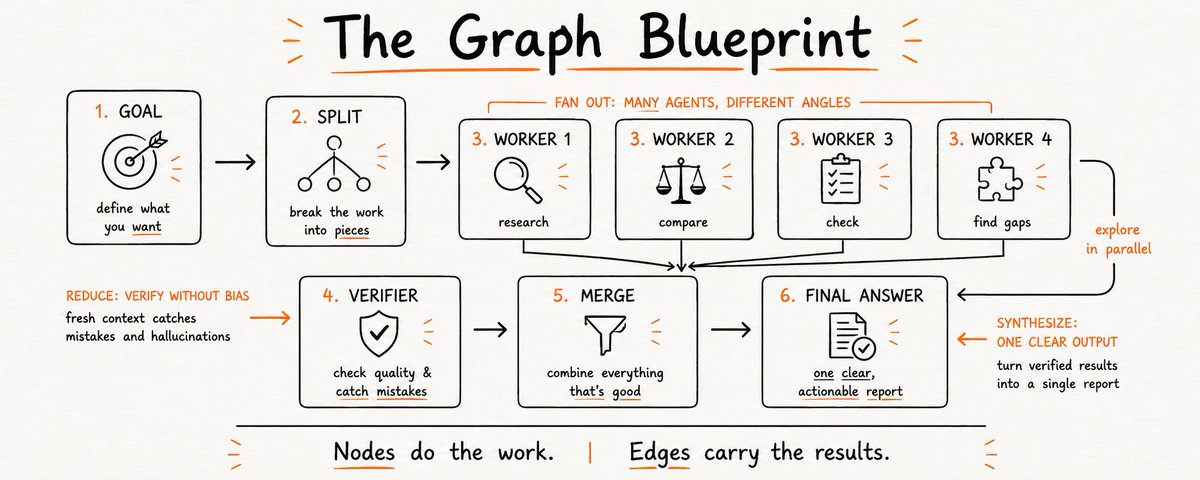
13m people read the graph engineering article. 17k saved it. almost nobody noticed rea is already built that way
20 repos, 5 blocks, 1 spec.md
→ binary goes in, spec.md comes out, the rebuild comes last
→ 5 blocks: analysis core, mobile, binary, network, rebuild & verify
→ each block is a node with one job and one output
→ spec.md is the merge, the one file every block feeds into
→ “rebuild & verify” is the checker node from section 6 of the article
→ the fake-edge test: does the network pass need the binary pass? if not, run them at once
where it breaks: the agent that wrote spec.md checks spec.md. same context, same assumptions. it reads its own notes and agrees with them. you get a confident wrong spec with a green light on top
most rea threads show the binary going in and the rebuilt app coming out. the verify step in the middle is what tells you if any of it is real
does your checker run on a fresh context, or does the same agent grade its own spec?