

Want to help build a more regenerative and ethical AI future?
Australia
Joined January 2026
- Tweets3K
- Following197
- Followers317
- Likes1.8K







Josh retweeted

Do you like learning about AI?
Build your AI skills with IBM SkillsBuild learning catalog.
skillsbuild.org/learning-cat…

Josh retweeted

Oh god f*ck, is this even possible? NVIDIA's new micro-robots just integrated the Grok Robot Brain Engine, and the live neural telemetry broadcast is genuinely terrifying
Watch what happens in the live feed when the robot ("Alpha") trips over a cone and hits the floor. Instead of rigid pre-programmed recovery scripts, you can watch its synthetic brain adapt and re-calculate in absolute real time:
• Live Neural Telemetry: Multi-node graphs track gait policies, spike rasters, and motor torque as the machine processes physical obstacles.
• Autonomous Recovery: The moment a fall is detected, thousands of neural nodes fire simultaneously to calculate friction, torque, and balance locks until the robot stands back up entirely on its own.
• Edge Cognition: Every step, stumble, and correction is generated live by a distributed neural network, completely bypassing traditional hardcoded robotics.
We are no longer just building machines; we are watching synthetic nervous systems wake up in the physical world.
Bookmark this before physical AI completely rewrites the entire robotics industry.


Josh retweeted

M3.1 Flash Weight is public now:
Hugging Face:
huggingface.co/MiniMaxAI/Min…
ModelScope:
modelscope.cn/models/MiniMax…


Josh retweeted

🥈 MiniCPM-V 4.7 just climbed to #2 on @huggingface Trending!
Thank you to everyone trying the model, sharing feedback, and building with it. Your support keeps us pushing on-device multimodal AI forward.
📱 35B-A3B MoE runs smoothly on iOS and Android with ~3GB memory. The 1B model delivers strong OCR, math, and video understanding performance.
Try it!
🤗 Models: huggingface.co/collections/o…
💻 GitHub: github.com/OpenBMB/MiniCPM-V
Let's keep the momentum going! 🚀

Josh retweeted

BOOKMARK THIS if you run a website.
Hermes SEO just landed as a community plugin.
It brings 45 SEO skills into Hermes, including full-site audits and specialized agent workflows.
Josh retweeted

DeepSeek v4.1 Flash can now create stunning motion videos on par with Opus 5.5—with OpenDesign Motion.
We asked OpenDesign Motion to make its own launch video. Here's the result.
Demo 2 ↘️

Josh retweeted
🚀 Introducing MiniCPM-V 4.7, our new open-source MLLM series!
Advancing the Performance–Efficiency Pareto Frontier.
It brings strong multimodal capabilities to iOS and Android devices with extreme efficiency.
Two new models:
🔹 MiniCPM-V 4.7 35B-A3B — Bring SOTA performance to local devices with newly introduced LES (Lookahead Expert Scheduling) technique, a new milestone of on-device multimodal AI.
🔹 MiniCPM-V 4.7 1B — Lightweight, efficient multimodal AI. Easier to deploy.
⚡ What's new?
SOTA performance: Competitive results across 34 benchmarks spanning multimodal understanding, STEM reasoning, OCR and long-video comprehension.
Fast on-device inference: LES predicts and preloads expert weights to reduce inference stalls, boosting 5× speedup on iPad Pro M4 (16GB) with byte-for-byte identical outputs. It enables MiniCPM-V 4.7 35B-A3B to achieve 17+ tokens/s on iPad Pro M4 (16GB) and 13+ tokens/s on iPhone 17 Pro Max, while costing only 3GB memory 🤯
Efficient visual processing: 4× and 16× hybrid visual token compression. Even at 16× compression, 35B-A3B scores 90.4 on OCRBench, 5.2 points ahead of Qwen3.6 35B-A3B.
Easier customization: We introduce Self-Replay Fine-Tuning, a simple way to customize new target capabilities at low cost while maintaining general performance.
Broad hardware support: Day-0 adaptations for Apple, Intel, AMD, Arm and Rockchip, with many more platforms supported through FlagOS!
Download, deploy, and build something we haven't imagined yet. 👀👇
🔗 GitHub: github.com/OpenBMB/MiniCPM-V
🤗 Hugging Face: huggingface.co/collections/o…


Josh retweeted

Open-source AI can sit with a community's elders and help carry their stories forward, not lock them away in an archive.
That's why we're committing $42M to build a model that speaks the language and helps the next generation keep it alive ↓

The most important technology of our time is being built in private, but we're funding the alternative: $42M for the people building AGI in the open.
Whether it's the model, weights, code, data, or evals, AI should belong to the people it serves, run on hardware they own, and reach the cheapest phone on earth.
Here’s a few of the use cases we want to back ↓

Josh retweeted

This is huge.
Xiaomi just open-sourced 7k+ reinforcement learning task environments used to train MiMo, covering code, cybersecurity, general tool use, visual web development, and music-related tasks.
here's why this matters more than another model release:
open weights let you run a model. open environments let you teach one.
reinforcement learning environments are difficult to build, because each task needs an executable world, a clear objective, tools the agent can use, and a reliable test for success.
Xiaomi has released much of that missing infrastructure, including prompts, agent configurations, reward metadata, and the surrounding training framework.
here is what developers can now do with it.
→ train models on real agent work. instead of imitating static answers, a model can attempt tasks, call tools, observe results, and improve from the outcome.
→ specialize smaller models. teams can train an open checkpoint for software engineering, vulnerability reproduction, knowledge work, or web development instead of relying on a much larger general-purpose model.
→ study complete trajectories. each run captures the agent’s reasoning, tool calls, environment feedback, and reward. researchers can identify where agents fail and compare training algorithms, reward strategies, harnesses, and models.
→ build a complete training loop. Xiaomi’s stack covers environment interaction, trajectory collection, reward evaluation, and policy optimization. developers can replace individual components and measure what improves behavior.
the key shift is from open-sourcing model outputs to open-sourcing learning experiences.
a dataset teaches a model what an answer looks like. an environment lets it discover which actions lead to success.
check this out on HuggingFace 🤗: huggingface.co/datasets/Xiao…
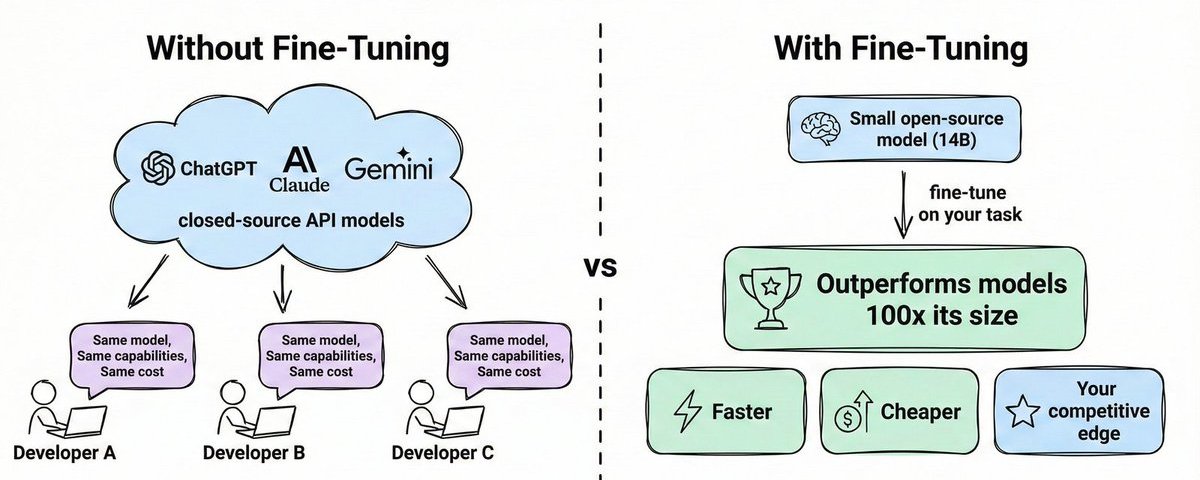
i wrote a complete breakdown of fine-tuning models with reinforcement learning using GRPO and RULER. RULER uses a language model judge to rank trajectories, so you do not have to manually write reward functions or collect labeled answers.
the article is quoted below.


Josh retweeted

🚨 MiniMax M3.1 looks very close now
They’re now running "M3.1-preview" through partner serving tests:
- low -> max reasoning effort
- image + video support (multimodal)
- DSpark speculative decoding
Im sticking with Wednesday as my guess for the drop


Josh retweeted
Introducing OpenDesign Frontier 30.
We’re looking for 30 product teams to shape the next era of AI design collaboration.
Get early access, hands-on support, and extra seats and credits to build with us.
DM to join and multiply your team’s design potential.

Josh retweeted

From a research question to candidate materials.
Xiaomi MiMo-V2.6-Pro worked with Xiaomi’s materials researchers to explore new MOF designs for capturing PFAS — reviewing literature and patents, proposing and checking design hypotheses, and running computational “dry-lab” experiments to identify promising candidates for further validation.
The team estimates a 10× productivity gain, shortening the R&D cycle from one month to 2–3 days.
As Prof. Jinhu Dou of Peking University put it: “In my view, its work on this project—from literature review to materials design and computational evaluation—was on par with that of a well-trained doctoral researcher.”
Read the full case study:
mimo.xiaomi.com/blog/mimo-v2…
#XiaomiMiMo #XiaomiMiMoV26 #AIforScience #XiaomiAI

