

Chronicling the art of velocity. ⊕ BÏF§ZF+18 ⊕
Joined December 2020
- Tweets16K
- Following1.5K
- Followers5.2K
- Likes24K



Scowl retweeted
Adalberto Libera (16 July 1903 – 17 March 1963) is one of the most representative architects of the Italian Modern movement.He graduated from Parma's Institute of Art in 1925 and then in 1928 from Rome's Scuola Superiore di Architettura he became acquainted with Futurism through his fellow Trentino Fortunato Depero. He was invited by Ludwig Mies van der Rohe to the 1927 Stuttgart Exhibition (Deutscher Werkbund). In 1928 and 1931 he organised the MIAR exhibitions of "Architettura Razionale" in Rome. MIAR then dissolved. To some extent Futurism influenced the art movements Art Deco, Constructivism, Surrealism, and Dada, and to a greater degree Precisionism, Rayonism, and Vorticism.


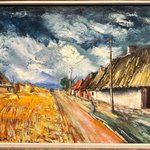
Maurice de Vlaminck (1876 – 1958)
During the Nazi occupation, Vlaminck published articles and books in collaboration with pro-Nazi or Vichy-backed French periodicals like Comoedia. In them, he heavily criticized modern art, Cubism, and "foreign" or Jewish-influenced artists like Pablo Picasso.
He had his portrait made by Arno Breker and participated in a committee for an exhibition of Breker’s work in Paris in 1942.
"Painting was an abscess which drained off an evil in me. Without a gift for painting I would have gone to the bad. . . what I could only have achieved in a social context by throwing a bomb. . . I have tried to express in art."
- 'Huts' (1937) from the Ausstellung Französischer Kunst der Gegenwart (French Art of the Present) exhibition
-Vlaminck in the studio of Arno Breker (1941)


French avant-garde and modernist artists, departing from the Gare de l'Est in Paris in October 1941 for a state-sponsored cultural trip to Germany.
Charles Despiau (polka-dot bow tie), Othon Friesz (light-color overcoat), André Dunoyer de Segonzac (mustache), Maurice de Vlaminck (black overcoat), Kies van Dongen (white beard), André Derain (behind and to the right of van Dongen).
Despiau marveled that German artists could now produce, “safe from all material worries.” Segonzac acknowledged that, in Germany, “the state is passionately interested in art.”


In his memoirs, the French ambassador to Germany, François-Poncet, mentioned that Hitler had purchased a statuette from the exhibition.
In "Les Temps" review of the show, they wrote:
"Chancellor Hitler visited the French exhibition of paint at the Prussian Academy of Fine Arts this morning. In course of this visit, which lasted close to three-quarter an hour, M. André François-Poncet, the French Ambassador, presented the paintings on view to the Chancellor. Adolf Hitler showed the most vivid interest in these works of modern French painting and sculpture"
Nazi Cultural policies like Entartete Kunst (Degenerate Art) were inconsistent and did not apply to all modern art.
Both Derain and Vlaminck had been exhibited in Berlin in the very year of the Degenerate Art show, in 1937, in a show of French contemporary art, under the patronage of Hermann Göring. Even Hitler visited the exhibition hall in the company of the French ambassador.
The show even exhibited quite radical Cubists like Léger, Lhote, Gromaire, and Braque.
—cover of the official catalog for the Exhibition of French Contemporary Art (Ausstellung Französischer Kunst der Gegenwart), which took place in June–July 1937. The cover features an illustration signed in the bottom left by French painter, draughtsman, and engraver Bernard Naudin.


Scowl retweeted

A clever fellow might exhort, "Rise above the times, by all means"; I, for one, believe that one must rise above life and death as well.
Sōseki Natsume, 'The Wayfarer'


Scowl retweeted

“The future: not an extension of the self through time, but the occurrence of transcendence—of going beyond the limits already reached.”
—Georges Bataille


To counter the widespread international outrage and anti-fascist messaging of Picasso’s Guernica, Adolf Hitler commissioned German marine painter Claus Bergen to produce a heroic, pro-regime painting titled "The Bombing of Almeria."
(The bombardment of Almería was a naval action which took place on 31 May 1937, during the Spanish Civil War.)

