



Serzh retweeted

🤯 Holy smokes!
This Jensen Huang’s talk on entrepreneurship at Stanford from 16 years ago is pure genius.
I listened it 5 times.
It will teach you more in 5 minutes than 2 years of MBA.
Serzh retweeted

Elon Musk claims that Ukraine allegedly violated Starlink's terms of use and used the system on combat drones.
As someone who was inside the process at the Ministry of Defense, I can say with certainty that this is not true.
In February of this year, whitelists were introduced. Stationary terminals could be registered by both military personnel and civilians.
But for any satellite terminal to work while on the move, it had to be added to a special list and connected to the military Starshield system. Otherwise, no satellite communication terminals in Ukraine would work.
In other words, using civilian Starlink for drone missions was technically impossible. All drone missions that required satellite communication could only be carried out using Starshield.
We are very grateful to the United States and SpaceX for access to critically important satellite communications. Ukraine did not violate the terms of use.

Serzh retweeted

Russia bombs Ukrainian schools, kills civilians in their sleep: SILENCE
Ukraine bombs a couple Russian bot farms:

Serzh retweeted

Can $NEAR really reach $50 in the upcoming bull run?
➠ Since Feb 2026, every dollar NEAR Intents earns goes straight into buying $NEAR on the open market.
➠ So the price question becomes a usage question. Grow the volume, grow the buybacks, grow the valuation. We ran the math for three cases - Bear, Base & Bull.
✦ Where NEAR stands today
Price: ~$4.93.
Market cap: ~$6.45B.
Supply is fully unlocked, so market cap and FDV are the same number. No VC cliffs left.
NEAR Intents, the cross-chain swap layer that now drives almost all of NEAR’s revenue:
➠ $4.7B in volume over the last 30 days
➠ $33B+ cumulative volume
➠ $2.07M in protocol revenue over 30 days, 100% routed to NEAR buybacks
➠ NEAR keeps ~4.4 bps of every dollar swapped
Add the L1 itself: ~1M transactions a day, 82K+ daily active addresses, 600ms blocks, 1.2s finality. 70% of gas is burned.
Put together, NEAR holders capture roughly $26.6M a year today. The market values that at $6.45B, around 243x.
✦ The framework
We’re not inventing a multiple. We’re taking the one the market is already paying for NEAR today and asking a simple question: what happens to price if the numbers go up?
✦ Bear case: ~$6.21 (+26%)
➠ Intents volume grows to $6B/month (current trend, nothing heroic)
➠ Take rate stays at 4.4 bps
➠ L1 activity up 50% to 1.5M tx/day
➠ Holder economics: ~$34.3M/year
➠ Implied valuation: ~$8.33B
Even the bear case is a straight continuation of what’s already happening on chain.
✦ Base case: ~$11.80 (+139%)
➠ Intents volume a bit over 2x, to $10B/month
➠ Take rate edges up to 5 bps
➠ L1 at 3M tx/day
➠ Holder economics: ~$65.2M/year
➠ Implied valuation: ~$15.83B
For context, Intents went from $5B cumulative in Nov 2025 to $33B+ now. Doubling the monthly run rate is not a stretch on that curve.
✦ Bull case: ~$27.95 (+467%)
➠ Intents becomes default cross-chain plumbing for wallets and agents: $20B/month
➠ Take rate reaches 6 bps
➠ L1 at 6M tx/day on agent traffic
➠ Holder economics: ~$154.3M/year
➠ Implied valuation: ~$37.5B
This is the “chain abstraction actually wins” scenario. Ambitious, but every input is a number NEAR already reports today, just bigger.
✦ The honest part
You deserve the full picture, so here it is.
➠ These targets assume the market keeps paying today’s multiple. Multiples usually compress as revenue grows, so treat the bull number as the ceiling of this framework.
➠ NEAR more than doubled in the past month. Some of that is the new US spot ETF and treasury buying, not just fundamentals.
➠ Intents had a $3.8M bridge exploit on Oct 1. Contained, but worth knowing.
✦ Why this setup is different
Most L1s pay fees to validators and call it value accrual. NEAR wired its main revenue engine directly into token demand. That means you don’t have to guess at narratives. You can watch the Intents dashboard every month and know exactly which case we’re tracking.
What do you think?
$NEAR => $6.21?
$NEAR => $11.80?
$NEAR => $27.95?
Or are you mega bullish and $NEAR => $50? Let us know in the comments 👇

Serzh retweeted

I rarely tweet about war, as X is my space for work.
But today I stumbled upon the use of Jetson Orin in Russia’s drones. It’s really tough to see the use of AI powered by NVIDIA chips to kill civilians in Ukraine.
At NEAR we move the frontier of AI. @ilblackdragon even invented the modern AI that turned NVIDIA from a graphic chip producer into an organization sitting in the middle of the next technological revolution.
I sincerely hope that practices of not working with sanctioned entities are thoroughly followed by @nvidia. It’s definitely the time to double check the distribution channels and consult with Ukrainian officials about the S/Ns of chips found in drones.
@JensenHuang, please make everything possible to stop killing people in Ukraine with your hardware.
Serzh retweeted

Fucking hell in Kryvyi Rih. Russia struck shopping mall with jet drones in the middle of the day while it was crowded.
After rescue team arrived, Russia hit one more time, as it often does to increase the death toll.
Right now it is reported about 2 people killed, 15 more wounded.


Serzh retweeted

Karpathy didn't make a course.
He made THE course.
3 hours. Free.
Tokenization. Attention. Hallucinations. Tool use. RLHF. DeepSeek. AlphaGo.
Every behavior you've ever wondered about in an LLM - where it comes from, why it exists, how it was engineered.
The gap between engineers who understand this and engineers who don't isn't technical depth.
It's the ability to conceive of entirely different things.
Readers added context they thought people might want to know
This video was stolen from @karpathy's YouTube channel.
youtu.be/7xTGNNLPyMI?si…
Serzh retweeted

Wow, this tweet went very viral!
I wanted share a possibly slightly improved version of the tweet in an "idea file". The idea of the idea file is that in this era of LLM agents, there is less of a point/need of sharing the specific code/app, you just share the idea, then the other person's agent customizes & builds it for your specific needs.
So here's the idea in a gist format: gist.github.com/karpathy/442…
You can give this to your agent and it can build you your own LLM wiki and guide you on how to use it etc. It's intentionally kept a little bit abstract/vague because there are so many directions to take this in. And ofc, people can adjust the idea or contribute their own in the Discussion which is cool.


LLM Knowledge Bases
Something I'm finding very useful recently: using LLMs to build personal knowledge bases for various topics of research interest. In this way, a large fraction of my recent token throughput is going less into manipulating code, and more into manipulating knowledge (stored as markdown and images). The latest LLMs are quite good at it. So:
Data ingest:
I index source documents (articles, papers, repos, datasets, images, etc.) into a raw/ directory, then I use an LLM to incrementally "compile" a wiki, which is just a collection of .md files in a directory structure. The wiki includes summaries of all the data in raw/, backlinks, and then it categorizes data into concepts, writes articles for them, and links them all. To convert web articles into .md files I like to use the Obsidian Web Clipper extension, and then I also use a hotkey to download all the related images to local so that my LLM can easily reference them.
IDE:
I use Obsidian as the IDE "frontend" where I can view the raw data, the the compiled wiki, and the derived visualizations. Important to note that the LLM writes and maintains all of the data of the wiki, I rarely touch it directly. I've played with a few Obsidian plugins to render and view data in other ways (e.g. Marp for slides).
Q&A:
Where things get interesting is that once your wiki is big enough (e.g. mine on some recent research is ~100 articles and ~400K words), you can ask your LLM agent all kinds of complex questions against the wiki, and it will go off, research the answers, etc. I thought I had to reach for fancy RAG, but the LLM has been pretty good about auto-maintaining index files and brief summaries of all the documents and it reads all the important related data fairly easily at this ~small scale.
Output:
Instead of getting answers in text/terminal, I like to have it render markdown files for me, or slide shows (Marp format), or matplotlib images, all of which I then view again in Obsidian. You can imagine many other visual output formats depending on the query. Often, I end up "filing" the outputs back into the wiki to enhance it for further queries. So my own explorations and queries always "add up" in the knowledge base.
Linting:
I've run some LLM "health checks" over the wiki to e.g. find inconsistent data, impute missing data (with web searchers), find interesting connections for new article candidates, etc., to incrementally clean up the wiki and enhance its overall data integrity. The LLMs are quite good at suggesting further questions to ask and look into.
Extra tools:
I find myself developing additional tools to process the data, e.g. I vibe coded a small and naive search engine over the wiki, which I both use directly (in a web ui), but more often I want to hand it off to an LLM via CLI as a tool for larger queries.
Further explorations:
As the repo grows, the natural desire is to also think about synthetic data generation + finetuning to have your LLM "know" the data in its weights instead of just context windows.
TLDR: raw data from a given number of sources is collected, then compiled by an LLM into a .md wiki, then operated on by various CLIs by the LLM to do Q&A and to incrementally enhance the wiki, and all of it viewable in Obsidian. You rarely ever write or edit the wiki manually, it's the domain of the LLM. I think there is room here for an incredible new product instead of a hacky collection of scripts.
Serzh retweeted

Сьогодні вперше українська мілтек компанія вийшла на американську фондову біржу! Це оборонний стартап Swarmer заснований в 2023. Неймовірний темп, враховуючи що в середньому від заснування до IPO компанії проходить 8-10 років. Я звісно ж купила акцій, щоб підтримати нацвиробника)

Serzh retweeted

SOMEONE CREATED A GITHUB REPO WITH AN ENTIRE SETUP FOR AN AI AGENCY
Engineers, designers, growth marketers, product managers.
Broken down how even a rookie could understand.
It has over 10K stars in 7 days
GitHub: github.com/msitarzewski/agen…


Serzh retweeted
I packaged up the "autoresearch" project into a new self-contained minimal repo if people would like to play over the weekend. It's basically nanochat LLM training core stripped down to a single-GPU, one file version of ~630 lines of code, then:
- the human iterates on the prompt (.md)
- the AI agent iterates on the training code (.py)
The goal is to engineer your agents to make the fastest research progress indefinitely and without any of your own involvement. In the image, every dot is a complete LLM training run that lasts exactly 5 minutes. The agent works in an autonomous loop on a git feature branch and accumulates git commits to the training script as it finds better settings (of lower validation loss by the end) of the neural network architecture, the optimizer, all the hyperparameters, etc. You can imagine comparing the research progress of different prompts, different agents, etc.
github.com/karpathy/autorese…
Part code, part sci-fi, and a pinch of psychosis :)

Serzh retweeted

Try getting your personal agent that is fully confidential on agent.near.ai - happy to help set it up and show what it can do for you
Serzh retweeted

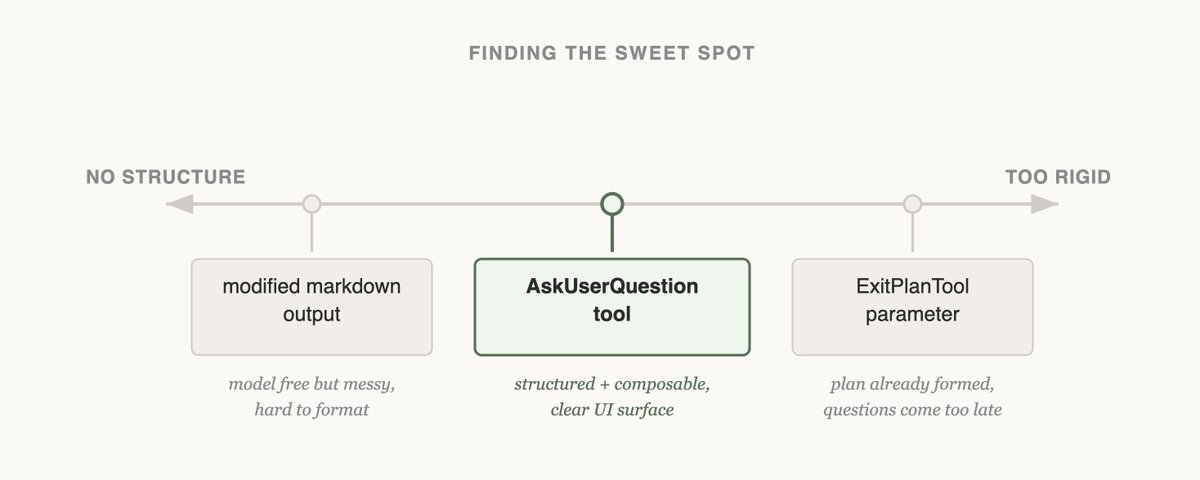
A Claude Code engineer just shared one of the most valuable articles I've ever read on AI agents.
Anthropic rebuilt their tool system 3 times because their models outgrew it.
The takeaway: design for how the models see, not how you see.
Most won't read this.
Act accordingly.



Serzh retweeted
Using crypto shouldn't mean all your financial activities are publicly visible by default. near.com lets you transact in any asset, confidentially, as an account option. Powered by @near_intents, built on @NEARProtocol.


Huge launch. Standing on the shoulders of the Zcash giants, @NEARProtocol just debuted Confidential Intents allowing confidential execution for cross-chain transactions. This the way. Privacy first.