

Web3 infrastructure with hands-on support · by @htwtech_
Joined November 2024
- Tweets9.8K
- Following141
- Followers1.9K
- Likes21.2K




Choosing a Solana RPC provider in 2026?
We compared seven providers on pricing, method-level limits, regional coverage, streaming, archival access and SLA terms.
👉 See what’s included, what costs extra, and which trade-offs matter for your workload:
supanode.xyz/blog/best-solan…

🟢 @HyperliquidX's official Python SDK defaults to 5% slippage tolerance when you call market_open()
That setting determines the limit price your application submits. The helper sends an IOC order, fills what it can within that bound, and cancels the remainder.
The 5% is a price tolerance, not a fee or a prediction of your actual slippage. If your product needs a different bound, pass it explicitly.
This is one of the decisions hidden behind a convenient SDK call. Our guide follows the integration from SDK configuration to signed orders, execution results and retry handling:
👉 supanode.xyz/blog/hyperliqui…

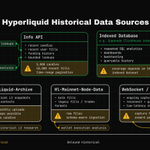
Backtesting on Hyperliquid? Start with what you’re trying to simulate.
Candles can support a price-signal test. Funding models need historical rates, while liquidity and slippage analysis needs historical order-book snapshots.
The available history matters just as much. Hyperliquid’s Info API provides the latest 5,000 candles: roughly 3.5 days at the 1-minute interval.
👉 Where to get the data your test needs, how far each source reaches, and what you’ll need to process yourself:
supanode.xyz/blog/hyperliqui…

Love you too ❤️
Keep shipping, we’ve got the infra


Glad we’re doing this together, @SuperteamKZ 🤝
Always good to work with people who genuinely care about growing Solana in Kazakhstan. We’re happy to support builders with the infra they need.
We’re ready to support more builder communities across the ecosystem. If you’re building one, let’s make it happen!

Superteam KZ × Supanode
We're partnering with @SupanodeXYZ , a high-performance RPC and data infrastructure provider built by the @htwtech_ team.
For teams building on Solana, Supanode covers the full stack: RPC and WebSocket, Yellowstone gRPC streaming, ShredStream, stake-weighted transaction landing, a historical data indexer, and dedicated nodes.
🔗 supanode.xyz

🟢Supanode now supports @RobinhoodApp Chain
Available for teams building on the network:
→ RPC and WebSocket access
→ Dedicated full and archive nodes
→ A DEX indexer with SQL access to swap and pool history
For live blocks and contract events, use WebSocket RPC with 𝚎𝚝𝚑_𝚜𝚞𝚋𝚜𝚌𝚛𝚒𝚋𝚎. Robinhood’s public Sequencer Feed also uses WebSockets, but carries sequencer data for Nitro nodes.
Our guide explains which endpoint your app needs, how to set up subscriptions and how to recover missed events after a disconnect:
supanode.xyz/blog/robinhood-…

Thanks a lot

I want to give @SupanodeXYZ their flowers after today.
I put Jeet Analyzer through a real infrastructure stress test across multiple providers, and SupaNode genuinely impressed me.
Fast. Stable. No babysitting. No drama.
I wasn’t running some cute little demo either. I was throwing actual forensic workloads at it, hammering RPC calls, tracing wallets, and trying to find the edges.
SupaNode just kept eating.
Plenty of companies can hand you credits.
The better question is what happens when you actually use them.
Today, @SupanodeXYZ showed me they built something serious.
Respect where it’s earned. 💀⚙️
#Solana #Web3 #BuildInPublic
You are welcome

We are delighted to announce we are working with @SupanodeXYZ
Any project will benefit from switching to Supanode, including a trading bot.
At the end what matters when you are connecting to infra provider is consitency and performance!
Learn more at
app.segmento.tech/kol/campai…
On @HyperliquidX, a cancel can be processed before a buy that reached the network first
When both enter the same consensus batch, HyperCore processes cancels before actions containing GTC or IOC orders.
A resting sell order can therefore be removed before your buy is matched. Your buy executes against the updated book, potentially filling only part of the requested size. For an IOC order, the unfilled remainder is canceled.
The full walkthrough of HyperCore’s batch ordering and matching, with a worked order-book example:
supanode.xyz/blog/hyperliqui…

Build, simulate, sign, submit, and confirm a custom @JupiterExchange swap
Jupiter /𝚋𝚞𝚒𝚕𝚍 returns instruction groups instead of a finished transaction. That gives you room for custom logic, while the rest of the transaction lifecycle moves into your application.
From there:
→ add custom instructions without breaking the route’s account-state assumptions
→ simulate the complete transaction and set its CU limit from measured usage
→ check onchain status before retrying the same signed transaction or rebuilding and re-signing
👉 The full TypeScript flow, including 𝚝𝚡.𝚓𝚞𝚙.𝚊𝚐 vs your own RPC: supanode.xyz/blog/jupiter-ap…

Pumpfun Expands Beyond Solana With HyperEVM Token Trading
Pumpfun said its app now fully supports HyperEVM, allowing users to trade any HyperEVM token with USDC. The dominant Solana memecoin launchpad charges 0% trading fees on Solana and 0.1% on HyperEVM, Robinhood, BNB, Base and other supported markets.
Follow a Pump.fun token from its first trade to its first PumpSwap swap.
That path runs across two Solana programs: Pump handles the bonding curve and migration, while PumpSwap takes over once the pool goes live.
Curve completion and migration are separate events. The curve can be full before the PumpSwap pool even exists.
👉 Here’s how to follow every stage using WebSocket or Yellowstone gRPC:
supanode.xyz/blog/pump-amm-d…

𝚕𝚘𝚐𝚜𝚂𝚞𝚋𝚜𝚌𝚛𝚒𝚋𝚎 has a scaling detail that matters for wallet monitoring: its 𝚖𝚎𝚗𝚝𝚒𝚘𝚗𝚜 filter accepts exactly one 𝙿𝚞𝚋𝚔𝚎𝚢. Add a second, and the request fails with 𝙸𝚗𝚟𝚊𝚕𝚒𝚍 𝚙𝚊𝚛𝚊𝚖𝚜.
So an address list becomes many subscriptions, not one wider subscription.
Monitoring 2,000 wallets means 2,000 subscription IDs to track, recreate after every reconnect, and check for missed events.
WebSocket may still carry the data just fine. But at that point, the simple option has become a subscription management system.
👉 Full breakdown of Solana streaming options:
supanode.xyz/blog/solana-dat…

Say you need every wallet that bought a token within five minutes of its creation.
Once swaps and creation events are decoded into tables, the core of the query becomes a join and a time condition:
𝚜.𝚋𝚕𝚘𝚌𝚔_𝚝𝚒𝚖𝚎 𝙱𝙴𝚃𝚆𝙴𝙴𝙽 𝚌.𝚋𝚕𝚘𝚌𝚔_𝚝𝚒𝚖𝚎
𝙰𝙽𝙳 𝚌.𝚋𝚕𝚘𝚌𝚔_𝚝𝚒𝚖𝚎 + 𝙸𝙽𝚃𝙴𝚁𝚅𝙰𝙻 𝟻 𝙼𝙸𝙽𝚄𝚃𝙴
RPC gives you the source transactions. Indexing turns them into tables.
Before this query works, the records still have to be backfilled, decoded, normalized, stored, and reprocessed when decoder logic changes.
That’s the indexing work.
👉 From raw Solana transactions to queryable data:
supanode.xyz/blog/solana-ind…

HTTP response: 200
RPC response: signature returned
Explorer: no transaction found
All three can describe the same Solana submission.
sendTransaction confirms that the RPC accepted the transaction, not that the leader received, scheduled, or included it.
👉 The full submission-to-inclusion path:
supanode.xyz/blog/solana-tra…

A trading system reconstructs and decodes a transaction from raw shreds before execution
It gets the intent early, but still does not know whether it actually succeeded.
So production stacks often split the job:
> ShredStream ➡️ early detection
> gRPC / RPC ➡️ execution result, confirmation, reconciliation
Full breakdown:
supanode.xyz/blog/solana-shr…

150 markets × 3 feeds (trades, l2Book, candle) = 450 Hyperliquid WebSocket subscriptions
That's before user-specific streams. The public endpoint has a per-IP cap of 1,000 subscriptions and 10 unique users
👉 Limit math and recovery patterns: supanode.xyz/blog/hyperliqui…

Yellowstone gRPC changes the Solana data path from periodic requests to a live stream of filtered updates.
But the stream is only the ingestion layer. Teams still need to handle recovery after disconnects, ordering, deduplication, and storage.
Full trade-off breakdown: supanode.xyz/blog/yellowston…

