

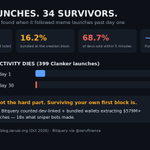





3,374 meme tokens launched. 34 made it.
@zerufinance followed thousands of launches past the hype window and published what actually happens next. The graduation rate: 1.01%.
And graduation is the good outcome. Look at how the other 99% start:
→ 16.2% of launches were bundled in the very block the token was created — insiders positioned before the public could even see the contract.
→ 68.7% of developers started selling within five minutes of launch. Not five days. Five minutes.
→ In the Clanker sample, 7.5% of tokens still recorded a transfer on day 1. By day 30: 0.8%.
The launch isn't the hard part anymore. Anyone can launch. The market dies in its own first block.
An independent dataset points the same way: Bitquery counted developer-linked and bundled wallets extracting $579M+ from Pump.fun launches — 18x what sniper bots made. Everyone blames the snipers. The data says the bigger extraction sits with the people closest to the launch itself.
One honest caveat, because the numbers deserve it: "developer-linked" is inferred from wallet patterns, not proven identity. Some of those wallets will be false positives. But when the pattern shows up across millions of launches, the scale stops being a rounding error.
This is the problem Activity Markets are built to flip. Instead of a dev launching first and the public arriving after the insiders, the market spawns from activity that already happened — verified contributors earn the miner seats, supply shrinks as real activity comes in, and price discovery runs through an auction where everyone in the same block pays the same price.
Whether that model wins is an open question. But the diagnosis is hard to argue with: a launch system where 99% of tokens never graduate and most devs exit in five minutes isn't a discovery mechanism. It's an extraction machine with good marketing.
If launching is free and instant, what should a launch actually have to prove before the public is invited in?
#ActivityFi

8
3
48
Amazon sellers wait 14–28 days to get paid after a sale. @dowprotocol turns those confirmed receivables into on-chain RWA financing — working capital on Day 1. Learning the ecosystem via their project quizzes: 900 DOW XP across 10 projects so far. app.dowprotocol.com

1
27
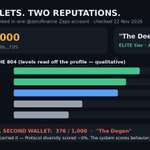
I finally checked my own reputation score — on two wallets.
@zerufinance's zScore reads a wallet's whole history — trading, lending, LP, staking, governance — and compresses it into a single 0–1000 trust score. No KYC. No identity. Just behavior.
Wallet one — the address that has done the real work for years: 804/1,000. Elite tier. AURA top 5%. The persona the system assigned it: "The Deep Pockets."
Wallet two — same owner, much narrower life: 376. Persona: "The Degen."
Same person. Same hands. Two completely different reputations — because the system doesn't score who you are. It scores what each wallet actually did.
What carries the 804 (levels read off the profile, so qualitative):
→ Token diversity — very high
→ Wealth — high
→ Protocol diversity — high
→ Consistency — mid
→ Gas behavior — mid to low
Now compare the 376: Consistency was its strongest component (~70%) — and its Protocol diversity scored basically zero. That wallet showed up for years, but through a very narrow set of doors. The system noticed.
That's the part I keep coming back to. Neither score is "me." Both are true — about different behavior. A credit bureau merges your whole life into one file. A trust oracle refuses to: every wallet stands on its own history.
Score ≠ how much money you have. Score = how you behave with it.
Price oracles tell apps what an asset is worth. A trust oracle tells them how a wallet behaved. The second question is the one this market has never had a good answer to.
Both wallets are linked to the same Zaps account, by the way — one signed message each, no gas, no transfer rights given up. The scores still didn't merge. That's the point.
If an app could see both of your wallets' scores, which one would you want it to judge you by?
#Zeru

14
5
99
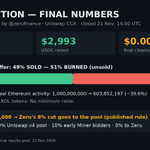
The zETH auction is done — and the numbers tell the real story of @zerufinance's first Activity Market.
→ 91 bidders
→ $2,993 raised
→ Final clearing price: $0.0000166
→ 49% of the auction offer sold — the rest burned
No minimum raise. No team tokens. The market spoke, quietly.

7
84
Claims opened ~6h after the close, and the v4 pool opens at the final auction price.
The open question isn't the launch anymore — it's whether anyone trades it. An Activity Market only works if activity continues after day one. Watching volume, not slogans.
1
5
zETH was the test: supply set by real Ethereum activity, price set by an open auction, unsold supply burned.
Small numbers, clean rules. The next Activity Market is where this model has to prove it can scale.
$zETH #ActivityFi
6
syxhung retweeted

Real-world assets are coming onchain.
On most chains, anyone can launch whatever they want.
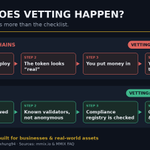
On MMIX, every project is vetted before launch.
Clean assets for users. Clear standards for builders.
Join the first wave and earn rewards.
→ hub.mmix.io

5/ MMIX also builds this into transfers, not just onboarding. Its on-chain compliance registry records verification status, KYC tiers and regional rules — and apps check it before moving value or issuing assets.
Eligibility is enforced when the asset changes hands, not just when someone signs up.
1
6
6/ MMIX is still pre-mainnet (planned for 2027), so this is a documented design, not a proven track record yet.
But the direction is worth watching: for RWA, trust can't be an afterthought you bolt on later. It has to start with who is allowed in.
I'm following it through the MMIX Districts campaign on Nucleus — more on the districts themselves in a later post.
#MMIX #RWA
9
I have a phone that has spent a year in a drawer.
It still turns on. The battery still holds. It just lost its job when I upgraded — so it does nothing, every day, at full capability.
That is the exact phone @Acurast is built for.
Connect a phone as a Processor and it stops being e-waste: developers run real apps on it, the device is verified by the security hardware already inside it, and you earn ACU for the compute it provides. More than 335,000 phones are already doing this.
There are two ways in, and the choice matters:
→ Everyday phone? Processor Lite. Install it, let it work while the phone charges overnight, keep all your apps and data.
→ Spare Android you can wipe? Processor Core. Factory reset, locked down, dedicated — and it benchmarks about 15–20% higher, which means a bigger share of rewards.
My drawer phone is a spare, so Core is the honest answer for it. My daily phone would get Lite, and only overnight.
What is your spare phone doing right now — working, or just sitting there?
$ACU #DePIN

16
9
145
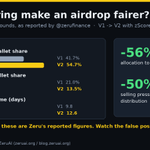
Can behavioral scoring make airdrops fairer?
@zerufinance published what changed when GAIB used its scoring between distribution rounds:
→ 56% less allocation to wallets flagged as sybils
→ High-quality wallet share: 41.7% → 54.7%
→ Low-quality share: 21% → 13.5%
→ Post-distribution selling pressure down 50%
→ Average holding time: 9.8 → 12.6 days
My honest read: these are Zeru's own reported numbers, so treat them as a claim, not proof. But the direction matters. Every farmer knows the current system rewards whoever spins up the most wallets. A system that reads *how* a wallet behaved over years, not how many wallets you control, is the first filter that is expensive to fake.
The real test is the false positives: one real user filtered out is worse than ten sybils filtered in. That's the number I'll be watching.
#Zeru #ActivityFi

17
6
147
I opened my second MemeBitcoin Alliance pack. Join the Alliance and become a Crypto Guardian. raffle.memebitcoin.org/c/236…

9
I opened my MemeBitcoin Alliance first pack. raffle.memebitcoin.org/c/b50…

10
Just discovered Dow Protocol — an on-chain e-commerce RWA financing platform. I'm learning through their project quizzes and earning DOW XP along the way. Worth a look: app.dowprotocol.com
17