

Helping hundreds of investors hedge against uncertainty with strategic insights into the commodities supercycle I Capital growth I Five decades of experience 🪙
The Commodities Supercycle
Joined March 2026
- Tweets1.1K
- Following445
- Followers307
- Likes906







Trying to nail the exact tick of a top or bottom is a fool’s game. You only know where the exact bottom was in hindsight, which is why I map multiple scenarios and let a rules-based system dictate execution.
To document the process, I shared a potential bearish roadmap for #silver on Patreon a week ago:
🔵 $48.49 looked like a temporary low in an unfinished Wave Y
🔵 Major support sat at $46–$44, with a final Wave Y target zone of $39–$40
🔵 Until price reclaims and holds $54, the sell-off isn't over
With silver now in the low 40s, the bearish path is playing out, though this is not a prediction of a perfect bottom, and things are still ongoing. Capitulation is psychological and takes time; it has to flush out weak hands before smart money steps in cleanly without overhead pressure.
#criticalmetals $SLV

49
Agreed. When shorts get blown out in a parabolic run like January, they fight hard on the paper side whenever rate or fiscal narratives give them an opening.
Near-term whipsaws are definitely part of the game. That's why separating short-term paper pressure from multi-year physical accumulation matters so much IMO.
1
13
Repeating "they don't care about price" doesn't magically suspend supply and demand. Price-insensitive buyers draining physical supply over multi-year stretches create a structural bid that tightens the market.
China just racked up 24 straight months of gold buying (~26t in October, a 3-year high) and stepped up dip-buying as prices dropped. Persistent physical absorption into weakness builds a floor and tightens float; it's not a zero-impact event. Eventually, something gives, and it won't take 10 years.
2
31
Spot on @silverape1974. Redefining "institutional" to exclude the largest sovereign reserve managers on earth is just dodging the argument.
And even by his own narrow definition, the data still buries him: physically backed gold ETFs just pulled in 211 tonnes ($31B) in Q3 alone (pushing global ETF holdings to a record 4,256 tonnes), while Tether sits on 146+ tonnes of physical bullion. Both sovereign and private institutional vehicles are stacking hard assets right in front of him.
1
16
You're just moving goalposts now. First nobody wants hard assets; when shown the balance-sheet flows, central banks suddenly "don't count" and buyers who "buy at any price" somehow have "no impact on price," which violates basic supply and demand.
Doubling down on an arbitrary and illogical "10-year dead zone" prediction with zero evidence is just you trying to sound confident after getting caught ignoring the data.
11
Central banks just bought 321 tonnes of gold in Q3 alone (taking 2026 purchases to 675 tonnes) and Tether holds 146+ tonnes of physical bullion (more than most sovereign nations) while you pretend nobody wants hard assets.
With U.S. publicly held debt crossing 101% of GDP, $2T annual deficits, and global debt at a record $353T, fiscal dominance guarantees structural real-rate suppression and currency debasement.
And you're calling a 10-year dead zone ... 😂
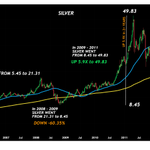
History doesn't always repeat, but in commodities it often rhymes.
2005–2011 Silver Cycle (Chart 1):
🔵 Ran from $5.45 to $21.31• Brutal -60.35% crash to $8.45 amid peak doom & gloom• Launched a 5.9x (+490%) bull leg to $49.83 over the next 2+ years
2024–Present Silver Cycle (Chart 2):
🔵 Ran from $23.03 to $121.65
🔵 Just tagged $46.55—a -61.73% pullback sitting right on the .618 Fibonacci zone
Even if we probe a few dollars lower before finding the final floor (bringing the target down slightly) we'd all be very well rewarded in a $250+ #silver environment.
No guarantees in markets, of course, and risk management always comes first, but the setup is eerily similar in many ways.
#Macro $SLV $AGQ


81


Fair play. I can't argue against or rule out short term downside at this juncture. Appreciate the civil back-and-forth!
2
IMO this comparison ignores macroeconomic plumbing. In 1979, Paul Volcker had ~32% debt-to-GDP and a stock market below 40% of GDP, giving him the room to hike rates to 20% and break gold's back. Today, with $40.5T+ in national debt (~130% debt-to-GDP), $2T annual deficits, and a hyper-financialized stock market sitting at 228% of GDP (~$75.4T), a Volcker-style rate shock would implode the Treasury market, trigger a massive wealth-effect crash, and freeze corporate credit.
Add in the fact that today’s marginal buyer is central banks steadily de-dollarizing into physical reserves rather than Western retail panic, and it’s clear fiscal dominance keeps the Fed trapped. Normal pullbacks aside, they cannot engineer punitive real rates to crush hard assets without blowing up the entire economy first.
1
48
CME is nearing a physical storage deal with ConverDyn to launch a physically backed #uranium futures contract.
For decades, uranium price discovery has been stuck in a thinly traded, opaque market with cash-settled contracts that big institutions largely ignore.
Backing futures with real U3O8 inventory at Metropolis Works changes the plumbing entirely:
🔵 Real institutional access: Funds finally get a direct, liquid vehicle to trade physical yellowcake without operational headaches.
🔵 Supply tightness gets exposed: Paper contracts can be printed endlessly, physical pounds at a conversion facility cannot.
🔵 Grid reality: AI data-center power demands and sovereign energy security are locking in baseload nuclear demand for decades.
Wall Street is building the rails because the structural deficit in #nuclear fuel is becoming impossible to ignore.
$U.UN.TO $NLR

CME Group is finalizing a deal to store uranium at ConverDyn's Metropolis Works facility, a step toward a physical yellowcake futures contract. investingnews.com/cme-nears-…

Bruce Poole retweeted

“When gold is purchased, especially on a physical basis, and brought into China, it’s very unlikely to leave,” Daniel Ghali, head of metals research at Deutsche Bank, said.
“It’s a liquidity drain from the system that is unlikely to come back.”
Incorrect. Since leaving the gold standard in 1971, gold has compounded at ~8.8% annually vs. ~3.9% for US CPI, a 4.7% real annual return above inflation (12.5x increase in purchasing power).
Even against equities, gold outperformed the S&P 500 (with dividends reinvested) over both the 2000–2025 (10.96% vs. 8.00%) and 2006–2025 (11.27% vs. 10.90%) windows.
Saying it "at best keeps pace" only holds true if you cherry-pick the 1980 blow-off top.
3
12
Germany is scrambling to reactivate coal and oil-fired power plants as natural gas supplies tighten.
Shutting down reliable #nuclear baseload while hoping intermittent sources can carry an industrial economy was always a fatal policy error. If Europe’s largest economy wants genuine #energy security and grid reliability without burning more dirtier hydrocarbons, reversing the nuclear phase-out isn't just an option, IT'S PARAMOUNT.
Physics win, every single time. ☢️

JUST IN: Germany prepares to reactivate coal & oil-fired power plants during energy emergencies as natural gas supplies tighten.
49
Bruce Poole retweeted

JUST IN: Germany prepares to reactivate coal & oil-fired power plants during energy emergencies as natural gas supplies tighten.
That is the beauty of the royalty model in a high-price environment: zero mine-level inflation exposure paired with 100% upside capture on commodity prices. Stacking $1.2B+ in nine-month net income with over a billion in cash on the balance sheet shows why FNV remains the gold standard for compounding without operational headaches. Absolute masterclass in capital efficiency.
37
While Nvidia’s leadership turmoil has triggered short-term jitters across tech valuations, a dollar cut from a chip order does not translate into a proportional loss of physical metals demand. Shifting workloads or supply chains cannot bypass the broader, unyielding macroeconomic realities underpinning the commodities supercycle: sticky structural inflation, aggressive global data-center power demands, and multi-year deficits in critical mineral supply. Short-term sentiment shocks create volatility, but the underlying economic drivers of the metals bull thesis remain firmly intact.
31
The hotter CPI print and sticky inflation narrative are giving the dollar legs in the near term, keeping the pressure on miners and physical metals. But as you noted, looking back at the 70s playbook, sticky inflation ultimately acts as the rocket fuel once the rates shock exhausts itself. A final DXY push into major overhead resistance lining up with the back-end of this metals correction makes total macro sense before the turn into 2027.
Short-term headwinds, structural multi-year opportunity. Great breakdown. 👍
1
57
Quick macro check as we navigate Q4 into 2027
From gold’s near-term resistance battle to the massive public-to-private capital shift targeted beyond 2030, here are some thoughts about where things stand:
📉 The Gold Push & Pull: Near-term fluctuations, but overhead resistance at $4,225 remains a strict ceiling. Until we print a weekly close above that level, the risk of a deeper flush down toward January lows is entirely on the table.
📊 The Dow & Capital Flows: Despite loud calls for an imminent equity crash, structural support is holding firm at $45k–$42k as private capital continues to dodge government debt.
⛏️ The Miner Divergence: Physical metals hit lower lows this autumn while quality miners printed higher relative lows, exhibiting a classic intermarket divergence. But this setup relies entirely on structural floors holding. A breakdown below key validation levels invalidates the thesis instantly.
🔀 The 2032 Inflection Point: With deficits projected near $2 trillion and mounting geopolitical/fiscal friction, quantitative models continue to point to 2032 as the ultimate systemic convergence where capital shifts definitively from public to private.
The Bottom Line: Analysis isn’t about picking a permanent direction, it's about managing probabilities, respecting validation levels, and tracking the multi-year macro shifts.
#Macro #Economy $SPY $GDX
66