

Founder of (redacted). Onchain since 2014. Never financial advice. Views are my own.
Beacon Chain
Joined July 2021
- Tweets2.8K
- Following851
- Followers1.4K
- Likes12.3K







Pinned Tweet
Ethereum’s stablecoin dominance is going vertical.
Many VC led initiatives often paint Ethereum as falling behind Solana by citing gamable metrics such as TPS.
It is simply not the case when you consider ungamable metrics such as capital onchain and in applications. A bot can rapidly send a valueless token back and forth but it cannot falsify actual value.


Taylor.eth retweeted

they call that the vitalik candle


Glad to see that Ethereum L1 will have a new strong prediction market contender that is dedicated to decentralization, and being ethical and not corposlop, and to actually trying to do interesting and meaningful things with this class of economic primitive.
firefly.social/post/x/210212…

Taylor.eth retweeted

AI will prove your code is correct
It's an increasingly common take that AI hacking means cybersecurity is doomed.
I disagree. I think cybersecurity is naturally defense-favoring once people get their shit together. And anyone who continues to hold cryptocurrency (including me, ~90% of my net worth) is implicitly making that bet.
Here's why I am making that bet.
First, the oversimplified punchy one-line statement:
If AI can prove Navier-Stokes and FLT, then AI can prove the statement "this program is secure" as a mathematical theorem. Even if the program is very complicated.
Now, the nuance:
(See also: vitalik.eth.limo/general/202… )
The word "secure" is hiding all kinds of skeletons in the closet in terms of what it actually means. What does it mean for Signal (the encrypted messenger) to be "secure"?
The most basic definition you might think of is: no one who doesn't hold the recipient's secret key can read the contents of the message.
But:
* Did you remember to include _other_ critical forms of security? Can the adversary forge messages? Can the attacker prevent messages from reaching the recipient? Can they cause your client to crash by sending malformed messages?
* Have you made sure that your model of the adversary includes attackers that interfere with the protocol actively and not just passively? And attackers that interfere by replaying messages to you or the recipient that either of you sent over the wire at any point earlier?
* What if the adversary hacked (or _is_) the Signal server?
* How did you learn which public key belongs to the recipient in the first place? What if that process was tampered with?
* What if your device gets hacked at some point in the past or future - is your message still safe then?
* What if your key leaks because of a bug in your operating system? Or because you got a bugged version of the Signal client? Or what if the database is corrupted?
* Or the libraries, interpreter or compiler of the programming language you wrote it in?
* What if your key leaks because tiny perturbations in perceptible signals generated by the hardware leak mathematical relationships that can extract the key a few hundredths of a bit at a time?
* Are you hiding the *size* of the payload? Does that matter?
* You're definitely not hiding the identity of the sender and the recipient, and the exact time each message was sent (think: not just time-of-day, but also time deltas between one message and the next). Is that not enough to deduce a lot of important facts about what relationships you have, and what *kinds* of conversations you are having?
So ... even definitions can be over a thousand lines of code, and need deep careful thought to figure them out.
Working on making definitions more human-readable is of extreme importance - it's perhaps the only "high-level language" that matters right now.
But even still, even despite all of the above, for security-critical components, the definition is a much smaller attack surface than the implementation. Verifying that the definition is adequate is a much more tractable task than scanning over the code directly - and can become even more tractable with better tooling.
Definitions are also _additive_: if two groups have two different definitions A and B, then, well, you can just prove that the program satisfies both A and B. Code is not additive in this way: if a program is A + B, a bug in A _or_ B can sink the whole thing. Definitions are additive. And if you can't satisfy A and B at the same time, you've isolated the most important philosophical issue for your project to spend its next few weeks grappling with.
Sometimes, definitions are not much smaller than the implementation - UI components might be one example. But for many of the most critical components - message-passing protocols, sandboxes, cryptography like SNARKs and FHE - the asymmetry is real.
Historically, a large class of failures with this approach have come from people only verifying a small portion of their code, that they self-declared to be the security-critical portion, and ignoring the rest - and it turns out that something in the rest of the code is security-critical too.
This was reasonable back when verification was difficult and scarce. The solution today: sorry, you have to verify over literally your entire program, including database, networking, any caching layers, everything. Modern AI can do it.
So it's not about "the good guys find all the vulnerabilities before the bad guys do" - that could maybe work too, after all a finite program only has a finite number of vulns, but it's riskier - it's specifically an asymmetric strategy of making code that is much more resilient in the first place.
This is the kind of direction that Ethereum is going in for the next few years. There is no future for blockchains - especially blockchains with scalability and privacy - without doing this. We need to make software actually secure. And we have already made a lot of progress.
Taylor.eth retweeted

Robinhood buying a ton of ETH seems like an obvious move at this point.
They'll likely make $ on it for their balance sheet + it will pay for itself many times over in terms of the marketing and onchain activity it would likely spark.
As I think more about ETH for this cycle, this is probably the bull case nobody is talking about. Not the SOV narrative. Just institutions deploying/building and then "signaling" to the community with ETH purchases.
That could be quite reflexive during "risk-on" conditions for crypto.


I’m watching OLY
OLY aims to become the de facto ETH value accrual token
One token backed by staked ETH and ETH at work in DeFi
Oh and if you sell OLY early, you pay fees to the long term holders who are essentially just ETH bulls

𝗧𝗵𝗲 𝗢𝗟𝗬 𝗠𝗶𝗻𝘁: 𝗛𝗼𝘄 𝗜𝘁 𝗪𝗼𝗿𝗸𝘀
Most tokens are built on nothing. No revenue, no reason to exist beyond the next buyer, and no answer for the day that sellers outnumber buyers. In a system without any structure to absorb sell pressure, the people with the greatest conviction lose the most.
OLY is built the other way round.
Sellers fund the protocol. That revenue buys staked ETH, provides liquidity in the deepest pools on Uniswap, pays stakers directly, burns supply, and stands protocol capital below the market where selling has to pass through it. The people who commit longest are priced best, paid most, and hold the only votes.
The OLY mint goes live on 28 August and only runs for ~45 days, with an option to extend to 90. This is a guide to how it works and how to position before Day One.
𝗧𝗵𝗿𝗲𝗲 𝗠𝗶𝗻𝘁 𝗣𝗶𝗹𝗹𝗮𝗿𝘀
The OLY mint is distributed across three Pillars.
Prices across all three rise 2% per day, compounded, for the entire mint phase. The compounding is uniform, so the gap between the tiers is set on launch day and never closes.
Pillar I is the longest tier, up to 4.5 years, and it carries the lowest price.
Pillar II sits in the middle, around one year.
Pillar III is liquid and priced highest.
Day One is the cheapest the mint will ever be. The longest commitment also receives the highest share weight, the largest payout share, and the governance power. Any tokens left unminted when the mint phase closes are burned. They do not roll over and they are not reallocated.
A separate 1 billion OLY sits in the auction contract, which the DAO can vote every 369 days on whether to auction for ETH.
𝗘𝗮𝗿𝗻𝗶𝗻𝗴 𝗮𝗻𝗱 𝗚𝗼𝘃𝗲𝗿𝗻𝗮𝗻𝗰𝗲 𝗠𝗲𝗰𝗵𝗮𝗻𝗶𝘀𝗺
Staked OLY earns from multiple streams of protocol revenue:
Market sell fees, collected in ETH inside the transaction.
Validator rewards from the staked ETH vault through Lido.
Trading fees from the liquidity vault, which holds full-range positions in the deepest Uniswap pools.
A capped loyalty emission that halves every 888 days.
Collected ETH splits six ways: 34% to the staked ETH vault, 16% to the Liquidity Defense, 16% to the liquidity vault, 16% direct to stakers, 16% to buy and burn, 2% to Genesis.
Because the liquidity vault earns fees in both sides of every pair, staking one token pays a portfolio. Stakers earn ETH, stETH, WBTC and stables, funded by trading activity across the whole market.
Shares play two roles in the OLY ecosystem:
They set your portion of payouts
They set your voting weight.
There is no separate governance token. Voting power comes only from staked, time-locked shares. Staking runs from 88 days to 1,776 days. Longer commitments earn up to 4x shares, with the maximum at 1,776 days.
Payouts land on five cycles: 8, 28, 90, 369 and 888 days, approximating a full crypto cycle.
Read the OLY whitepaper at oly.io/whitepaper.
Mint opens 28 August.

2
112
Taylor.eth retweeted

When platforms like Revolut bring Euro-backed stablecoins to Ethereum, they are choosing the network with the deepest liquidity, the most battle-tested security, and the most composable infrastructure.
The world’s institutions are choosing Ethereum. The choice is clear.
Congrats to @Revolut and @stablecoin.

Taylor.eth retweeted

Brian avoiding to mention ethereum


Crypto doesn't get enough credit for the financial access it's already unlocked for the world.
- Stablecoins brought the dollar onchain. Anyone, anywhere can own a low inflation currency, and send it 24/7 for a fraction of a cent.
- DeFi gives anyone access to credit.
- Tokenized stocks let 4B unbrokered people get exposure to the US stock market.
- Bitcoin gives a store of wealth that can't be inflated away.
There’s more to do of course, but don’t forget about how far we’ve come
Taylor.eth retweeted

Even if calling you a maximalist is too strong a word, you’re clearly a Bitcoiner first and foremost. Even searching your profile for ‘ETH’ and you congratulate its ATH ‘for those who celebrate’ like it’s something you don’t personally ascribe to.
teapaw.org/brian_armstrong/status…
Taylor.eth retweeted

So, people who use Base effectively selling ETH for BTC
hmm
If you are an ETH maxi and hold your money in ETH as a SoV, don't use Base
Taylor.eth retweeted

The most profitable playbook for crypto extractors:
1) Copy Ethereum
2) Give insiders a high % of the coin to shill fake narratives
3) Copy apps on Ethereum to create an illusion of “builders”
4) Create fake transactions, volume and engagement
5) Dump on people
This worked for a while but eventually people wake up and understand the playbook.
Then they realize the only path to a $10T+ market cap is credible neutrality.


🎵Joe-Lee, Joe-Lee, Joe-Lee, Joooe-Leeeee🎵

Sharplink has anchored the launch of @eth_systems, alongside @BitMNR and @ethereumjoseph, to build the technology that makes best-in-class privacy a standard on Ethereum.
On a public ledger, the default is full exposure, which does not work for all financial institutions. That’s why this work is so critical.
globenewswire.com/news-relea…

8
625
Ethereum as the second child learned from the shortcomings of the first, Bitcoin:
Joe Chalom & Tom Lee > Saylornomics
PoS > PoW
Smart contracts > small logic
Tokenization > n/a
DeFi > n/a
Scalable > constrained
Sustainable security budget > programmed security budget crisis
More decentralized validator set > diminishing mining rewards causes centralization
Slashing > no slashing
Privacy coming > n/a
Ethereum disrupts the world by making it a better place for all assets, not just one
When Ethereum becomes the foundation securing and settling a large % of the world’s wealth, then it will leap well above Bitcoin

On this MilkRoad podcast with John Gillen (@BitcoinJesusETH) and @joechalom, I mentioned ETH as both ultrasound money and as the highest powered money on the planet. And then John mentioned two "high powered" organizations that have recently emerged to grow the Ethereum platform. Here is a bit more on these topics.
Some people outside the Ethereum ecosystem scoff at the idea of ETH as ultrasound money.
Ethereum is building towards a future in which most economic activity is onchain, so has been focussed on massively growing modular scalability and ensuring that transaction fees are as small as possible, with the understanding that certain kinds of transaction fees, especially at Layer 1 will inevitably end up being expensive when Layer 1 becomes used mostly for high value activities and becomes deep infrastructure. As my colleague Joseph Chalom has pointed out, this is the same early-growth-over-near-term-profits strategy that has led to massive adoption by companies like Amazon.
Many accept gold as sound money. Many also accept Bitcoin as sound digital money, given the idea that there will only ever be 21 million BTC issued and that BTC is currently disinflationary.
As the Ethereum economy grows and accelerates, more and more ETH will be held tightly, staked, and consumed in everyday business activities. Increasingly Ethereum will become globally systemically important just as the internet and web technologies have. And ETH will become systemically important to hold and use for nation states, financial institutions, enterprises and individuals.
In the near term, the Ethereum ecosystem will bounce back and forth for a while between its sound money state and its ultrasound money state. In Ethereum's sound money state it will act like Bitcoin with ETH serving as a disinflationary currency. In its ultrasound money state, ETH will be deflationary, a great characteristic for a collateral money to possess. Eventually the Ethereum ecosystem will remain in its ultra sound money state permanently as the amount of ETH burned in transactions will be larger than the amount of ETH issued to process transactions and secure the protocol. And since many transactions in the Ethereum economy will involve stablecoins in different forms including properly decentralized stablecoins, the numeraire and means of payment functions of money will be mostly handled by these stable value instruments.
Central bank issued fiat money is often called high-powered money (aka the monetary base, or M0). M0 refers to the total amount of highly liquid currency issued by a country's central bank. This form of money is "high-powered" because it's the foundation of the broader money supply created through the banking system's credit creation mechanisms.
I like to think of Ethereum as the highest powered money on the planet, but in a different sense:
- Gold and BTC are high-powered money in various senses, but ETH goes beyond.
- Like gold and BTC, ETH is not debt-based (or credit-based) money.
- Like BTC, gold and silver that you hold physically, transactions involving ETH on Ethereum Layer 1 are uncensorable, whether these are simple payments or complex smart-contract-based programs being run.
- Like BTC, ETH is relatively cheap to hold and store securely.
- Ethereum is inexpensive and easy to use, regardless of how much value is involved, e.g. whether a transaction transfers $1 of value or $billions.
- ETH is disinflationary and will become ultra-soundly deflationary.
- ETH is diversely useful and rapidly mobile collateral money.
- ETH and BTC cannot be used by a despot of a nation state to financially exploit or financially repress the citizenry. This is likely to have positive geopolitical ramifications over time.
- ETH is programmable money. You can attach arbitrary logic to transactions. You can build an entire economy on smart contract-based agreements and business processes. (See Shodai Network.)
- ETH is the base money of an exponentially growing ecosystem that should see growth for decades. As such its current monetary premium will continue to grow because everyone will have to hold some. Some of the current monetary premium of ETH is speculative, because despite how dominant Ethereum is in the smart contract-enabled blockchain ecosystem, it has not yet hit its stride.
- Machine intelligence is going to supercharge every scientific and technological pursuit and grow global GDP larger and faster than any of us can imagine. And it will be Ethereum L1 and modular Ethereum L2s that undergird the bulk of the important high-valued agreements, transactions, payment flows, and complex business processes on which the next generation decentralized economy will run.
In the episode, John Gillen referred to @ethlabs_org and @ethereuminsti (Ethereum Institutional) as high powered organizations. What he meant by that is that they are both non-profit, credibly neutral stewards and builders of the Ethereum protocol, network and ecosystem. Ethereum is a sovereign network that cannot at this point be shut down, corrupted or co-opted by powerful nation states, unless they exercised unreasonable and catastrophic measures.
The transformation that hybrid human-machine intelligence operating on decentralized infrastructure will effect over the next few years and decades for financial, social networking and governance activities is unfathomable. Governments, big money and big business have now accepted this. Not financial advice.
Taylor.eth retweeted

it’s pretty cool to see the types of stuff DATs are funding now in the Ethereum ecosystem with EthLabs and Ethereum Institutional
perhaps all we needed to get to the next level were actors with sufficient motivation and financial incentive to drive mass adoption
A quarterly coordination call between all major Ethereum entities would help Ethereum in many ways
1./ Shows people exactly where to jump in with their skillsets
2./ Proves these are specialized units with a shared vision, not schisms
3./ Provides "forward guidance" on the future of Ethereum
4./ Celebrates milestones and showcases progress
@ethereumfndn @Etherealize_io @Consensys @ethlabs_org @ethcforg @BitMNR @BitDigital_BTBT @Sharplink @VivekVentures @joechalom @ethereumJoseph @adietrichs @VitalikButerin ... (this is not a comprehensive list)


Taylor.eth retweeted

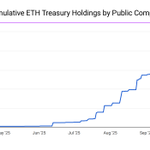
Public companies now hold nearly 7.5M ETH on their balance sheets! 📈
From basically zero in mid-2025 to ~7.5M ETH in roughly a year.
Most of them are still accumulating more.
Every angle tells the same story:
🔹 Exchange reserves at all-time lows
🔹 Staking rate at all-time highs
🔹 Public company treasuries scooping up millions
ETH is getting pulled off the market faster than it's coming on.
Less to sell, more locked away.
Let's see how long ETH stays down this much.
Data via @TheBlockCo

Taylor.eth retweeted

Tom Lee: Ethereum DATs can use ~$500 million in annual staking rewards to fund grants for Ethereum ecosystem
“The Ethereum Treasuries — Bitmine and Sharplink among others — now own 7% of the Ethereum supply… Treasury stock is essentially supply permanently taken out from the ecosystem, but we also own the yield. The yield is around 3% so today these public treasuries are generating ~$500 million in rewards, and that is what we can use to fund and grant the crypto ecosystem.”
Lee believes that the Ethereum Foundation narrowing its focus to CROPs (censorship resistance, openness, privacy and security) is the right decision.
“Ethereum is a $240 billion network value entity. It has been operating for 11 years without a single day of downtime. There’s 11,500 nodes in 89 different countries. And there’s 15,000 developers. I think this is too big to be coordinated by a single foundation.”
As Ethereum continues to scale, he believes the ecosystem will move beyond a foundation-centric model and points to private companies like Etherealize, Optimism, Consensys, Enterprise Ethereum Alliance, and Offchain Labs that represent the Ethereum ecosystem and are already doing enterprise engagement.
“This list doesn’t yet reflect the spinoffs coming from the Ethereum Foundation. There’s at least five, and I think Bitmine will play a role in granting and supporting any of those that come out.”
“I think Ethereum is in good hands because the foundation is going to be stronger by staying focused. We have a lot of private sector companies already building products and important L2s on Ethereum. And of course, the treasuries are here to help with funding and granting… If you’re bearish, you are selling at the bottom.”
(June 2026)

Proud to support @ethlabs_org - a new world-class R&D lab focused on strengthening the Ethereum protocol.
Ethereum's credible neutrality is almost impossible to replicate, and it's positioned to become the settlement layer for global finance. More talent strengthening the protocol compounds that lead.
We're glad to be building alongside them to accelerate institutional adoption.
