TechTranslate (@TechTranslate_G) header
TechTranslate (@TechTranslate_G) profile picture

Technical and scientific facts, step by step explained by an engineer. Every day, an interesting fact here on TechTranslate! Please visit my YouTube channel.

Germany, Europe, Earth
Joined December 2023
Photo by TechTranslate (@TechTranslate_G)Photo by TechTranslate (@TechTranslate_G)Photo by TechTranslate (@TechTranslate_G)Photo by TechTranslate (@TechTranslate_G)Photo by TechTranslate (@TechTranslate_G)Photo by TechTranslate (@TechTranslate_G)Photo by TechTranslate (@TechTranslate_G)Photo by TechTranslate (@TechTranslate_G)Photo by TechTranslate (@TechTranslate_G)Photo by TechTranslate (@TechTranslate_G)
TechTranslate The purpose of this account is to share my passion for explaining interesting technical and scientific facts that are not intuitive, often misunderstood, or simply odd. I'm always eager to learn, particularly when others provide context, correct me, or even prove me wrong. For unknown reasons, I have the urge to add the correct context to posts that state common misunderstandings or conspiracies. I primarily engage in this because conspiracy theorists are very active on social media and create a false sense of balance. Unfortunately, in recent years, I've encountered people in real life who were influenced by social media and believe in these theories, proving that this is becoming a real issue. This fact truly saddens me. I am realistic; I know I cannot convince the extremists or hardcore conspiracy theorists. However, I hope the context I provide will assist the undecided and vulnerable in making an informed decision. It's encouraging to receive so much positive feedback in recent weeks and to see that many people here are fed up with these conspiracy theorists. Happy Anti-Conspiracizing! 😉 Best regards ❤️ Geee from TechTranslate Technical and scientific facts explained step by step. 😃👍
13
5
1
56
15,432
TechTranslate retweeted
Large filament eruption north of the large southern coronal hole. Possibly earth-directed. We'll have to wait for coronagraph imagery…
5
109
12
506
35,295
TechTranslate retweeted
2 CMEs (solar storms), both deflected NW-ward ↗️ by the L-shaped coronal hole in the east ⬅️/south⬇️. 2 Type II and 2 Type IV bursts were detected. However, the position below the streamer belt took energy. Arrival probably together with stream interaction region, 11/12 october
2
16
2
83
3,607
A new perspective! 🛰️ Voyager 1 had been in space for two weeks and was 7.25 million miles (>11 million km) away OTD in 1977 when it captured this view of the whole Earth and the Moon in the same frame. It was our first image of the kind, but definitely not our last. 1. Voyager 1, 1977 2. DSCOVR, 2015 3. Artemis I, 2022 4. Artemis II, 2026
35
565
17
3,026
75,368
TechTranslate retweeted
Filament eruption on the southern central solar disk. Earth-directed CME ('solar storm') possible
5
45
2
175
7,570
TechTranslate retweeted
A bit of activity behind the northeastern limb of the Sun. (SDO AIA 171, 193, 304)
7
67
2,084
TechTranslate retweeted
NASA’s Nancy Grace @NASARoman Space Telescope is now in space and beginning the journey to its operating location near the Sun–Earth L2 Lagrange point, roughly 1.5 million kilometres, or just under one million miles, from Earth. Roman launched on August 30, 2026, aboard a @SpaceX Falcon Heavy from Kennedy Space Center, and separated successfully from the rocket about half an hour later. It will spend roughly three months travelling toward L2 while engineers gradually deploy, activate, test and calibrate its systems and instruments. On August 31, the spacecraft completed its first planned mid-course correction, a short engine burn that refined its trajectory toward L2. L2 is one of five Lagrange points produced by the gravitational interaction between the Sun and Earth. They are often described as places where gravitational forces “balance,” although physically the situation is a little more subtle: in the rotating Sun–Earth system, the combined gravitational acceleration of the Sun and Earth allows a spacecraft near L2 to orbit the Sun with the same angular period as Earth despite being farther from the Sun. Roman will therefore not remain motionless at L2. Like the James Webb Space Telescope, it will follow a large halo orbit around the L2 region and will occasionally perform small station-keeping manoeuvres to prevent its orbit from drifting. L1, L2 and L3 are dynamically unstable, while L4 and L5 are stable. For an astronomical observatory, L2 is an extremely useful environment. The Sun, Earth and Moon remain roughly in the same general direction from the spacecraft, making it easier to keep them away from the telescope’s observing direction and to maintain a relatively stable thermal environment. At the same time, Roman remains close enough to Earth for high-rate communications and receives essentially continuous sunlight for electrical power. These advantages are among the reasons JWST also operates around Sun–Earth L2. Once Roman is commissioned, its main strength will be its combination of Hubble-class angular resolution with an enormously larger field of view. Its 300-megapixel Wide Field Instrument will survey large areas of the infrared sky rapidly rather than concentrating primarily on individual targets. Roman is expected to return around 1.4 terabytes of data per day, allowing astronomers to study the distribution and evolution of galaxies across cosmic time on an unprecedented statistical scale. Those surveys are designed to investigate some of cosmology’s central problems, particularly the nature of dark energy, the distribution of dark matter, and the growth of large-scale structure. Roman will also conduct extensive exoplanet studies, including gravitational microlensing surveys capable of detecting planets that are difficult to find with transit or radial-velocity methods. The observatory also carries a Coronagraph Instrument, primarily a technology demonstration, that will suppress starlight sufficiently to directly image and characterize some giant exoplanets. The technologies demonstrated by this instrument are particularly important because more advanced versions could eventually contribute to missions such as the proposed Habitable Worlds Observatory, whose long-term objective includes directly imaging potentially Earth-like planets around nearby stars. Roman’s coronagraph therefore has scientific value of its own, but it is also an important technological step toward much more demanding future observations. Roman’s journey to L2 is consequently not simply a transfer from Earth to a distant fixed point. It is the beginning of an extended commissioning process in which the observatory is being configured and calibrated while travelling toward a carefully controlled orbit around L2. NASA expects the transfer and commissioning phase to take roughly three months, with the first public images anticipated in early 2027. What I find most interesting about Roman is that its real scientific advantage is not simply obtaining sharper or deeper individual images. Hubble and JWST already perform exceptionally well in that regime. Roman changes the scale of the experiment: it combines high-quality space-based imaging with surveys containing enormous numbers of galaxies and stars. For cosmology in particular, that statistical power is what makes it such an important mission.
33
328
17
1,445
31,202
TechTranslate retweeted
Strong M8.1-class solar flare from the Sun's eastern limb (⬅️) accompanied by a Type-II radio burst (estimated speed 1201 km/s). A coronal hole southwest of the source region will likely deflect CMEs eastwards.
1
23
3
86
3,892
TechTranslate retweeted
Timelapse of the ISS Optimal Propellent Maneuver (OPM)! We use this to reorient station's attitude in preparation for docking events. This one occurred over some magnificent Mediterranean city lights!
101
705
75
4,194
413,930
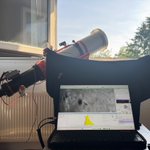
My shot of the Sun, full disc, with forest fire smoke levels down for a moment. Invert color, and non-invert mono. I like the little floating prominence a little away from the Sun at about 4 o'clock on the clock dial. You can barely see it, look closely. Transparency on my chunk of Earth was poor for a normal day, good for a forest fire smoke day. In the third photo, of my scope today, you can see down the valley to the right how much smoke is lingering around in general, even though sky looks blue. Seeing was poor for any day, jet stream 51 meters per second. But I had to do it just to keep in practice and avoid cabin fever! Yesterday I couldn’t even see the mountains 4 miles away, there was so much smoke. Full tech details. astrobin.com/yoh03q/
1
7
9
388
TechTranslate retweeted
Watch light travel, at 2 billion frames per second
6
4
29
1,732
TechTranslate retweeted
That time the camera on the robotic barge captured the same Falcon 9's launch, space jellyfish and landing.
60
658
28
7,026
261,661
TechTranslate retweeted
Got out this afternoon and caught another ISS transit. They must’ve adjusted their orbit last night, because the spot I picked out became less ideal when I checked it this morning. Wild that we can predict this transit down to the SECOND.
13
10
2
50
1,435
TechTranslate retweeted
Reminder: it is just this easy to debunk flat earth with two simple observations. The stars rotate in opposite directions above the opposite hemispheres.
4
2
17
446
TechTranslate retweeted
This is not CGI.
206
302
91
2,362
4,217,171
The Sun’s chromosphere, AR4492, yesterday (H-alpha photography). At first, I hesitated to set up my gear because there were still a lot of cirrus clouds in the afternoon… but it was worth it. It cleared up at about 5:30 pm, and the seeing became quite good.
1
1
1
4
270
An eruption is observed, an arc of plasma on the far side of the sun.
11
42
1,135
TechTranslate retweeted
Star Trails prove we're on a rotating globe
26
15
3
164
3,880
TechTranslate retweeted
Tow this home and stand it up as a monument!
207
465
26
7,763
135,794
TechTranslate retweeted
These videos will go around the globe as much as the next Starship! 🔥🔥🔥
18
42
830
11,435