Student of the market. History doesn’t repeat itself but it often rhymes
Joined July 2017
- Tweets17K
- Following1.2K
- Followers448
- Likes25.6K








Sucks reddit is so woke, even the slightest right wing posts get banned. I'm done with being censored constantly. The format and layout of the site is better than Twitter imo. Here discussions are too shallow often because you barely can post any characters.
1
1
79
Niel 尼尔 retweeted

The turn of the month trading strategy (end of month effect)
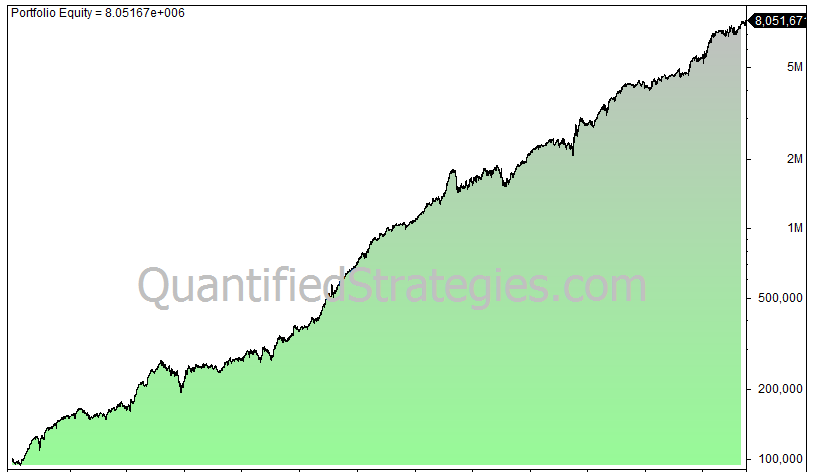
The turn of the month strategy performs very well in most markets and frequently beats the buy and hold strategy despite its low exposure time. We go long at the close on the fifth last trading day of the month, and we exit after seven days, ie. at the close of the third trading day of the next month.
We backtest the following trading rules:
We enter at the close on the fifth last trading of the month, and we exit at the close on the third trading day of the new month.
The turn of the month strategy has worked very well for the S&P 500 since at least 1960 (Shown in the image below)
Can the strategy be improved or made different? If you have any suggestions, please comment 👇
#tradingstrategies
ALT The turn of the month trading strategy (end of month effect)


Niel 尼尔 retweeted

Cathie Wood @CathieDWood told investors in 2021 she expected 40%/year annaulized returns over the next 5 years. 5 years was her exact time horizon. In her macro view she also anticipated deflation, despite CPI rising over 7%.
Instead she generated -14%/year real annualized returns and inflation has been elevated for 5 years.
#cluelesscathie is among the worst investors to ever live.
The bigger mystery is how her fund has not gone out of business after destroying so much wealth. This is harder than the Reimann Hypothesis to figure out $ARKK $ARKG $ARKF
Someone should follow the money to see who these "investors" are that tolerate 5 years of -14% returns. Seems suspicious

In Dec 2021 Cathie Wood stated ARK's 5-year expected CAGR had risen to nearly 40% (from 15% earlier that year), with her flagship strategy potentially delivering 40%.
As of late Nov 2026, ARKK's actual 5-year annualized total return is about -11%.
That is a gap of roughly 51 percentage points.
Adjusted for cumulative US CPI inflation of ~21% over the period, the real return was substantially more negative (around -14% annualized).


Niel 尼尔 retweeted

Polymarket's fees are now 36% higher than on Kalshi.
2 day ago Polymarket US replaced its 3.475% standard taker fee with a tiers based system.
You now need >$250k taker volume over the last 30 days achieve the same 3.475% rate.
Under that threshold, you will now pay a lot more.
Here’s what you now pay in for a buy at 50c based on tier:
- Under $10K -> 4.75%
- $10K to under $50K -> 4.25%
- $50K to under $250K -> 3.75%
- >$250K -> 3.475%
Kalshi’s standard rate on the same trade is 3.50%.
To think that Polymarket used to have 0 fees less than a year ago, and that Kalshi was considered the expensive platform.

Niel 尼尔 retweeted

We're like 3 years into this, and we still don't appreciate the level of crazy we're witnessing.
Google goes all-in on AI Mode to chase ChatGPT (because, like Rodger Daltrey, they "won't get foooooled aaaagaaaaaiinnnn" - as in when Bing beat them to the punch).
Now, OpenAI has no idea what it's doing. So it's the blind leading the blind.
No one knows how to monetize this or, wait for it... wait for it... wait for it... if an ad model even works in an environment where the entire intent is just to get the information and then go do your thing outside that environment.
So now we have AI Mode ads don't do jack for Google revenue (what took them so long to see the obvious is amazing) and ChatGPT ads ain't great either (via @sengineland).
At this point, I feel both companies should create T-Shirts that say "I'm with stupid"

Niel 尼尔 retweeted

AI total spend continues to flatline even within a pool most receptive to adoption.
Certainly nothing like the parabolic growth required to make all the downstream expectations & commitments pay off.

Niel 尼尔 retweeted

Things in Western Europe will improve when a few hard realities are understood:
1. Europe has no God-given right to be wealthy or stable. Things can & will decline and fall apart if not maintained and adapted to new realities. Things that worked in the 1970s may be counterproductive now.
2. Energy is the basis of the economy. Without it, nothing else matters. While efficiency will be important, any economy where energy is scarce will inevitably be one that struggles
3. Not all cultures are equal. Some create prosperity, some lead to misery, some are outright evil. If Europe doesn't accept this, the cultural basis of its previous success & prosperity will be destroyed forever
4. Have kids, or die out. In the long term, few things matter this much. You can't create a European future if there are no Europeans left for it, and as the experiences of the last few decades show, non-European immigration simply makes Europe culturally less European - and doesn't magically make these people culturally European.
5. The state can not - and should not - save every individual from him/herself from him/her bad choices or ineptitudes. The idea of a nanny state which can ensure that everyone always live comfortably with minimal effort & contributions 100% of time is not feasible. The socialist promises of 30 years of wealthy retirements for everyone and Europe being able to take on endless low skill immigration were lies.
6. If a society has no way for ambitious & creative people to get rich from working hard, everyone will get poorer because of it. The hard truth is that much of our economic future depends on businesses being built & transformed by ambitious & sometimes ruthless individuals. Not everyone is able or willing to do this, and without them, there is no one to employ others and no wealth & growth to tax. But if businesses & wealth are seen solely as an evil force to be taxed into oblivion, they will go elsewhere.
7. In some cases, the best way for society to deal with a criminal is to lock them up and throw away the key. A small percentage of humans are ticking time bombs - low IQs, high aggression potential, psychopathic traits, socialised into criminal structures or a culture of lawlessness. Society can't fix them. They go in and out of court rooms and across Europe states, NGOs & social workers waste billions of hours & Euros to try & fix the unfixable. Not least because of mass immigration from dysfunctional societies, our legal systems & high trust societies built on principles such as the benefit of the doubt & correction via socialisation are overwhelmed by the amount of aggressive young men with no interest to contribute to society.
All of this is fixable. But the first step is accepting reality.
Niel 尼尔 retweeted

Peter Thiel's critique of European tech is sharper than most people quote it:
"In the social democratic European societies, it's acceptable to be moderately successful. It's not acceptable to be wildly successful."
That's not a cultural observation. It's a structural diagnosis.
Look at the pattern: Skype sold to Microsoft. Spotify relocated to New York and listed in the US. DeepMind sold to Google before it could compound. Klarna — one of Europe's most valuable fintechs — spent years being investigated and regulated the moment it hit scale.
The moment a European startup gets big enough to matter, the social contract shifts. Regulators, press, and public sentiment move from neutral to hostile. So founders learn to exit early — not because they lack ambition, but because the system taxes it.
Europe produces world-class talent and early-stage innovation. It just doesn't retain the compounding.
The constraint isn't capital. It's the ceiling culture places on acceptable ambition — and founders respond rationally to the incentives they're actually given.
Niel 尼尔 retweeted

The amazing thing about Google getting hammered today is not that its core Search business is under stress. It’s how long it took investors to figure that out.
AI is changing the regime under which the hyperscalers became some of the highest-return-on-capital businesses in human history. Google & Meta, and to a lesser extent Amazon, are at the centre of this disruption.
They became the modern-day landlords of the digital economy. Google auctioned search intent. Meta auctioned attention. Amazon auctioned product discovery. They controlled access to consumers and charged advertisers increasingly expensive rents for the privilege. Beautiful low capital intensive businesses. Until the rules change.
AI is doing precisely that,faster than the internet revolution that created these empires. I barely use a web browser for search anymore. It has degenerated into a window for opening websites. Why scroll through sponsored links & SEO garbage for dog food when an AI assistant can find what I need? I doubt I am alone.
Their response? Join the party and build staggering amounts of compute. Google alone is heading towards US$200bn of capex in 2026, while its Search growth is already slowing.
Clayton Christensen explained the problem in Innovator’s Dilemma. Incumbents struggle when technological disruption destroys the economics of the very businesses that made them successful. But throwing trillions at the disruptive technology won’t make another high ROIC units. Instead it renders the entire shop average.
Worse, AI is on track to become commoditised, with economics eventually resembling airline seats: enormous fixed costs, relentless capacity additions, falling unit prices and fierce competition. Models become cheaper, more interchangeable and increasingly tailored to individual needs. Much of that intelligence will eventually run locally on personal devices. Who pays the landlord when the tenants no longer need his building?
In 2025, Google generated US$225bn from Search, Meta US$196bn from advertising. How much of that can they defend, let alone replace, while committing hundreds of billions to a data centre arms race? It’s just ridiculous. In 2 years time they can buy these zero-moat compute factories for 20 cent on the $.
The problem is the moat. I’d argue that 98% of businesses have no durable moat. Schumpeter’s creative destruction eventually erodes any competitive advantages in a free enterprise system, growth fades and returns on capital gravitate towards 5–7% as competition brings supply into balance with demand.
Bruce Greenwald explained in Competition Demystified just how hard it is to build a economic moat. My favourite is what Buffett calls share of mind. Try displacing Coca-Cola, Pampers or WD-40 with a 5% discount. Good luck.
Where is AI’s moat? Switching costs are near zero. I switch bw 4-6 models and already use 2 specialised AIs for commodities, each offering proprietary data and knowledge depth. If at all, I see opportunity for high ROICs in owning scarce, valuable info & domain expertise rather than another tech layer.
But that is hardly the 10 trn-dollar TAM that spoiled Google & Meta executives want to present on their next earnings calls. They think unrealistically big, with precious little capital discipline. Instead of accepting that the regime change, rest assured that they will throw endless good money after bad. Like 100% sure!
History offers zero comfort for that process. Look at the former kings of the S&P 500: AT&T, GM, DuPont, IBM, Exxon, Kodak, Sears, Xerox, GE, Philip Morris, Pfizer, Citigroup, Intel or PanAm. Some went bust, others lost dominance; few retained their extraordinary economics.
Expect Google to join the decay list.


As someone who has personally spent $500k / mo+ on Google Ads for years, I can tell you with certainty:
This revenue growth in Search is artificial & extremely unhealthy for Google’s business long term
Search volumes are declining as legacy search is being increasingly cannibalized by non-monetized LLM queries
Google’s response?
Manufacture revenue growth via short-sighted, highly extractive, customer-hostile tactics. I.e. charge advertisers more for lower quality clicks, including clicks they do not want and explicitly did not approve Google to charge them for
A few examples to illustrate:
For all of its history until recently, Google operated on a 2nd price auction model
I.e. if you bid $5 CPC and the next highest bidder bids $1 CPC, Google charged you $1.01 for the click (one penny more than the 2nd highest bidder) rather than the $5 you bid
This was a genius move by Google early on as it incentivizes advertisers to input their true maximum willingness to pay rather than trying to play the game of bidding low and constantly adjusting to try to stay just ahead of the next highest bidder while still not paying too much
However recently, Google silently deprecated the 2nd price auction and began charging advertisers as much as their bid and budget caps allow, regardless of what anyone else is bidding
It’s a short-sighted cash grab at the expense of the long term health of the advertiser ecosystem
Making thing worse, Google also recently nerfed keyword targeting precision
Google previously had precise keyword targeting settings that allowed advertisers pick individual search phrases to bid on, defined down to the character w/ exact match or phrase match targeting
This was one of the core features that made search advertising magic, enabling advertisers to run extremely precise campaigns based on exactly what their target customer typed
But now, even if you bid on a specific term or phrase using the strictest exact
-match targeting settings, Google will show your ad across 1000’s of unrelated keywords, labeling them as as “exact match (close variant)”
The definition of “close variant” means whatever they want it to and changes constantly. The result is advertisers get billed for clicks that are totally irrelevant to their business and that their targeting settings explicitly forbid Google from targeting. Google does it anyway and there’s no ability to turn this off
So now exact match is broad match, and broad match is just meaningless spam
This is all very bad for advertisers, but for Google, it allows them to show your ad and bill you for clicks across 1000x more searches that were previously going unmonetized (mainly because they’re garbage queries no one wants)
This is how you grow revenue atop declining search volumes
Lastly, and perhaps most egregiously, Google quietly stopped respecting budget caps by a factor of 2x. For example campaigns we’ve been running for years with $1000 daily budget caps suddenly began spending $2000+ per day
And the extra spend is entirely on the garbage keywords Google arbitrarily throws in as “exact match (close variants)” which have no value to our business, but can’t be turned off
Google offers no refunds nor any recourse for overspend or spend on keywords you explicitly did not target
These are not the actions of a healthy business. These are the actions of company whose core business is in decline but desperately needs to pump quarterly earnings so Wall Street will continue to fund insane capex while hopefully looking through their rapidly deteriorating negative free cash flow
Google operated a benevolent monopoly for the better part of 25 yrs
Meaning the value Google captured from Search was but a small fraction of the value it created, and that spread produced a potential energy that justified expectations of high earnings growth far, far into the future
This is now no longer the case
At the alter of AI capex, Google is sacrificing the golden goose
Niel 尼尔 retweeted

the complete lack of announcement through twitter or discord from Polymarket (besides a few messages from staff in DMs and a vague allusion to an “incident” in their discord) to warn people about this hack will likely do significant damage to their reputation
and it comes at perhaps the most inopportune time: as the midterms give prediction markets their biggest moment in the news cycle for the next two years, all anyone will talk about is Polymarket’s website being hacked and their team failing to adequately warn its users about it even after the hack was well underway
Niel 尼尔 retweeted

JESC viewers:
2022 33 million
2023 27 million
2024 23 million
2025 16 million
This year it dropped in many countries. In Italy, one of the biggest countries, it dropped 310k to a total of 20k. Many countries put it on a secondary channel due to it being on primetime tv.
Niel 尼尔 retweeted

Polymarket significantly changed the rules for the second time yesterday on the Russia x NATO military clash market, after $7m had already been traded.
The new rules state that interceptions of strikes on ships in NATO countries territorial waters (which is sovereign territory), won’t be considered as a military clash.
The original rules did not have any such carveout and it is impossible to know where Polymarkets bar-raising will finish before we place a bet on these markets. For example, would an intentional drone strike on Bucharest that is intercepted count if the target was a foreign-owned civilian building? Would the US defending a cruise ship from a drone strike while it’s docked in Miami count? (Weirdly, a recon drone shot down over any of those targets would 100% count)
Although I don’t agree with it, I don’t have a huge problem with the actual ruling of the specific incident that was clarified yesterday. I believe the pattern of strikes on nearby ships, alongside statements from President Dan and EU officials, provided strong enough evidence of targeting Romanian territory. But it's a judgment call that could go either way.
The trouble is the bar has now been raised significantly again for future incidents when millions has already been traded, and we can’t accurately price these markets without predictability that rules won’t change under our feet.
Niel 尼尔 retweeted

French women are speaking up 🔥
“It’s an immigration crisis. They come to France only for economic advantage. They don’t want to become French. They are not French in their spirits.
For women it is very complicated.
There is a lot of sexual harassment by migrants, a lot of rapes by migrants. And it’s not only in Paris, it’s in all the big cities of France. Where you have migrants, you have problems.
Women are the first victims. And the government don’t want to speak about that. It’s taboo.
It’s very difficult to get migrants to go back to their country, because their country don’t want them. We have a lot of left-wing liberals. For them migrants are victims all the time.
So it’s very unjust, because there are a lot of poor French people too.
You’re a racist if you just say the truth. Open your eyes and you can see what we say. This is the truth.”
Refreshing and necessary. This pattern is repeated across Western Europe.
Action is long overdue.
Niel 尼尔 retweeted

If you’re selling gold because of fusion alchemy, you’re front-running a reactor that doesn’t exist, fed with mercury that costs 100,000x more than the gold it makes, to produce bars you couldn’t legally sell for 15 years.
Marathon Fusion’s idea is real physics, since fusion neutrons can turn mercury-198 into gold.
1. Even optimistic models give 2–5 tonnes per gigawatt plant per year, against roughly 3,500–4,000 tonnes of annual mine supply
2. Enriched mercury-198 sells for about $15,000 per milligram today, while gold trades near $135 per gram
3. The gold would need 14–18 years of storage before it can be sold, so a plant’s first sellable bar arrives well over a decade after it switches on


Last month, we demonstrated high-rate alchemy: turning mercury into real, stable gold, beating CERN’s record by a factor of 10.
Last week, we enriched isotopes in the world’s most powerful plasma centrifuge, beating the Soviet record that stood for 40 years.
Now, we’re building a fusion reactor in San Francisco to achieve record power density.
Niel 尼尔 retweeted

Everything TradingView offers for $240/m… is now free
alertsify.com/tradingview-al…