


Tree retweeted

$IREN
Let’s talk prepayments and what they actually do for neoscalers. I’ll use 1 IT-MW so the math is easy to follow.
1. Start with two deals.
- Deal #1: $22M per year for 5 years, no prepayment
- Deal #2: $22M per year for 5 years, 90% prepayment (GPU Capex)
Both deals are worth $110M over five years. Assume the GPUs cost $40M in both.
2. Who pays the GPU bill?
In Deal #1, the neoscaler has to come up with the full $40M before the GPUs start earning. That money has to come from somewhere. Cash on hand, debt, equity, or some combination.
In Deal #2, the customer sends $36M before the GPU bill is due. The neoscaler adds $4M and pays the same $40M bill.
That's the first benefit, there's $36M less to fund upfront for Deal #2. That $36M would otherwise have to be funded with GPU financing (debt).
What does the 90% prepayment save IREN if it replaces borrowing?
The GPU bill is $40M per IT-MW. The customer sends $36M before the bill is due, so IREN only has to come up with $4M for the GPUs.
Now say IREN had to borrow that $36M instead. Use 14% (2033 converts is yielding = cost of capital), and assume a 5-year loan with equal monthly principal payments. Over 5 years, IREN would pay $12.8M of total interest or $2.6M per MW-IT.
The implication being that a deal with no prepayment would be pricing at $24.6M all other things being equal.
But in a prepayment-less deal, you'd still need to find a lender to advance you 90% of the GPU cost.
3. Now lets follow the cash after the GPUs start running.
In Deal #1, the customer pays $22M every year. $0 upfront + $110M over five years = $110M.
In Deal #2, the customer has already paid $36M, so there’s only $74M left to collect.
When that cash comes in depends on when the customer gets to use its credits. It matters.
If the credits are spread evenly over all five years…
-$36M / 5 = $7.2M credited each year
-$22M annual bill − $7.2M credit = $14.8M each year
-Total: $36M upfront + $74M in years 1-5 = $110M
If the credits start in year 3…
-Years 1–2: The customer pays the full $22M each year, so the neoscaler collects $44M
-Years 3–5: $36M/3 = $12M annual credit, so the customer pays $10M each year
• Total cash: $36M upfront + $44M in years 1–2 + $30M in years 3–5 = $110M
So what’s the benefit of starting the credits in year 3?
Look at how much cash the neoscaler has collected by the end of year 2:
-Credits over five years: $36M upfront + $29.6M from years 1–2 = $65.6M
-Credits start in year 3: $36M upfront + $44M from years 1–2 = $80M
That’s $14.4M more cash per IT-MW in the first two years
If we use the same 14% cost of capital rate to put value on collecting more money upfront, the back end credits is worth $3.3M more per MW-IT in present value. A bird in the hand is....
So what's it all worth per IT-MW, at a 14% cost of capital (present value)?
-90% prepay vs. borrowing for the GPUs: $11.3M (~$12.8M of interest you never pay)
-Credits that start in year 3: +$3.3M
-Total: $14.6M, about 13% of the $110M
Put another way - a deal with no prepayment would need to price at $26.2M/yr, not $22M, to be worth the same. And you'd still have to find someone to lend you 90% of the GPU bill.
Same $110M collected on paper. Very different deals!
Prepayments and when they're credited back matter! In this deal, it's worth $4.2M per MW.
(IREN structures contracts to credit prepayments on the back end of contracts. source: deferred revenue)
Tree retweeted
$IREN
IREN’s FY27 funding story gets a lot clearer when you look at what’s already funded and what funds it, what still needs funding, and what IREN can borrow against.
This is my attempt at drawing that picture!
A. The >$4B ARR program is already funded
That’s Prince George, Microsoft’s Horizon 1–4, Mackenzie, and the first 50 MW at Childress. I estimate ~$15.2B of total capex across those deployments, split between ~$11B of GPUs and ~$4.2B of data centers.
The funding looks different at each site. Microsoft’s prepayment and the $3.65B GPU facility cover roughly 95% of Horizon 1–4 GPU capex. Mackenzie has $2.4B of Blue Owl/PIMCO financing plus customer prepayments. The first Childress 50 MW is covered within the funded program through cash.
Many of these bills still come due at delivery, that's why not everything has been fully paid even though its fully funded.
B. The next Childress expansion still needs $6B.
In my model, that’s $4.9B of GPUs and $1.1B of data center retrofits across three blocks at Childress:
- NVIDIA: $2.0B. The GPUs were ordered, and the contract gives IREN a basis to raise GPU financing.
- Second frontier lab block: $1.7B. I’m modeling GPU financing and a possible customer prepayment.
-Remaining 70 MW gross: $2.4B. I’m treating this block as uncontracted. A signed customer deal would likely come before GPU financing.
That’s my breakdown of the $6B.
C. Where can the money come from?
Slide 19 of the investor presentation lays out $5B from GPU financing and customer prepayments, $5–7B from data center-backed debt, and $2–3B from other corporate debt. That’s $12–15B of potential funding capacity at targeted terms, before converts or equity.
1. GPUs → $5B targeted from financing and customer prepayments
In my build, the GPU pool includes $1.4B for the first Childress 50 MW block, $1.6B for NVIDIA, $1.4B for the second frontier lab block, and $2B for the remaining 70 MW gross I’m treating as uncontracted.
That's a total of over $6.33B of unencumbered GPUs across.
About $4.4B of the $6.33B of unencumbered GPUs is tied to three signed customer contracts. The remaining $2B is tied to the 70 MW gross block that hasn't been been contracted/procured:
Childress 50MW #1: 1.4B of GPU capex. The first Childress block is already covered within the funded >$4B ARR program. Because they've paid cash for these GPUs, it can free up cash it had earmarked for them by borrowing against them. This first block holds the first frontier lab contract. Should be very financable.
NVIDIA: $1.6B of GPU capex. This is the one I’d have the most confidence in financing. IREN has a signed 5-year, $3.4B contract with an investment-grade counterparty. A lender can underwrite the equipment and the payments NVIDIA is contracted to make. I'd finance this if I could, but I'm $200K short. $%@#
Childress 50MW #2: $1.4B of GPU capex. IREN confirmed it signed an expansion that doubles capacity for the frontier lab. I’m modeling that expansion in the second Childress block. I think it’s financeable, because it's the frontier lab. A meaningful prepayment from the frontier lab would make the financing easier. IREN also disclosed a five-year deal with a 90% GPU prepayment that I believe is also in this same block.
2. Data centers → $5–7B targeted from asset-backed debt
My estimate puts the unencumbered data center base at $6B in September, growing to $10B by FY27-end as IREN spends more on constructing it's data centers.
My biggest buckets are $3B at Horizon 1–4, $2.7B at Sweetwater 1, and $2B across the Childress air-cooled halls and site infrastructure. Horizon 1–4 is the one I’m watching first. These are *my* estimates.
The Microsoft GPUs already have their own financing. If IREN can borrow against the buildings once the remaining halls are accepted, it can recover some of the cash it already put into construction and redeploy it.
How much IREN can raise near term depends on which assets lenders will finance.
I expect these funds to be used to fund the data center capex for Sweetwater 1 and Horizon 5-6 (i.e., 1HFY28)
3. $2–3B in potential corporate debt.
Corporate debt isn't dilution!
What backs it? The cash left over across IREN’s sites after they pay principal and interest on the project debt, plus any assets they haven’t pledged yet. That’s what lenders can underwrite at the parent level. And if they raise it as straight debt, zero share dilution.
And lastly...
unencumbered
/ˌənənˈkəmbərd/
Unencumbered (pronounced uhn-in-KUHM-berd) is an adjective meaning free from burdens, obstacles, obligations, legal claims, or liens
(I retain the right to be wrong 73% of the time and happy to answer any questions!)


Tree retweeted
My last $IREN post looked at the economics of building a new AI data center. A post from @_Sgr_A_Star got me thinking about the mining halls IREN already owns at Childress. From a developer’s perspective, that’s a different deal. How much cash could I get back out of a retrofit while I still own the property?
I ran it on the same 10 IT MW example as before. IREN disclosed a five-year deal at about $22M of annual revenue per IT MW, with the customer prepaying 90% of the estimated GPU cost. IREN didn’t name the site. I wanted to see what those terms could do on a retrofit.
I used $400M for GPUs and $80M to convert the halls. That $8M per IT MW is @_Sgr_A_Star ‘s well reasoned assumption, at the high end of the $5M–$8M conversion range Core Scientific showed for its own projects. The customer advances $360M, leaving $40M on the GPU bill.
Say IREN puts up the $80M for the retrofit, then borrows $100M against the GPUs and $80M against the finished property. After paying the remaining GPU bill and $21.8M in fees and reserves, $118.2M comes back to IREN. That’s the entire $80M retrofit investment back, plus $38.2M of borrowed cash for the next build.
The first site keeps earning. At my assumed 75% operating margin, I get another ~$220M over five years after customer credits, upkeep, debt payments and estimated taxes. I’ve assumed no sale. IREN still owns the site and GPUs, with ~$55M of building debt left.
Here’s why I think it matters. Of the 250 gross MW IREN plans to retrofit at Childress, ~60 MW is allocated to NVIDIA. That leaves ~190 gross MW outside the NVIDIA deal. At my assumed 1.4 gross MW per IT MW, that’s about 135 IT MW, or roughly 13½ times this example.
If that whole footprint earns similar terms and financing, I get ~$1.6B back as the loans fund in phases, including $520M above the new retrofit investment, plus **$3B of cash over five years of service**. What I like as a developer is that the same property could help pay for the next build while it’s still earning on the first contract. Of course some of that capacity may be spoken for under deals already closed, but the illustration is important. One day the market will understand the flywheel $IREN has at its disposal. This is not a troubled company. It’s priced like it is. I recommend acting accordingly! (NFA of course 😉)

Tree retweeted

Oracle has secured all the funding we need to fulfill our contract with OpenAI. With our final capital raise earlier this month, we became the first hyperscaler fully funded for this investment cycle. The financing we outlined at Oracle Investor Day, including vendor financing, is in place. Any further private discussions with vendors are just additional options. Our ability to deliver on our OpenAI contract does not depend on those discussions. Any media reports that will come out and say the contrary are incorrect and wrong.
Oracle and OpenAI are making rapid progress on our infrastructure partnership. Our Abilene campus, where Astra-6 was trained, is nearly complete. Shackelford, our next gigawatt-scale campus, is fully permitted. The handover of NVIDIA Vera Rubin racks in its data halls is on track for the coming weeks.
We continue to expect positive free cash flow in the second half of FY2028. We are targeting more than $30 billion in free cash flow in FY2029 and expect to self-fund future growth beginning that year.
Tree retweeted
How much more stock does $IREN actually need to sell to cover its $6B funding gap?
I’ve lost count of how many times I’ve seen this question on X. The dilution concern is fair. IREN has already sold a lot of shares. What I keep coming back to is how much of the remaining buildout they could fund with the assets they own and the contracts they sign.
First, the $6B was a September 30 number. After quarter-end, IREN raised about $630M through its ATM at an implied average of roughly $36 per share before fees. Giving them credit for that raise, I get about $5.4B left to fund against the original FY27 capex plan.
My last post looked at how IREN finances one AI deal. This time I put together four ways it could cover that $5.4B without another ATM sale or convertible.
The last row is the one I keep coming back to. IREN reported $6B of unencumbered data center assets, including land and projects under construction. If it can borrow $3B against Horizons and other eligible sites, another $2.4B in new GPU loans would cover the balance. That case assumes zero new customer advances.
Sweetwater is the obvious one to watch for a big prepayment, but a few smaller contracts at Childress or in Canada could help too. IREN already signed a five-year deal with a prepayment covering 90% of the associated GPU cost. Even a lower percentage on the next few deals could make a real dent.
That’s why I’d pay as much attention to the payment terms as the headline contract value. A smaller deal that puts cash in IREN’s hands before the GPU bills come due could do more for FY27 funding than a much bigger deal that pays in July. It would be a mistake to think that management is not close to addressing this very concern. I think we get news in the next month before the holidays. Buy the steep discount if you can!


Tree retweeted
The Fed Goes Rogue
There has been more Fedspeak in the past two weeks than in any other two-week stretch this year. Warsh appears to have a rebellion on his hands. So much for no forward guidance.
The Fed’s Keynesians are willing to risk everything, brushing aside data and theory. Headline inflation is an oil shock, not a demand boom: 3.7% against 2.6% core, with Dallas Fed trimmed-mean PCE at 2.3%.
October’s monthly CPI slowed from 0.6% to 0.4%. Shelter, a third of the rise, is partly the Fed’s own making. Core goods rose just 0.2%, and used cars fell 1.2%. There is no evidence of second- or third-round effects.
Services excluding energy cooled to 0.3%. Services inflation of 3.2% sits below its six-decade average of 4.7%. History is clear that rate hikes don’t fix services. After the Fed began hiking in March 2022, services inflation climbed from 5.1% to 7.6% over ten months. Under Volcker, it peaked at 18.1% eight months after the October 1979 shock. Services follow wages, rents and productivity, not the last rate move.
Meanwhile, base effects are doing the tightening for them. The real policy rate, proxied by the 2-year, is 1.93%. As the energy spike drops out, it rises to as much as 3.9% by December 2027, the tightest since 1990.
Their acolytes on Wall Street amplify the noise. This is not a disciplined policy debate. It is a political institution at war with itself.
Enough monetary policy by anecdote. Show us the data. Defend the theory. Explain the policy.
Remember how this crew acted when Biden and Yellen were in charge. They embraced MMT!
For a case study in the damage an unelected institution can do when it goes rogue, watch today’s Federal Reserve.
🤖 Made with AI

Tree retweeted
I work in real estate development, so when I saw the prepayment terms on $IREN’s newer AI deals, my first question was simple. How much of my own cash would I actually have tied up in one of these? I ran the numbers on 10 MW.
IREN reported about $22M in annual revenue per IT MW on recent five-year contracts. It also disclosed a five-year deal with a customer prepayment covering roughly 90% of estimated GPU cost. I used those figures for this example. The financing, margin and exit are my assumptions.
Using IREN’s illustrative costs, 10 MW takes $400M of GPUs and a $200M data center. At $22M per MW per year, that’s $1.1B of revenue over five years. The customer pays $360M up front, leaving $740M to collect over the contract.
I assume IREN puts in $200M of peak equity, then borrows $100M against the GPUs and $116M against the facility.
$200M equity + $360M prepayment + $216M debt − $600M build − $22M fees and reserves = $154M back to IREN.
That financing returns 77% of the original equity. IREN still owns the project and has $46M of its original cash tied up.
I used a 75% operating margin. For context, IREN’s own example leaves 85% of revenue after direct operating costs. My assumption puts five years of operating costs at $275M. Add $10M for upkeep, and $455M of the $740M still to collect is left. After principal, interest and modeled taxes, operations return roughly $206M.
So before selling anything, IREN gets about $360M back on $200M invested. That’s $154M from financing and $206M from operations. It still owns the site and GPUs, with about $79M of debt left.
I’d look at renewing the compute contract before selling. I modeled a year-five sale so I could compare the return with a real estate deal. For the property, I assumed a future colocation tenant could support $14.1M of annual net operating income. At an 8% cap rate, less conversion and lease-up costs, I get about $157M for the property. I valued the GPUs separately.
Including the sale, I get about $469M back on $200M invested. That’s $2.35 back per dollar over five years, or roughly $269M of project-level profit (~38% modeled equity IRR). Not bad if you ask me! As @_Sgr_A_Star says, word.
The number that interests me most is the $46M. That’s how much of IREN’s original $200M is still tied up after financing. The other $154M can go toward the next build while the first contract is still running.

Tree retweeted

Stop stressing about $IREN's capex and assuming they’ll dilute shareholders to death at the current market cap...
The company’s unfunded capex “gap” for FY27 is $6B.
Management’s expected GPU financing and customer prepayments alone already cover about $5B of that.
And to be clear, their assumptions here are stupidly conservative, because they are only modelling around 90% of GPU capex being funded through BOTH prepayments and financing combined.
... $IREN literally signed a new 5-year contract two weeks ago where the customer alone prepaid 90% of the GPU capex.
They could then layer GPU-backed debt on top for another 50% of capex and get to 140% of the underlying GPU capex being funded, just ad they did across their 80 MW of Mackenzie capacity.
Non-dilutive funding is clearly not the issue in this market environment. Customers are DESPERATE for compute.
How is that not obvious??
We all know $IREN already has Anthropic as one of its customers. The company’s CCO recently said they have “one of the two leading AI labs” as a client.
And given Anthropic’s hunger for compute and willingness to sign contracts across a wide variety of cloud providers, it’s pretty clear who that is.
If $IREN wanted to, it could sell 100% of its FY2027 capacity, the same capacity that still requires the $6B of funding, to Anthropic and demand prepayments worth more than 100% of the underlying capex tied to those contracts.
All they would have to do is give up some revenue per MW in exchange.
So instead of signing a 5-year contract at $22M / MW, they'd likely get ~$20M / MW... Ouh no, what a disaster lol.
Anthropic is currently getting absolutely fleeced by $SPCX, paying something like $30M / MW for old-ass H100s and H200s.
They would happily jump on 100 MW of B300s for just two-thirds of the price if the trade-off is simply prepaying a larger portion of the contract upfront.
But if you’ve been paying attention, $IREN generally doesn’t pre-sell large amounts of capacity far in advance, while also prioritizing customer diversification to de-risk its contract portfolio.
If they really needed the funding, though, they could lean much harder on prepayments.
The market is totally retarded for failing to see that... 🙃
I’m looking forward to reflecting back on this period and quote-reposting a bunch of the stuff I’m publishing these days.

Tree retweeted
$IREN
I thought Kent made some very revealing comments on this interview that are very bullish and completely refutes the "nO MoRe cApiTal!" sentiment in the markets right now. Two in particular were key take-aways for myself.
1. Kent was very confident about the GPU debt markets remaining open to IREN
Quote:
"Similarly, on the GPU debt financing side, where we've raised over $6 billion in the last number of months, that market very much remains open. And by June 30 next year, we'll have a very significant amount of unencumbered GPUs that we can arrange debt financing against."
2. The increased scrutiny of hyperscalers' balance sheets and why that is already benefitting IREN
Quote:
“What we're actually seeing from the largest users, whether hyperscalers or the large foundational AI labs, is a continued increase in demand. If you look at hyperscalers, for example, who have increased scrutiny on their balance sheet positions, I think it's actually becoming more attractive for them to contract with players like ourselves. Instead of taking capex onto the balance sheet, they can secure compute as an opex line item. So that's actually driving an increase in demand on our side, contrary to some of those very specific examples, which I think are more tied to the underlying assets themselves.”
These two comments don’t guarantee anything, but they give me greater confidence that GPU debt financing will remain available to IREN - even for deployments backed by non-investment-grade customer cash flows.
They may also offer clues about who could become the anchor tenants at SW1 and Horizon 5–6.
Could we see a bidding war among hyperscalers and frontier labs for that capacity?
Here’s hoping. 😀

I know Kent personally. He's a real talent for $IREN and the AI infrastructure industry. I always listen when he talks to understand the inner loop where IREN plays.
When he says development timelines have stretched from 2 to 3 years to 7 plus in most jurisdictions. The bottleneck isn’t capital or GPUs it’s the multi-year process of securing land, power, and permits. Companies that started building that pipeline years ago have a structural advantage that can’t be compressed or bought later. That’s the game IREN is in.
Tree retweeted

We started shipping the Nvidia H100 in 2022.
A year ago it rented for $1.96/hour.
Today: $3.10.
+58%, on a chip that was supposed to be obsolete by now.
So much for GPU depreciation.

Tree retweeted

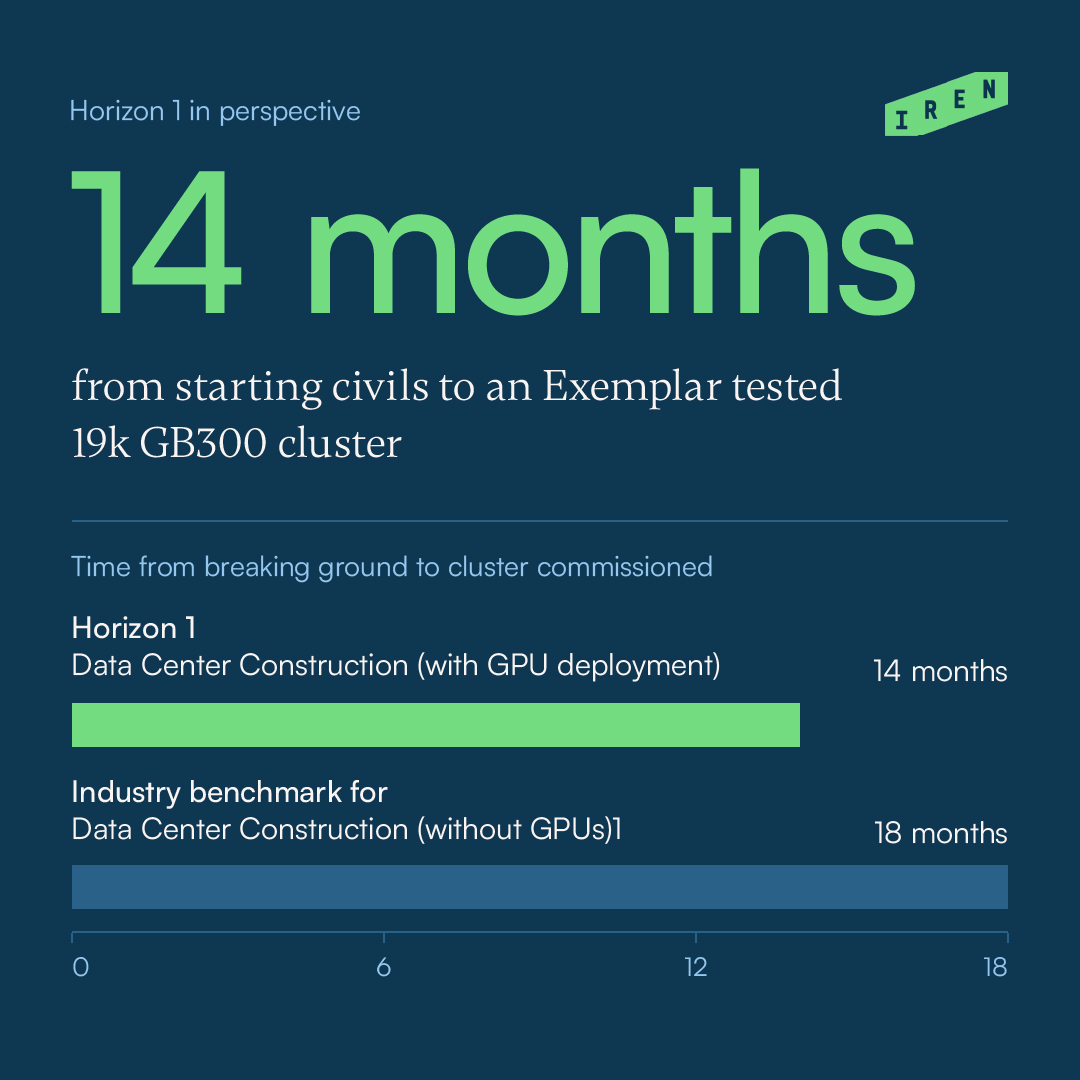
22% faster delivery than the industry benchmark.
Horizon 1, the first of four 50MW (IT) AI Cloud deployments for Microsoft, went from starting civils to an NVIDIA Exemplar Cloud-tested GB300 cluster in 14 months.
IREN's vertical integration delivers end-to-end control across design, engineering and construction, so contracted capacity reaches customers sooner.

Tree retweeted

Reasons not to hike rates at all, let alone 50bps:
1. Oil just crashed 20%
2. CPI is backward-looking
3. Inflation is at the average of the last 40 years
4. Stocks crashed last week
5. It's one print. An ugly print, but one print, and the Fed shouldn't be making decisions based on one data point
6. Inflation was a lot higher in 2021 and there was no urgency then, why, I wonder, does everyone have religion about this all of a sudden?
7. You never hike into a supply shock
8. Everyone knows this is about politics
9. Everyone knows Warsh is strongly disliked
10. And Warsh is a proxy for Trump
11. Copper just broke the uptrend
12. A 50bp move is for emergencies. Nothing here constitutes an emergency.
13. See my previous tweet
Tree retweeted

IREN: I Tripled My Position After The Crash $IREN #markets #business #investing seekingalpha.com/article/496…

Tree retweeted
Don’t Strangle the Supply-Side Recovery
The case for another Federal Reserve rate increase is crumbling. Gasoline prices are falling. Some DRAM spot prices are retreating. Two-year inflation breakevens have dropped 20 basis points in three days to 2.18%. Yet the tightening debate remains trapped in yesterday’s inflation.
That is how policy mistakes happen.
Tariffs and chip shortages raise the price level. They do not automatically create permanently higher inflation. Once those increases enter the comparison base, their contribution to annual inflation fades.
A product that rises from $100 to $110 records ten percent inflation. If it stays at $110 a year later, inflation is zero. No rate increase is needed to make that arithmetic work.
As 2026’s price spikes roll out of the annual comparison in 2027, base effects will pull inflation lower, without another Fed hike.
Now add actual price declines. Gasoline and parts of the memory market are reversing earlier increases. Disinflation is not merely approaching. It is underway.
The bigger story is productivity. Strong productivity growth, falling unit labour costs and a strong jobs market describe an economy expanding its capacity, not simply overheating. Businesses can produce more, support higher wages and contain costs simultaneously.
These are the green shoots Trump’s supply-side agenda is designed to cultivate: stronger investment, greater productive capacity and non-inflationary growth. The test of that agenda is sustained improvement in output and costs, not whether every strong jobs report triggers another inflation scare.
Employment growth is not the enemy of price stability. Weak productivity is. Treating every sign of economic strength as excessive demand risks strangling the supply expansion that makes growth sustainable.
The bond market is delivering its own warning. Two-year breakevens approaching 2% undermine the argument that inflation expectations are becoming unmoored. In fact they’re negative for the year.
The Fed must explain what another hike would fix. Higher borrowing costs cannot repeal tariffs or manufacture chips. They can crush investment just as productive capacity begins delivering results.
Those demanding tighter policy carry the burden of proof.
Do not punish stronger supply for looking like stronger demand.
🤖 Made with AI

Tree retweeted
@RealJimChanos Is this serious? I’m a CRE developer and I can tell you one thing. If i could collect prepayments from future apartment renters that cover 30%+ construction costs of that community, id be in heaven. You talk about it like it’s nothing important whatsoever. Yes it’s a capital intensive business. Yes there are risks. And therefore YES there is immense upside. The paybacks are so quick now and they are designing for future GPU generations in mind. DSX will give their LPS all sorts of upside options in the future. AI is not going away. $IREN

That’s just another form of financing. And the market has finally figured that out. $IREN
Tree retweeted
$IREN CCO Kent Draper just confirmed on the earnings call that the company has secured all the relevant construction permits for SW1 & SW2.
That removes one of the biggest uncertainties hanging over $IREN heading into earnings, especially after the Texas election results raised concerns around an extended freeze on new data center permits.
Honestly, the stock should be up 20% on that news alone.

At this point, I don’t even care that much about a potential delay in $IREN's Horizon deployments with $MSFT
...especially if it really comes down to the cabling topology mess-up that appears to have originated on Microsoft’s side.
We’re likely talking about a few extra weeks here, which isn’t going to break the camel’s back or change the fundamental setup.
The one thing I REALLY care about tonight is a reiteration of the 2027 capacity guidance.
With Texas flipping blue and the incoming governor aiming to continue the temporary pause on new construction permits, I’d really like management to directly or indirectly confirm that $IREN already has every permit it needs to finish Phase 1 of Sweetwater 1 (300 MW, gross).
I’m not asking for much…