

I always follow my followers. Time is the only invaluable asset.
Joined November 2021
- Tweets11.7K
- Following4.7K
- Followers2.5K
- Likes15.4K




“18 years in bitcoin” when bitcoin less than 18 years old. lol.
Good riddance on another individual who didn’t take any accountability for coldcard vulnerabilities.
unavailable
8
23
525
TrypsinThirteen retweeted

It’s kinda crazy that 70-80 year olds are generally seen as unemployable due to physical and mental decline. But we’re allowing them to run our entire country.
TrypsinThirteen retweeted

I'm bullish on #Bitcoin, and I'm bullish on the ecosystem.
That's why I'm bullish on $STX and it has proven to be one of the strongest runners since the market bottomed.
It's up 190% and simply just at the start of a new run.
Why?
@Stacks have just sold out Bond 3 of their #Bitcoin staking, and it's sold out already in the bootstrap phase.
It's significant, as staking your Bitcoin can enable passive income on top of simply holding your Bitcoin, which, inevitably is everyone's dream and stands by the thesis of Bitcoin.
If I'd be able to allocate my assets into Bitcoin, have them stored in self-custody (or a provider that I trust) and I am able to earn 3% or more on a yearly basis, I'd be more than happy.
That's the product that Stacks provides, and that ultimately benefits the underlying token.
For every staked $BTC, it requires $STX to be locked equivalent to 5% of the underlying $BTC value for the entire period of the bond.
This creates a flywheel: the more Bitcoin being staked, the more $STX being locked, the smaller the supply.
Super interesting concept and I think an interesting narrative for the upcoming bull cycle.


TrypsinThirteen retweeted

🚨 Hear me out…
I’m sick of pretending this is a functioning country with a functioning government.
Congress is not “divided.” It’s not “gridlocked.” It’s not “just politics.” It is a criminal class of 535 people who have spent decades selling this country piece by piece while lecturing the rest of us about democracy, values, and the rule of law.
They pass spending bills they don’t read. They pile debt on people who weren’t even born yet. They take money from foreign interests, lobbyists, PACs, and industries they regulate, then act shocked when anyone calls it what it is: influence-peddling.
They protect their own. They investigate their enemies. They never investigate themselves with the same hunger.
The worst part isn’t even the money. It’s the moral rot. A government that can lecture parents, churches, and working people about morality while shielding predators, burying files, redacting names, and treating elite sex-crime networks like a scheduling inconvenience has no moral authority left. If the same evidence, the same flight logs, the same sealed names, and the same “we can’t comment” stonewalling applied to anyone outside their class, those people would already be in prison. For this crowd, it becomes “complicated,” “ongoing,” or “not the right time.”
Foreign interference isn’t some abstract threat they discovered last week. It’s a business model. They take the money, take the trips, take the talking points, then wrap themselves in the flag and tell you anyone who notices is a conspiracy theorist.
They will fight harder to protect their donors and their secrets than they will fight to protect the border, the budget, or the people who actually pay for all of it.
I don’t hate “government” as an idea. I hate this government, the one that treats citizens like a revenue stream, treats accountability like an attack, and treats the most disgusting crimes as a club you only get punished for if you’re not connected.
No more polite language.
No more “both sides” anesthesia. If Congress had a shred of honor left, they would open every sealed file, name every protector, cut the foreign cash pipelines, and submit themselves to the same laws they impose on everyone else. They won’t. That’s the point.
They are not public servants. They are a protected class. And the country is rotting under them.
- B
TrypsinThirteen retweeted

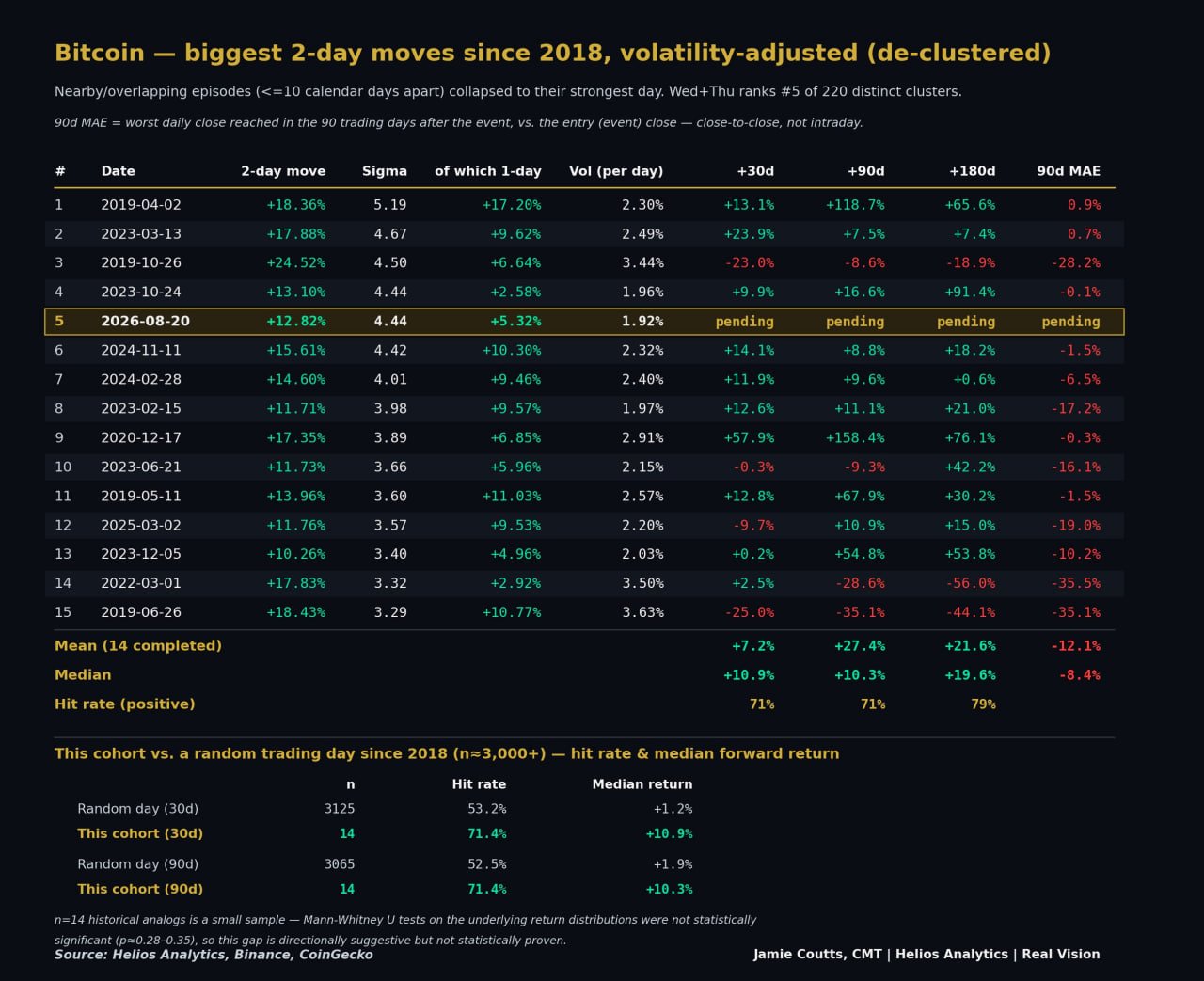
What is the medium- to long-term read on this week's $BTC rally? Firstly, anyone drawing a trend line will notice a break in the downtrend on the daily chart. But what does the magnitude of the move tell us? Once you volatility-adjust the move (Bitcoin has been in a structural volatility downtrend), this week's 2-day move is the fifth-largest since 2018 (a 4.4 sigma move).
It doesn't read as a normal countertrend rally. The 2018 & 2019 lows both had a volatility squeeze, followed by a big impulse move higher. Both were large in % terms but not as big as this one in volatility-adjusted terms.
So a cycle inflection, not a counter-trend bounce, and the forward statistics support that. Bitcoin has been higher >70% of the time 30/90/180 days after moves like this, compared to roughly a coin flip in a random study. Also, the median return is much higher than random. Fourteen prior instances is a small sample, so before the "n=" crowd start arking up, this is probabilistic tilt, not a certainty.
What makes the timing interesting is what's happening in the bond market. Long yields are creeping higher again after the Treasury's move this week.
Bitcoin's role as an early warning for a coming liquidity impulse is now firing. Since Q4 liquidity momentum had rolled over hard and was on the precipice of going negative leading into these 2 Treasury interventions. You simply can't have debt issuance exploding at the rate it is while the liquidity floor under it erodes. But nothing the Treasury has done changes the supply equation. They have affected the dollar and the curve, but it won't be enough.
That said, it doesn't mean Bitcoin will go vertical from here. There is a wall of overhead supply at the low $80k range it needs to work through. And while the liquidity backdrop is serious, maybe the Phony War
teapaw.org/Jamie1Coutts/status/20…
- will continue for a while longer. What's changed is that Bitcoin is starting to do its job again as the earliest tell for where liquidity must be heading because the market finally woke up to reality. And with each chapter of this modern fiat experiment, Bitcoin'sfunction as a non-sovereign hard asset becomes clearer to more and more people.

In the autumn of 1939, war broke out and the world braced for it to be total. Then for six months almost nothing happened. Historians ended up calling it the Phony War, mobilization without any real strike, a pause that got mistaken for calm.
I think we just watched the financial version of that play out, except the run up wasn't quiet at all.
The pressure had actually been building for weeks. 30-year yields grinding up to a 20-year high, real yields creeping higher in a way that felt less like normal supply digestion and more like the market starting to price in disorder. A genuine test of whether the government can keep issuing debt at this pace without something breaking. First, the Treasury blinked, ostensibly to support the $JPY. Then, overnight, the Treasury doubled the size and frequency of its long-bond buyback operations.
On the surface it looks like a technical liquidity fix. But what it actually is, is the government increasingly stepping in to buy its own debt because the market was telling it pretty loudly that private demand alone couldn't keep clearing it. While it is the new paradigm, by 'normal' conventions its not routine. That's a response to real strain, and in its own way an admission that the fight over how this debt gets financed has already started . Hence why they indicated the buybacks could be increased.
Here's the part that matters most though. It's small. A few tens of billions against a $739 billion quarterly borrowing need. It doesn't shrink the debt stock or change where it's heading. What it does is buy some time and calm some nerves. The market read it as resolution; yields fell, debasement assets; gold and Bitcoin (especially) bid. But putting a band-aid on a wound that's still bleeding doesn't mean the wound is gone. It just tells you the wound is real and acknowledged.
Combined US federal and nonfinancial corporate debt is now near $48 trillion, up from roughly $36.4 trillion five years ago. That's not a chart that quietly resolves itself. Somebody has to finance it, and increasingly it looks like the buyback desk and eventually the Fed will be doing more of that work than the bond market itself.
Markets relax when pressure eases, even temporarily. This doesn't feel like the end of that pressure to me, though, more like the months before it comes back in force. And history's a decent guide here. Don't wait for the next leg of stress to go looking for a store of value; position for it during the quiet instead. The market is telling us with the move in bitcoin:native and $GLD overnight.
We haven't seen the big artillery yet. But the market just told us the war's already started.


TrypsinThirteen retweeted

Desse rank, Trezor, Foundation e BitBox foram as fabricantes com melhor pontuação. Sendo que a Trezor Safe 5 configura como a melhor custo-benefício atualmente.
Entretanto, outras carteiras também possuem alto níveis de segurança, você pode conferir a lista completa aqui.
Na semana passada, enviamos um relatório completo de autocustódia para membros da @formadores_edu, abordando como aumentar a segurança do seu bitcoin, melhores práticas e configurações.
Se você quiser receber o material completo, preencha o formulário abaixo que meu time entrará em contato:
forms.formadoresdemercado.co…

Bitcoin, with its fixed supply and independence from political discretion, is the purest expression of that thesis. Yet it remains curiously subdued.

Bitcoin: priced by politics, not scarcity. This can’t last forever.
At a time when advanced economies are running structurally large deficits and public debt trajectories are drifting further from sustainability, the case for scarce, non-sovereign stores of value should be strengthening.
Bitcoin, with its fixed supply and independence from political discretion, is the purest expression of that thesis. Yet it remains curiously subdued.
This is not because the macroeconomic argument has weakened. If anything, it has become more difficult to ignore. Currency debasement is no longer theoretical, it is embedded in fiscal arithmetic. What has changed is the willingness of institutional capital to express that view.
The constraint is political. In the United States, an increasingly adversarial regulatory climate, personified by Senator Elizabeth Warren’s campaign against the crypto industry, has introduced a new kind of risk premium. Large asset managers are not questioning Bitcoin’s design, they are questioning the cost of being seen to endorse it.
This distinction matters. Bitcoin does not require legislative approval to function. Its monetary properties are not contingent on the passage of the Clarity Act or any other regulatory framework. The network will continue to operate exactly as designed, indifferent to Washington’s posture.
Markets, however, are not indifferent. The marginal buyer today is a regulated institution, and regulated institutions are acutely sensitive to political signalling. As a result, price discovery is being shaped less by macroeconomic reality than by regulatory ambiguity.
The prevailing narrative, that Bitcoin’s next advance depends on the end of a “war on innovation,” misstates the issue. Innovation is not what is at stake.
Capital formation is. Without clear rules, capital hesitates, even when the underlying thesis is intact. The Clarity act has nothing to do with Bitcoin.
The deeper implication is uncomfortable. Bitcoin’s muted price action is not a rejection of the debasement argument, it is evidence that markets are discounting political risk more heavily than monetary risk.
That may prove to be a miscalculation.
Bitcoin does not need regulatory clarity to endure. The United States needs it to compete. In its absence, the system drifts into a peculiar equilibrium, one in which investors privately acknowledge fiscal realities while publicly pricing as though they do not.
As M2 expands and sovereign debt compounds, an asset defined by perfect scarcity sits sidelined, not by flawed design, but by institutional timidity, waiting for markets to accept that neither political intimidation nor legislative inertia can suspend arithmetic indefinitely.
The insanity that Team Warren is holding US industrial policy hostage is one thing. The lack of independent research by Wall St is another.

5
40
313

TrypsinThirteen retweeted

BREAKING: 🇺🇸 FINAL #BITCOIN AND CRYPTO CLARITY ACT TEXT WILL BE RELEASED TONIGHT – POLITICO CONFIRMS
PRESIDENT TRUMP WILL PERSONALLY APPROVE THE FINAL TEXT
THE NEGOTIATIONS ARE OVER. WE ARE AT THE FINISH LINE.
A VOTE WILL HAPPEN SOON
HERE WE GO 🚀🚀


TrypsinThirteen retweeted

대한한국 월드컵 32강 진출 경우의 수!!
아래 9개 경우의 수 중 "3개" 적중 시 대한민국 32강 진출이라고 하네요!
D조 : 호주 대 파라과이에서 한쪽이 승리하기 (단 파라과이 한점차 승리 시 다득점 봐야함)
E조 : 독일이 에콰도르한테 지지않기
F조 : 일본이 스웨덴 두점차 이상으로 이기기
G조 : 이집트가 이란 이기기
H조 : 스페인이 우루과이 이기기
I조 : 세네갈이 이라크에 두점차 이상 승리하지 않기
J조 : 오스트리아 대 알제리에서 한쪽이 이기기 (단 알제리가 이길 시 두점차 이상 승리 필요)
K조 : 우즈벡이 콩고 이기기
L조 : 가나가 크로아티아 이기기

Excited to see what all the MSTR bears say this week.

Strategy has increased its USD Reserve by $300 million to $1.4 billion and plans to continue replenishing it to support the credit quality of its Digital Credit securities. We also acquired 520 BTC for $35 million, increasing our $BTC Reserve to ₿847,363. $MSTR $STRC strategy.com/press/strategy-…

8
18
233


TrypsinThirteen retweeted

$MSTR has $61,719M BTC.
Selling $30M is okay.
I am ready to sell some puts if the market freaks out.