

Christianity must return to its Origen.
Joined November 2023
- Tweets70.6K
- Following1.4K
- Followers2.8K
- Likes32.2K





Pinned Tweet
I’ll undoubtedly be on a John Behr kick until such time as I finish his corpus. For the present, you’ll have to bear with my fanboying. In this case, a superb insight about the perspective of Ignatius of Antioch, taken from his 2024 article, “Who Guards the Guardians?”

Roko’s Basilisk, if it converts to Catholicism.


Tfw you tell people you game to blow off steam, but you’re actually just looking for more twitter memes in the end.


Exceedingly predictable series of events.
-Webbon advocates a simplistic form of traducianism not far off Tertullian and even the model Augustine entertained without decision
-Thomists conclude all traducianism is heresy as such and that only creationism is orthodox

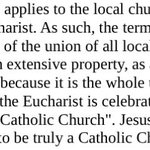
Catholicity was not originally “universality”, but rather the plenitude of the Church encountered in its celebration of the Eucharist.


Nick Land was apparently a big fan of Fr. Ripperger.

Noooo ... lifesitenews.com/news/breaki…

Untold Fortune retweeted

Solaris (1972), dir. Andrei Tarkovsky.
"To know is not enough. We must know why."

Origen the “pacifist”, indeed. Save for the fact he believes *physical* force is but a shadow of the type of actual force the Gospel expects us to practice.


“No jurisdiction. Zero.”

I have to tell you, I've been looking at the situation, very strongly, and what I'm seeing - to be frank, everyone is seeing it - is that the Bishop of Rome, he's got no power here. No jurisdiction. Zero. It's simple, but no one wants to talk about it. They say he's in charge, but I say, 'Excuse me, not in this realm.' We have are own, beautiful thing going on here.
I've been talking to the best people, real scholars, top theologians, very smart, and we're seeing that in the entire first millenium, the first thousand years, which were very successful, very productive, some say the most productive thousand years there ever were, the nature of the episcopal polity. Let me tell you it's a very fair system, a conciliar system, you have the bishops, they talk, they get things done. It's not about one guy calling all the shots from some big palace. It's about the local, it's about the autocephalous, a big word, but I can spell it, a very good word, believe me, for the local way getting of gettings things done.
They're saying there was a pentarchy in the canons of the council of Nicea. The original canons, actually read them. Five great cities, five great seats. Very balanced, very stable, spread out evenly, not like later. We're seeing that this system was able to make the very best decisions, and going back to this classic polity, it's going to be a beautiful thing. No one does episcopal polity better than we're going to do it, believe me. Some are saying I'm the new Constantine.
When you *really* think about it, Hildegard of Bingen would be the single most pro AI saint in history.

From the Greek word mēkhanē, a machine is, in contrast to a techne, a way of 'tricking' nature by geometrically redirecting the flow of natural force. In redirecting natural force, it concentrates, repeats, and automates the power of the tool that effects a change. Although the idea of mechanism had formerly been subordinated to Life and living organisms in the Porphyrean Scala Naturae, and the refusal to acknowledge machines as eternal ideas is as old as Xenocrates, the Incarnation empties divinity from its unmixed purity and elevates matter to partake sacramentally of the glory of God.