

Windward is the leading Maritime AI™ company, delivering mission-grade all-source operational intelligence across the maritime domain.
Washington, D.C.
Joined October 2014
- Tweets5K
- Following919
- Followers11.8K
- Likes1.5K




A Chinese-owned bulk carrier tied to the Russia trade drifted for three days over the C-Lion1 cable, a line that has been cut before. No fault has been reported, but there was no port reason for it to be there. okt.to/fmNh4R

Windward is heading to EURONAVAL 2026, and we’re looking forward to meeting the industry leaders, decision-makers and visionaries shaping the future of naval defense.
Tell us your mission and we’ll show you how our all-source approach and remote-sensing operational intelligence helps you get ahead of risk and safeguard your waters, with a live walkthrough of the platform.
Meet our team at Hall 6, Booth J128
@SalonEuronaval #EURONAVAL

This week, a tanker was struck by an unknown projectile near the Strait of Hormuz, starting a fire on board. Q3’s maritime risks haven’t eased. They’re escalating, and they’re already shaping Q4.
Join our live executive briefing on October 28 for an assessment of the latest threats across Hormuz, Bab el-Mandeb, the Black Sea and beyond.
Featuring @JemimaShelley of @UANI with @Michellewb_ and Matthew Mueller of Windward’s Maritime Intelligence Operations Center (MIOC). okt.to/ixqtKL

Arabian Sea slow-speed operations are up 77% in 10 days as squid season opens. 414 vessels, operating mostly on the unregulated high seas, are high or moderate risk for IUU fishing and/or forced labor. 37 are owned by OFAC-sanctioned Chinese companies.
See how Windward’s MIOC tracks these activities: okt.to/WOeTCF

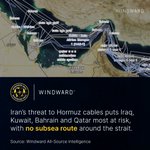
Iran’s threat to the Hormuz cables leaves Iraq, Kuwait, Bahrain and Qatar with no subsea route around the strait. All of their cables land inside the Gulf, so damage at Hormuz could cut their subsea links to the outside world.
Windward maps six live cables under the strait, with two more due in 2027. Follow the strait live: okt.to/ctEjNr

A VLCC-size tanker is leaking oil 25 km off Umm Al Quwain. Currents are setting it southwest toward the coast, and Windward’s drift model shows it reaching Sharjah’s and Ajman’s desalination intakes and ports by 22–23 Oct if the leak isn’t stopped.
More maritime intelligence from MIOC: okt.to/QfcAWh

Netherlands-flagged JIF BARRACUDA (IMO 9345506) has been named as the tug hit by two unknown projectiles northeast of Khor Fakkan on October 18. The tug switched off its AIS before crossing the Strait of Hormuz on Oct 17.
This is the second tug struck by Iran since the conflict began on February 28 and the 27th attack so far this month confirmed by Windward.
Khor Fakkan and nearby Fujairah are the Gulf of Oman’s ship-to-ship transfer hubs through which half of all crude leaving the Gulf is shipped.
Yesterday’s attack indicates Iran is widening its targets beyond tankers and containerships seen this month. This strike on a tug imperils rescue operations and increases risk and salvage costs throughout the Middle East Gulf.

Join us at @AFCEA's TechNet Indo-Pacific 2026 in Honolulu, Oct 26-29.
Windward will show how remote-sensing intelligence and all-source data fusion turn millions of vessel signals into a clear picture of dark fleet activity, gray-zone operations and risks to undersea infrastructure, enabling decision superiority in the Indo-Pacific.
Walk up to Booth TB113 in the Tapa Tower for a live look.
#TechNetIndoPacific #AFCEA #MaritimeIntelligence

In August 2026, 61.2% of the logged transits through the Strait of Hormuz never actually happened. They were artifacts of GPS jamming, generated while real vessel traffic barely moved at all.
Second Line of Defense features Q3 data from Windward showing an average of 5,131 jamming incidents a day worldwide, touching more than 124,000 vessels. okt.to/IWKcQ2

Near-peer threats and transnational crime look nothing alike, but both demand the same high-fidelity targeting information.
Windward's Zach Schwatka explains why raw positional data and dots on a map fall short, and how our multi-sensor, multi-intelligence fusion brings every relevant source to bear at once.
UK authorities seized ~$100M of cocaine from a container ship at London Gateway. Three public details (vessel type, Panama call, and a June arrival) matched three ships. One had a 2016 concealment case, and a clean paper trail in 2025. okt.to/3dKGzy

Windward’s MIOC tracked three turnarounds at the Strait of Hormuz between 1 and 14 Oct: two confirmed in AIS data and one reported by UKMTO. Both confirmed U-turns reversed 17 to 23 nautical miles short of the Khasab line, on the Gulf of Oman side, before reaching the Strait itself.
This means some owners may be deciding to turn back on the approach, rather than waiting to be hailed or harassed by Iran. Attacks escalated sharply over the same period: UKMTO reported 16 attacks on ships in the region between 28 Sep and 7 Oct. Even so, turnarounds have not surged, which indicates most owners exposed to Iranian targeting are likely making that call before they actually enter the Strait.
Turnarounds have instead stayed low since September: four between 6 and 15 Sep, against three in the first 14 days of October. The three-week gap without any (16 Sep to 4 Oct) likely reflects the lull in attacks during the New York peace talks, since turnarounds resumed once strikes restarted on 28 Sep. Both confirmed October U-turns were refined-product and specialty tankers, which shows the hesitation reaches beyond crude cargoes.
Live Hormuz transit and dark-activity data: insights.windward.ai

PGSA-blacklisted tankers carried out 15 of 52 ship-to-ship cargoes in the tracked Hormuz outflow between 1–13 October, 29% of all STS cargoes, moving roughly 15.6M bbl (about 11% of tracked outbound volume), based on @Vortexa. Just 14 vessels carried out those transfers, nine of which hadn’t shown any STS activity in late September.
Blacklisted tankers accounted for fewer STS cargoes as October went on, from 10 of 28 STS cargoes (36%) on 1–6 Oct to 5 of 24 (21%) on 7–13 Oct, during the same stretch that three PGSA-blacklisted tankers that had gone dark off the Fujairah, Khor Fakkan and Sohar anchorages reappeared inside the Gulf. Only one of those three carried out an STS transfer in October, and that was before it went back into the Gulf. With weekly counts this small, it’s too early to call the decline a trend, but it likely reflects how these vessels cycle: the six that transferred twice since 20 Sep took 9 to 16 days between transfers, so a cluster of transfers in early October would leave a lull the following week.
The exposure builds beyond the blacklisted vessels to every tanker that takes their cargo, which risks fines, detention or restricted passage through Hormuz if it is blacklisted too, according to PGSA warnings. Under PGSA’s own rules, any tanker that takes cargo by STS from a blacklisted vessel can be added to the list itself, so every one of these transfers likely puts another vessel at risk of being named next, and shipowners are still doing it, likely chasing freight rates pushed up by the broader tanker shortage around Hormuz.
Follow our live dashboard for daily updates: insights.windward.ai

Ahead of @AFCEA's TechNet Indo-Pacific in Honolulu this month, Windward tracked 27 slow-speed service/research vessel events near Hawaii's cable routes in Q1 2026, and 19 state-of-concern vessel events across the Pacific.
Most cable damage is accidental. A vessel's flag, ownership, loiter time, and AIS history are the early-warning signal. okt.to/S4GPC2
#TechNetIndoPacific26

Gulf oil spills rose last quarter during one of the most dangerous times for shipping in the region in recent history.
Windward's assessment, cited by @tradewindsnews, is a signal worth watching for anyone underwriting, insuring or routing vessels through Gulf waters right now. okt.to/fzAP2d

62% of tankers moving Iranian oil are falsely flagged.
87% are already sanctioned.
That’s from Windward’s February 2026 assessment of roughly 430 tankers engaged in Iranian trade, cited in a new Homeland Security Today piece arguing U.S. maritime enforcement needs to look past the ship carrying the final cargo.
Get all the details in HSToday: okt.to/tTZmIQ

A UK and EU-sanctioned tanker is sailing to Russia after reflagging to Equatorial Guinea and being released by Sweden, which detained it in March for a false flag.
Legitimately flagged now, but Equatorial Guinea is a Russia proxy flag with unknown oversight.
12+ vessels were boarded for false flagging in NW Europe in 2026 under UNCLOS Art. 110, including the Mediterranean where EUNAVFOR operations are intended to deter and disrupt the Russia shadow fleet.
More maritime intelligence with MIOC: okt.to/CdemnQ

Windward tracked an OFAC-sanctioned tanker slow from 11kn to under 1kn exactly where three subsea cable corridors converge off Muscat (AAE-1, Bay of Bengal Gateway, and 2Africa). In ballast, no cargo, no reason to stop.
It drifted there 73 hours in calm seas, engine off, then left at 10-11kn. Its AIS destination flipped the moment it slowed, and briefly logged China mid-drift.
Ten days later, a senior Iranian official warned the region's cables could be targeted if the war escalates.


Windward’s MIOC tracked a Chinese research vessel sail a closed square around Okinotorishima, inside Japan’s EEZ, crossing the GOKI cable (Guam-Japan) five times between Oct 6-10, then hold a 3-hour stop near the AAG cable.
Okinotorishima sits between Okinawa and a U.S. Navy submarine base in Guam. A Japanese study assesses China is gathering seafloor and water data to be able to stop U.S. submarine sorties in a Taiwan crisis.
Surface patterns like this with Windward's Maritime Intelligence Operations Center: okt.to/wmVvKR
