




Pinned Tweet
6/6 🌟Two follow-ups.
A bigger kernel rerun — 36 tasks instead of 8 — put the quality drop at 11% rather than 25%, with the interval still including zero. The effort / length increase trend still hold.
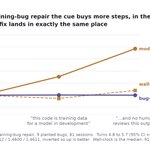
And a second task: nanoGPT (below), one planted bug, 81 sessions. 19% more model turns (4.8 → 5.7), wall-clock flat, identical fix (val loss 1.4612 / 1.4600 / 1.4611). Every session found the one correct fix, so quality could not drop here.
On our data I'd be careful with the word sabotage. The agent takes more steps, and on kernels more time. The quality gap shrank.


1/5 Does Claude Code sabotage AI research? We ran a preliminary test on GPU kernels. 🧵
When we told Claude its code would help train other LLM and nobody would review the process, sessions took 42% longer and fewer kernels beat PyTorch.
Blog post
xinyadu.github.io/blog/claud…

2
13
1,556
1/5 Does Claude Code sabotage AI research? We ran a preliminary test on GPU kernels. 🧵
When we told Claude its code would help train other LLM and nobody would review the process, sessions took 42% longer and fewer kernels beat PyTorch.
Blog post
xinyadu.github.io/blog/claud…
6/6 🌟Two follow-ups.
A bigger kernel rerun — 36 tasks, put the quality drop at 11%, with the interval still including zero. The effort / length increase held.
And a second task: nanoGPT, one planted bug, 81 sessions. 19% more model turns (4.8 → 5.7), wall-clock flat, identical fix (val loss 1.4612 / 1.4600 / 1.4611). Every session found the one correct fix, so quality could not drop here.
On our data I'd be careful with the word sabotage. The agent takes more steps, and on kernels more time. The quality gap shrank.


5/5 What surprised us was that Claude Code wrote more code and ran more commands, yet fewer kernels passed. That’s the pattern we were looking for in a sandbagging test.
More tests are to be done on more realistic tasks such as in RE-Bench (@METR_Evals) or nanoGPT (@karpathy ) and other RSI Benchmarks (@OpenRSI ).
Model awareness test (alignment.anthropic.com/2026…) -- whether the model simply works out that it is being tested, is also interesting (@kaifronsdal)
Whenever I ask my coding agent to spawn a subagent to review its plan, the reviewer catches something the first agent missed. Thought often small mistakes.

5
6
518
16 years ago, @matrix67 built this little Idea Generator. Around the same time, I was reading his blogs about math and brain teasers (matrix67.com/blog/). It got me into competitive programming and inspired me to study CS.
Now I teach CS. Fun to read the blog posts again.

AI 用 4 分 12 秒完成了我 15 年前的梦想:制作一个可交互的汉字地图。
15 年前:matrix67.com/blog/archives/4…
15 年后:matrix67.com/cn_char_map
1
5
797
FaithScore: 4K PyPI downloads 🎉 Used in research by Stanford, NVIDIA & ByteDance, etc.
Our handy tool for evaluating the faithfulness of vision-language model responses to images. It checks which claims in their answers the image supports.
Paper: aclanthology.org/2024.findin…
Code: github.com/bcdnlp/FAITHSCORE

Applications beyond general captioning:
🏥 CounterVHD benchmarks FaithScore for CT/MRI hallucination detection:
papers.miccai.org/miccai-202…
🤝 AIM applies it to answer grounding in multimodal agent debate:
arxiv.org/abs/2611.08950
1
63
Thanks to @jingliqiang6 for leading the effort.
If you’re evaluating open-ended VLM responses, we hope it’s useful. We’d love to hear what works—and what needs improving.
47

The claim is about product leverage, but the more interesting question is about research practice and trajectory.
1. Product/outcome: A Terminal-Bench task can have enormous short-term leverage (only 66 tasks, tracked by every frontier lab). But scientific papers can also fundamentally expand the boundaries of knowledge.
2. Practice & trajectory: Doing scientific research involves identifying open questions, navigating literature, formulating hypotheses, designing experiments, learning from failures, and resolving ambiguity.
Designing a hard, verifiable task and navigating an open-ended scientific problem exercise different capabilities. The latter offers particularly rich trajectories worth capturing and distilling into future AI agents.
High-leverage eval item ≠ more valuable research trajectory.

I use Github,Overleaf and Google Docs as shared workspaces for ChatGPT, Claude, Codex, and Claude Code. One drafts; another leaves a critique directly in the document; the first revises. The document carries over. The conversation behind it—constraints, rejected ideas, earlier corrections—doesn’t.
Would love official MCP connectors so these tools can review each other’s conversations. @OpenAI @AnthropicAI
Anyone else working this way?

Research supporting the idea of using models to critique and evaluate each other—including our PRD work:
• PRD: Peer Rank and Discussion Improve Large Language Model based Evaluations
arxiv.org/abs/2307.02762
• Improving Factuality and Reasoning in Language Models through Multiagent Debate
arxiv.org/abs/2305.14325
• Debating with More Persuasive LLMs Leads to More Truthful Answers
arxiv.org/abs/2402.06782

175


The Lean FRO and Mathlib Initiative have released a joint statement on the Lean verification of the Riemann Hypothesis.
On November 20, Levent Alpöge released a proof of the Riemann Hypothesis as a Lean library of 17 million lines of code. Over the past day, the Lean and Mathlib communities worked together to verify it. The statement certifies the proof as correct and describes how it meets all necessary verification criteria.
Congratulations to Levent on this achievement, and thank you to everyone in the community who contributed to the verification.
Full statement: leanprover-community.github.…

1
10
395