

founder @3janexyz. leverage is a God-given right
Joined January 2021
- Tweets1.4K
- Following793
- Followers4.9K
- Likes8K


DeFi has just crossed the chasm from a fully reserved system to a fractionally reserved system.
3Jane now enables anyone to generate yield on promises to supply capital later. Capital can remain outside DeFi’s contracts and still back those promises.
The promise can exceed the liquidity held against it, letting anyone run fractional reserves and effectively become their own shadow bank.
With this update, promisors can tap the much larger market for senior secured debt through @Morpho to fund capital calls, commit up to 6.25x their onchain net worth, and earn yield on the full commitment.
@ImperiumPaper is right that DeFi is speedrunning financial history.
A balance sheet can monetize two things: (a) capital and (b) the capacity to commit capital.
DeFi built its core markets around the former. Capital enters a smart contract, then earns yield. We accepted this mental model so completely that we named our measure of scale TVL.
LCC makes the latter a market through unfunded capital commitments. 3Jane buys future access to capital while its owners keep it productive elsewhere.
Crypto is a ~$2.8T asset class, while DeFi’s contracts hold ~$90B. A market for promises lets DeFi’s funding capacity grow beyond those deposits. 3Jane draws that capital into USD3 as calls are met. At 7.5% margin, each dollar posted supports a $13.33 commitment.
U.S. banks already sell this capacity at scale, carrying ~$11.3T of unused loan commitments. They sell access to capital before they need to deliver the cash.
LCC engineers TradFi’s most powerful liquidity mechanism into self-enforcing, internet-native code. It crowdsources balance-sheet capacity at global scale, letting anyone earn yield on their unfunded capital.
I encourage crypto market participants to revisit their priors.
Bubbles are, of course, mathematically impossible in this new paradigm.

U.S. banks hold $11T+ in undrawn commitments. Promise looping is live on LCC, bringing fractional reserves to capital commitments in crypto
Earn promise fees on up to 6.25x your net worth: +7.8% APY on top of your DeFi assets deployed elsewhere, funded via @Morpho debt if called


We discovered a sophisticated recording device that was hidden inside one of our offices. We used our models to understand the device and where it had come from, identifying that a specific employee had planted it a few days earlier. We referred the matter to the FBI, and we’re grateful to the agents and prosecutors who moved quickly to make an arrest. The FBI’s investigation is ongoing and we will continue to support their work.
At this time, we have no indications of this individual inappropriately accessing or exfiltrating model weights, source code, or customer data. The employee was terminated.
We take protecting our technology, data, and people seriously, and as a matter of national importance. Our security program is designed to protect against a wide range of threat actors, from insider risks to cybercriminals to nation states, and this case is an example of how AI can help address these sophisticated security threats.

I've long believed that for the cryptoeconomy to surpass the traditional financial system, it has to find an elegant, scalable answer to undercollateralization, starting with promises of capital
Traditional finance runs on promises. Banks extend credit lines that are rarely fully drawn, funds call committed capital as deals close, insurers pay out only when claims arrive
This is one of the first steps in that direction by turning credit scores into an internet-native first-class citizen that can be collateralized alongside stablecoins, BTC, and ETH, allowing us to scale promised capital in a sustainable way
If successful, we'll have created a superior mechanism for capital formation that funds capital calls, insurance, guarantees and other commitments across the frontier economy
Introducing credit scores on @3janexyz x @cred_protocol
Reputation can now be collateralized to generate higher yield within DeFi, permissionlessly and at scale, starting with undercollateralized promises on LCC
Please do not listen to this *at all*
The industry collectively continues to confuse stagnation with exhaustion of the design space. The fallacy goes something like this:
An exhausted field would stagnate; this field is stagnating; therefore it’s exhausted
This mindset is poisonous for builders. It slowly convinces people that there is nothing left to discover
When people stop believing there is anything left to discover, they assume all hard problems have already been solved, which destroys the ambition required to create breakthrough innovations
So, everybody focuses on incrementalism & horizontal progress
DeFi’s true potential is yours to discover

Crypto teenage years are over. I hope you enjoyed it (and made decent bank on it).
The time when the industry discovered itself, tried all the crazy stuff, shunned traditional standards in favour of more innovative, never-before-tried strategies has come to an end.
I personally enjoyed it very much, and will be forever grateful for living through an era where simply being online and with an active address was enough reason for people to gift away sometimes 100s of thousands (Big shoutout to Tornado Cash and Uniswap).
Crypto is no longer about having fun, good vibes and posting on Twitter. It's about hitting KPIs and creating shareholder value. It's about building a valuable brand and deep corporate relations that grow the bottom line.
Historically the labour market in crypto has been pretty fucked, being 'crypto native' was a hard requirement, in short supply with an unreliable workforce (opp cost was messing around in the trenches), nowadays the crypto edge has eroded substantially, the crypto career risk has subsided meaningfully and the domain specific knowledge has shifted from deeply niche to traditional skills (tech and finance) which allows for crypto projects to tap into a broader workforce.
Regardless of the money, working in a high stakes environment and being respected by your contemporary peers is the raison d'être for most of us here. I don't have enough fingers to count how many of my peers 'made it', stayed crypto native and now wander through life, outdated and desperately resting on former glories from their beach mansion, where they escaped to avoid taxes knowing that they'll never again make the kind of money they made in the past.
It's never about where you are now, it's where you want to be in a couple of moves. The crypto shift has been obvious and glacially slow, however caught a lot of people blindsided who refused to 'grow up' with the industry and are now the 40-year-old skater who just won't let go.
All this to say that I'm once again grabbing my buttoned shirts, getting on 30-hour plane ride, 11 timezones away, and going to be Singapore for Token2049.
Looking to grow KPIs together so hit me up if you have potential business with Spark.


AI agents fundamentally threaten the fractional reserve banking model by eliminating the behavioral inefficiencies that banks historically monetized
Banking as a construct is premised on a heterogeneity in human activity over time, allowing banks to successfully monetize liquidity transformation whilst modelling expected demand deposit withdrawals
This is largely due to consumer (1) information asymmetry (2) variation in financial literacy (3) variation in activation energy
AI agents compress all 3 towards zero and can replicate for free across all +300m U.S. consumers
I've maintained that this is one of the strongest bull cases for 100x growth in DeFi TVL over a 10 year timeline

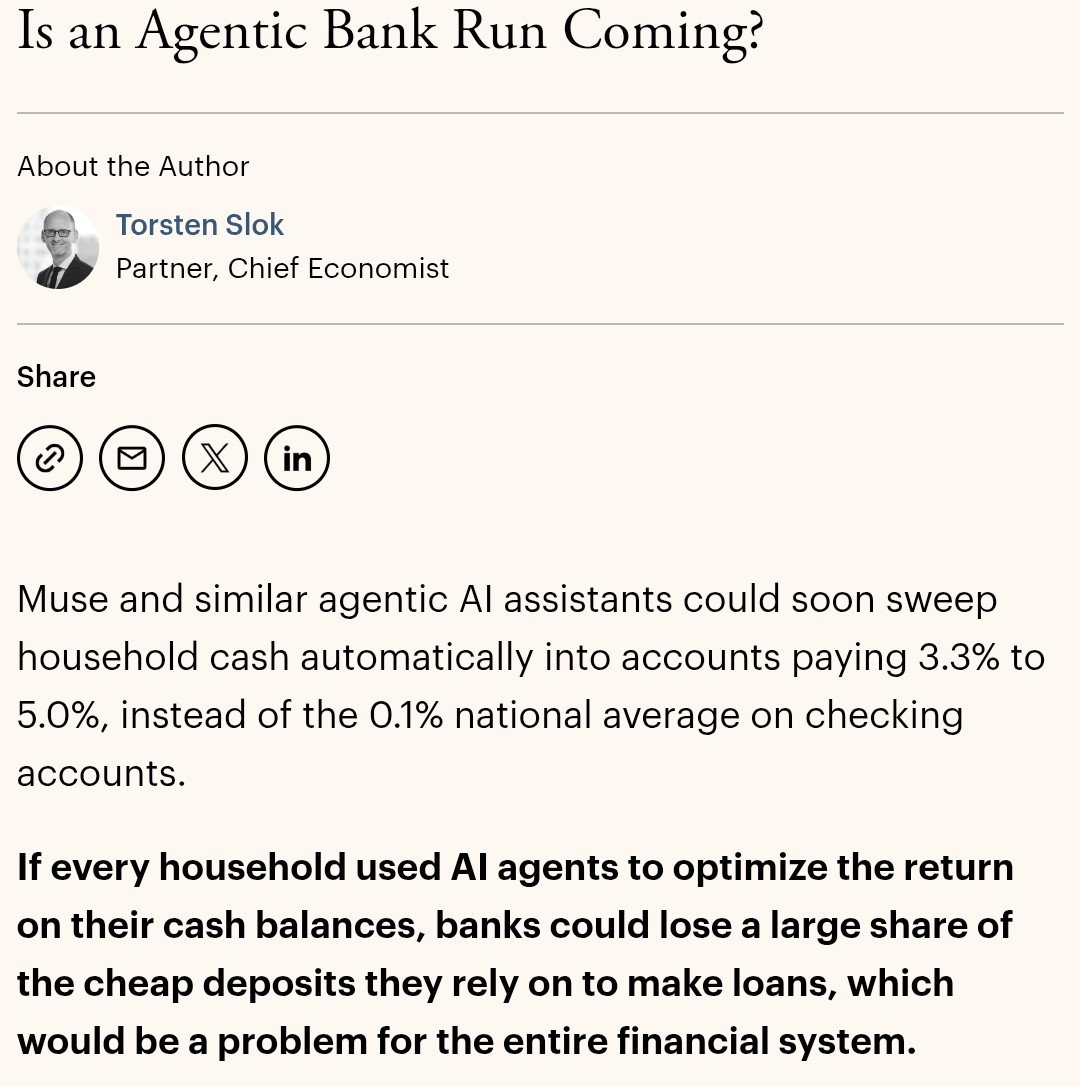
The chief economist at Apollo is warning that mass adoption of AI agents could trigger a bank run as they optimize user investments. Gary Gensler spent his last few years as SEC chair warning that the exact same problem will hit the markets: the pursuit of algorithmic perfection at scale destroys system stability. Personal-finance agents making simultaneous optimal decisions could potentially cause a massive flash crash.
Agent acausal coordination, with no messages passed between them, will show up in a lot of places. Markets will get the big headlines, but huge numbers of clever advisors making very similar choices will impact all of human society. Capability gains make this worse, not better. The smarter the agents, the narrower the optimal path; and knowing that other agents see that exact same path lets them move together without talking to each other. Agents do not need to collude to act in unison. Thus, they break no human laws by doing so. Human laws were not written for this. They were not written for a lot of what is coming, and it is about to start happening very fast.

3Jane will be at DealCatalyst Asset-Backed Finance in New York next week
@_yakovsky & Head of Credit @obadje_ will be there to evangelize cryptonative securitizations
Hit is up if you are around
Onchain native is an R&D bet on familiar financial functions, reinvented in an unfamiliar way for an unfamiliar future with a convex payoff at the end
What is being built today will eventually form the bedrock of a programmable financial system for the new class of internet-native actors. The time horizon to get to that point is a commercial question for startups in the short-term that has no bearing on its inevitability
Restaking is a surety bond. Insurance collects >$5T in premiums yearly for that kind of promise
LSTs are a tradable claim on a pool of yield-bearing assets, issued by a contract instead of a trust. Agency MBS are a $9T market
CDPs are banks with the exclusive function of issuing liabilities against an asset. Banks hold >$100T of assets against the liabilities they issue
Each reinvents its industry in an unapologetically cowboy yet structurally superior way by an order of magnitude. Some of what comes out of this will have no precedent at all. Fractional reserve banking is simply lending, pooling, and a demand option yet nobody put them together for a thousand years.
All of it strikes at the heart of how finance itself operates. Otherwise it could not be structurally superior. Excruciating activation energy for the most highly regulated industry on the planet. This is precisely its weakness when attempting to reason about it on yearly timelines
It took stablecoins a decade to go from a dollar-quote pair on Bitfinex to >$100B in supply and the settlement rail for >$10B in tradfi assets


There’s a growing view that crypto is now in its “1→100” phase. Some go so far as to say it’s no longer crypto, just finance- meant as a compliment. That may be true in lots of pockets, but it is a profoundly unimaginative view that I happen to take personally
The vast majority of novel financial structures DeFi enables for human financial coordination have yet to be invented. And that is before considering a post-AGI economy, where agents can coordinate capital and risk in real-time across N parties, making entirely new classes of financial structures viable
It's difficult to overstate how much DeFi innovation has not only stagnated but regressed over the past 5 years due to talent exodus rather than an exhaustion of the design space
Financial innovation is about to undergo a cambrian explosion, driven by superintelligence and far less constrained by the number of people working on it. @saylor using chatgpt to create $STRC is the first example of AI hallucinating a novel financial structure into existence which now operates at >$1B scale, and it’s only the beginning
The frontier has not disappeared
13/ This effectively turns a 'promise' into a standardized financial object that can be syndicated globally and permissionlessly, and subsequently cleared programmatically