

VMMC & Safdarjung Hospital, New Delhi, IN @SJHDELHI
Joined September 2020
- Tweets393
- Following1.7K
- Followers297
- Likes12.1K




Abhishek Yadav retweeted

I was working on my upcoming talk on 𝗙𝘂𝗻𝗰𝘁𝗶𝗼𝗻𝗮𝗹 𝗰𝘂𝗿𝗲 𝗶𝗻 𝗺𝘆𝗲𝗹𝗼𝗺𝗮, thinking how much this conversation has changed.
For years, we said “treatable, but not curable.” Now we are discussing what cure should actually mean.
Bispecific antibodies have changed our expectations. In MajesTEC-3, 36-month PFS was 83.4% with teclistamab–daratumumab versus 29.7% with DPd/DVd in relapsed myeloma. Numbers that make you pause while preparing a slide.
And inevitably, I kept returning to BMT. Where will "autologous transplant" fit as these therapies move earlier? 🔎
➡️ For eligible patients in India, I still see ASCT as one of our strongest consolidation options: effective, established and comparatively affordable. Its role remains important while sequencing evolves.
The IMS–IMWG cure framework presented at IMS 2026 requires:
1️⃣ Complete remission for ≥5 years off all anti-myeloma therapy.
2️⃣ Sustained marrow MRD negativity at 10⁻⁶ by NGS or next-generation flow, with ≥4 negative assessments, including at year five, and no intervening positivity.
3️⃣ Negative PET/CT or diffusion-weighted whole-body MRI at the beginning and end, with no intervening positive scans.
𝗧𝗵𝗲 𝗳𝗶𝘃𝗲-𝘆𝗲𝗮𝗿 𝗰𝗹𝗼𝗰𝗸 𝘀𝘁𝗮𝗿𝘁𝘀 𝘄𝗵𝗲𝗻 𝘁𝗿𝗲𝗮𝘁𝗺𝗲𝗻𝘁 𝘀𝘁𝗼𝗽𝘀.
At Fortis Memorial Research Institute (FMRI) Gurugram, we do NGS MRD at 10⁻⁶. Across India, flow MRD at 10⁻⁵ is often more accessible and less expensive. It remains valuable, although it does not meet this deeper threshold.
This is why limited-duration bispecific therapy deserves more discussion in our setting. Infections, repeated visits and financial toxicity matter. We need evidence on who can stop, when, and how to monitor them. These approaches are being studied.
Through 𝗙𝗜𝗡𝗜𝗧𝗘-𝗠𝗠 𝗜𝗻𝗱𝗶𝗮, we are collecting retrospective and prospective data on outcomes after BCMA bispecific discontinuation in routine care.
I started making slides about functional cure. I keep coming back to what it could mean for a patient: years of being well, time away from treatment, and more life outside the hospital.
#TurningPagesTuesday @IMFmyeloma

Delighted to share that our team abstract has been accepted at #ASH26!
Grateful to my mentor, @PLMcCarthyMD for sponsoring it. This wouldn't have been possible without his generous support and guidance.
#MultipleMyeloma #CARTcell

Abhishek Yadav retweeted

Behind the scenes with legends at @nmdp_org #ONEForum. 💙💚
Dr. Mary Horowitz has fundamentally shaped modern blood and marrow transplantation: she transformed the Center for International Blood and Marrow Transplant Research (CIBMTR) into a world-leading international research enterprise; helped establish and lead the national Blood and Marrow Transplant Clinical Trials Network (BMT CTN), enabling landmark multicenter clinical trials; advanced evidence that expanded access to transplantation for older adults, patients with alternative donors, and those with nonmalignant diseases; pioneered the use of large-scale real-world transplant data to inform clinical practice and improve outcomes; and mentored generations of transplant physicians and scientists, leaving a legacy that extends far beyond her own scientific contributions.
She didn’t just advance the field; she helped build the infrastructure that makes progress possible.
Her impact is genuinely extraordinary. 🙏


Abhishek Yadav retweeted
Myelofibrosis stands no chance if @arpitapgandhi has anything to say about it! 💪 The only potential cure remains #allogeneic HCT. Excellent @ASH_hematology expert panel review including Dr. Gandhi’s input here: pubmed.ncbi.nlm.nih.gov/4287… @nmdp_org #ONEForum

Abhishek Yadav retweeted

Does the gene behind apical HCM change what happens to the patient?🫀🧬
I presented our work on this at the HCM Society session at #AHA26 today.
Thank you to my coauthors and the HCM Society for the platform.
@AJamilTajik @fuadfehmi @AuroraCVFellows @PatrycjaGalazka
#ApicalHCM


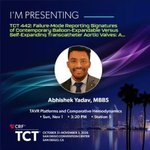
Presented at TCT 2026 in San Diego — second consecutive year presenting at TCT! Grateful to be part of another great meeting.#TCT2026

Excited to present our research at TCT 2026 in San Diego! Looking forward to an inspiring few days of scientific exchange and learning from the global interventional cardiology community.
#TCT2026

1
12
462
Abhishek Yadav retweeted
In a phase 1 study of anito-cel, a CAR T-cell therapy, for relapsed or refractory myeloma, all 38 patients had a response. Severe cytokine release syndrome and immune effector cell–associated neurotoxicity syndrome were rare. Full study results: nej.md/4ArvK6r
Science behind the Study: Anito-cel for Multiple Myeloma nej.md/4hF5Gxj

ALT A graph from an Original Article published in the New England Journal of Medicine article titled "Phase 1 Study of Anito-cel, a D-Domain BCMA CAR T Cell for Refractory or Recurrent Myeloma." The graph shows progression-free survival among all patients who received anito-cel. The NEJM identity sits at the bottom.
Work I started as a medical student ,manually analyzing years of paper-based medical records is finally presented as a poster at #IMS2026.

Abhishek Yadav retweeted

🔥 Excited to share that #paper2agent is published in @Nature today!
Papers have long been the primary format for communicating scientific knowledge, but they remain static. Putting that knowledge to work requires connecting findings to data, navigating supplementary materials, and adapting methods to new questions - effort repeated by each new reader.
We introduce Paper2Agent, a multi-agent framework that automatically turns research papers into virtual authors. Paper2Agent turns a paper’s manuscript, code, data, and supplements into an MCP server that any AI agent can access, with automated testing and iterative refinement in an agentic loop. The paper then becomes a virtual author you can talk to: trace claims to evidence, analyze your own data, and collaborate with other papers’ virtual authors
Agentifying a paper turns it from something people read into something people and AI agents can discover and build on - providing the context needed to interpret its findings and reuse its methods reliably. We tested how reliably these agents put papers to use. Across multiple benchmarks, agents created by Paper2Agent outperformed baselines such as Claude Code working directly with papers' PDFs and code repositories.
Once papers become virtual authors, they can collaborate - much like human researchers do. In one case study, agents built from AlphaGenome and two large-scale genetic perturbation studies worked together to propose a new computational approach for integrating evidence across different perturbation datasets. By connecting predictions from one paper with experimental data from others, they helped pinpoint a likely causal gene for psoriasis.
We hope Paper2Agent makes scientific knowledge easier to access, reuse, and build on - a first step toward a future where millions of paper agents proactively collaborate with human researchers and one another to advance discovery.
🤖Talk to the virtual author for Paper2Agent itself: paper2agent.ai
📎Paper: nature.com/articles/s41586-0…
💻Code: github.com/jmiao24/Paper2Age…
VERY grateful to work with this incredible team: @james_y_zou, @jkpritch, Yaohui, and Joe!


Abhishek Yadav retweeted

What does a difficult-to-treat, real-world B-cell Acute Lymphoblastic Leukemia (B-ALL) population actually look like?
Our study, published in @NaturePortfolio 's Blood Cancer Journal, reports baseline characteristics of 105 patients with relapsed/refractory B-ALL — drawn from a broader cohort of 250 patients — prior to treatment with NexCAR19 — the world's first humanized, and India's first, CAR-T cell therapy. We're sharing a look at that data here: a heavily pretreated, real-world population reflecting the challenges physicians face in routine practice.
Disease burden:
• More than half of patients had primary refractory disease or an early relapse — a subgroup historically associated with limited treatment options and poor prognosis
• 35% had high-blast leukemia (≥5% blasts) prior to leukapheresis, indicating clinically active disease at the time of treatment
• 2 out of 3 patients had Ph-like or Philadelphia chromosome-negative (Ph-ve) B-ALL — subtypes that lack the BCR-ABL1 alteration targeted by tyrosine kinase inhibitors in Ph-positive disease, making them harder to treat with standard therapy and more prone to relapse
• 10% had CNS involvement before leukapheresis, adding further clinical complexity
Treatment history:
• 3 in 4 patients had received two or more prior lines of therapy
• 34% had prior exposure to inotuzumab, reflecting a cohort already exposed to contemporary treatment approaches before CAR-T
Together, these characteristics define the real-world clinical context in which NexCAR19 was evaluated — a diverse, heavily pretreated population, not a curated trial cohort. Read the full paper to see how NexCAR19 delivered efficacy outcomes while also providing a favorable safety profile in ALL.
doi.org/10.1038/s41408-026-0…
How does this profile compare to the B-ALL patients you encounter — in the clinic or in your own research? We would love to know your perspective.
#biotechnology #bloodcancer #ImmunoACT

Abhishek Yadav retweeted
I give away my entire 🧠 and 20+ years of #GVHD treatment experience here.
Please watch so I can pass the torch off to you. 🔥
These cases are nuanced and may not be managed exactly the same by other experts in the field. There is still a lot of gray area here.
Thanks to @yazan_migdady and @VuMediHemOnc for the opportunity to share my personal take on GVHD management ! 🙏❤️

🩺 How do experts approach the most challenging GVHD cases when standard treatment strategies fall short?
As part of our #HowITreatInHematology #Vumedi Spotlight Series:
Dr. Shernan Holtan (@sghmd) of @RoswellPark shares a case-based approach to managing complex acute and chronic GVHD, including biomarker-guided decision-making, tissue repair strategies, and steroid-sparing therapies in high-risk clinical scenarios.
Featuring discussion and commentary from Dr. Yazan Migdady (@yazan_migdady), host of the How I Treat in Hematology series.
🎥 Watch on Vumedi: tinyurl.com/um6abtww
🔗 Explore more content from the How I Treat in Hematology channel on Vumedi: tinyurl.com/44ufprsx
#GVHDsm
Abhishek Yadav retweeted

The World Youth Heart Federation (@WYHFGlobal) is now officially accepting applications for National Chapters!
Join us for an info session on May 9 at 7 PM (EST).
Learn how creating a #WYHF National Chapter allows you to:
✅ Join a growing global network of youth leaders
✅ Lead and contribute to youth-driven cardiovascular health campaigns
✅ And more!
Info Session Registration: bit.ly/4n3iMWu
Application (Deadline May 31): bit.ly/49fd2mz

What stood out most at #ACP2026 wasn’t just the knowledge—but the people who go out of their way to mentor and support us.


1
3
387
Thankful to the incredible faculty at American College of Physicians for the time, effort, and belief they put into shaping the next generation.#IMACPphysicians #ACP2026


2
287
Podium winner at #ACP2026
Presented a rare case of Ghoshal hematopoietic dysplasia presenting as aplastic anemia—highlighting TBXAS1-mediated marrow failure in adults. @ACPIMPhysicians #IMPhysicians


2
7
408
Convocation 🎓
This milestone is built on my parents’ unwavering support, my professors mentorship, and my friends constant encouragement. Deeply grateful.

3
453


