

Research Scientist @AsteraInstitute. Postdoc at @Harvard with @du_yilun and @gershbrain. PhD with @SchmidhuberAI. Prev: Apple MLR, AWS AI Lab. Same handle on 🦋
Cambridge, MA
Joined January 2018
- Tweets175
- Following513
- Followers769
- Likes1K






Anand Gopalakrishnan retweeted

🚨new method day! 🚨
Trust[ing results] in ML conferences is utterly broken. Let's fix it with an algorithm!
We are excited to introduce 𝗧𝗿𝗮𝗶𝗻𝗶𝗻𝗴 𝗪𝗶𝘁𝗻𝗲𝘀𝘀𝗲𝘀, a system for “honesty” certificates of data and evaluations which a verifier can cheaply check and trust.

Anand Gopalakrishnan retweeted

What if a foundation model could tell us how to modify its architecture to boost inference and reasoning instantaneously—without retraining? What if that tweak incurred near zero latency cost during generation and supported indefinite state tracking? arxiv.org/abs/2608.17981
Anand Gopalakrishnan retweeted

By the same token, some still don't seem to know that DeltaNet (shorthand for Delta Network) was introduced 5 years ago as a direct descendant of ULTRA (ICML 2021, @ImanolSchlag @SchmidhuberAI ).
Numerous recent papers refer to DeltaNet without citing the original 2021 paper.


Some still don't know: Google's 2017 normalized quadratic Transformer [TR1] is based on the principles of the 1991 unnormalized linear Transformer [ULTRA]. In 1991, KEY/VALUE was called FROM/TO. ULTRA’s computational costs scale linearly in input size, rather than quadratically! The 1993 paper on a recurrent ULTRA extension [FWP2] introduced the attention terminology: learning "internal spotlights of attention" by gradient descent. See the T in ChatGPT! Details and references: people.idsia.ch/~juergen/199…

Anand Gopalakrishnan retweeted

1/?) As promised to Sander Dieleman (@sedielem), we’re finally excited to share:
Towards Closing the Autoregressive Gap in Language Modeling via Entropy-Gated Continuous Bitstream Diffusion
We show that continuous diffusion can achieve very strong language modeling performance when operating directly on bitstreams, outperforming masked and uniform diffusion baselines, and essentially matching autoregressive models under our evaluation settings.

Anand Gopalakrishnan retweeted
[1/5] Intelligent behavior relies on maintaining an evolving, dynamic model of the environment. But even frontier models sometimes fail at tracking state in dialogs, e.g., actual transcript from 4/20/2026:

Anand Gopalakrishnan retweeted
Back in 2019, I reduced transformer LM KV-cache size by: (1) setting K=V (storing only K), (2) deeper FF blocks & fewer self-attn layers overall.
Published at ICASSP 2020. To my knowledge, the first publication on KV-cache reduction--lmk if you know anything older!

Anand Gopalakrishnan retweeted

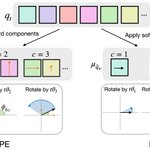
Can we replace RoPE with PoPE (Polar Coordinate Positional Embeddings) in pretrained language models?
Turns out we can! Using small pythia models, after a small recalibration (~2% of pretrain), we get significantly better length generalization.
1/3
teapaw.org/agopal42/status/200390…


Our new paper shows that RoPE—the positional encoding used in most modern LLMs like Qwen, Gemma, DeepSeek—has a fundamental flaw: it entangles "what" (content) and "where" (position) information.
Our fix (PoPE) is simple but powerful. Paper: arxiv.org/abs/2509.10534

Anand Gopalakrishnan retweeted

State of the art World Models still lack a unified world memory for representing and predicting dynamics out of their field of view.
Why is that, and how can we fix it?
Introducing Flow Equivariant World Models: models with memory capable of predicting out of view dynamics!🧵⬇️
Anand Gopalakrishnan retweeted

When you're crossing the street and turn your head, you typically remember whether or not a car is coming from the other direction - so why can't today's world models?
Introducing Flow Equivariant World Models
flowequivariantworldmodels.g…
Led by @hansenlillemark & @huskydogewoof🧵👇

Anand Gopalakrishnan retweeted
Humans can't write programs that classify cats vs dogs. Deep learning lets GD write that program.
Continual learning is the same: it's too hard for us to design good CL algorithms. Let GD write that algorithm too. That’s the idea of metalearning CL algos: arxiv.org/abs/2312.00276
Anand Gopalakrishnan retweeted
Am I the only one who thinks Cotter & Conwell's "Fixed-weight networks can learn" (1990) is so underappreciated in light of in-context learning (and beyond)? with follow-ups including @HochreiterSepp's masterpiece (2001).
Cited 62 times (of which 10% are me). Seems too few.

Anand Gopalakrishnan retweeted

On the final day of #NeurIPS2025, I've realised that interpretability is the study of imaginary entities (concepts, features, circuits, ... ) that researchers wish existed in models
a.k.a., the Reification fallacy in Interpretability
surajsrinivas.substack.com/p…
Anand Gopalakrishnan retweeted

What if the attention pattern that would lead to AGI was sitting in front of the entire AI community all week?

Anand Gopalakrishnan retweeted

interested in the science of deep sequence modeling? interested in improving transformer reasoning and memory? looking for some inspiration for your next research project?
stop by our poster for some concrete practical/theoretical open questions on these topics!

Come by our poster at the Foundations of Reasoning in Language Models workshop at NeurIPS 2025!
🧩 “Deep sequence models tend to memorize geometrically; it is unclear why”
📍 Sunday, Dec 7 at 3 pm — Upper Level Room 33ABC
arxiv.org/abs/2510.26745

Anand Gopalakrishnan retweeted

At NeurIPS and interested in continual learning? Stop by our spotlight poster this Friday @ 11am (#508).
Our work provides a computational approach to the big world hypothesis through embedded agents.
Feel free to reach out if you want to meet up while in San Diego!

Anand Gopalakrishnan retweeted

Attending @NeurIPSConf? Stop by our poster "Do Language Models Use Their Depth Efficiently?" with @chrmanning and @ChrisGPotts today at poster #4011 in Exhibit Hall C, D, E from 4:30pm.

Anand Gopalakrishnan retweeted
Sharing a story of generosity at #NeurIPS25.
I had to cancel my trip due to illness. @maxmbeck, @julien_siems and @robert_csordas, who are not coauthors, generously agreed to present my poster.
I'm really moved by the kindness of this incredible group of RNN stars.
Anand Gopalakrishnan retweeted

We found a new way to get language models to reason. 🤯
No RL, no training, no verifiers, no prompting. ❌
With better sampling, base models can achieve single-shot reasoning on par with (or better than!) GRPO while avoiding its characteristic loss in generation diversity.
Anand Gopalakrishnan retweeted
[1/4] As you read words in this text, your brain adjusts fixation durations to facilitate comprehension. Inspired by human reading behavior, we propose a supervised objective that trains an LLM to dynamically determine the number of compute steps for each input token.

Anand Gopalakrishnan retweeted
Why do video models handle motion so poorly? It might be lack of motion equivariance.
Very excited to introduce: Flow Equivariant RNNs (FERNNs), the first sequence models to respect symmetries over time.
Paper: arxiv.org/abs/2507.14793
Blog: kempnerinstitute.harvard.edu…
1/🧵