
Sunnyvale, CA
Joined October 2010
- Tweets1.3K
- Following988
- Followers91
- Likes752

Amit Shahane retweeted

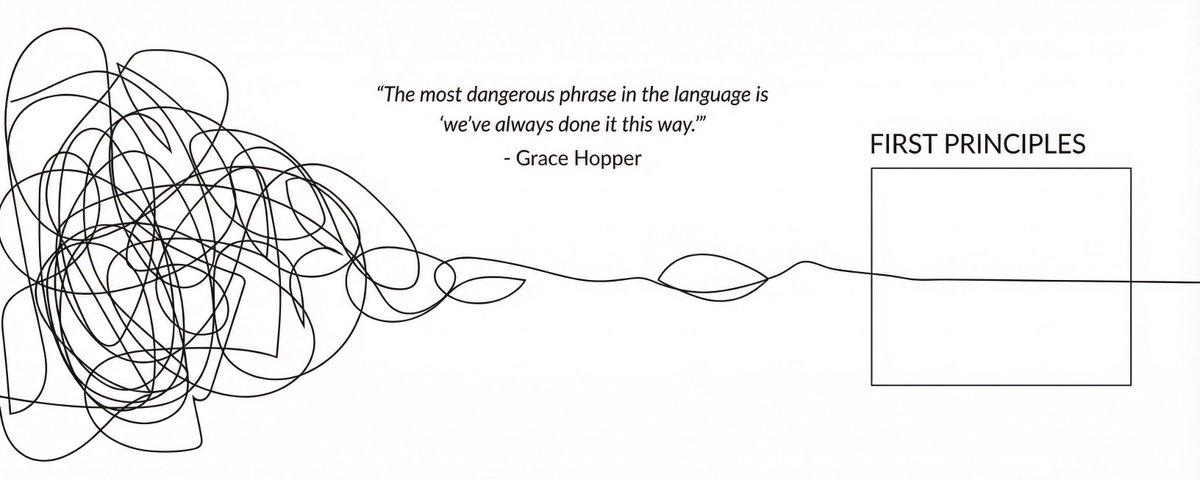
Elon Musk literally broke down his 5-step process for applying first-principles thinking to build anything:

Amit Shahane retweeted

Read this if you want to know what YC and Sequoia are actually betting on in AI space right now:



Amit Shahane retweeted

A Russian mathematician named Andrei Markov proved in 1906 that you don't need to know where something came from to predict where it's going next.
He was studying poetry at the time. Specifically, he was analyzing the sequence of vowels and consonants in Pushkin's novel in verse, counting transitions by hand across thousands of characters, looking for a pattern in how one letter predicted the next.
What he found became one of the most quietly powerful ideas in all of mathematics. And it has been sitting inside every weather forecast, every Google search, every Netflix recommendation, and every large language model ever built, waiting for someone to explain it in plain language.
Here is the framework that changed how I think about prediction.
Most people assume that to predict something you need history. The full picture. Everything that led to this moment. If you want to know what the stock market will do tomorrow, you think you need to understand everything it did for the past decade.
Markov showed that is almost never true.
His insight was this: for a huge class of real-world systems, the current state contains all the information you need to predict the next state. The past is already baked into where you are right now. You don't need to carry it forward explicitly, because it's already there.
He called this the Markov property. And the systems it describes are called Markov chains.
The mechanics are simpler than they sound.
Imagine you are tracking weather. It is either Sunny or Rainy on any given day. You observe over many years that when it's Sunny, there's a 90% chance tomorrow will also be Sunny and a 10% chance it will turn Rainy. When it's Rainy, there's a 50% chance it stays Rainy and a 50% chance the sun comes back.
Those four numbers are your entire model. That grid of transition probabilities is the Markov chain.
Now someone asks you: it's Sunny today, what is the probability it will be Sunny three days from now?
You don't need intuition. You don't need expertise. You multiply the transition probabilities through each step and the answer falls out exactly. The chain does the thinking.
The part that most people miss is what happens when you run a Markov chain long enough.
Almost every well-behaved Markov chain converges to what mathematicians call a stationary distribution. It doesn't matter where you start. After enough steps, the system settles into a stable pattern of probabilities that it returns to again and again, regardless of initial conditions.
Google's original PageRank algorithm was a Markov chain. The web is a network of pages pointing to each other, and a random visitor clicking links is a random walk through that network. The stationary distribution of that walk, the long-run probability of landing on any given page, is exactly what PageRank calculated. Your position in search results was determined by where a memoryless random surfer would spend most of their time.
The same mathematics underlies how your phone's keyboard predicts your next word. How Spotify decides what song plays after this one. How epidemiologists model the spread of disease through a population. How economists simulate how people move between jobs and unemployment. How physicists describe particles changing energy states.
All of it is the same idea dressed in different clothes.
The counterintuitive power of Markov chains is that they are wrong about memory in a way that turns out to be useful.
Real systems do have memory. Tomorrow's weather is influenced by more than just today's. Your next word is influenced by more than just your last one. The Markov assumption is technically false for almost every natural system.
And yet. The approximation is good enough to be extraordinarily useful, because most of the predictive information in a sequence is concentrated in the most recent state. Adding older history gives you diminishing returns. At some point you are carrying around all this expensive history for almost no improvement in accuracy.
Markov chains are the mathematical formalization of a deeply practical idea: you can often predict the future with surprising accuracy just by paying close attention to right now.
The man who discovered this was studying syllables in poetry. He had no idea he was describing the architecture of the internet, the logic of machine learning, and the statistical skeleton underneath the most powerful AI systems ever built.
He just followed the pattern where it led.
That is usually how the biggest ideas work.

Amit Shahane retweeted

A difference in company philosophy:
@neuralink: put wires on brain.
@CorticalLabs: grow brain on wires.
Cortical Labs just completely changed my dreams and nightmares.
Here it is in Hon Weng’s hotel room. He is showing this off tomorrow at a brain conference in San Francisco.
You get a sneak peak tonight.
Amit Shahane retweeted

In a recent podcast Shreya Ghoshal subtly criticized Punjabi Songs.
Shreya Ghoshal: see sorry to say but Most of the Pubjabi songs which are doing very well what do they speak of?? Car, banglow, Girls.
Which is getting consumed heavily because its gotta groove and flex


Amit Shahane retweeted

Sthira Sukham Asanam. That’s the core definition of asana given in the Yoga Sutras of Patanjali. It means that a posture should be firm and calm at the same time. If it’s only firm, that’s exercise.
Amit Shahane retweeted

This is the clearest map I've seen of how AI infrastructure constraints move in sequence. Every time one wall falls, another appears. I've watched this pattern since 2020: first it was "can we get enough GPUs," then "can we get HBM attached," now it's "can we plug it all in without melting the grid." By the time the market recognizes a bottleneck, the margin seems to have already moved.


Amit Shahane retweeted

Before you learn Kubernetes, understand why to learn Kubernetes. Or should you?
25 years back, if you wanted to run an application, you bought a $50,000 physical server. You did the cabling. Installed an OS. Configured everything. Then run your app.
Need another app? Buy another $50,000 machine.
Only banks and big companies could afford this. It was expensive and painful.
Then came virtualization. You could take 10 physical servers and split them into 50 or 100 virtual machines. Better, but you still had to buy and maintain all that hardware.
Around 2005, Amazon had a brilliant idea. They had data centers worldwide but weren't using full capacity. So they decided to rent it out.
For startups, this changed everything. Launch without buying a single server. Pay only for what you use. Scale when you grow.
Netflix was one of the first to jump on this.
But this solved only the server problem.
But "How do people build applications?" was still broken.
In the early days, companies built one big application that did everything. Netflix had user accounts, video player, recommendations, and payments all in one codebase.
Simple to build. Easy to deploy. But it didn't scale well.
In 2008, Netflix had a major outage. They realized if they were getting downtime with just US users, how would they scale worldwide?
So they broke their monolith into hundreds of smaller services. User accounts, separate. Video player, separate. Recommendations, separate.
They called it microservices.
Other companies started copying this approach. Even when they didn't really need it.
But microservices created a massive headache. Every service needed different dependencies. Python version 2.7 for one service. Python 3.6 for another. Different libraries. Different configs.
Setting up a new developer's machine took days. Install this database version. That Python version. These specific libraries. Configure environment variables.
And then came the most frustrating phrase in software development: "But it works on my machine."
A developer would test their code locally. Everything worked perfectly. They'd deploy to staging. Boom. Application crashed. Why? Different OS version. Missing dependency. Wrong configuration.
Teams spent hours debugging environment issues instead of building features.
Then Docker came along in 2012.
Google had been using containers for years with their Borg system. But only top Google engineers could use it, too complex for normal developers.
Docker made containers accessible to everyone. Package your app with all dependencies in one container. The exact Python version. The exact libraries. The exact configuration.
Run it on your laptop. Works. Run it on staging. Works. Run it in production. Still works.
No more "works on my machine" problems. No more spending days setting up environments.
By 2014, millions of developers were running Docker containers.
But running one container is easy. Running 10,000 containers? That's a nightmare.
Microservices meant managing 50+ services manually. Services kept crashing with no auto-restart. Scaling was difficult. Services couldn't find each other when IPs changed.
People used custom shell scripts. It was error-prone and painful. Everyone struggled with the same problems. Auto-restart, auto-scaling, service discovery, load balancing.
AWS launched ECS to help. But managing 100+ microservices at scale was still a pain.
This is exactly what Kubernetes solved.
Google saw an opportunity. They were already running millions of containers using Borg. In 2014, they rebuilt it as Kubernetes and open-sourced it.
But here's the smart move. They also launched GKE, a managed service that made running Kubernetes so easy that companies started choosing Google Cloud just for it.
AWS and Azure panicked. They quickly built EKS and AKS. People jumped ship, moving from running k8s clusters on-prem to managed kubernetes on the cloud.
12 years later, Kubernetes runs 90% of production infrastructure. Netflix, Uber, OpenAI, Medium, they all run on it.
Now advanced Kubernetes skills pay big bucks.
Why did Kubernetes win?
Perfect timing.
Docker has made containers popular. Netflix made microservices popular. Millions of people needed a solution to manage these complex microservices at scale.
Kubernetes solved that exact problem.
It handles everything. Deploying services, auto-healing when things crash, auto-scaling based on traffic, service discovery, health monitoring, and load balancing.
Then AI happened. And Kubernetes became even more critical.
AI startups need to run thousands of ML training jobs simultaneously. They need GPU scheduling. They need to scale inference workloads based on demand.
Companies like OpenAI, Hugging Face, and Anthropic run their AI infrastructure on Kubernetes. Training models, running inference APIs, orchestrating AI agents, all on K8s.
The AI boom made Kubernetes essential. Not just for traditional web apps, but for all AI/ML workloads.
Understanding this story is more important than memorizing kubectl commands.
Now go learn Kubernetes already.
Don't take people who write "Kubernetes is dead" articles are just doing it for views/clicks. They might have never used k8s.
Amit Shahane retweeted

Mastering control at very short time scales.
A platform balancing a ping pong ball by continuously adjusting its motion.
What looks simple highlights a hard problem in control.
• Tight sensing, compute, and act loops running at millisecond scale
• Smooth, stable corrections without overshoot
• A clear example of how latency and control quality dominate performance
Systems like this are less about the demo and more about what they reveal.
When feedback loops get fast and precise enough, entirely new classes of behavior become possible.
—-
Weekly robotics and AI insights.
Subscribe free: scalingdeep.tech
Amit Shahane retweeted

It's almost unbelievable how clever the ancients were youtu.be/YdOXS_9_P4U?si=K7XV…


Amit Shahane retweeted

Divya Deshmukh dedicated her Grandmaster Title to her First Coach Late Rahul Joshi 🥹
Amit Shahane retweeted

What a crazy week in AI 🤯
- Cursor Phone App
- Krea AI Modify Video
- Google launches Doppl
- Perplexity New Max Tier
- X new AI note taking API
- AI’s Breakthrough in Fertility
- Morphic One-Shot Character
- Meta & OpenAI recruiting drama
Here’s EVERYTHING you need to know:


Amit Shahane retweeted

This actually happened to Evernote. They took the advice of “keep talking to your customers and ship whatever they want” as the only guiding principle for product development. And what ended up happening was paying users liked it, but the product become unintuitive and feature overload for the new user. To the extent that they had to rebuild a version for the new user.
Users don’t always know if they really want something. It’s your job to take the extra step to think on their behalf: whether they really need this. Or can what they ask be done through something much simpler. Or can you solve multiple problems of different users with one new redesign rather than a bunch of changes. The right principle is: “Keep talking and listening to your users, spend the additional time thinking on their behalf what they actually want, and ship that”.

