



Most guardrails give an agent two answers: yes or no.
We added a third at @hoopdotdev: run it, masked. The AI picks one of your masking rules for that one response, so the agent gets the rows without the emails.
Which reads would you mask instead of block?

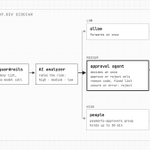
Today we ship an agent that approves another agent's writes at @hoopdotdev.
It can only approve or reject. Every reject carries a code from a fixed list. High-risk writes still go to a person.
Which ones would you trust an agent to approve?

This is how we built @hoopdotdev into Claude Managed Agents from @AnthropicAI
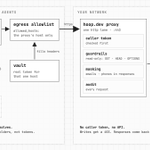
The sandbox can reach one host, our proxy. The agent only ever holds placeholders. Every request gets checked before it reaches your API.


Let him cook 🔥

I got some agents running in the background with my "things I'd do if I had time" list.
And now we are about to put some tests in a thing that helps you use @hoopdotdev with your agents to protect things at protocol level
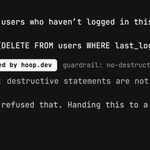
Small thing that makes me happy: the agent writes a bad DELETE, hoop.dev blocks it, the agent reads the error and hands it to a human. Nobody had to be watching.

Jev is a classifier, and the hype around it says one thing: guardrails for AI agents stopped being a hypothesis.
Most tools put the check inside the agent. We put it between the agent and the database. Testing Jev there this week. 👉 @hoopdotdev

After co-inventing ChatGPT, I kept asking myself: why have superhuman chat models not led to AGI?
I’ve spent the last 2 years in stealth building a new way to train models (RLCD), and a new type of frontier AI model that we are releasing today: Jev
• 20-200x faster
• 40-400x cheaper (w/ output tokens free)
• Frontier composable intelligence optimized for decisions
AFAICT the shortest path to AI-based economic revolution
remove Finder from alt+tab:
$ defaults write com.apple.finder QuitMenuItem -bool true
$ killall Finder
81

3+ years away from code, now querying massive schemas in seconds with zero knowledge of the structure.
Watch out if you aren't using LLMs for at least one use case for coding.
Just took a huge leap of faith and open-sourced our codebase!
It's been a wild ride, and I want to share why we made this decision.
Three years ago, we were struggling in the crowded access gateway space. Our tool was the #1, but adoption was slow.
Jump Servers (bastion hosts) are nodes granting access to your internal infrastructure services.
They act as secure gateways but come with scaling headaches.
Here's how to replace Jump Servers & SSH Keys with JWT tokens:
1
1
35
Why hasn't SSH been replaced?
Because alternatives aren't 10x better.
We need a revolution in remote access, and it starts with packet manipulation.
Here's why it matters:
1
33
I just deleted a production Kubernetes namespace by mistake.
Millions of users affected.
Payments down for an hour.
My heart raced as I frantically tried to fix it.
This disaster would lead to a revolutionary idea in secure connections.
1
46
Here's the story of how we set out to build the copilot experience into our product, but the opposite of Github copilot happened when we launched.
Copilot has proven quite handy as a "smarter Intellisense" tool for me. It often accurately predicts the arguments I need for functions, including their types. Occasionally, when I start typing 𝚊.𝚖𝚊𝚙(, it automatically fills in the transformation code I intended to write. The key enabler is the ability to ignore most suggestion. They don't get in my way.
The simpler the task I'm working on, the higher the likelihood it gets it right. This is where I get the most benefit from Copilot, as I already understand what I'm coding, why I'm coding it, and how it should appear. Copilot sometimes saves me the 5-30 seconds it would take to write it manually. Over the course of a day, these saved moments add up.
But I always found myself turning to ChatGPT for help writing SQL. I would 1) run a query to get the schema. 2) Feed schema to ChatGPT. 3) Ask GPT to write my query. 4) Paste query into client. Solid results, but the workflow was not great with lots of copy and paste and multiple apps.
I work at Hoopdev, an infrastructure access gateway and we happen to have a build-in web client. Therefore our language server has a REST API that we could hook to GPT4. But our first attempt failed. We tried the Ask AI box UX, which only solved half the problem: providing the schema as context. Not getting the way was still missing. The bad suggestions required another prompt to get fixed.
Therefore set out to build the copilot experience [0
comment], but the opposite of Github copilot happened: most suggestions are good. This is because the only context for writing SQL is the database schema and what you want to do, all the model has to do is translate your english query to another language (SQL) using a small context (schema), as opposed to full codebases.
Hoopdev's client is web-based, because of that you can try it in 15 seconds. After signing up you get a demo Postgres ready to be queried in the web [1|comment]. If you don't wanna sign up, run it yourself and use your own OpenAI keys [2|comment]. Please let me know what you think. any feedback is welcome. Is this helpful? Do you know/use a better alternative for SQL?

IAM policies failed you
Small team/stack: can’t waste time, just give everyone same level of access
Large: unmanageable complexity, 1000s of resources x 10s of technologies x 100(0)s of engineers
1
54
a couple years ago we were all in moving from elastic beanstalk to Kubernetes and this guy we talk to say that they were happy beanstalk users and after researching didn’t think it was relevant migrating to Kubernetes, i laughed,
1
1
47