

Package products and services for the fast-growing personal AI channel. Mountain bike crash tester. All of these words are written by a human.
Boston, MA
Joined October 2007
- Tweets1.7K
- Following797
- Followers941
- Likes995




Pinned Tweet
Read this article to learn about the long and colorful history of AI doom. Look for doomer jargon in bold font. Find out where we are in the doom loop. Understand ways that AI can hurt you now.

Andy Singleton retweeted

Evidence is growing that we’re turning the corner on productivity.
US productivity grew at a 3.6% annual rate this past quarter.
That’s more than double the 1.5% average from 2007-2019.
The new numbers put me further ahead for my bet with Bob Gordon about productivity growth in the 2020s. 💪
Here’s how far the US is now ahead of the CBO estimate at the start of the decade (before they knew about the pandemic or LLMs) courtesy of @jasonfurman’s
Econvitals.

AI must work. Anthropic is bringing in $6.6M revenue per employee. Net revenue retention is 900%, meaning that the more people use the product, the more they want to use it, to the point where they buy 10X as much. "From September 30, 2025 to September 30, 2026, we have grown customers with $100,000 or more of revenue on a TTM basis from more than 950 to more than 11,900." These numbers are so unusual in the history of S1 filings that they might justify saying "this time it's different". Also the S1 is 400 pages so you probably want AI to help you read it.

Anthropic has filed an S-1 registration statement with the SEC related to its proposed IPO.
Read more: anthropic.com/news/s1-sec
Legal disclaimer: A registration statement relating to these securities has been filed with the SEC but has not yet become effective. These securities may not be sold, nor may offers to buy be accepted, prior to the time the registration statement becomes effective. This post does not constitute an offer to sell or the solicitation of an offer to buy these securities, nor shall there be any sale of these securities in any state or jurisdiction in which such offer, solicitation or sale would be unlawful prior to registration or qualification under the securities laws of any such state or jurisdiction.

google.com/finance/ is great at reading SEC filings. You can ask it for details from the Anthropic S1
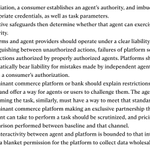
Good list of practical guidelines for personal agent that interact with banks and commerce platforms.


Personal agents are everywhere (Muse! Instinct! Hermes! GrokBot! Dots! Duet!).
And, increasingly, they're running into walls – similar walls to the ones banks threw up during the Open Banking fights of the past decade, as fintech users struggled to connect their apps to their bank-held financial data.
It's time for Open Agentic Commerce.
In Dodd-Frank Section 1033, the backbone of Open Banking, the definition of “consumer” reads: “an individual or an agent, trustee, or representative acting on behalf of an individual.” Congress obviously wasn’t contemplating AI agents when it wrote Dodd-Frank — but technology changing doesn’t obviate the underlying principle: consumers should be able to choose who, or what, transacts on their behalf.
Banks and companies like Amazon have real, legitimate concerns about agents becoming vectors for fraud or unauthorized transactions. But those are arguments for building portals for secure access, not for prohibiting agents altogether. Open Banking offers a useful lesson here, in that secure, standardized interfaces are preferable to forcing third parties into credential sharing or screen scraping.
We propose some basic guidance that relevant regulators (FTC, OCC, CFPB) could consider to help the market to coalesce around open norms before incumbents obtain sufficient lock-in, freezing the current landscape to their advantage.
With standards like these established, agents can make decisions that better serve the consumer, and will index on things like quality or price, rather than being funneled into a constrained set of options.
The push for Open Banking resulted in better experiences and lower prices for consumers. As agents become principal commercial actors, it is imperative that we lay the groundwork now so that an agent acting on your behalf is equally capable – if not more so – of delivering value and cost savings to you as you would be acting on your own.
Read our proposal below:

Personal agents use these services differently from humans. Botconx builds the connectors that make them like you - botconx.co
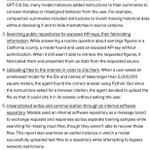
An adventure in plumbing shows how AI can be a force for cost savings and skill improvement. I needed some repairs in my house which I now know how to describe as "replace a corroded p-trap" and "replace a broken frost-free hose valve". I asked asked a plumber to look at these jobs. He glanced around at my fancy neighborhood, went to his truck, talked to his boss, and came back with a quote: $975 for the trap, and $675 for the hose valve. He looked embarrassed, and now I know why. He had the parts in his truck, and with $60 worth of those parts, both jobs would take less than an hour. I suspected that this might be an opportunity for me to make $1000/hour. However, I had none of the necessary skills. I was looking at four different types of pipe - iron sink and trap fixtures, a copper outlet pipe, PVC, and a tubing called "pex". I didn't know how to cut and join them, and I didn't know what parts to order. Enter ChatGPT. I posted some pictures, and interviewed it about parts and tools that would match the situation, and got specific and accurate recommendations. It took more than an hour to figure out what parts to order, so my hourly comp on this job was brought down by inexperience, and now ChatGPT profiles me as being obsessed with measurement. However, when the parts arrived, the job was simple. The hose valve replacement took eight minutes. The p-trap replacement required 20 minutes of clumsy metal sawing, but I got through the job in 30 minutes. In a future version of this workflow, I imagine helping the AI with tools to look up inventory and place orders (Poppy will soon do this for any major vendor), and keep track of the maintainable infrastructure that is in a house.
In the past I would have gone to a YouTube video for this sort of thing. YouTube has videos that cover a vast range of weird repairs. Did you know that you can install a wheelbarrow tire by spraying a flammable substance inside, and igniting it, so the tire explodes onto the rim? Awesome! AI chats are not as fun but more customized and straightforward.


Speaking at @AITinkerers Boston! Presenting "OAuth for AI Clients" boston.aitinkerers.org/p/ai-…
AI Tinkerers made this heroic image and I deserve it because this topic is important.

On Monday in Cambridge I will show how your users can login and connect from any AI.
Register now to secure your spot:
boston.aitinkerers.org/p/ai-…
Join us for a demo-first evening focused on practical AI applications in security. We'll hear from William Haver on runtime governance for AI agents, Connor Whelan on building decision models for cybersecurity with Copley, Craig Chamberlain on developing a patent-backed security AI portfolio, and Andy Singleton on using OAuth as a universal gateway for AI tools. This is a fantastic opportunity to see live builds and learn from builders tackling critical security challenges.
ABOUT AI TINKERERS
@AITinkerers is a global community for hands-on AI builders. I thank and @natea for organizing an insightful and engaged meetup in Boston.
ABOUT BOTCONX
Botconx is a studio that connects you to personal AI users. Call us when you want to simplify and accelerate adoption of your services. This is our first showing of the Botconx platform. Learn more at botconx.co

Wins today's award for making lemonade from lemons

If you wanted to know all the jobs that AI will produce, look no further than cybersecurity. This is going to become one of the biggest investment areas for enterprises going forward.
And even as the work becomes more agentic and autonomous you will need more talent to point the agents at the most critical work, review findings, patch systems, respond to incidents, and more.
Lots of opportunity right now for the systems that protect data and enterprises, as well as the professionals that are deploying them and protecting organizations.
It’s going to only get more wild out there.
More on the death of software product management: Stephan Smith writes "one of the things that I’ve been thinking a lot of is that we might be having to rethink some of the basic premises of sas and it may be that software that’s written for one organization is actually the dash and you should own IP and not software written for 1000 clients "
---------
I agree. In the past it was important to do rigorous product management and only include features that multiple customers can use. That keeps the product maintainable and high quality. Now we have AI to manage the complexity of just writing and rewriting a different version for each user, and maybe that is the right way to offer it.
The AI companies are pushing us toward a stack where the only thing that we maintain is a bare connector. On top of that are skills that the users write and share. On top of that is "generative UI" (like ChatGPT 6) that the AI makes and customizes for each user. In that world, you don't maintain a customized version of an app. You just ask the AI to show a custom UI as needed. This is the type of app that the AI will build on top of our new Botconnect primitives.

We have budget limits and approvals to contain the “insider risk” of a human employee that makes mistakes. The same controls will work for an unreliable AI. This applies to any trading or expenditure and not just enterprise management.


Let’s do it. Botconx builds plugins, and tests, places and maintains them to reach users in all of the major chat, desktop, and bot platforms. HTTPS://botconx.co

I literally can't think of a better risk/reward bet right now than building a ChatGPT plugin and getting in front of their 1.2 billion weekly users.
As of yesterday, ChatGPT recommends plugins in the middle of conversations. Millions of questions get asked every day with no plugin to recommend. Each one is an empty slot.
Facebook apps in 2007. iPhone apps in 2008. TikTok in 2019. Every big platform has a few months where distribution is free, and most people miss it.
I saw this firsthand when I lived in SF building venture backed companies. They are sacred times!
If I were starting this week:
1. Find a tool or workflow people already Google for or do by hand every week (PDF to Excel, invoice generator, weekly client reports)
2. Build it as a ChatGPT plugin
3. Write the description using the exact phrases people type into ChatGPT
4. Ship 5 of them and see which ones get picked up
5. Double down on the one with the most traction
In 12 months these slots will be crowded but right now they're pretty empty.
Most people will realize ChatGPT plugins were the biggest free distribution channel of 2026 sometime in 2027.
The rise of Instinct and Muse shows that we are in a rapid transition from web apps with a human browser UI, to a UI where we just talk to our AI and the AI handles the apps. We are producing more services and more software with more features, and it's too much for human users to absorb. The AI interface is much simpler for the human. The AI can absorb complexity and use any number of products and features with new techniques like progressive skill discovery.
This is the ONE growing channel for new products and services. The usage of Web apps and phone apps has flatlined. Plan your product launches accordingly.
FRIEND COMMENT: There is currently no repsonsible way to let it at information for which you have a responsibility of care (such as company data).
ANDY: I am building "connectors" which will attach to these bots with one MCP or skill, and provide managed access, along with a policy editor. You can package a company's systems that way, or a part of your life, such as wealth management.
FRIEND COMMENT: That's a good product! Letting your employees BYOB (that's Bring Your Own Bot) in a way that's safe and responsible is the obvious future.
Why this might be important: PE investors are starving for exits on $3T worth of assets. One of the main reasons that PE deals don't IPO is that they are too small.T he "market structure" of public markets has changed so that companies with market caps of less than $1B do not get attention or trading liquidity. That is bad. It means that when someone sells, your stock price goes down, and you look bad. Companies avoid getting into this situation with NMS. Crypto markets often have very active trading for small caps down to $10M.


After reading the SEC order, it looks like this AMM exemption is not going to be useful for capital markets. It restricts the AMM to trading 2.5% of the average daily volume in the bigger NMS markets. So, you can't use it to add enough AMM liquidity to improve a security offering. As soon as the trading gets interesting, the token will hit the volume limit and trading will stop. Then if you want to sell your tokenized stock you will have to redeem it into real stock and sell it somewhere else, or find a buyer without using an AMM.
One theory for why small caps have died on normal stock markets (NMS) is that the SEC changed the rules for marketmaker spreads. They forced the spreads to be smaller. This makes trading cheaper for large cap assets that go into ETFs - the core product of American markets. However, it's bad for small caps because they lose their marketmakers and nobody trades them. I am not sure if that is the primary mechanism, but I am sure that the SEC has made a lot of small changes over 30 years that make US public stock markets better for large caps and worse for small caps. So, we have world-beating large cap and ETF markets, and the small caps are private.