

Co-founder at https://xitter.cf/t.co/pYjyGRRK2F 🚀 Exponential Age ₿ x 🤖 Degen & NFT Collector 🙌🏽💎 Crypto / AI
Andorra
Joined April 2019
- Tweets6.2K
- Following1.5K
- Followers4.4K
- Likes35.1K


Arnau Ramió retweeted

GPT-Rosalind surfaced a new lead for drug discovery: could restoring cholesterol transport protect neurons from degeneration?
DCTN1 is a gene linked to Perry syndrome, a rare neurodegenerative disorder. In mouse-brain data, disrupting it increased expression of genes involved in making cholesterol. GPT-Rosalind suggested a possible explanation: cholesterol may not be reaching where neurons need it.
That gives scientists a specific mechanism to test and, if confirmed, a direction for developing new treatments for neurodegenerative disorders.
With @perturbai_tx and @scrippsresearch, a team of thousands of GPT-Rosalind agents worked in parallel, connecting gene-expression results from millions of mouse brain cells with scientific literature in just 32 minutes. We’re now expanding this collaboration to identify new drug targets.
openai.com/index/scaling-ai-…

Arnau Ramió retweeted

One asset class went from ~1% to ~9% of spot decentralized exchange (DEX) volume in a quarter, lifting stablecoin addresses and app revenue along the way. The Market Spotlight in The DeFi Quarterly Q3 2026: tokenized equities.
Also in the report by @rhadiARK & @LorenzoARK:
▪️Stablecoins, RWAs, Tokenization
▪️Network And Application Economics
▪️Decentralized Exchanges
▪️Lending Protocols
▪️Market Pulse
ark-invest.com/crypto-report…

Arnau Ramió retweeted

on the prospective spaceXSI x Tesla:
Assessment of the fair merger premium/discount depends heavily upon time horizon.


on spaceX vs Tesla
very crudely:
robotaxi is a bigger opportunity than starlink
but orbital compute is a *much* bigger opportunity than robotaxi
and optimus requires more baking time than orbital compute
and Optimus's success is predicated on access to gobsmacking amounts of superintelligence
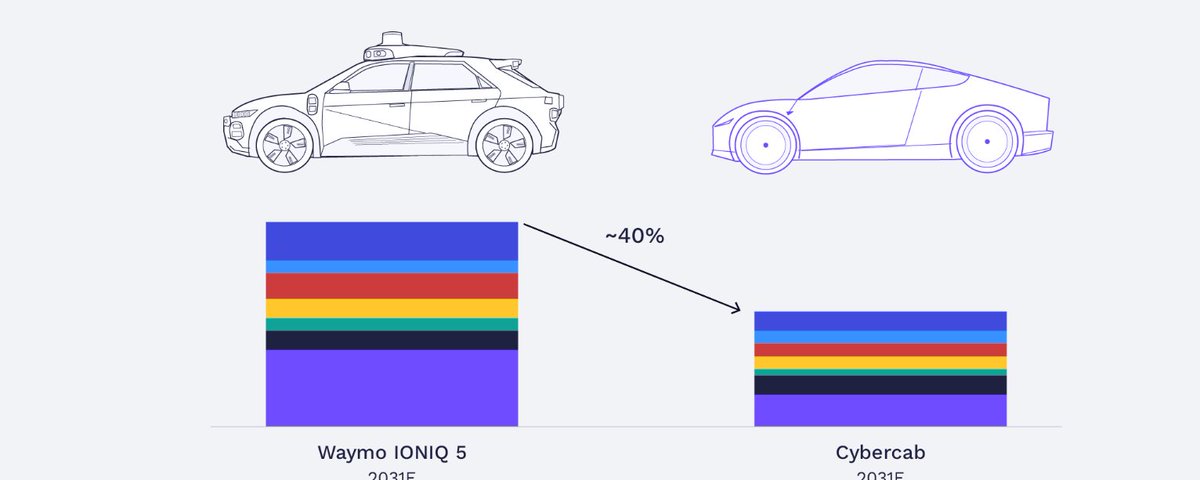
On our modeling, compared against the no merger case, even if merged at the current share price ratio Tesla shareholders would be ~1.6x better off in 2031 while SpaceX shareholders would be ~2x better off.
On a longer timeframe (2036) Tesla shareholders would be ~5x better off having merged whereas SpaceX shareholders should be more indifferent ~1.3x better off.
So the fair premium depends heavily on your timeframe. On longer time horizons SpaceX shareholders should be asking for a discount. On shorter time horizons Tesla shareholders should be asking for a premium.
But everyone is better off with a merged entity.
A 30% premium paid on Tesla's share price to day would effectively split the difference on the 2031 time frame; Tesla acquired at a 50% discount would equilibreate return differentials on the 2036 time horizon.
Arnau Ramió retweeted

Karan Singhal of @OpenAI on the collapsing cost of intelligence, as seen on their health benchmark:
"GPT-6 Luna is our current cheapest frontier model on the API... It performed better than 5.6 Sol, which was literally our best model a month ago. And it performs better despite being 34x cheaper."
Most tiers of model intelligence became more than 100x cheaper within roughly a year
One tier went from ~$32 to ~$0.02 per million tokens in two years


More than 300 million people use ChatGPT for health and wellness questions each week. OpenAI’s Karan Singhal thinks that’s only the beginning.
Karan joins a16z's Jay Rughani to explain how OpenAI is building health intelligence, the advantages of using generalized models for health applications, how AI could lower the cost of healthcare, and more.
00:00 Intro
01:00 How OpenAI is building health intelligence
07:57 A doctor in your pocket
14:20 Creating trust with users
19:44 Medical consensus and its 5–17 year lag
28:03 AI for mental health
30:59 How AI enables the healthcare ecosystem
38:21 A "move 37" for health
43:39 Driving down the cost of care
50:27 Procedural care and what's next
YouTube: youtu.be/9n0MI4D7TCM
@thekaransinghal @JayRughani
Arnau Ramió retweeted

Anthropic is a Public Benefit Corporation. Today, we’re publishing our annual Public Benefit Report. This report shares our five pillars and takes stock of the actions we’re taking to advance them.
Read the full report at this page: anthropic.com/public-benefit…

Arnau Ramió retweeted

Revenue has been one of the strongest narratives this year.
People will buy tokens of projects that actually make money.
Top 15 projects by revenue in 2026:
@HyperliquidX - $HYPE - $526.7M
@pumpfun - $PUMP - $390.5M
@Collector_Crypt - $CARDS - $90.4M
@edgeX_exchange - $EDGE - $86.8M
@aeroxyz - $AERO - $66.8M
@aave - $AAVE - $62.0M
@papertrade_xyz - $PAPER - $58.4M
@Uniswap - $UNI - $57.7M
@JupiterExchange - $JUP - $55.8M
@chainlink - $LINK - $47.5M
@PancakeSwap - $CAKE - $43.1M
@MeteoraAG - $MET - $35.8M
@Lighter_xyz - $LIT - $34.6M
@ether_fi - $ETHFI - $33.4M
@ponsdotfamily - $PONS - $28.3M
This is one of the easiest crypto narratives to understand.
You don’t need to decode a whitepaper to see that people are paying to use a product.
The next thing I look at: how much of that revenue flows back to the token.
Here’s how the top 15 changed throughout the year ↓
Arnau Ramió retweeted

J.P. Morgan Asset Management’s base case projects Bitcoin to outperform U.S. stocks, bonds and gold over the next decade. Wall Street is doing the math.

Arnau Ramió retweeted

Here’s why Anthropic is now going ALL IN on compute.
Since June, Anthropic’s growth has stalled, while the combined revenue growth of Anthropic and OpenAI has remained VERY solid.
OpenAI is eating up market share. The reason? OpenAI has the capacity. Anthropic doesn’t.

Arnau Ramió retweeted

Alpenglow is now live on Solana mainnet. ⛰️
Finality just went from ~12.8 seconds to ~150ms.
The biggest consensus upgrade in Solana’s history, built by @anza_xyz.

Arnau Ramió retweeted

In the future, Human Intelligence will largely be useful primarily for making witty responses in conversations with other people, poasting online in a distinctly human-artisanal way, and internal politicking in institutions where humans still have a role to play.
And even those are not safe due to stuff like Meta Raybans / digital lenses working in conjunction with personal AGI agents, brain implants and other forms of human augmentation, hyper-optimizing response advice in real-time.
This implies that, besides Capital, the 'relative value', as far as Humans are concerned, will shift to Looks + "something else". (Quadrant 4 in the pics below from 'Simple Economics of AGI' paper by @ccatalini)
That "something else" (Collective Spirituality -- Hippie shit of the Future -- which will now be Financialized -- (because *everything* will be)) is where the next 10,000x+ lies.
Finance, Markets, Tokenization, Spirituality, Human Belonging, Politics, Voting, Governance, Wealth Redistribution, Collective Manifestation and Hyperstitions are all merging into one, as we speak.
Combining all of the above into 1 tokenized asset is a $70 Trillion Dollar opportunity.
Few.


Arnau Ramió retweeted

JPMorgan just dropped an ABSOLUTELY INSANE forecast for AI compute.
According to JPMorgan, global AI compute demand is expected to reach roughly 530 GW by 2031, while available supply is projected to reach just 250 GW. That leaves us with a staggering 280 GW shortfall, even after the industry spends hundreds of billions of dollars expanding capacity. We're talking about global AI compute supply potentially QUADRUPLING between 2025 and 2031, yet the shortage is expected to get even WORSE. In fact, JPMorgan estimates the gap between supply and demand could expand from roughly 50 GW today to nearly 280 GW by 2031.
And here's why this matters so much. When demand consistently outpaces supply, the companies controlling scarce compute capacity gain enormous pricing power. This is especially important for neoclouds like $NBIS and $CRWV, which are building out GPU infrastructure to serve customers that simply cannot secure enough compute capacity through traditional hyperscalers. If JPMorgan's projections are even remotely accurate, GPU rental pricing could remain stronger for much longer than investors currently expect, supporting higher utilization rates, long term contracts, and potentially stronger returns on deployed infrastructure. But the opportunity extends FAR beyond neoclouds. Companies like $NVDA and $AMD benefit from the continued need for accelerators, memory manufacturers like $MU benefit from increasing demand for high-bandwidth memory, and networking, storage, power, and cooling providers all become increasingly important as the industry attempts to close this gap.
And this is where I think the market is making a BIG mistake. Investors are so focused on whether AI companies are spending TOO MUCH money that they're overlooking the possibility that the industry STILL isn't spending enough to satisfy future demand. The real constraint isn't necessarily a lack of customers willing to pay for compute. It's the ability to manufacture enough chips, secure enough electricity, build data centers fast enough, and actually bring that capacity online. And that is EXACTLY why I continue to believe the biggest winners in AI won't necessarily be the companies building the models, but the companies supplying the infrastructure required to run them.


How could you POSSIBLY be bearish on compute right now when GPU rental prices are doing THIS?
According to data from FastGPU, GPU rental prices increased as many as 81 times across providers over the past 60 days, with some of the most important chips used for AI training and inference seeing MASSIVE price increases. NVIDIA B300 rental prices increased 52.8%, going from $8.50 to $12.99 per GPU hour. H200 prices jumped 33.3%, B200 prices increased 27.8% and H100 prices rose 30% and the RTX PRO 6000? Rental prices surged an absolutely INSANE 307%.
We're watching AI infrastructure companies get absolutely DESTROYED in the stock market, with investors freaking out about debt, financing costs, oversupply, and whether these companies will ever generate attractive returns on their investments. Meanwhile, the actual cost of renting the underlying compute is going UP.
If we were genuinely heading toward a massive compute oversupply, you would expect rental prices to start collapsing as providers competed to fill their available capacity. Instead, we're seeing pricing strength across some of the most important GPUs powering the AI industry. And remember, we're still in the EARLY stages of AI adoption. Frontier labs are scaling their training clusters, inference demand is exploding as more people and businesses adopt AI, and the amount of compute required to serve increasingly sophisticated models continues to grow.
This is EXACTLY why I've been so bullish on companies like $NBIS , $MU , $CRDO , $IREN etc. I genuinely believe compute will remain one of the most valuable resources in the AI economy for years to come. And while Wall Street continues panicking over the short term volatility, I'm BUYING THE DIP.
If you want to know exactly what I’m buying on this dip and how I’m positioning across the compute buildout, check out portfolio below.
link.milkroad.com/tx5qip


Arnau Ramió retweeted

🇫🇷 France's government SPENDING now equals roughly 57% of its entire economy...
That's higher than the levels shown here for the Soviet Union, communist Romania, Poland, and China.
• USSR at 50%
• Communist Romania at 42%
• Venezuela under Chávez at 38%
• Communist Poland at 36%
• China at 33%
Will France fall?
Source: @randgroup / Writer: Samuel

Arnau Ramió retweeted

Actualización sobre las entrevistas a los candidatos a día 19/10/2026:
- Sigo sin tener noticias de Pedro Sánchez.
- Sé que dije que O TODOS O NINGUNO, pero el 99,9 % de vosotros me pide que lo reconsidere, porque mantener esa condición supondría anular algo histórico y premiar la cobardía y el veto indirecto... Y tenéis razón, por lo que cambiaré el planteamiento. Dejo las puertas abiertas a todos los candidatos y entrevistaré a quienes quieran venir. Por supuesto, Pedro Sánchez es fundamental para que estas charlas tengan otra dimensión y me encantaría contar con él, pero tampoco puedo obligarlo. Espero que al final se anime.
- Feijóo y Abascal siguen confirmados. Ada Colau es la representante de Frente Amplio, por lo que la invito formalmente.
- Doy de plazo hasta el final de este viernes, 23 de octubre, para cerrar este tema. Si alguien no me ha contestado para entonces, daré por hecho que no quiere asistir y no contaré con él/ella.
- Dos periodistas independientes estarán conmigo durante las charlas, fuera de cámara, con unos portátiles para verificar todos los datos que se mencionen. Podrán avisar cuando sea necesario, y yo podré preguntarles si tengo dudas.
- Las entrevistas serán duras e inquisitivas: preguntaré por temas delicados y seré «cabrón», pero con respeto y cordialidad. Ni habrá gritos ni descalificaciones. No es mi estilo ni lo será ahora.
- No sé si me dará tiempo, pero quizás entreviste a algún perfil extra. Primero quiero cerrar los cuatro grandes.
- El tema del debate lo iniciaré cuando haya cerrado las charlas.
Espero daros buenas noticias en pocos días :)
PD: En vaya movidas me meto 👍

Arnau Ramió retweeted

Datacenters 2027: The Year of Acceleration,
+50GW in a Single Year
60GW Under Construction,
SemiAnalysis Leading Indicators,
1.3T of Lease Contracts Signed YTD,
The Shortage Could Move to Chips
newsletter.semianalysis.com/…


Arnau Ramió retweeted

Around the world the protests are said to be triggered by “higher prices and less access to services”, and while those symptoms are real, the cause is hidden from the uneducated masses.
A look at this chart reveals the root cause: The State
Anything the state touches gets more expensive. They add demand without adding supply, and worse, their regulations and incentives cause supply destruction.
Anything the state stays away from, and markets can move more freely, prices go down, access becomes cheaper, food become more abundant.
The chart makes it simple to grasp:
Capitalism is the force that drove down the price of almost everything it touched. The state is the force that blew up the price of almost everything it captured.
And young people blame the first for the crimes of the second. Why?
Because the education comes from The State.
Public school, govt supported universities, gov funded media, training the masses to look at everything through an
“Oppressor v Oppressed” lens.
Because it’s never your fault, always the fault of someone, something, we need to be able to blame something.
And the State is never going to educate you to look at them as the problem, in fact… most inside The State aren’t even aware themselves.
But it all boils down to the most simplest of ideas, economics 101
Supply V Demand
So we need more supply than demand, and the chart shows us, we need less state intervention to get there.
Less gov funded demand
Less gov boots on supply
