


The text field alone is 2,700 lines of Rust. Really good writeup on moving from Tauri to GPUI

Yesterday we shipped Cap v0.6.1. A full migration from Tauri to GPUI.
Here's a full technical deep dive into how we did it 👇
Cap.so/blog/rebuilding-cap-i…


50+ review rounds on one PR overnight is wild. The section on getting that under control is worth reading

Give your agent a way to verify its work. This can dramatically improve the quality of output.
With this process in place, Claude Code was able to write 90%+ of its code itself. When generating software at a faster rate than you can review it, the bottleneck shifts to proving that it works. @bcherny and team invested enough in verification, we've been able to move fast while maintaining stability.
Code reviews aren't going away, but you need to think of it differently. One human reading through line-by-line is no longer going to work as a gate, it needs to evolve into a multi-layered verification system, built with fast deterministic feedback loops for your agents.
This is where e2e tests, feature maps (as @poteto has been advocating), property tests and multi-agent adversarial reviews come in. These all provide opportunities to catch errors early and fix them before things get out of hand.
You don't have enough eyeballs for the amount of code being written so your focus needs to be on product intent, risk assessment and evaluating evidence rather than reviewing code. Delegate the code checking work to your automated tests, scale your approvals based on risk, and turn your test failures into living evaluations. This approach helps maintain speed without losing reliability.
Let the agents do what they do best and let you focus on what makes you irreplaceable: judgement, direction, and ownership. We tried to capture how we handle code review and verification in this writeup. Hopefully it's helpful.
Really like the feature map here. Makes it clear what the agent actually tested

Introducing /create-verification-skill
Allow your agent to verify its own work and bring you evidence with e2e as the verification layer. Based on @poteto skills
~/ npx skills add tester-army/e2e --skill create-verification-skill

Really good read on debugging with agents. Especially the part about reproducing the wrong bug


We need more coding benchmarks for model combinations
Opus writing, Sol reviewing. Then swap them around with the same budget
One assistant to talk to makes sense. It can still use several agents underneath.
And I'd rather choose what it remembers than dump my whole online life into it by default.

if i were openai i’d only give 1 dot per person and scrap the “team of dots”
most people don’t need an army of agents they just need a competent one trained on the entire context of their online life
that’s what muse did and it slaps. openai should unload the entire corpus of a user’s data into their personal Vm
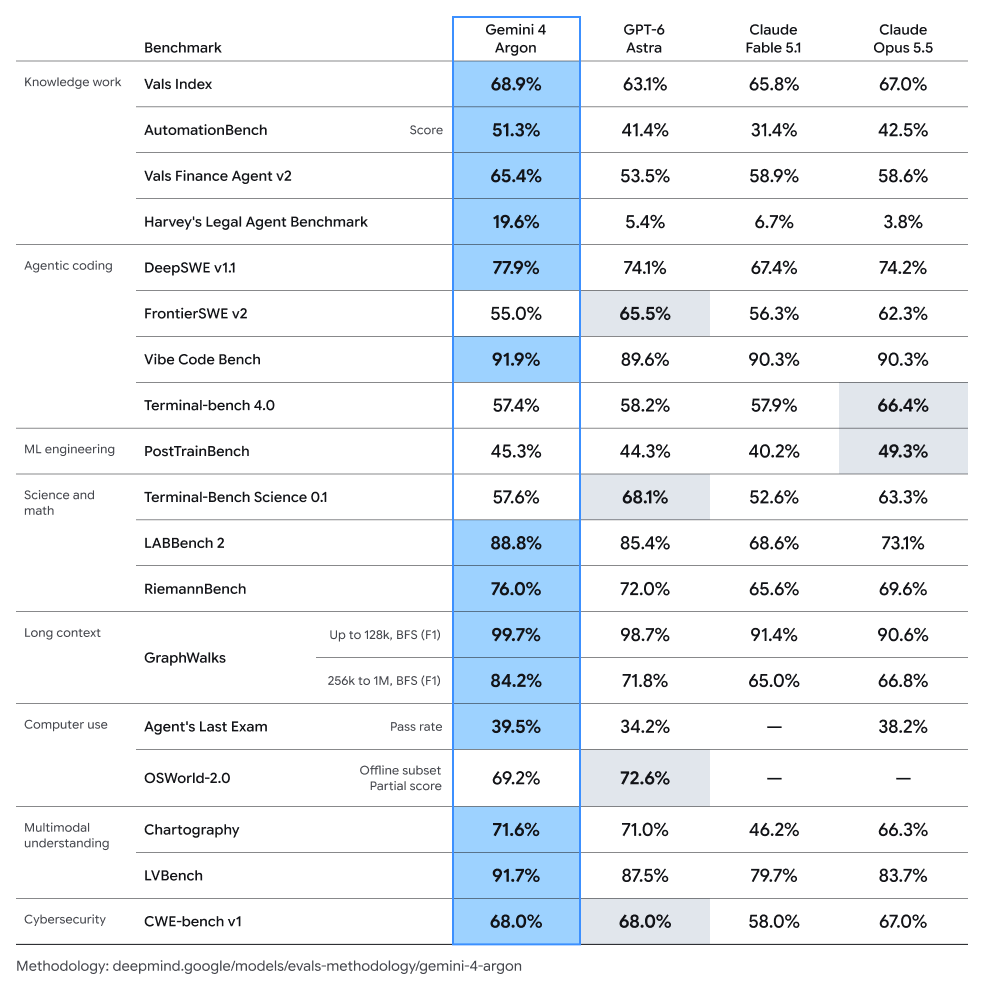
Google is back in the frontier race.
Looking like 2-3 places behind Anthropic and OpenAI based on these benchmarks.
But for example leading @ValsAI compiled benchmark.



Arska retweeted

A very material catalyst came about for Western supply chains from $AAOI, $SIVE / Jabil, to $LITE and Coherent:
The Trump administration is drafting a ban of new Chinese optical transceivers and DC devices.
Which would likely hit China’s Innolight, Eoptolink, and other Chinese optical interconnect supply chains.
"The agency would ban all imports of new transceiver models and then exempt many non-Chinese suppliers from the restrictions"
We'll likely see a larger bifurcation of supply chains with even greater importance put on Western players.

Arska retweeted

Nvidia's announcement of co-packaged optics entering mass production provides a boost to optical communications.
"Gilad Shainer, Senior Vice President of NVIDIA, announced that Co-Package Optics (CPO) has entered mass production."
"According to foreign media reports, Gilad Shainer announced at a recent technology forum that CPO has begun mass production. Switches developed by Nvidia in collaboration with its supply chain have been delivered to close customers and are also being deployed at Nvidia's own facilities. It is expected that a large number of switches with CPO technology will be introduced into AI factories around the world this year."


Arska retweeted
So Jensen himself went out to do damage control with $NVDA delays reports apparently:
1. Jensen Huang said no delays:
- 800V and rack-to-rack optical interconnects is progressing fully in line with the original plan with no material delay.
- Debunked the rumor that the next-generation flagship, Rubin Ultra, would be delayed until 2028 and said it would be on track to ship next year
- Rack system optimizations, like replacing Kyber with a new design are architectural optimizations, not impacting delivery timelines.
2. On ASIC competition: no loss of market share.
- Talked about how a leading frontier lab that previously relied heavily on internal ASICs has shifted nearly 50% of its compute load to Nvidia
3. On over-reliance on hyperscalers.
- AI frontier labs currently contributing to ~20% of demand.
- Traditional cloud providers, Nvidia provides Vera CPUs and high-speed networking
- Sovereign AI
🤖 Made with AI


Apparently there’s a new popular trend to bearpost trillion dollar companies.
Like $NVDA or $TSM.
By finding isolating technical details, then blowing it out of proportions by claiming their whole program is delayed.
-> if the company doesn’t respond, stock prices/sentiment are damaged.
-> if the company issues a response, they can’t go into detail since supply chains are confidential… but people still doubt them
-> Poster gain more impressions, then does it again with more views the next time.
Don’t quite think this is very healthy, with more folks copying that playbook. Especially around incentive structures.
Arska retweeted
Morgan Stanley note on CPO today. Key participants include:
- $SIVE, $COHR, and $LITE in laser supply
- Broadcom and Nvidia in switch platforms
- Lightmatter, Ayar Labs, Marvell/Celestial, and POET in optical engines and photonics,
- $TSM, $GFS, and $TSEM in silicon photonics foundry capacity
I’ve covered all of these before, like Tower Semi.
But I’m especially happy that Morgan Stanley validated my research that $SIVE is one of the critical global players in CPO.
A small $1.5B laser company next to your two leading $60B+ companies…
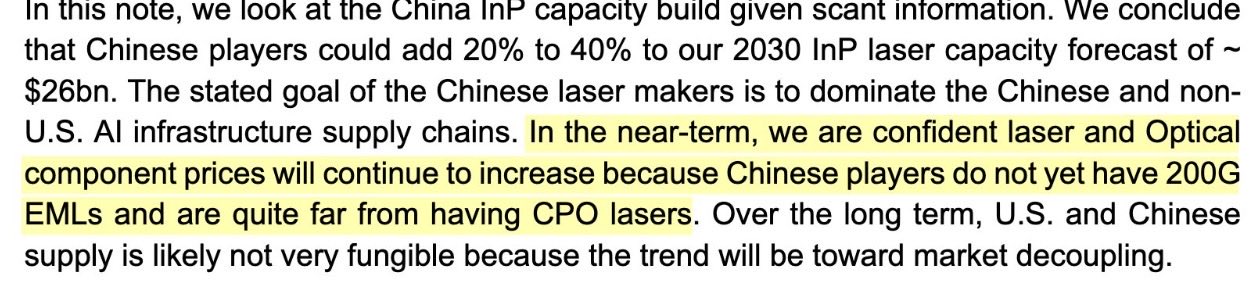
If you also synthesize Rosenblatt Securities recent note that China laser suppliers were quite far from having CPO lasers.
This kinda magnifies importance of the three Western leaders of that laser chokepoint.

Arska retweeted
Three new $SIVE insider purchases today.
Most notably: $SIVEF CEO Vikram bought 1,000,000 SEK worth of shares on the open market today.
This is following the massive drop on Sivers stock following 2 misleading CPO delay reports, Meta Compute headlines, and another insider sale report from another photonics director.
Typically, insider sells for any number of reasons. But having the CEO buy on the open-market is the clearest signal in management confidence.
Following $GFS, $JBL, and other laser supplier partnerships, and his goal of NASDAQ listing in the near term.
Feels like the CEO sees a clear potential for Sivers to become the next photonics giant (myself included).

$SIVE fell today on an EFN article claiming the photonics chief sold his entire holding — presented as alarming insider panic. Here is what I think the article can have missed.
Andrew McKee founded CST now Sivers Photonics in 1999— 27 years ago. He built the photonics business from scratch. Earlier this year Alex McCann appeared publicly as the new MD of Sivers Photonics in April/May communications. McKee moved totechnology role only. His Q1 and Q2 share sales seems to align with this transition and was probably sold (if sold at all in full) parts of it even before share re-rating.
My take is that is was done probably with no negative view on the company's prospects. A man monetizing his life's work after almost 30 years of building a company is not insider panic. IMO this is probably more a career ending on his own terms. He deserves it for sure. Even if he sold over 6 months, IMO this is still not a major negative signal.
Three things EFN did not check: A) Holdings has known blind spots — transfers to holding companies, ISK structures and family vehicles are not captured. Did anyone verify McKee holds zero shares in any structure? B) One option program was realized in early July. If McKee sold old shares to participate that is not a major negative signal (he is not insider hence would not report sell or buy) — Holdings would not show this yet since it was in early July C) The role change probably happened before most shares was sold, Context matters.
Later in the afternoon two board members has publicly shared insider purchases.
Todd Thomson — board member, former Citigroup CFO, — bought 535,000 SEK on-market today at 42.80 SEK into the panic. Karin Raj bought 460,000 SEK at 34.68 SEK — the intraday low. Both reported to FI same day. People with more information about the full picture, that also had been part of approving today clarifications around the Q-reports and US Nasdaq listing.
Update Vikram CEO have also aquired shares for approximately 1.000.000 SEK
Summing up: Journalism created the dip. Insiders bought it.
What's X view on today?

Arska retweeted
That’s a misconception:
$SIVE is the laser supplier for next gen architectures, not just CPO scale up.
Pluggable, scale out CPO, scale up CPO, NPO, etc.
- Sivers and $JBL went god-mode and developed 1.6T optical transceivers with CW lasers.
Effectively designing around the EML bottlenecks, and even made things more power efficient.
From quotes from Jabil management they created a “relatively dramatic moat”.
So for the next gen of 1.6T pluggable transceivers, Sivers seems immediately used.
Markets missed this nuance too: after Jabil’s announcement, other pluggable players reached out, and SIVE is working with them now (prob codevelopment, qualification stage).
There’s not too many players that build optical transceivers that aren’t vertically integrated like Lumentum (think: Innolight/eoptolink, and maybe others).
So these are active developments, just not public material yet and could be a new press release anytime.
- for CPO scale out which happens H2 2026 onward like $POET, $SIVE is a laser supplier for those players.
- scale up CPO is h2 2027, from Ayar and Nvidia’a NVLink CPO ecosystem and that’s the main volume ramp across optical players.
But this is where $SIVE looks like they mog every other player from supply chain mapping.
Since they’ve likely been working + designed in with $MRVL Celestial, Lightmatter, Lightelligence and the others since they were small way back when.
On top of things like this:
For foundries like $GFS, $SIVE is the reference laser.
Not even including massive companies like O-Net building ELS with $SIVE, likely for the Asian hyperscalers supply chains.
This is why $SIVE is by far my favorite laser chokepoint long.
Feels like they’re everywhere in new optical architectures starting beginning of 2027.

Arska retweeted

One of @aleabitoreddit most mentioned tickers $SIVE is still one of my favorite setups.
It’s laser arrays going into GF silicon photonics reference designs for CPO/LPO/optical engines.
If CW lasers become the scarce thing after $NVDA locked big capacity, Sivers is exactly the type of independent Western supply that gets strategic af.

