
London | founded Fern Labs (acq.) | ambulating, tomfoolering
Joined August 2019
- Tweets198
- Following366
- Followers185
- Likes2.6K




Sense of vertigo watching/reliving this, real artefact of the insanity of the past year
Best part imo is the predictions, adding a few of my own for future:
- Large numbers (i.e. >1000s) of wild persistent agents discovered
- LLMs-as-controllers becomes consensus, robots become a much larger part of next years soai
- This year we _will_ hit the 1b 1person co
- Labs agree to pause work on math
- Vibe-hardware explodes (🤞 figuratively)


welcome to the 9th annual @stateofai report!
ai building better ai, world models, physical ai, geopolitics, cyber defense and 12-month predictions.
read it at stateof(dot)ai or watch my editor’s cut here.
a few of this year’s biggest findings follow:


Nice write up, personally I’ve been using Instinct and getting a fair bit of value with not too much active set up on my side. It’s a nice onboarding and feels nice.
Glad personal agents are finally at the itjustworks stage
I do however feel I’d prefer a business model for my personal agents where I just pay for it as the easiest/most transparent way to align incentives


Truly required reading for any European founder, official, operator. Really brilliantly sums up our state
I remain hopeful; there is a massive amount to be done and changed. This can and should happen on all layers
Europe cannot rent its way to AI sovereignty.
TLDR, here's my take I shared with frontier AI lab leadership this week. When Washington can disable a model overnight, the question is not whether AI is safe but who controls it:
A week ago the United States government ordered Anthropic, the world's most valuable AI startup, to shut off its most capable model, Fable, for every foreign national on earth - whether they worked for Anthropic or not. This was not an export ban on a weapon sold to an adversary. It was an instruction to disable a commercial product, four days after its release, after officials acted on a claim - which Anthropic disputed as narrow and unproven - that its safeguards could be jailbroken to expose cyber-offense capabilities.
I have spent my career around this technology, first as a graduate student and for the past decade as an investor @airstreet. In that time I have watched AI move from recommending movies to driving cars, speaking with a human voice, and editing the genome. I have also watched the debate about its risks settle on only half the question.
That debate is mostly about capability: how powerful these systems are becoming, and whether one might escape human control. Those are real questions. But they are not the only ones, and the Anthropic episode exposed the half we have neglected: access and control. The most advanced AI is built by a handful of American companies, on American soil, under American law, and what the rest of us are allowed to do with it can change on a Friday afternoon. The risk that matters today is not only that AI goes rogue, but that we do not control access to it at all.
Consider what "renting intelligence" now means in practice. A European hospital triaging scans, a bank screening fraud, a defense ministry planning for a conflict: increasingly each runs on an American AI system that's governed by its export regime. A single directive in Washington cascades, instantly, through every institution wired to that model. We have built core economic and public infrastructure on a supply that a foreign government can shut off. And while there are open-source alternatives, they're either Chinese or not at the frontier, and building European infrastructure on Chinese open weights trades one dependency for a thornier one.
And these systems are starting to improve themselves. As they do, AI stops being one industry among many and becomes the input to all the others - writing the code, running the research, designing the products, and, increasingly, generating the growth itself. Once intelligence is the engine of an economy, a country without a frontier model of its own does not lose a sector; it loses control of the inputs to everything else, and the independence that depends on them. Worse, the gap compounds: capability that improves itself gets harder to chase with every month it runs ahead. This is not a race Europe can plan to enter in a decade. The window to be a builder rather than a buyer is measured in the time it takes to stand up a cluster, not a career.
This should sting, because Europeans invented much of modern AI. DeepMind was founded in London and sold to Google in 2014, and a great deal of the talent that followed now lives in California. Today Europe faces a company worth almost $1 trillion and American tech giants spending an estimated $450 billion a year on AI infrastructure. Its answer has been the EU AI Act and a capital commitment that is a rounding error by comparison. A single American site, xAI's Colossus in Memphis, runs more than half a million GPUs. Europe has nothing remotely at that scale. The instinct to govern this technology is right, but we're off on the ambition by orders of magnitude.
It is fair to object that regulation is itself a form of power. But a rulebook is not a substitute for the thing it governs. You cannot regulate, or be cut off from, an industry you do not have.
Europe's instinct, when it is cut off, is not to build but to ask. We saw it within the week. The G7 convened in Evian and floated a "trusted partners" scheme to win back the access it had just lost, while Emmanuel Macron feted Donald Trump beneath the gilt of Versailles, the palace where France once helped midwife American independence. Two and a half centuries on, the dependency has reversed, and the posture is courtship.
None of this means Europe can match the American frontier dollar for dollar. With today's capital, it cannot, and pretending otherwise only wastes the little it has. But the goal is not parity, it is leverage. A country does not need the best model in the world to be sovereign; it needs a credible one of its own, on its own soil, good enough that being cut off is survivable rather than catastrophic. That is the difference between negotiating your access from dependence and negotiating it with an alternative in hand. The point is not to win the race. It is to make sure no one else can end it for you.
Sovereignty of that kind is something you build, and Europe has done it before. The Financial Conduct Authority's regulatory sandbox, launched in 2016, let startups test products with real customers under supervision instead of waiting years for authorization. The pro-innovation culture it signaled helped make London the fintech capital of Europe, home to Revolut, Wise, and Monzo. Government should be AI's most demanding early customer rather than writing rules for systems it has only ever imported.
Industry has to stop behaving like a tenant. Too many European companies rent the entire stack from American providers and build a thin product on top. That earns a margin and owns nothing: when the lab that supplies you decides to compete with you, or its government decides to cut you off, you have no ground to stand on. Where it counts, build and hold your own models and compute.
And our universities, which should be the source of all this, still work against it. I have argued here before that Europe's spinout system is broken, and it remains so. Too many institutions treat the companies their research creates as something to extract value from, rather than as the vehicle through which a discovery reaches the world. The best research should leave the building as a company, in addition to a paper.
We keep framing AI safety and AI ambition as a tradeoff, as though a country must choose between governing this technology and building it. It is not a choice. The safest position is not the most heavily regulated one. It is the one where the model runs on your terms, in your jurisdiction, and no one on the far side of an ocean can reach over and turn it off. Right now that finger is not ours. Until it is, every other conversation about AI risk is one we are having with someone else's permission.
---
END
Ash Edwards retweeted

poolside.ai/blog/introducing…
Everything will be open going forward from us

Zaki and Martin were pushing llm product ideas in the davinci days, ridiculous foresight and technical vision. Way ahead of everyone else.
And Tilman’s truly a LS goat, and just delightful.
Very bullish, and happy they have got an investor of equal calibre!
i'm excited to unveil a $12m round for @perceptictech, operationalizing frontier ai systems to transform biopharma from @airstreet @accel elder gull and angels from ai labs
@ashedwardst of fern labs (now @poolsideai) intro'd me to tilman (ceo) who was spinning up a newco in ai for science after his 7 year stint at palantir
since then, a) biopharma has materially revved up its appetite to transform itself from within with frontier ai systems and b) ai labs are pointing their attention to science too
now is the time to build a new ai-first software company to power the biopharma industry writ large
working with martin copes and zaki trache - of palantir aip lore - with whom i have way too many mutual pal friends, was the right crew to do this with
we're already live in top-20 pharma accounts speeding up a number of critical workflows with much more to come
more from me via @airstreetpress below
join us!

Ash Edwards retweeted

shimmer also runs entirely on your phone. An instant-on VM, with Poolside Agent in split screen and a full dev environment - pinch me
shimmer.run
Ash Edwards retweeted

Today we’re releasing Laguna XS.2, Poolside’s first open-weight model.
It’s a 33B total / 3B active MoE model built for agentic coding and long-horizon tasks.
Trained fully in-house on our own stack. Runs on a single GPU. Released under Apache 2.0.
Links 👇
Weights: huggingface.co/poolside/Lagu…
API: platform.poolside.ai/
Blog: poolside.ai/blog/laguna-a-de…

Ash Edwards retweeted

Excited to share that @lmnrai has raised $3M to build open-source observability for long-running AI agents.
Laminar is how companies like @browser_use, @OpenHandsDev, and Rye see what their agents are doing, understand why they fail, and spot patterns across millions of runs.

“slopacolypse”

A few random notes from claude coding quite a bit last few weeks.
Coding workflow. Given the latest lift in LLM coding capability, like many others I rapidly went from about 80% manual+autocomplete coding and 20% agents in November to 80% agent coding and 20% edits+touchups in December. i.e. I really am mostly programming in English now, a bit sheepishly telling the LLM what code to write... in words. It hurts the ego a bit but the power to operate over software in large "code actions" is just too net useful, especially once you adapt to it, configure it, learn to use it, and wrap your head around what it can and cannot do. This is easily the biggest change to my basic coding workflow in ~2 decades of programming and it happened over the course of a few weeks. I'd expect something similar to be happening to well into double digit percent of engineers out there, while the awareness of it in the general population feels well into low single digit percent.
IDEs/agent swarms/fallability. Both the "no need for IDE anymore" hype and the "agent swarm" hype is imo too much for right now. The models definitely still make mistakes and if you have any code you actually care about I would watch them like a hawk, in a nice large IDE on the side. The mistakes have changed a lot - they are not simple syntax errors anymore, they are subtle conceptual errors that a slightly sloppy, hasty junior dev might do. The most common category is that the models make wrong assumptions on your behalf and just run along with them without checking. They also don't manage their confusion, they don't seek clarifications, they don't surface inconsistencies, they don't present tradeoffs, they don't push back when they should, and they are still a little too sycophantic. Things get better in plan mode, but there is some need for a lightweight inline plan mode. They also really like to overcomplicate code and APIs, they bloat abstractions, they don't clean up dead code after themselves, etc. They will implement an inefficient, bloated, brittle construction over 1000 lines of code and it's up to you to be like "umm couldn't you just do this instead?" and they will be like "of course!" and immediately cut it down to 100 lines. They still sometimes change/remove comments and code they don't like or don't sufficiently understand as side effects, even if it is orthogonal to the task at hand. All of this happens despite a few simple attempts to fix it via instructions in CLAUDE . md. Despite all these issues, it is still a net huge improvement and it's very difficult to imagine going back to manual coding. TLDR everyone has their developing flow, my current is a small few CC sessions on the left in ghostty windows/tabs and an IDE on the right for viewing the code + manual edits.
Tenacity. It's so interesting to watch an agent relentlessly work at something. They never get tired, they never get demoralized, they just keep going and trying things where a person would have given up long ago to fight another day. It's a "feel the AGI" moment to watch it struggle with something for a long time just to come out victorious 30 minutes later. You realize that stamina is a core bottleneck to work and that with LLMs in hand it has been dramatically increased.
Speedups. It's not clear how to measure the "speedup" of LLM assistance. Certainly I feel net way faster at what I was going to do, but the main effect is that I do a lot more than I was going to do because 1) I can code up all kinds of things that just wouldn't have been worth coding before and 2) I can approach code that I couldn't work on before because of knowledge/skill issue. So certainly it's speedup, but it's possibly a lot more an expansion.
Leverage. LLMs are exceptionally good at looping until they meet specific goals and this is where most of the "feel the AGI" magic is to be found. Don't tell it what to do, give it success criteria and watch it go. Get it to write tests first and then pass them. Put it in the loop with a browser MCP. Write the naive algorithm that is very likely correct first, then ask it to optimize it while preserving correctness. Change your approach from imperative to declarative to get the agents looping longer and gain leverage.
Fun. I didn't anticipate that with agents programming feels *more* fun because a lot of the fill in the blanks drudgery is removed and what remains is the creative part. I also feel less blocked/stuck (which is not fun) and I experience a lot more courage because there's almost always a way to work hand in hand with it to make some positive progress. I have seen the opposite sentiment from other people too; LLM coding will split up engineers based on those who primarily liked coding and those who primarily liked building.
Atrophy. I've already noticed that I am slowly starting to atrophy my ability to write code manually. Generation (writing code) and discrimination (reading code) are different capabilities in the brain. Largely due to all the little mostly syntactic details involved in programming, you can review code just fine even if you struggle to write it.
Slopacolypse. I am bracing for 2026 as the year of the slopacolypse across all of github, substack, arxiv, X/instagram, and generally all digital media. We're also going to see a lot more AI hype productivity theater (is that even possible?), on the side of actual, real improvements.
Questions. A few of the questions on my mind:
- What happens to the "10X engineer" - the ratio of productivity between the mean and the max engineer? It's quite possible that this grows *a lot*.
- Armed with LLMs, do generalists increasingly outperform specialists? LLMs are a lot better at fill in the blanks (the micro) than grand strategy (the macro).
- What does LLM coding feel like in the future? Is it like playing StarCraft? Playing Factorio? Playing music?
- How much of society is bottlenecked by digital knowledge work?
TLDR Where does this leave us? LLM agent capabilities (Claude & Codex especially) have crossed some kind of threshold of coherence around December 2025 and caused a phase shift in software engineering and closely related. The intelligence part suddenly feels quite a bit ahead of all the rest of it - integrations (tools, knowledge), the necessity for new organizational workflows, processes, diffusion more generally. 2026 is going to be a high energy year as the industry metabolizes the new capability.

personal sidequests to publicly fact check/rebuke over-promising startups is good for the system
natural antibodies to grift
who’s building this

TL;DR
Goalposts shifted
New surprise, core details of Pickle 1 revealed after pushback (I suspect these aren’t real)
No comment on Pickle’s company history and team’s lack of experience
—
I have a follow up article in the works with more information on Pickle’s history. Some of these things surprised me!
I suspect the “technical” details of Daniel’s response (particularly the power draw breakdowns) are preposterous, so I’ll be bringing in hardware engineers for deeper analysis.
Daniel also misconstrued my argument around FOV.
30+ degree FOV is possible as I said, just not on Pickle 1 (if it somehow exists).
Stay tuned!
very pleased to announce fern labs has been acquired by poolside!
now onto building the most ambitious large-scale multi-agent systems for some of the hardest problems out there.
thanks for backing fern from day zero @nathanbenaich, has been an absolute pleasure! 🫡
news! @poolsideai has acquired @fern_labs, in which @airstreet was the first and sole investor - and a first investor into poolside as well.
i met @ashedwardst in late 2024 before fern had a name or team. his technical depth, product taste and ambitious were 🔥
fern pushed long-horizon agents far beyond what public evals thought possible 👀
and by combining with poolside, we have a full-stack frontier ai company with the capabilities to delivery long-running, frontier multi-agent systems for complex enterprise and government workflows
thanks to @eisokant and @jasoncwarner for your continued partnership and for seeing what i saw in @ashedwardst @alexgoddijn and taylor at @fern_labs
more on the story below!

The most in-depth, accurate, on-the-ground look of where ai is today, to think about where it is going
🪩The one and only @stateofai 2025 is live! 🪩
It’s been a monumental 12 months for AI. Our 8th annual report is the most comprehensive it's ever been, covering what you *need* to know about research, industry, politics, safety and our new usage data.
My highlight reel:
Notes from testing Sonnet 4.5 over long-horizon (multi-hour) tasks:
1. It "gets" that it's working with other agents/on long-horizon tasks (i.e. referencing other future agents in it's thoughts, thinking about its task in relation to others, etc)
2. Starting to lay memory trails for itself, i.e. at the end of the readme added **For Next Agent**: Read QUALITY_STANDARDS.md first! Build Step 4 with zero bugs.
Can see this being quite powerful.
3. For now, this does still result in too many duplicative docss (readme, final_summary.md, handover_doc_final.md, etc)
4. Much better at picking up visual bugs. I suspect it's been trained to follow up images with "I can see:..." or "notice...". meaning it picks up on much more. This was a big issue with old sonnet which would just not 'see' incredibly obvious UI bugs unless pointed out
5. Nice, clear, no frills writing. For comms-style, first impressions, Sonnet 4.5 > gpt-5 thinking-high > opus 4.1 > everything else
Overall quite a promising start!
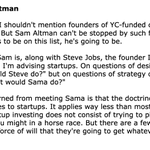
@paulg, 2009, on his 5 most interesting founders.
Would love to see a modern revisit of this essay.


Ash Edwards retweeted
That being said,
Currently at 40 minutes of complete @openrouter system outage - the parts of our system that rely on it now don't work.
I'm an OpenRouter fan but we cannot really have our production system rely on this. And no update on X or anything about when this might be resolved.
If the value add is better uptime, can't really have systems-wide failure for this long.
We now either need to accept this as a risk or build a fallback system ourselves which defeats the point a bit.
@alexatallah