

Joined September 2013
- Tweets15.2K
- Following2.6K
- Followers1.8K
- Likes352K




Pinned Tweet
Memory is still priced by the market like a commodity.
But structurally, it might actually be the sector with the highest barriers to entry long-term among all other semis.
Hyperscalers can design custom CPUs, accelerators, and ASICs to reduce reliance on incumbent GPU/CPU chip designers.
AWS is making its own CPUs, Google is making its own TPUs (to replace GPUs).
But leading-edge memory is a different game.
It is less about architecture alone and more about manufacturing depth: scale, yield, process control, capex discipline, and decades of accumulated know-how.
None of the hyperscalers can realistically build leading-edge memory.
$MU $000660 $402340
Asymmetric Focus retweeted

*MICROSOFT EARNINGS CALL SUMMARY $MSFT
-90% OF CLOUD REVENUE FROM NON-FRONTIER MODEL CUSTOMERS
- SEES FY2027 TOTAL REVENUE UP DOUBLE DIGITS
- CY2026 CAPEX ~ $175B, WILL GROW CY2027
- COPILOT REVENUE +60% Q/Q - ENTERPRISE DEPLOYMENT +75% Q/Q
- Q4 BACKLOG +25% (W/O OPENAI)
Asymmetric Focus retweeted

SK Hynix missing numbers is BULLISH for SK Hynix. I'm serious. Hear me out.
The Korean analyst who predicted the Q2 miss said it happened because SK Hynix has a higher HBM mix.
HBM is the more durable, higher-moat business that should command a higher multiple. HBM is in major shortage the next several years. SK Hynix is number one in HBM. Just see how Dario, Sam, Hock, and Jensen appeared to greet HBM makers in SF last week.
In the short term, the higher DRAM-mix players benefit, but long term it's a detriment as China will eventually enter the DRAM space one to two years out with more capacity. China will be no where in HBM.
So a Q2 miss caused by more HBM mix actually means SK Hynix is BETTER positioned in the long run. Don't listen to me, listen to the Korean axe who has a Buy rating, a very high PT, and nailed the mechanics of this quarter.


SK HYNIX $SKHY Q2’26 EARNINGS HIGHLIGHTS
🔹 Revenue: $54.6B (Est. $57.7B) 🔴; -5.4%
🔹 Operating Profit: $41.6B (Est. $44.2B) 🔴; 76.3% operating margin
🔹 DRAM ASP: +~30% QoQ
🔹 NAND ASP: +mid-50% QoQ
2026 Market Outlook:
🔹 DRAM Demand Growth: +mid-20% YoY
🔹 NAND Demand Growth: +high-teens% YoY
Business Highlights:
🔹 Long-Term Supply Agreements: 10 customers
🔸 Smartphone and PC sales temporarily adjusted on challenges securing memory volumes; growth expected to recover as supply tightness eases
🔸 Big-tech customers expanding infrastructure investment and memory procurement on surging AI service growth and a shortage of computing capacity


Asymmetric Focus retweeted

A couple of important points regarding CXMT competitiveness:
1. CXMT will always have a cost/bit disadvantage as they don’t have access to EUV machines. Samsung uses up to 7 layers with EUV while SK Hynix uses 5 (ramping toward 6 on 1c DRAM). Doing these layers using DUV requires multipatterning that reduces throughput. So CXMT will not be able to catch up to Korean or American tech companies on cost per bit basis,even with good yields.
2. HBM logic die requires access to manufacturing at leading-edge nodes. Samsung makes HBM logic die in-house (4 nm for HBM4, with plans for more advanced nodes later). SK Hynix does it at TSMC 12 nm (with higher-performance options such as 5 nm or 3 nm under consideration for later generations). CXMT will have a severe disadvantage there too.
Asymmetric Focus retweeted

My increasingly strong opinion is that compute is the biggest moat in AI.
Scientific breakthroughs don’t stay secret for long. Papers get published, researchers move, ideas leak, open source catches up. Give it enough time and almost everyone has access to roughly the same algorithms.
What doesn’t diffuse nearly as fast is the ability to run 10x bigger training runs, collect 10x more RL experience, serve billions of inference tokens, and iterate faster because you can afford thousands of experiments in parallel.
Scaling compute is brutally hard. It’s GPUs, power, substations, networking, cooling, land, permits, supply chains… and hundreds of billions of dollars. You can’t just decide to build that overnight.
The more I look at the industry, the more it feels like the frontier is less about having one genius idea and more about who can compound compute the fastest. Scaling laws reward whoever can keep scaling. That’s a very hard moat to replicate imo!

BREAKING: Nvidia is in talks with OpenAI to guarantee $250 billion in financing for a data center in Ohio.
Details include:
1. The guarantees from Nvidia would help OpenAI lease a 10GW project that SoftBank is developing in Ohio
2. In total, the project could cost more than $500 billion, the largest data center project ever announced
3. The power for the project is controlled by the US government and funded separately by Japan under a recent trade deal
4. Commerce Secretary Lutnick is reportedly involved in deciding who will get the power
The data center buildout just hit a whole new level.
Asymmetric Focus retweeted

“38x slowdown once shuffle data exceeds available DRAM and spills to SSD.”
From a joint Micron/Meta white paper.
The DRAM bottleneck almost certainly lasts the longest.
OP from @jukan05

Asymmetric Focus retweeted
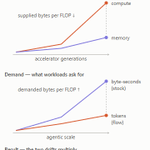
Jensen Huang tells Bloomberg that Nvidia is constrained by shortages of HBM and LPDDR memory, land, power, and construction workers. Basically, the chip maker is supply constrained versus demand.
"I think we have the ability as an industry to double each year, but we're going to have a hard time growing much faster than that"
IS DOUBLING REVENUE EACH YEAR IN YOUR MODELS?
Asymmetric Focus retweeted

UBS on Samsung Electronics (005930.KS): “Agentic AI keeps pushing pricing higher”
UBS says the memory upcycle is getting stronger because agentic AI is widening demand beyond HBM into DDR5/LPDDR5 server memory and NAND for KV cache + storage. This is not just a “Samsung catches up in HBM” call; the bigger point is that conventional memory may stay undersupplied into 2028 while Samsung has more capacity flexibility than peers.
Key proof points:
• UBS now sees DRAM bit end-demand accelerating to +36% YoY in 2027 vs +21% in 2026
• NAND bit demand moves to +23% in 2027 vs +20% in 2026, with no meaningful new non-China NAND capacity
• DDR and NAND contract pricing ex-LTA could rise +17% QoQ in 3Q26 and +12% in 4Q26
• Samsung could get ~60% of server DDR5 covered by LTAs, with 60–70% of volume fixed
• HBM shipments were raised to 11.0bn Gb in 2026 and 24.0bn Gb in 2027
Why it matters:
The market usually debates Samsung as an HBM execution laggard versus SK Hynix. UBS is reframing it as a broader memory scarcity story: HBM is absorbing DRAM wafer capacity, DDR5 demand is improving, NAND is tightening, and Samsung has P4/P5 capacity optionality that could matter more as customers scramble for supply.
HBM angle:
UBS thinks Samsung has improved HBM4 yields and performance, though thermal issues may not be fully solved. Even so, UBS forecasts Samsung reaching 41% HBM bit share in 2027 vs SK Hynix at 39% and Micron at 20%.
Pricing / model angle:
UBS is lifting 2026E/2027E operating profit by +14%/+27%, putting its 2026E/2027E OP forecasts 28%/62% above Visible Alpha consensus. The model is basically saying memory pricing power is still under-earning in consensus.
Capital returns:
If Samsung sticks to returning 50% of FCF ex-M&A, UBS estimates extra shareholder returns of Won117tn in 2026E and Won261tn in 2027E on top of regular quarterly dividends.
UBS view:
Buy / APAC Key Call Buy, PT raised to Won550,000 from Won400,000. Upside case is Won750,000, downside case Won200,000. Main caveat: memory industry revenue is approaching US$1.6tn in 2027E, so affordability becomes the key risk if pricing keeps ripping.


Asymmetric Focus retweeted

UBS points out that open-source models are generally more memory-intensive than frontier models because context windows are longer and KV-cache requirements continue to grow in absolute terms, even with quantization, making open-source deployments more HBM- and storage-intensive
Memory bros can’t stop winning


Asymmetric Focus retweeted

This is why we own SK Square ($402340.ks) instead of owning SK Hynix ($000660.ks) or $SKHY (ADR)
SK Square (SK local) trades at a -55% discount to SK Hynix (SK local) and SK Hynix (local) trades at a -30% discount to $SKHY (ADR).
This means SK Square (local) trades at a -68% discount to $SKHY
SK Square owns ~20% of SK Hynix (equity)
SK Hynix owns ~30% of Kioxia (equity & converts)
NFA.
DYOR.
*We are long SK Square (local) at @FirstWaveFund


SK Hynix (local) ie A000660.KS is now trading at a 43% discount to $SKHY (SK Hynix ADR, up +23% today) which should mean that SK Hynix (local) will be up significantly tonight when the KOSPI opens for trading at 8pm EST.
Additionally, SK Square which owns 20% of SK Hynix (local) is trading at a 40-50% discount to SK Hynix (local).
Add it up and SK Square is currently trading at a massive discount to $SKHY -- this gap will likely tighten up in the coming weeks/months.
**We own SK Square at @FirstWaveFund


Asymmetric Focus retweeted
Kimi K3 may be an important inflection point for AI. Potentially negative for Anthropic and OpenAI while being net positive for essentially every other company in the world. I mean that very literally. Although the real “Sputnik moment” would be an open-source frontier model that was also token efficient unlike Kimi K3 which is 50-70% more expensive to run than GPT 5.6 per Artificial Analysis.
Rationale:
A world where there are only 2-3 dominant frontier labs with 90% inference margins is net negative for every other layer while being awesome for those 2-3 labs. Those labs would become monopsonies for power, data centers, semiconductors and hyperscalers and would obviously vertically integrate over time into all those layers while also completely subsuming the application/software layers.
Anything that lowers margins and increases competition at the model layer is good for every other AI layer: power, semiconductors, hyperscalers, neoclouds and yes even software.
This is why Jensen is so supportive of open-source. An open-source model requires the *exact* same amount of compute to run as a closed frontier model of similar size and architecture. Kimi K3 is roughly the same price as GPT 5.6 Terra on a per token basis, which actually suggests that it is less computationally efficient as I am sure that GPT 5.6 is priced to a higher margin than K3. And given that K3 is a token wastrel, i.e. token inefficient, it is significantly more expensive per task than GPT 5.6 and Grok 4.5, which are much more token efficient. Cost per token and token efficiency (i.e. intelligence density per token) are the drivers of intelligence per unit of cost. The winning AI companies will be those that offer the most intelligence per $ over time.
Lower margin % at the model layer = more margin $ at every part of the infrastructure layer and is a godsend for software. This can happen either through open-source models like K3 at the frontier *or* having a vertically integrated model company like Meta, SpaceX or Google at the frontier. Both outcomes result in a lower margin % at the model layer as vertically integrated model companies don’t really care where the margin $ come from. This is why it was so painful for OpenAI and Anthropic when Google was right there with them from a model competitiveness perspective and why Grok 4.5 and Muse 1.1 were just as important as Kimi K3.
The reason Kimi K3 is only *potentially* negative for Anthropic and OpenAI is 1) the @ericvishria point that the Claude and ChatGPT products and harnesses may be more important than their models today and 2) the hypothesis that they have much more advanced model checkpoints internally that are already being used for RSI. In the latter scenario, reaching RSI even a few months ahead of other labs might be enough to cement a permanent lead.
Time will tell on both points. And likely fairly quickly.
Caveat would be that since Kimi K3 is not token efficient and thereby actually more expensive than ChatGPT 5.6, we may need to see a more token efficient open-source model at the frontier or see Grok 5/Composer 4/Muse 2 at multiple points on the Pareto frontier for this potential risk to Anthropic and OpenAI to play out. And I am sure they will both vertically integrate as quickly as possible while continuing the product/harness strength they have shown over the last 8 months.


Asymmetric Focus retweeted

Furthermore, since the weights occupy more than 1.5 TB of HBM capacity, the KV cache for K3’s KDA and Gated MLA will need to be offloaded to CPU DDR5 and NVMe, even at relatively low user concurrency, because little space remains in HBM. 6/8🧵
Asymmetric Focus retweeted

CLSA is bullish on SK Hynix. It sees massive upside ahead.
CLSA just hiked its 12-month target price for SK Hynix (#000660) to ₩3,700,000. It maintained its High Conviction Outperform rating.
After a roughly 37% correction from recent highs, analysts see this as the perfect entry point into a structural supply shortage that will last through 2030. AI server demand is exploding. It is overwhelming chip production capacity for years to come.
Q2 operating profit is expected at ₩63 trillion. That is slightly below estimates due to HBM4 timing. But nothing structural. CLSA calls 2027 the worst memory shortage in history.
Biggest catalyst? An eye-watering ₩230 trillion in shareholder returns planned for 2026-2027 through dividends and buybacks.


#하이닉스 #CLSA
1. SK하이닉스의 12개월 목표주가를 370만 원으로 상향 조정하며 '강력 매수(High Conviction Outperform)' 의견을 견지함.
2. 최근 고점 대비 약 37%에 달하는 주가 조정을 2030년까지 이어질 구조적 공급 부족 국면에서의 결정적 매수 기회로 평가함.
3. 2분기 영업이익이 63조 원으로 예상치를 소폭 하회할 것이나, 이는 HBM4 양산 시점 차이에 따른 일시적 현상에 불과함을 명시함.
4. 2027년을 역사상 최악의 메모리 부족 시기로 규정하며, AI 서버 투자 확대가 2030년 이후까지 공급 능력을 압도할 것으로 전망함.
5. 2026~2027년 사이 약 230조 원 규모의 압도적인 주주 환원이 단행될 것으로 기대함


Asymmetric Focus retweeted

$MU
Do we all understand that agentic AI needs memory like humans need water?
It has to recall all the steps and operations.
The last two weeks were tough but I still believe we are in the first half (maybe quarter) of this story.
This quoted post is unavailable.
Asymmetric Focus retweeted

Roughly 3.5 years ago I put c.£15k into
$RKLB, December 2022 and then followed my money with a further c.£15k in 2023. I could not believe the price I was paying for the shares $4 - $5. This was probably one of the best investments I've made, returning more than 20.00x
I thought I would never find an opportunity as obvious or as mispriced again, but here I am again in disbelief... I genuinely cannot believe that Samsung Preferred's are trading at a 3.00x - 3.50x FY27 PE multiple. This to me is the most obvious investment in the entire market, Samsung Electronics is the most profitable company in the market... with:
> Extremely clear forward demand from the AI industrial revolution
> US, Korean and Chinese governments, and many other nations, currently "all in" on the sector
> Extreme barriers to entry for new suppliers, technology, equipment, know how, etc.
> Extreme secondary demand waves due to come into play and compound from 2030 and beyond with level 2 cars and robotics.
Samsung Preferreds are my largest position
My only frustration is that its a bit boring, I can't brag to you guys about finding some niche unknown stock, I can only point at the obvious that is right in front of you.
The emperor is wearing robes and they are very nice
#partyinkorea