

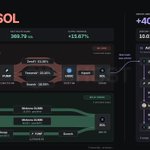
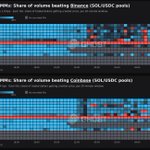


Atomic Arb is not a substitute for good routing
User lost 50.11 SOL to poor routing
Mriya captured 40.1 SOL arb profit
Even if 100% of that is rebated to the user (unlikely), they're still out 10 SOL
If it turns out apps themselves profit from this, their incentives are misaligned with users. The worse the execution, the more the atomic arb profit.

u8 retweeted

Validators! CVE-2026-98432 is patched in the linux kernel but not yet patched on ubuntu. Here's what you need to do if you're running ubuntu:

upgraded our replay runtime (for recent epochs) to 4.4 and now replaying at 20-24 slots/s
2 epochs replaying concurrently on a 9275F

transaction execution in agave 4.4 is significantly faster btw, notice where @cryptomeleabs upgraded

Ghost RouterEval is pretty good at spotting inefficiencies


Building a router, Part III
We took past trades and replayed them through our router against the same onchain state they originally executed in. Compared that to what users actually got
In this trade, better routing would have returned ~1,000 bps more, worth ~$600 to the user.
As more trading moves onchain (incl tokenized securities), evals for execution quality become more important than ever: "what did I receive" vs "what could I have received"
More on this in our talk at Scale or Die at BP2026

Spent a bit of time this morning looking into this
Based on this initial examination, I believe at least 1 relay solver may be leaking private intent data to sandwichers
Looking at the RH sandwich attacks conducted by these bots(*), every single sandwich contained at least 1 victim from Relay
One interesting thing to note about this is that often the swaps have multiple pools they can route through and Relay solvers do a primitive (**) form of onchain routing where they swap multiple candidate routes, reverting each one, and then selecting the best one to run. So that means the attackers have to perturb the pool just enough that they can profit but not so much that the solver routes through another pool
(*) Subset of bots where 100% of sandwiches have >=1 Relay victim (search period: last 6 days)
0x44c0ba0b734d4b7705fcd07ddae9fbbc078d74dd
0x38b3f8125bbbd45b56d0c3a535b90181d7dd3880
0x2a23c6d2522f07d230abf9c7a96d703520fd222b
0x18e0efe5be1cbb4e060c26f7f16f276be4dbc38c
0x9d61ad5c82586ae118af38e1cc68c8d1ad50771a
(**) by primitive onchain routing, I don't mean it in a negative way, just that it's the simplest way

Hey @fomo, @seyong and @RelayProtocol, check your team or partners: someone is front-running your users (sandwich attack) on the Robinhood chain, likely using private order info.
Wallet: 0x44c0ba0b734d4b7705fcd07ddae9fbbc078d74dd
Contract (since Sep 24): 0x68a04a63fd1d8eabf167ef48ed0a0ef06c2374d9
Solver affected: 0xccc88a9d1b4ed6b0eaba998850414b24f1c315be
Impact on your users: ~$14k+ in the first day
Sandwich attacks: 328
Typical lead over your solver: 1–4 blocks
Solver volume hit: ~$412k
