

Dermatopathologist (Derm trained Dermpath) It was love at first slide. Data analysis, Debates, Philosophy. https://teapaw.org/t.co/jJQcOXJykn
Joined December 2019
- Tweets50.1K
- Following1.1K
- Followers28.8K
- Likes12.4K


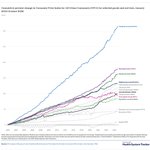



I like KFF, but this is one of the most misleading graphs in healthcare analysis.
The reason is simple: The categories listed aren't actually composed of things the label implies.
For example: If you go to a hospital and receive prescription drugs there, you might expect the cost to go under "prescription drugs and medical goods", but so long as the medication is administered by a provider, that cost (including the cost of the drug itself) never makes it to that category. Instead it gets filed under "Inpatient & Outpatient care".
And it's not just drugs, even hospital administrative fees don't even show up in the "Administration" category. That gets quietly filed under "inpatient & outpatient care" too.
In fact, the green "Administration" bar only covers governmental program admin plus insurer overhead. It explicitly excludes other administrative expenditures. Billing, coding, prior authorization, revenue-cycle work...all of that never makes it to the Admin category. It just gets chewed up by "inpatient and outpatient care".
There are other problems aside from misclassifications too, for example long term care costs in the US are likely to be understated as home-based LTC is not reported...but even before we get to those issues, the "inpatient and outpatient care" is just so broad, it might as well be called "healthcare".

Source:
healthsystemtracker.org/brie…

1
1
259
Waiting time to see a specialist was ~7 days, and waiting time for elective surgery was also ~7 days.
For my dog.
3
39
2,193
Avi Bitterman, MD retweeted

WSJ: Ukraine used Israeli Starlink alternative to strike the Crimean Bridge.
Ukraine’s Armed Forces first used the HiSky satellite system to suppress Russian air defences in Crimea, and then to attack the bridge.
Unlike Starlink, HiSky works both in Russian-occupied Ukrainian territories and in Russia.
The system is more complex to operate and requires specialised personnel, so it is used only for particularly important operations.
Ukrainian military officials previously denied using Starlink or Starshield in attacks on the bridge but did not disclose which communications system they used instead.

Avi Bitterman, MD retweeted

Time to dust off this pearl...yes professionals in US get paid more than other countries. Especially economic professors

And now I make every argument @Jabaluck made about physicians making too much and adding to healthcare costs, only with professors adding to higher education costs (THREAD)


Doctors are paid more in the US than other countries mainly because the US has higher incomes for all sorts of jobs at given percentiles of the overall US income distribution, rather than differences in physicians relative locations in the income distribution.
In other words: doctors are paid what you would expect them to be paid in the US based on how income inequality works in the US. If you accept the US income inequality, you should accept that doctors aren't overpaid.
And if you don't accept the US income inequality rates, you should at least look at physician "overpayment" as not much unique about physicians but mainly a consequence of broad inequality across numerous professions in a country where income inequality is a reality.
I'll also note that I don't think mere income inequality issues is the sort of thing people mean when they say doctors are overpaid. They seem to mean it in a sense that it's fairly unique to the physician profession. Not just that they have a broad problem with income inequality and doctors just so happen to be on the naughty side of the income distribution among many other overpaid professions.
For example, a view that insists physicians are overpaid because all sitters on the naughty side of the income inequality distribution are overpaid would likely commit one to saying things like US Nurses are overpaid too (average nurse income is also highest in the US) and they should earn less. But very few people pushing the doctors are overpaid view seem to extend the logic to nurses, even to a lesser degree. So it doesn't seem to be merely income inequality concerns motivating the overpayment claim.
Maybe it's because of some conjunction of income inequality concerns + high earnings, but even then there's other professions that would meet such a criteria but yet seem to avoid the wrath of the righteously indignant lunatics rabidly frothing at the mouth over physician pay being high, while pretending that reducing the 8% of healthcare spending attributable to physician salaries would make a meaningful difference, as opposed to a relative dent in a colossally larger problem.
I'll leave that mystery as a psychological exercise to the interested reader.


Yup, that's correct. The real cap isn't going to be how much you can force the taxpayer to fund more Medicare residency spots, but rather how much capacity exists that could offer sufficient resident education, but currently don't.
At least for surgery, the most favorable estimate is only a 25% increase. I suspect reality will yield an even lower figure due to unexpected shortcomings.


I didn’t actually realize this, but I think the ‘real cap’ is educational experience on offer. I would be very interested to see how many large facilities/systems that don’t already have residency programs have the faculty and case volume for meaningful residencies to be added.
I’m not saying there aren’t, I honestly don’t know…but I would think you could point Ai at the numbers across the country and see how much residency ‘headspace’ we have to take advantage of.
Source for 25% figure:
pubmed.ncbi.nlm.nih.gov/2660…

203
Avi Bitterman, MD retweeted

Why would I sacrifice my potential earnings because some rando thinks “you make enough money”?
Why should I accept lesser pay because I’ve chosen a field to help people?
I grew up with a desire to help people, that’s why I became a doctor. But the moment anyone else starts trying to dictate unilaterally, what my work is worth, is the day I’ll stop.
I will not sacrifice my earnings because someone else thinks I should for some elusive moral reason.
I’ll be very clear here. My number one responsibility is to provide the absolute best quality of life for my family. If anyone thinks their own well-being is more important than that of my own family, then I won’t be there to help them.
You want high quality care? You want sacrificial doctors? Pay us what we’re worth.
You go sacrifice your time and money to pay for that quality service.
I’m done sacrificing mine.

Avi Bitterman, MD retweeted

Yup.
There is no cap on residency spots.
Just government subsidies for those spots.
Medicare-funded residencies bring hospitals substantial revenue, inexpensive physician labor, and a pool of future hires.
Guess who’s the largest U.S. sponsor of residency and fellowship programs? HCA.
That’s not a knock on HCA. It makes financial sense.

Myth: There is a funding cap on medical residency spots in the US.
Reality: There is a funding cap on medical residency spots paid for by Medicare specifically. Other interest groups (including hospitals who find it financially beneficial) can and do pay for spots beyond that. About 20% of spots are funded over and above the Medicare cap, and there is no limit or cap as to how many spots can be funded beyond what Medicare will fund.
Why this framing is disgustingly dishonest and deceptive:
The myth that there is a cap is incredibly deceptive because it falsely gives the impression that anything meaningfully different will happen to the number of medical residency sports by merely removing the "cap" you might think they're talking about.
In reality, there's no "cap" that you can just remove such that a bunch of spots will naturally pop up through the floodgates by all sorts of parties willing to fund them, because funding was otherwise simply being held back by an artificial cap. That mechanism already exists and has no cap. If you want more spots funded by the Medicare mechanism specifically, you will need additional policies to bleed the taxpayer for it beyond what they currently are being bled.
So when someone tells you that they want to "end the funding cap on medical residency spots", what they really mean is "make the taxpayer pay more to fund more residency spots through Medicare funding specifically".
Which is fine, if you want to defend that policy, go ahead...but at least be honest about the framing.
Avi Bitterman, MD retweeted
Nice pull by @mattyglesias.
American doctors make good money. But being well paid and being overpaid are two very different things.
What this study shows is that American physicians earn more largely because other highly skilled professionals also earn more in the US.
When evaluating physician compensation, consider:
• 11–16 years of education and training after high school.
• Potentially hundreds of thousands of dollars in student debt.
• Years of deferred earnings.
• Long hours, nights and weekends.
• The enormous responsibility and liability associated with practicing medicine.
More importantly, the study concludes that adjusting physician pay to match their relative earnings in other countries would barely reduce US healthcare spending.


Myth: There is a funding cap on medical residency spots in the US.
Reality: There is a funding cap on medical residency spots paid for by Medicare specifically. Other interest groups (including hospitals who find it financially beneficial) can and do pay for spots beyond that. About 20% of spots are funded over and above the Medicare cap, and there is no limit or cap as to how many spots can be funded beyond what Medicare will fund.
Why this framing is disgustingly dishonest and deceptive:
The myth that there is a cap is incredibly deceptive because it falsely gives the impression that anything meaningfully different will happen to the number of medical residency sports by merely removing the "cap" you might think they're talking about.
In reality, there's no "cap" that you can just remove such that a bunch of spots will naturally pop up through the floodgates by all sorts of parties willing to fund them, because funding was otherwise simply being held back by an artificial cap. That mechanism already exists and has no cap. If you want more spots funded by the Medicare mechanism specifically, you will need additional policies to bleed the taxpayer for it beyond what they currently are being bled.
So when someone tells you that they want to "end the funding cap on medical residency spots", what they really mean is "make the taxpayer pay more to fund more residency spots through Medicare funding specifically".
Which is fine, if you want to defend that policy, go ahead...but at least be honest about the framing.

My health insurance monthly premium decreased from ~$1,200 to ~$690, in an environment where premiums are increasing.
What changed? I left New York.
Now the same plan that I was sharing cost with my employer is well below what my employer will pay for entirely and would now cost me nothing.
More bizarrely, apparently now I can get the most decked out plan my insurance company offers, *With NY Access*, and even then still pay less than what I was paying for a mid-tier plan as a NY resident.
Why is this?
Well, there's a lot of reasons, but one significant contributor is New York (and Vermont) don't use age ratings for individual market ACA plans. This means that everyone in the same rating area pays the same regardless of age. Other states generally use the standard federal age rating rules (up to 3:1). So in NY and Vermont, if you're relatively young, you're essentially paying extra (up to 3 times extra) just to keep older people's insurance premiums lower than they otherwise would be.
Of course, NY has a other factors also driving prices up too, and age isn't even the largest factor. Prices there are high in general so local medical prices are naturally high as well, HCRA surcharge taxes are unusually heavy, and more state specific coverage requirements.
But it's interesting to note just how much a "private" marketplace can still push public redistributive aspects.
Good riddance.

