

Power Markets at Modo Energy
Brooklyn, NY
Joined May 2024
- Tweets209
- Following99
- Followers461
- Likes234






Brandt Vermillion retweeted

I just finished getting through every document filed on @FERC's website related to the show cause (there were dozens)!
Four ISOs propose a new class of non-firm transmission service, where a data center connects with the stipulation that it curtails under certain grid conditions. MISO, NYISO and ISONE would set those conditions with price thresholds: $100/MWh, $200/MWh and $250/MWh.
FERC hasn’t accepted any of these filings yet, and I’d expect a lot to change.
Full article here: modoenergy.com/research/en/f…





Brandt Vermillion retweeted

I don't think data centers stop getting built. I think emboldened leaders demand:
-No NDAs/Full process transparency
-Paying full cost of infra/electric (and subsidizing everyone else's)
-Actual consideration for quality of life concerns
-Big $$ involvement in local communities
And the builders will positively JUMP to agree to it all. New leaders deliver a win for everyone while being "tough on tech" and the whole system keep turning -- in a way that's frankly better and more sustainable.
We ran a session on the greater macro constraints on data center load growth and our view on what we think they can deliver in terms of grid demand last week - much of that still stands in the face of election results.
Watch here: youtube.com/watch?v=01oVOKWE…

All we could talk about in the office yesterday was trying to read tea leaves on what various governor race results meant for our load forecasts across key ISOs like ERCOT, SPP, MISO, etc.
Check out our article where we get into it in detail: modoenergy.com/research/en/u…

All we could talk about in the office yesterday was trying to read tea leaves on what various governor race results meant for our load forecasts across key ISOs like ERCOT, SPP, MISO, etc.
Check out our article where we get into it in detail: modoenergy.com/research/en/u…
In summary, we think the results shift a % of the long run development in Texas (and a couple of other key states) to some other locales (thinking southern SPP and southern MISO primarily), but that the top line total data center capacity built doesn't change too much
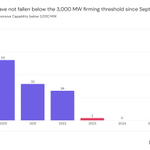
ERCOT's firming requirements take effect from 2028 for new generators with IAs signed from 2027.
Initial cost should be small with few resources obligated, but it will become a structural cost for new generation if low reserve margins return and the obligated pool grows

2
114
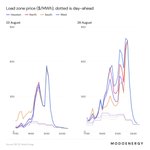
1/ Some volatility returned to ERCOT's Real-Time Market this week.
Settlement prices peaked at $561/MWh on August 23 and $781/MWh on August 26, were in the mid-triple digit range for multiple hours each day, and settled above day-ahead in nearly every interval.

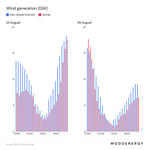
4/ What was specific to the 23rd was thermal outages. Dispatchable capacity on outage for that evening rose 3 GW after the day-ahead market closed, from 8 to 11 GW.
ERCOT's 90th percentile expectation for August is just 8.5 GW, and their modeled maximum is 11.7 GW.

1
58

4/ What was specific to the 23rd was thermal outages. Dispatchable capacity on outage for that evening rose 3 GW after the day-ahead market closed, from 8 to 11 GW.
ERCOT's 90th percentile expectation for August is just 8.5 GW, and their modeled maximum is 11.7 GW.

1
20

It's a highly uncertain time in US power markets, and policy noise has made FTM grid-scale BESS harder and pricier to develop lately. But the long-run signal is intact: Li-ion pack prices have fallen from $1,200/kWh in 2010 to about $108 today.
🧵

But BESS development isn't the only variable in flux in power markets. Demand is moving too, even though headline load forecasts look inflated (as supported by Gov. Abbott's letter to the PUCT and ERCOT this week, New York's data center moratorium and PJM market design uncertainty). Despite headwinds for load growth, our ERCOT projection still indicates ~25% growth in observed peak demand by 2030, which is staggering for a grid operator.

1
2
113
