

Sir John Hicks Professor of Economics, @LSEecon. Macroeconomics with distribution(s). Coeditor of the American Economic Review.
Joined January 2019
- Tweets7.4K
- Following1.6K
- Followers29K
- Likes21.8K




Pinned Tweet
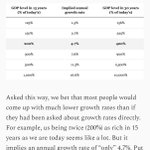
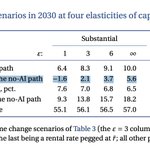
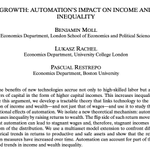
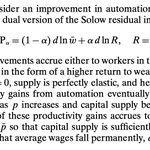
For those interested, here are my slides from yesterday's Cowles Lecture at the Econometric Society Meetings @YaleCowles @econometricsoc
benjaminmoll.com/cowles_lect…
Thanks so much for listening and for the great discussion and comments!

Ben Moll retweeted
Two greats join our bet:
- @dwarkesh_sp on the explosive-growth side
- @Thom_Wolf on my side
benjaminmoll.com/growth_bet/
Total pot now $700k 💰

Ben Moll retweeted

LMK if you want to join the fast growth side, happy to join the low-growth side if I can get a counter-party

Two greats join our bet:
- @dwarkesh_sp on the explosive-growth side
- @Thom_Wolf on my side
benjaminmoll.com/growth_bet/
Total pot now $700k 💰
Ben Moll retweeted

Given the popularity of this bet and the fact that having @ben_moll moderate is unscalable. What prediction markets would be most useful in addition to GDP and unemployment? Creating them is relatively easy, getting enough liquidity is what my team is working on.
Two greats join our bet:
- @dwarkesh_sp on the explosive-growth side
- @Thom_Wolf on my side
benjaminmoll.com/growth_bet/
Total pot now $700k 💰

Ben Moll retweeted

If you believe AI will result in explosive growth please reply! I'd like to join this bet but need to find a counterparty
Two greats join our bet:
- @dwarkesh_sp on the explosive-growth side
- @Thom_Wolf on my side
benjaminmoll.com/growth_bet/
Total pot now $700k 💰
Two greats join our bet:
- @dwarkesh_sp on the explosive-growth side
- @Thom_Wolf on my side
benjaminmoll.com/growth_bet/
Total pot now $700k 💰
Also note: I'm holding odds constant by design. If you want floating odds determined by the market you can find them here on @Kalshi and on some other platforms
xitter.cf/AndreyFradkin/status/2…

Those interested in making bets on explosive economic growth due to AI can now make these on Kalshi without emailing @ben_moll. Liquidity is thin, but with the right incentives / subsidies I think these markets can be highly informative.
kalshi.com/markets/kxgdpyear…

Ben Moll retweeted

Really excited to receive this -- thanks @sffed, very much enjoyed the visit, as always!

Congratulations to @ChristianKWolf, winner of the @sffed's Janet Yellen Award for Monetary Research, presented at our 3rd annual Conference on Macro-Finance Research. 🏆
His contributions to econometrics and macroeconomics are deeply impacting both monetary research and policy.


Ben Moll retweeted

He is so close to getting how the mere threat of bad policy can cause permanent damage

Hence their result:
Because billionaires leave forever, the state of California loses an infinite stream of income tax revenue.
But because the dreaded annual wealth tax never materializes, the state gains nothing in revenue (beyond the one-time tax).
This is what delivers their net loss of nearly $40 billion.
Ben Moll retweeted

This is the standard way to score tax policy. You score the law as written (in this case a one-time wealth tax) and the behavioral consequences from that law (people worried it will last moving).
There are arguments against that approach. But is not “highly inappropriate” or “dishonest” to do what JCT or any other neutral body would do.
Let’s be clear: this is a highly inappropriate way to model the effect of Prop 40 on taxpayer behavior.
For one, it’s a basic violation of rational expectations, a cornerstone of modern economics.
In Jaros and @joshrauh world, the billionaires act irrationally: they respond to a policy that does not exist and will never exist.
Economics students around the world are taught this is not an appropriate way to model behavior — but apparently in this context (fighting Prop 40) it’s OK.
Ben Moll retweeted

My view on the California wealth tax proposal is probably more nuanced than some of my followers may want it to be.
Prop 40, as designed, has both strong pros and strong cons.
My main complaint is that the scientific debate around it has been polluted by political prejudices.
🧵
Ben Moll retweeted

Global growth is projected at 3.1% in 2026 and 3.4% in 2027. But the stable headline masks diverse growth outcomes across countries, depending on their exposure to energy prices and to the tech-driven investment boom.imf.org/en/publications/weo/…


Ben Moll retweeted

🚨 New paper🚨 Can LLMs predict how households spend, work and respond to policy? We build a benchmark to find out: HouseholdBench. With great coauthors @jinhuang9306000, @DiegoFerreras, Yutong Xie, Walter Yuan, Qiaozhu Mei and @ChenLian92. (1/7)

Ben Moll retweeted

Everyone talks about what AI will do. But almost nobody asks who will pay for the machines. Taking advantage of AI will require an extraordinary amount of capital, from data centers to new power plants. Will that capital be around?
I try to address that question in the first draft of my new paper “Saving for the Machines.”
To show how important capital is to fuel the transition to an AI-based economy, I document how the same technology path that generates 11.7% annual growth when households choose their saving rate optimally delivers only 2.2% when the saving rate remains fixed. In other words, if we experience slow growth over the next few years despite fast improvements in AI, this slow growth may reflect too little capital accumulation instead of a technological bottleneck.
The key to this result is that AI raises the capital share by moving tasks from labor to machines, which requires that those machines are built. In comparison, ordinary technical progress makes labor and existing machines better at the tasks they already perform.
To inspect the mechanism, I start from an accounting identity: the saving rate is the capital share times the ratio of investment to capital income. If I take the evolution of the capital share as given, I can ask how much the latter ratio moves in response to that evolution. Crucially, with an optimizing household, this ratio barely moves. As machines take over tasks and the return to capital rises, the household responds by letting consumption grow faster, by the intertemporal elasticity of substitution times the rise in the return. To pay for that faster consumption, capital must also grow faster by the same amount. So, the household keeps investing about the same fraction of what the machines earn. And since machines earn a larger share of output, the saving rate also goes up. With a fixed saving rate, the same accounting identity tells me the opposite: the ratio falls in proportion as the capital share rises.
Will the U.S. and other advanced economies then generate enough capital? For many reasons, I doubt it. We might end up in a situation where many of the opportunities offered by AI are left on the table. This is particularly important for all who think that AI might get us out of many problems, such as fiscal troubles (like in France) or ultra-low fertility. We need to save for the machines, and it is not clear we can do that.
Anyway, this paper has been long in the making (many months of hard work), but I have learned much from it. In particular, working through the model changed my mind about many issues related to AI. Again and again, my intuition said X, but the math said Y. And math always won in the end. That is why we write formal models.
A nice example is Proposition 5, whose proof is the one I like the most in the paper. With improving machines and strong task complementarity, there is no fixed balanced growth path because the target itself keeps moving. The nice part of the proof is to realize that, after the right normalization, the moving target becomes a fixed point, and the saddle gets steeper as machines improve. So instead of falling behind, the economy tracks the moving BGP more and more closely. A fair amount of ODE work to get there, but a very simple economic idea underneath it once you get it.
The paper is here:
sas.upenn.edu/~jesusfv/Savin…
and the slides are here:
sas.upenn.edu/~jesusfv/Slide…

Ben Moll retweeted

Quite a thing to say this on the day that a Russian strike kills a baby in a stroller.

Ben Moll retweeted

Why does this keep happening


It is a strange world.
Because 5.7 million people live in three small Baltic countries (whose total size is less than a Chinese Tier II city). and whose half of the population lives in Europe, and another third are Russians who cannot get citizenship, and because they have traumas and bad memories of the Soviet rule, the entire world of 8 billion people should go into a nuclear apocalypse and die.
Ben Moll retweeted

Remember this tweet in 2031 when we're all trying to figure out why Claude Fable 9.7 decided to seize control of the BEA.
Hey @AnthropicAI employees, would any of you like to put your money where your mouth is and join this bet?
Still very much looking for counterparties on the fast-growth (=real GDP growth > 15% by 2033) side
benjaminmoll.com/growth_bet/