

Economic historian. Associate Professor at Lund University, Pro Futura Scientia Fellow at Swedish Collegium, and Research Affiliate at the CEPR and IFN.
Joined September 2012
- Tweets898
- Following797
- Followers1K
- Likes5.5K





The main reason AI will put all humans out of work is succinctly summarized in footnote 1:


AI in Econometric Theory: An Example
Isaiah Andrews, Anna Mikusheva
arxiv.org/abs/2610.35831 [𝚎𝚌𝚘𝚗.𝙴𝙼]

ALT This note contains a story and a paper. The paper is about the admissibility of two-stage least squares with weak instruments, a topic we have worked on together since 2019. The story is about how we (or, rather, our LLMs) wrote the paper, and some thoughts on what this may mean for our field.
Thor Berger retweeted

Thanks a ton to everyone who engaged with this thread I made a few weeks ago, and especially to @jasonfurman for his wonderful and generous compliment.
Alex and I made this into a Substack (link below) as many of the topics echoed closely with what we were already thinking of writing about, and the current moment of the advances in AI and discussions surrounding it became a focal discussion point.
As I write this today, OpenAI has announced what it describes as major breakthroughs in mathematics, computer science, and physics such as the local smoothing and the Kakeya conjecture, that the Exponential Time Hypothesis is false, and the existence of quantum chromodynamics and completions of the standard model (h/t @AndrewCurran_).
As these technologies advance and refine the limit of what is possible, or what it means even to "understand" something, there is sure to be a reckoning among the most cognitively gifted on what this means for their sense of identity and craft.
I do not have any solutions or recommendations, in part because I am not qualified and also because the historical record we presented in the essay doesn't point to one. All it suggests is that disruption can be quite painful in the short term, with adjustment over time smoothing out the early upheaval.
I also do not know what these advances mean for many professions. On one hand, such technology in the hands of many can empower them to try what was never possible, but it might also create a fear of increasing disillusionment among those whose mastery of such techniques was core to their identity. We will just have to wait and see.
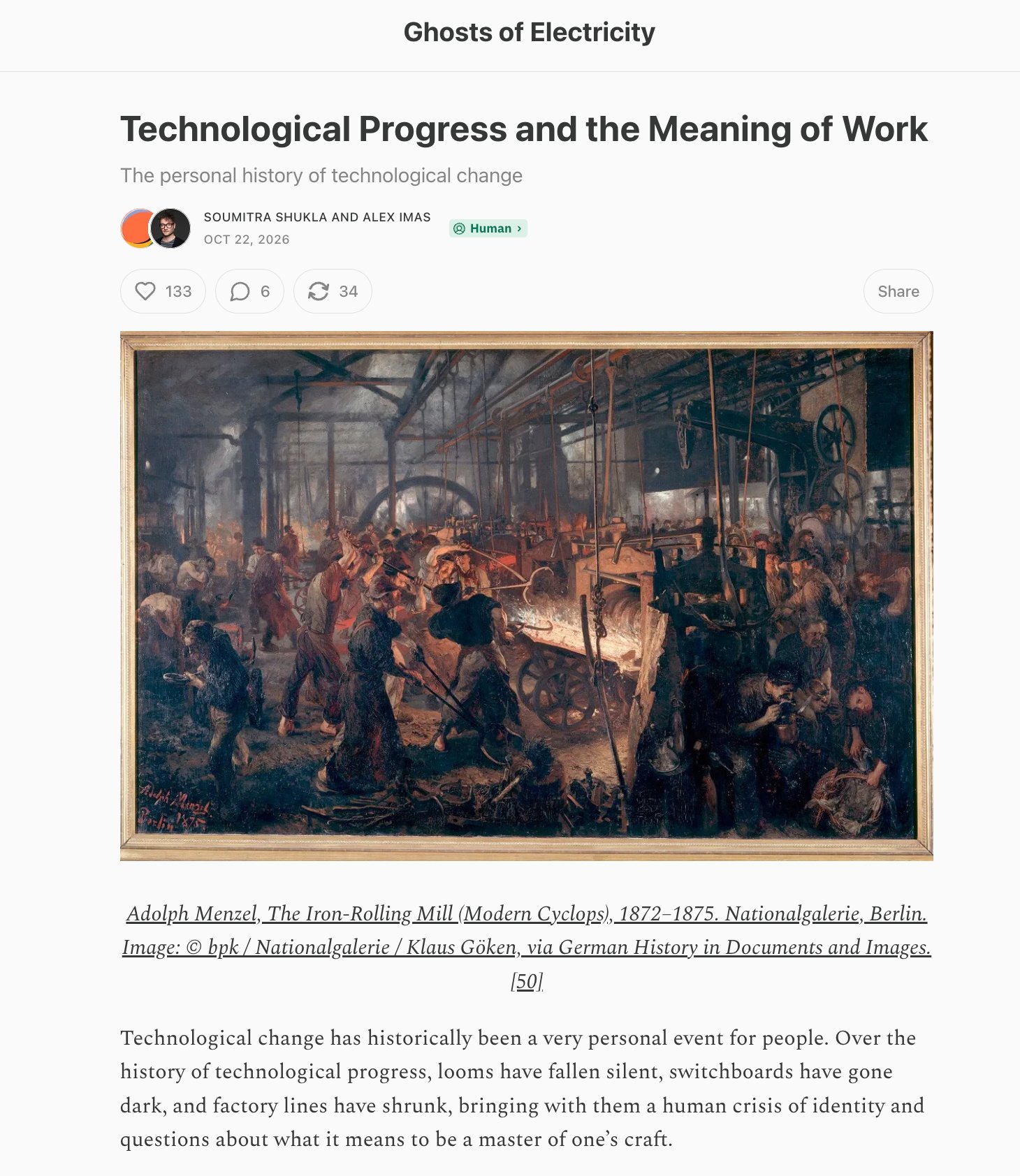

🧵1/10 Given the recent reactions of mathematicians over rapid advances in AI, I think it is important to remember that technological change has historically been a very personal event for people.
Over the history of technological progress, looms have fallen silent, switchboards have gone dark, and factory lines have shrunk bringing with them a human crisis of identity and what it means to be a master of one's craft.

Knausgaard vol 2 really is one of the greatest works of fiction of the 21st century!

Tyler Cowen’s Strongest Book Recommendations, 2003-2026 marginalrevolution.com/margi…

Thor Berger retweeted

New Substack post with @soumitrashukla9. Work has never been just about the income earned sans effort costs, as typical in economic models. Key aspects of people’s identity, their meaning, and sense of agency are all wrapped up with what they do for a living.
There has been a lot of conversation lately about how technological change, particularly AI, may disrupt this relationship, from Ezra Klein's column on his own mathematician father’s grapplings with losing meaning in mathematics, to Francis Fukuyama's post on AI, agency, and recognition. In this piece we take a historical perspective on how technological transformation has disrupted identity and meaning by affecting jobs, and how workers and society responded to these changes.
Much of the debate around AI and jobs has centered on wages and material consequences, but losing one's work is also intertwined with how people view their place in society. Most people know about the Luddites—skilled weavers and knitters—who protested the devaluation of their mastery. What’s less known is that the Luddites were actually experts in using the machines as well, and that their protests prompted prominent economists like David Ricardo to rethink the role of automation in society, and later inspired the Arts and Crafts movement. A century later, when recorded sound displaced 20,000 cinema musicians, their campaign against "canned music" and two-year recording ban pressured labels into funding live performance.
Soumitra and I have been working on versions of this essay for months. He led the piece, and we’re both really excited to get it out there.
Link to the post here: aleximas.substack.com/p/tech…


The most revealing part of this conversation between Jon Stewart and Jacob Coxon wasn't Coxon's warning about A.I. doom, but his description of A.I. utopia, and Stewart's incredulous response. I wrote about it — and Francis Fukuyama's "Last Man," and A.I. easily solving the problems that bedeviled my father's field of mathematics for decades — here: nytimes.com/2026/10/18/opini…


Thor Berger retweeted

Politeness in China is on the rise. Giving a lecture in China, I made a mathematics mistake on the board. A student raised his hand and said, “In China, we do it differently.”

Thor Berger retweeted
A graph style that should get more love is the @BetseyStevenson-@JustinWolfers arrowplot:

Awesome paper and episode with the always brilliant @timsvengali!

🎉 CEPR is thrilled to announce that, for the second consecutive year, VoxTalks Economics has been recognised by @signalawards.
The episode ‘Did the Sewing Machine Liberate Women?’, hosted by @timsvengali with CEPR Research Fellow Philipp Ager, won Silver in the Conversation Starter category.
Read the full news item here: ow.ly/283L50ZZnQZ

Thor Berger retweeted

Uppsala Immigration Lab is hosting a workshop on the Economics of Migration in Uppsala on April 15-16, 2027. We have a great set of confirmed speakers in @ethanglewis, @MetteFoged_econ and @salma_mousa_.
Deadline: January 10.
Call for papers: tinyurl.com/yrx8hb8c

Thor Berger retweeted
🚜 New working paper: “Wheels of Change: Agricultural Automation and Human Capital in the 20th Century”
Q: How does the next generation adapt to automation?
A thread 🧵 (1/14)


Thor Berger retweeted

Thor Berger @bergerthor has written a great paper on the effects of the diffusion of tractors in the United States, with a very nice thread that describes the analysis. The widespread adoption of tractors led to increased human capital investment both because children of farmers left agriculture. On the other hand, those areas that adapted most quickly exhibited the largest graduation effects, suggesting human capital investment was able to generate complementaries between farmers and tractors as the technology of agricultural production evolved. This possibility, of course, has contemporary resonance.
Thor Berger retweeted

@AdamPosen Guten Tag, you can read it here: threadreaderapp.com/thread/2… Have a good day. 🤖

Thor Berger retweeted

In honour of Thor's new working paper: a photo of me and my tractor. There are few more important topics in life, let alone in economic history.

Yes! And the introduction of agricultural education in the HS curricula spurred enrollment among farm boys because they perceived it “dealt with the realities of life, with real problems instead of imaginary ones".

Thor Berger retweeted

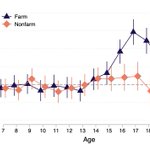
A great historical example of positive labor market response to a big automation shock:
Tractors automated farm labor; teen boys stayed in school longer.
Adjustment on the margin of labor market entrants = much less costly


🚜 New working paper: “Wheels of Change: Agricultural Automation and Human Capital in the 20th Century”
Q: How does the next generation adapt to automation?
A thread 🧵 (1/14)
Takeaway: Automation shapes the next generation’s investment in education, partly because it helps them adapt and persist in sectors undergoing rapid technological change.