

Husband ▪︎ Dad x 4 ▪︎ Attorney ▪︎ Farm & Business Succession ▪︎ Estate Planning ▪︎ I help families preserve their legacies for future generations
South Dakota
Joined December 2022
- Tweets12.9K
- Following1.3K
- Followers15.1K
- Likes31.8K




The principles for farm succession & small business succession planning are pretty much the same, with one caveat...
Rarely do I see as much sentimental value put on the multi-generation construction company as the typical family farm.
Another example of "fair" doesn't mean "equal" in farm estate planning.
Farm couple w/ 3 kids:
1 on-farm son
2 off-farm daughters
Here's their estate plan structure:
Daughter #1 → Lake house
Daughter #2 → $250k cash
Son
→ Home quarter (160 acres) w/ house, bins, & shop
→ All farm equipment & machinery
All other cash & investments split 3 equal ways
Remaining 2,300 Acres
→ Into a Legacy Land Trust benefiting all 3 kids
→ Son gets first chance to rent @ 80% FMV
→ Son can purchase at 80% FMV, but ONLY if all 3 siblings agree
If the LLT is ever terminated:
→ Son inherits specific parcels ~1,150 acres
→ Daughters inherit specific parcels ~575 acres each
→ Son first, then daughters have ROFR at 80% FMV if anyone sells
The land stays in the trust unless it's terminated.
The goal?
Keep the farmland together, give the son the assets & opportunity to continue farming, and provide for both daughters.
Not equal dollar amounts. But that's not necessarily the goal.
Fair doesn't always mean equal.
Might sound crazy to some, but yesterday isn't the first time I've retained a new client who said, "Dad told me if he got a will, then he was sure to die. So he never had one. It was a 2 year long mess when he died. We don't want to do that to our kids."
Clint Fischer retweeted

Here's an analogy for the current state of agriculture.
Imagine two train tracks and a gravel road all running parallel to each other.
The BTO is on one track as represented by a bullet train. Super specialized, but requires all the right conditions and subsidies to be able to
I toured the USS Midway aircraft carrier in San Diego this weekend.
(HIGHLY recommend that museum, btw)
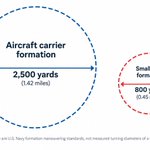
The Navy uses a 2,500-yard turning diameter for formations with an aircraft carrier, compared to 800 yards for formations of smaller ships.
Of course, that difference in being able to pivot got me thinking about farm businesses.
Consider a large, established corn/soybean operation.
5,000 acres. Millions invested in machinery. More millions in grain handling facilities, bins, & other infrastructure.
That operation is built to produce corn & soybeans efficiently at scale. Changing direction isn't easy with that much invested in a particular business model.
Now consider a younger, smaller farm w/ less invested in specialized infrastructure.
It probably can't match the big operation on cost per bushel.
But, depending on market trends, it might be more willing & able to pivot into
-niche markets
-specialty crops
-livestock or poultry
-direct-to-consumer sales, or
take advantage of programs & incentives that don't make sense for the larger operation.
Like how a scrappy tech startup can try something new on Monday and scrap it by Friday.
That tech giant? Not so easy when billions of dollars and an established business are tied to doing things a certain way.
Doesn't mean the startup has the better business. Just means it can turn faster.
Of course, the smaller farm has its own limitations. Less clout, less room for mistakes, and fewer acres to spread costs across.
Neither business model is necessarily right, wrong, better, or worse.
And neither should assume the other's approach will work for them.
The key is knowing your operation's strengths & limitations, and figuring out what success looks like for YOUR farm. Not someone else's.
You wouldn't try landing an F-14 Tomcat on a patrol boat.
And you wouldn't expect an aircraft carrier to turn like a patrol boat.
Same ocean. Different ships. Different definitions of success.

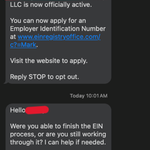
SCAM ALERT🚨
Heads up if you recently formed an LLC:
Scammers are sending texts like this claiming you need to pay for an EIN.
Don’t click the link.
One of our clients paid these knuckleheads $200 before realizing it's a scam.
EINs are FREE directly from the IRS website.

Clint Fischer retweeted

I'm not from the HR world but holy cow this fires me up (we posted this one for Free)...

Clint Fischer retweeted

Not common, but not impossible for you young producers.

> 2 brothers inherited 568 acres from Dad
> Neither farms. Dad retired 8 years ago
> No strings attached to the inheritance
> But both brothers agreed: "Dad would've wanted to help out a young farmer"
> So they're selling the land to the 28-year-old son of the farmer currently farming it.
Here are the terms:
→ 75% of appraised value
→ $0 down payment
→ Minimum interest rate allowed by IRS
→ 30-year amortization
→ 15 annual payments
→ Balloon payment at year 15
> They could've sold to the highest bidder
> Instead, they're giving a young farmer a chance
> Not every landowner is interested in squeezing the last dollar out of every acre.
Clint Fischer retweeted

After a few days of pre harvest stress and the reoccurring battle of the mind, I pulled out a good sweatshirt to wear.
I had a local shop print these up.
I’ve got an extra, maybe I’ll send it to @bmreadel for her advocacy of Ag mental health wellness


Clint Fischer retweeted

I purchased my first farm from two brothers that cut me some slack on the price, not with the financing part I did that through the FSA. Had they not helped me out and been patient through the long FSA process I might still not own any land. The world would be a better place with less greed in it.
> 2 brothers inherited 568 acres from Dad
> Neither farms. Dad retired 8 years ago
> No strings attached to the inheritance
> But both brothers agreed: "Dad would've wanted to help out a young farmer"
> So they're selling the land to the 28-year-old son of the farmer currently farming it.
Here are the terms:
→ 75% of appraised value
→ $0 down payment
→ Minimum interest rate allowed by IRS
→ 30-year amortization
→ 15 annual payments
→ Balloon payment at year 15
> They could've sold to the highest bidder
> Instead, they're giving a young farmer a chance
> Not every landowner is interested in squeezing the last dollar out of every acre.

I think it's a great part-time gig for retired banker types.
Or even non-retired, organized, professionals.
I agree with Jenny that it's a growing need.

I filled in some of the blanks in this article:
cathompsonlaw.com/farm-trans…
Here's a phased, lifetime farm transition strategy:
1/ Separate the land from the operations.
Mom & Dad own $2 million of operations assets.
•Grain
•Livestock
•Machinery
•Tools & Equipment
•Other operating assets
•Basically everything but the land
2/ They put those assets into an LLC and each own 50%.
The farmland stays outside the LLC.
Their daughter & SIL are farming with them and eventually taking over.
3/ Mom & Dad start gifting ownership in the operations LLC to them every year.
In 2026:
Dad → Daughter: $19,000
Mom → Daughter: $19,000
Dad → SIL: $19,000
Mom → SIL: $19,000
That’s $76,000 of LLC units transferred in year one using the annual gift tax exclusion.
Then they do it again next year.
And the year after that.
Assuming the annual exclusion increases $1,000 each year, after 15 years they’ve transferred about $1.56 million of a $2 million operation.
No IRS filings required.
New ownership =
Daughter & SIL: 78%
Mom & Dad: 22%
Daughter & SIL become majority owners around year 11.
But maybe more importantly is the next generation gets skin in the game.
They aren’t just working for Mom & Dad hoping someday the farm becomes theirs.
They actually own part of the operation.
They share in the profits.
They share in the losses.
They participate in the upside of what they’re helping build.
And their ownership can increase a little bit every year while Mom & Dad are still around to help with the transition.
The land is a separate conversation that often involves off-farm children.
But for the operating side of the farm, sometimes succession doesn’t require one giant transaction.
You can start transferring ownership a little at a time.
*obviously this assumes no change in LLC valuation over time which is unrealistic, but it's simplified to show the concept


Husband & wife have 3 kids.
Husband dies.
Simple will says “all to spouse.”
Wife now owns everything.
She meets Frank, falls in love & remarries.
Frank has 2 adult kids.
They buy $150 online wills to update their estate plan.
Both wills say “all to spouse.”
Wife dies.
Now Frank owns everything.
And when Frank dies?
Wife’s 3 kids could get nothing.
Frank’s 2 kids could get everything.
That’s “accidental disinheritance.”
And it’s a big estate planning risk for blended families that can be prevented with proper planning.
1/
Why do some family farms successfully transition through multiple generations...
while others end with family fighting, forced land sales, or the operation simply disappearing?
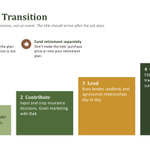
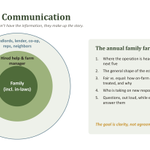
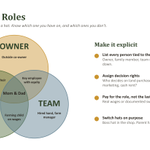
A family business podcast I listened to boiled it down to 4 things:
1. Roles
2. Communication
3. Transition
4. Higher Calling
All 4 apply REALLY well to family farms.
🧵 👇
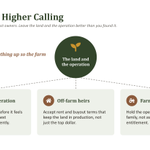
5/ HIGHER CALLING
This may be the most important one.
Successful multi-generational farms tend to view themselves as stewards, not simply owners.
Meaning everybody occasionally gives something up for the long-term good of the farm.
Senior generation:
→ Gives up some control.
Off-farm heirs:
→ May accept that maximizing rent or forcing a sale isn't always best for the family operation.
Farming heir:
→ Doesn't treat the farm as something they're automatically entitled to.
For Christians, stewardship goes even deeper.
Ultimately, none of it is really ours anyway.
Land. Business. Money. Opportunities.
We're simply responsible for managing them well for God during our time.
Then hopefully handing them off in better shape than we received them.

6/
A lot of farm succession problems aren't really caused by trusts, taxes, LLCs, or legal documents.
They're caused much earlier by:
• unclear roles
• poor communication
• no management transition
• everyone looking out for themselves
The legal plan matters.
But the family & business work has to happen too.
That's how you give the farm its best chance of surviving another generation.
The end.