

You Build. We Defend. Since 2014 protecting critical decentralized systems: L1 nodes, smart contracts audits, wallets, web3 dApps, exchanges, bridges.
Joined July 2014
- Tweets2.3K
- Following796
- Followers3.2K
- Likes3.4K




Pinned Tweet
Coinspect is now a Ledger security audit partner for Ledger wallet apps!
As one of Ledger's approved audit partners, we bring our crypto and embedded security expertise to help developers find and fix vulnerabilities before release.
Building a Ledger app? Let's talk.

Coinspect Security retweeted

How exploitable is the recent Broccoli 🥦 vulnerability (CVE-2026-111497)?
We went beyond reproducing memory corruption and demonstrated a control-flow hijack.
Not a realistic RCE exploit, but definitely not just a crash.
Here's what we found. 🧵
Don’t miss Joaquín Pereyra’s talk at DSS on Ill Bloom: how we found and responded to a wallet generation flaw that exposed millions.
November 1 · 10:30 AM IST · Amber · Mumbai


The DSS 2026 timetable is live.
Nov 1–2 · Mumbai · Amber + Pearl
Pick your talks, save a shortlist and share it with @summit_defi.
Agenda: defisecuritysummit.org/2026/…
Tickets: luma.com/9qtxqqxx
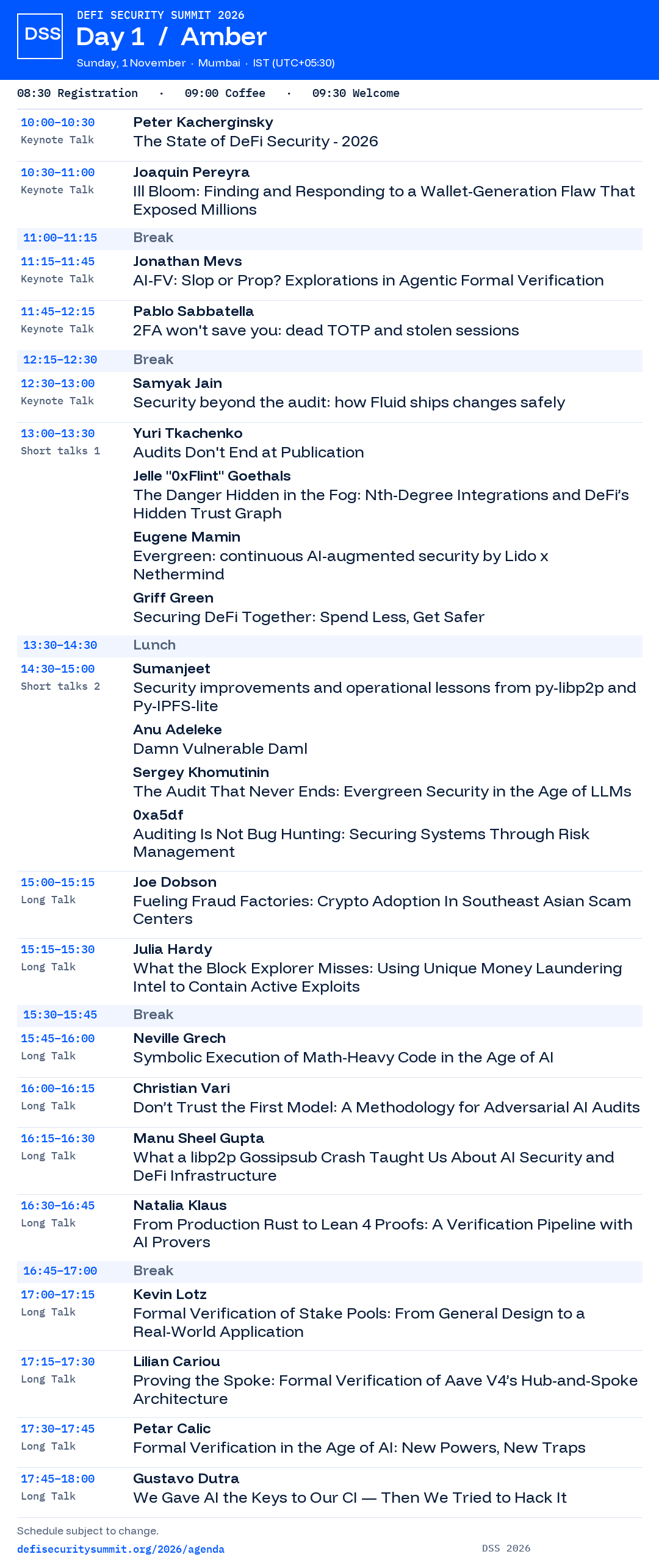
ALT DSS 2026 Day 1 Amber programme. All times IST. Schedule subject to change; full programme at https://defisecuritysummit.org/2026/agenda.

ALT DSS 2026 Day 1 Pearl programme. All times IST. Schedule subject to change; full programme at https://defisecuritysummit.org/2026/agenda.

ALT DSS 2026 Day 2 Amber programme. All times IST. Schedule subject to change; full programme at https://defisecuritysummit.org/2026/agenda.

ALT DSS 2026 Day 2 Pearl programme. All times IST. Schedule subject to change; full programme at https://defisecuritysummit.org/2026/agenda.
Recent BIND DNS vulnerabilities and weak CA private keys are reminders of how much trust Web3 users place in intermediaries.
HTTPS does not authenticate the frontend code users execute.
We need end-to-end content authentication. DappFence is a first step toward that.
Node.js patched a Brotli OOB write with RCE potential (CVE-2026-111497) 8 months after the upstream fix.
Express 5's express.json() accepts Brotli request bodies by default, letting untrusted HTTP requests reach the vulnerable native decoder.
Patch Node.js now!
Coinspect Security retweeted

We've released a SPR plugin to test network devices against the eMudhra subordinate CA issue. Devices with CA stores that were updated after April 30, 2025 could carry the vulnerable certificate. In practice this appears to be quite widespread
github.com/spr-networks/spr-…


Coinspect Security retweeted
While everyone’s patching PHP today, don't sleep on Node.js CVE-2026-111497 OOB write in the bundled Brotli decoder. Reachable via fetch(): a malicious server just replies
Content-Encoding: br.
Fixed in 26.12.1 / 24.22.1 / 22.23.4.
Update.
What if a dApp frontend could protect its users even after its DNS or hosting infrastructure is compromised?
We're building DappFence, an open-source project using standard browser features to detect and block malicious frontend replacements.
No extensions. No wallet changes.
Looking for security researchers and dApp teams willing to test it, challenge the design, and help make it better.
github.com/coinspect/dappfen…

Coinspect Security retweeted

Wallet testing getting closer to full automation 🦾

We've open-sourced the testing tool used for Coinspect's Wallet Security Ranking.
Run the same guided security checks on mobile and browser extension wallets, reproduce findings, and collect evidence:
coinspect.com/blog/open-wall…

We've open-sourced the testing tool used for Coinspect's Wallet Security Ranking.
Run the same guided security checks on mobile and browser extension wallets, reproduce findings, and collect evidence:
coinspect.com/blog/open-wall…


Web3 frontends are part of the attack surface too. 👇

Long time no see, Twitter. On October 9, I received a phishing email. The link led to the real portfolio.metamask.io page, which asked for my Secret Recovery Phrase.
MetaMask has fixed the bug. Here is how it worked.
Coinspect Security retweeted

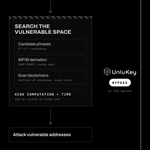
Was your seed phrase ever actually random?
More than $120M drained across 3 wallet hacks since May. And none of those breaches actually broke the cryptography itself
Trezor's Head of research and development put it this way: even if the entire Bitcoin mining network did nothing but guess seeds, getting through them would take roughly the age of the universe
Seed is supposed to be one out of 2^128 pick. And that math only holds if the wallet actually picked randomly
2026 clearly showed that assumption failed three times in five months:
- May 27, Ill Bloom: ~$3.14M swept from 431 wallets in one coordinated pass. Seed gen behind it was shipped in 2014 (more than a decade ago)
- Jul 30, Coldcard: 1,196 addresses emptied in 41 minutes for 1,082 BTC (~$70M). The firmware had been pulling seeds from a software fallback instead of the hardware RNG since March 2021
- Oct 17, Qubic: 1,404 wallets drained in 104 minutes for ~2.94T QU (~$1.4M)
Different chains, different products, same failure: the wallet asked for a random number and got something that only looked random
All of these look like bad luck, but here's what happens if we take a closer look:
• all these bugs are old
• the drain comes first, and the root cause got traced after
• the patch doesn't save you. updating does nothing for a seed that already exists, and the patch only covers new ones
• once the bug goes public, it's open season. separate attackers try to get advantage from it
• the victims weren't sloppy. 88% of the stolen Coldcard BTC had sat untouched for at least a year (~3.5 years dormant on avg)
It took 6 years to really fix cryptojs: "randomBytes is not random enough" issue from 2014 got fixed in 3.2.0, then 3.3.0 put the weak code back. The real fix only landed in 4.0.0 in 2020
None of this shows up in testing
Coldcard's weak seeds looked perfectly random and would have passed every statistical test, Coinkite even paid for an audit in March 2022 that covered the RNG, but still missed the bug
The main problem is that every weak seed is still a valid seed
Not sure where your seed came from?
- run your address through illbloom.org
- Coldcard: check Coinkite's tips
- Qubic: check which devices Qubic flagged
- flagged? make a fresh seed, move the funds (updating won't fix it)
Turns out the weakest part of self-custody wasn't the chain or the cold storage, it was fake RNG all the time

Qubic's Math.random() wallet drain is another example of a vulnerability Coinspect has been warning about for months.


Coinspect Security retweeted
"iPhones are safer than hardware wallets."
Check Calif's research.
Ledger attackers physically implanted hardware. They didn't remotely break into the device.
AI is making remote 0day exploits cheaper. It has not changed the value of reduced attack surface and physical isolation


web3 frontend security: A dApp can serve malicious code to just one user while everyone else sees a normal site.
DappFence doesn’t need to recognize the attack to block the code.
It verifies that frontend code is authorized, without waiting for a report or a blocklist update.👇