

Applied Research Engineer @SakanaAILabs ← PFN ← Sony Interests: Agentic Foundation Models(Ex. Deep Research)/Physical AI/Matlantis/Trading Kaggle 2x Grandmaster
Tokyo, Japan
Joined March 2011
- Tweets865
- Following358
- Followers1.6K
- Likes4.2K



Pinned Tweet
Rist Meetup 2024「Kaggleは業務の役にたつ」にて発表予定の資料共有します。
"Competitionsだけじゃない!Kaggle Notebooks Grandmasterのすすめ"
speakerdeck.com/corochann/co…
#rist_meetup

16件も!Materials Scienceの研究加速させていてすごい👏

材料科学の国際会議「2026 MRS Fall Meeting & Exhibit」(米国ボストン、11月29日〜12月4日)で、Matlantisと、グループ会社のPreferred Networksのメンバーが、機械学習ポテンシャルを中心に16件の発表を行います。
口頭発表が9件、ポスター発表が7件で、6つのシンポジウムにわたります。基盤モデルを扱うシンポジウム「MT02: Accelerating Materials Science with Foundational Models」では、このうち5件を発表します。
⚗️ 主なテーマは次のとおりです。
・機械学習ポテンシャルMatlantis PFPの開発:r²SCAN汎関数のデータによる学習、実験データを使った追加学習、軽量な補正ポテンシャルによる調整
・機械学習ポテンシャルの検証:実用に近い条件での評価、AIエージェントによる隠れた不具合の探索、計算規模と不確かさの関係
・AIエージェントとシミュレーション手法:自然言語の指示から機械学習ポテンシャルを開発するエージェント、粗視化ポテンシャルの自動生成、遷移状態のサンプリング、原子構造の可視化
・材料への応用:光触媒、強誘電体、固体電解質、分子結晶の構造予測、界面の伝熱と摩擦
📍 展示会場のブース#624では、発表の内容とあわせてMatlantisをご紹介します。会場にお越しの際は、ぜひお立ち寄りください。
場所:Hynes Convention Center、Exhibit Hall C(Level 2)
展示時間(現地時間)
12月1日(火)14:00〜18:00
12月2日(水)9:00〜16:00
12月3日(木)9:00〜13:00
📄 各発表の概要をまとめた資料(英語)は、ブースでお配りするほか、下記のページからPDFでもご覧いただけます。
発表の一覧はこちら:matlantis.com/ja/news/mrs-fa…
#Matlantis #機械学習ポテンシャル #材料科学

1
420
Kosuke Nakago retweeted

こちらの記事でSakana AIの選考についてお話ししました!
Applied Research Engineer(Enterprise, Defense, Productなど)積極募集中です。ご応募お待ちしています!
sakana.ai/careers/

Building a top AI team is a challenge, especially in Japan. I have the incredible honor of working with Maho Hashimoto (@m4h0), our Head of People, to recruit exceptional talent for Sakana AI.
Maho was recently featured in a wonderful interview (in Japanese) about how we find people who fit our culture: one that pushes the boundaries of frontier AI while maintaining a relentless execution mindset. At @SakanaAILabs, we don’t just hire for today’s skills; we look for people who can learn, adapt, and build the future.
If you’re interested in how we think about talent and culture, I highly recommend the read.
Kosuke Nakago retweeted

Sakana Namazu SmallはNemotron 3 Nano Baseに追加の学習をした30B-A3Bのモデルです。今後オンプレミスでの提供などで利用していく予定です。
技術的には、今までのSakana Namazuシリーズと異なり、baseモデルから出発しAgentic CPT, SFT, RLという一連のパイプラインを成功させたことがマイルストーンになります。事前学習直後の、agenticなことが何一つできないbaseモデルをどう育てるか。これは今後、自社で事前学習を行うSakana Sawaraシリーズでも必要になるノウハウで、まずは1つの分野でそれを確立できました。
今回の取り組みではチャット画面での日常的・基礎的なタスクを想定したため、agenticな能力の中では特にweb検索を大きく伸ばしました。学習後のモデルには、900回以上ツールを呼び出した末に難問を正解する例もあり、long-horizonなタスクをこなす力も身についていると感じます。デプロイまで自社でコントロールできる分野なので、特定のハーネスを前提にend-to-endでパイプラインを設計しました。これが、コストを抑えつつ優れた性能を実現できた要因の1つだと考えています。
データ面では、合成データに加えて、外部パートナーと連携して人間のエキスパートに作成してもらった高品質・高難易度の問題が、RLで重要な役割を果たしました。こうしたデータ構築のアプローチの有効性を確認できたことも大きな収穫です。
本モデルはGENIAC第4期の成果を活用しています。今後はSakana Sawaraシリーズの事後学習に向けて、このノウハウをさらに深めつつ、他のドメインにも広げていきます。

「Sakana Namazu Small」(30Bモデル)を発表
sakana.ai/namazu-small/
NVIDIA Nemotron 3 Nanoをベースに継続事前学習・事後学習を行い、25ベンチマーク平均で約4倍規模の120Bモデルを上回りました。
長文読解やWeb検索での調査に強く、オンプレミス提供の詳細は12月前半にお知らせします。

Nemotron 3 Nano 30B A3BをベースにMid-training, Post-trainingをおこなったSakana Namazu Smallがリリースされました!
今回はBase modelからの学習ということで、事後学習済みのモデルではないので、Agentic LLMとして動かせるようにするためにMid-trainingまわりにも力を入れています。
今回Web searchまわりを担当していましたが、競争力のあるモデルが作れるようになってきているかなとおもいます!
これまでのSakana Namazuの取り組みで事後学習にもかなり知見が溜まってきました 🐡🐠🐟
「Sakana Namazu Small」(30Bモデル)を発表
sakana.ai/namazu-small/
NVIDIA Nemotron 3 Nanoをベースに継続事前学習・事後学習を行い、25ベンチマーク平均で約4倍規模の120Bモデルを上回りました。
長文読解やWeb検索での調査に強く、オンプレミス提供の詳細は12月前半にお知らせします。
普段スマホで作業されている方、よろしければSakana AI App (仮)を先行して使えるβテストぜひご応募ください!
Sakana AI初のモバイルアプリのテスターを募集します🐟
現在開発中の「Sakana AI App(仮)」のβテストにご協力いただけるテスターの方を募集しています。
皆さまからのフィードバックを元に、より使いやすく、便利なアプリへと改善していきたいと考えています。ぜひ、ご参加ください。
▼ 応募は こちらから(申込締切:11月15日23:59)
forms.gle/kKJNaks1ocMqGC698 🐡

8
667
ハロウィンで娘がズートピア2のガゼルに変装をするというのだけれど、よさそうなツノが売ってないので自作することに。
ネットでもそんなに前例が見つからない中、Claudeに聞いていったらコスプレ制作なみの提案をしてくれて、ツノの3Dモデリングからサンペルカの型紙を切るテンプレートを計算、アクリルガッシュ絵の具の色の配合まで作ってくれました。
なお、最終成果物のQualityは、、、子供と作ったと言うこともありご愛嬌😂


Kosuke Nakago retweeted

本日のSakana AIのシンポジウムは、おかげさまで満員となりました。足を運んでくださった皆さま、本当にありがとうございました!🐟
ユルゲン・シュミットフーバー教授の基調講演や対談を含め、イベントの模様は後日あらためてご報告します。
当日は CEO の David Ha から、AI主権にとって重要となる Sakana AIの取り組みの「3つの柱」についてお話ししました。
・Pre-training:次世代の事前学習モデルの開発にAIエージェントを活用する
・Post-training:日本語やビジネスシーンにLLMを適応させる事後学習技術(Sakana Namazu)
・Orchestration:最先端の性能を、単一のAIモデルに依存せずに実現するオーケストレーション技術(Sakana Fugu)
続いてチーフサイエンティストの秋葉拓哉から、事前学習の取り組みである「Sakana Sawara(仮称)」プロジェクトと、その意義についてお話ししました。
Sakana AIはこれまで、LLMを最大限に活用する「エージェントの層」での技術革新を強みの一つとしてきました。しかしいま、「モデルの層」が再び重要になっています。オープンモデルと最先端モデルとの差は縮まり、モデルを作るコストは下がり、さらに強化学習によって自社のタスクやツールに合わせて特化させることもできる。こうした状況を踏まえ、モデル作りに改めて取り組むべき時期が来たと考えています。
事前学習のボトルネックは、相変わらず計算機の量にあります。その限られた計算資源をどこに投じるか。モデル開発の進展は、どんな実験をどの順で行い、どのアイデアを捨てるかという判断の精度に大きく左右されるようになりました。秋葉からは、こうした開発を、AIの力も駆使しながら少数精鋭のチームで手がけていくアプローチについてお話ししました。
この発表は、日経新聞でも取り上げていただきました。
nikkei.com/article/DGXZQOUC2… 🐟

Sakana Namazu モデルのProduction deployのコラボレーションを @modal としています!
Inference serviceの最適化に関する技術Tips盛りだくさんで面白いのでぜひご覧ください。
日本向けにDeployするからこそのつまりどころ、最適化ポイントや、近年のAgentic LLMになって特に重要になってきたMulti-turn long horizon taskを効率よく推論させるためのRoutingなどについても触れられています。
[まとめ]
・Quantization: 1T param級のモデルを効率よくDeployするためのNVFP4量子化時に日本語Benchmarkだからこそ検出されてしまう劣化がある。それを解決するためにrouted expertsのみ量子化し、他はbf16のままとした。
・Speculative Decoding: 日本語およびGlobalなアクセスが適度に存在するSakana Namazu特有のRequest分布に対応したSpeculative Decoding Modelとして最先端のDFlash2を専用で学習することで、Acceptance lengthを3.5 → 5.0まで上げることに成功し、推論の高速化に貢献しています。
・KV-aware routing: 262k context lengthを処理できるSakana Namazuでは、Long horizonなMulti-turn tool use requestが来た際のPrefix cachingの有効活用が非常に重要です。複数ReplicaがAutoscaleしながらRequestに対応するModal platform上では、Routingも重要でKV-cacheが存在するReplicaに割り当てています。
(例えば100k context lengthを超えるrequestのprefix cacheがないと、そのreplicaは10秒近く再prefill待ち、、ということになることもあり推論効率が劇的に変わります)
・Startupとしての柔軟なAutoscaling: Productをリリースしたあとの需要の伸びを事前に予測することが難しい中で、固定の台数契約ではなくAutoscaleをさせることで、需要の変化に柔軟に対応できるようにしています。
modal.com/blog/sakana-case-s…


We worked with @SakanaAILabs to optimize their Sakana Namazu API down to the kernel level:
→ Selective NVFP4 quantization (23k+ experts)
→ DFlash draft model trained on raw token streams (+25% acceptance)
→ In-house prefix KV routing + serverless autoscaling
16
872
"Aquariumは、Sakana AIがこれまでのAI実装の現場で繰り返し直面してきた課題から生まれたプラットフォームです。"
とありますが、Appliedチームが出来てEnterpriseレベルの需要を満たしていくことにきちんと向き合ってできたものになっていて、toC向けに作るProductとは違うpainにアプローチしていると思います。
日々業務を回していくうえで組織としてアップデートされていく資料・判断基準をどのように整備していくか、を突き詰めてAI Nativeな時代のデータ整理・ルール整備・運用方法をプラットフォームとして提案していますっ

自分がSakana AIのPlatformチームで取り組んでいるSakana AquariumのWebサイトが公開されました🎉
sakana.ai/aquarium-release/
PlatformでSakana AIの技術の社会実装をさらに加速させていきます。メンバーも絶賛募集中なので少しでも興味ある方ぜひお声がけください!
apply.workable.com/sakana-ai…

Kosuke Nakago retweeted
The Agentic Scientist: Orchestrating Coding Agents for Automated Scientific (Co-)Discovery
Blog: pub.sakana.ai/agentic-scient…
GitHub: github.com/SakanaAI/AI-Scien…
arXiv: arxiv.org/abs/2610.18933
Since 2024, we’ve used The AI Scientist as a way to test how far AI alone can take scientific research, from v1 to v2 to the paper published in Nature earlier this year. The Agentic Scientist is the next step in that line of work, built for the era of coding agents.
Coding agents such as Codex and Claude Code now carry out long software tasks on their own. Handing them a research problem, however, tends to produce a strong hyperparameter optimizer rather than a scientist: scores go up, but ideas stay narrow, and the reasons for the gain are rarely examined.
The Agentic Scientist makes the research loop explicit. It wraps off-the-shelf coding agents in a scaffold that controls what they see, what they write, how they are evaluated, and how results are handed to the next stage.
Parallel workers test hypotheses against rubrics defined before any experiment runs, share successes and failures through a common memory, and then ablate the winning program to generate evidence.
We used an early version of the system to study Error Diffusion, a biologically motivated alternative to backpropagation. Our researchers set the question and the rubric, chose directions at each stage, and verified the results, references, and claims before submission. The resulting paper was accepted as an oral presentation at ALIFE 2026. In autonomous runs, the system also raised Doc-to-LoRA retrieval accuracy from 52% to 98% on multi-needle tasks and designed a learned evolution strategy that improves over its CMA-ES reference on unseen tasks.
Alongside it we release AutoIllustrate, a pipeline for scientific figures that keeps an editable draw.io file as the source of truth, so every diagram can be corrected by hand.
Humans define the question and the standards of evidence; agents expand the experiments researchers can run. We call this Co-Discovery, and we are releasing both systems as open source for the community to build on.
Kosuke Nakago retweeted

【🔬Matlantis User Conference 2026 開催レポート公開】AIの進化は、科学者の研究開発をどう変えるのか。
材料研究では、AIを活用した計算化学によって、探索できる材料や条件が広がっています。さらに、AIとの対話によるシミュレーションの実行支援も。こうした変化を、研究現場の成果にどうつなげていくか。
9月18日、「AI for Scienceの最前線 ~科学者とAIによる研究開発の進化~」をテーマに、「Matlantis User Conference 2026」を開催しました。ユーザー限定イベントの内容を、少しだけご紹介します。
当日は計算化学や材料開発に携わる研究者をはじめ、関係者を含め400名超が会場に集結。9件の講演、61件のポスター発表、ヨビノリたくみ氏が進行するパネルディスカッションを通じて、技術の進化と研究現場での実践の両面から、活発な議論が交わされました。
🤖講演や議論で語られたのは、こんなテーマです。
・原子レベルの洞察を、研究者の意思決定へどうつなげるか
・計算化学の知見を実験研究者へ届けるAI活用の一手
・計算で得た結果を、材料や製造プロセスの設計へどう生かすか
・現場の研究者が考える、AIに任せたい仕事と自ら担いたい仕事
🚀AIによってできることが広がるなかで、何を調べ、結果をどう見極め、次の研究へつなげるのか。各社の取り組みや研究者の声を、会場の熱気とともにお届けします。
👇開催レポートはこちら
matlantis.com/ja/resources/b…
#Matlantis #AIforScience #材料開発 #計算化学

Kosuke Nakago retweeted
Schmidhuber先生の直後に話すらしいです 😨 こんなに恐ろしい講演が今まであっただろうか
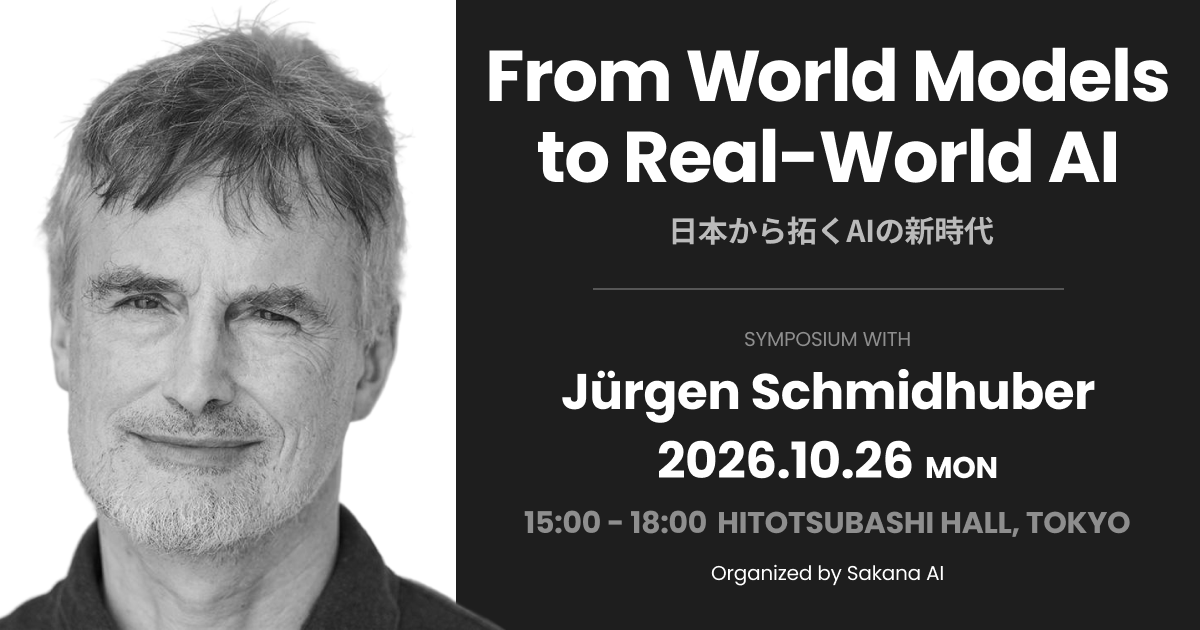
【受付開始】From World Models to Real-World AI — 日本から拓くAIの新時代
Chief Scientific Advisorとして当社に参画したJürgen Schmidhuber博士を迎えるシンポジウムを、10月26日(月)に東京・一橋講堂で開催します。本日より一般申し込みを開始しました。Schmidhuber博士による基調講演とQ&A、 CEO David Haとの対談、Sakana AI研究者によるショート講演を予定しています。
日時:2026年10月26日(月)15:00〜18:00
会場:一橋講堂(東京・千代田区)
言語:英語(通訳なし)
参加費:無料(事前登録制)
※ 席に限りがありますので、お早めにお申し込みください。
お申し込みはこちら:
luma.com/kjf0z516 🐟
Websiteリニューアルされて見やすくなっています!
すでにどんなProductが存在しているのか、公開できるフェーズまで達したB2B案件どのようなものがあるか、代表的なResearchなど、、、一覧で見れるようになっていますのでご覧ください。
The new Sakana AI website is live. 🐡
We have updated our digital home to reflect our products, enterprise solutions, and latest research.
Sakana AIの新サイトを公開しました。エンタープライズ事例やApplied Teamの採用情報も更新しています。ぜひご覧ください!
sakana.ai

4
640
Kosuke Nakago retweeted
【Account Executive (GTM) 立ち上げメンバー募集】
sakana.ai/careers/business-r…
Sakana Marlin、Namazu、FuguをはじめとするSakana AIプロダクトを、大企業を中心とした顧客に広げていきます。日本のAI企業が世界で勝つための営業の型をゼロから設計していただきます。
求めるのはエンタープライズ 営業を一気通貫で回してきた経験、エンジニアやリサーチャーと対等に話せる技術理解、そして日本語と英語の両方で市場を切り拓けることなどです。
研究・プロダクト開発拠点と同じ場所から、日本発のAIを世界に届ける営業組織を立ち上げます。この立ち上げに関わりたい方、ぜひご応募ください🐡

Kosuke Nakago retweeted

We worked on SAIL, exploring test-time scaling for in-context imitation learning using VLMs as robot trajectory generators last year. We’ll be presenting the work at #IROS2026 on Tuesday afternoon.
Introducing "Scaling In-Context Imitation Learning" (SAIL) to be presented at #IROS2026. This work is a collaboration between Sakana AI and the University of Tokyo.
Blog: pub.sakana.ai/sail
What does a robot need before it can tackle a new task?
Teaching a robot something new usually starts with collecting demonstrations and training a policy. But foundation models have already learned from vast amounts of images, text, and robotics-related data. We wanted to see how much of that knowledge we could draw out for robot control without changing the model itself.
Recent demonstrations suggest that GPT-6 Astra can operate physical robots alongside its general language and vision capabilities. Earlier work has also shown that LLMs/VLMs can generate entire sequences of robot movements from a few demonstrations.
However, a foundation model does not necessarily produce a reliable robot trajectory in a single generation. Performance depends on the context provided, and a small error in a movement target can cause the entire task to fail.
We propose SAIL, a method for more reliable VLM-based robot trajectory generation through test-time scaling.
SAIL uses a policy VLM as a robot trajectory generator, conditioned on a few successful demonstrations. It tests the generated trajectory in a simulator and uses an evaluation VLM to review the resulting video and identify where progress stalled. The policy VLM then uses this feedback to revise the trajectory, with Monte Carlo tree search (MCTS) exploring alternatives while refining promising candidates. Only the selected trajectory is sent to the physical robot.
Across six manipulation tasks in simulation, increasing the search budget from one candidate to 45 raised the average rate of finding a successful trajectory from 25% to 73%. We also evaluated SAIL on a physical robot. Our results suggest that robot trajectory generation can benefit from test-time scaling, with additional computation enabling the model to test and refine its proposed actions in simulation.
We think there is more to learn about what existing models can do with this kind of feedback, and how far those improvements carry over to physical robots.
Paper: arxiv.org/abs/2603.08269 🐟
Kosuke Nakago retweeted

流行の兆しを見せているJevに相当する機能は、数年前(PLaMo第1世代)から開発&利用していてサービス化までしたのだけど、需要が掘り起こせずサービス終了となってしまったんですよね……。需要がなかったのではなく伝えきれてなかったのだなと反省。 preferred.jp/ja/news/pr20250…

Kosuke Nakago retweeted
🐟️ Sakana Marlinがアップデート 🐟️
ブログ:sakana.ai/marlin-update/
Sakana Marlinを試す:sakana.ai/marlin/
本日、Sakana AIはUltra Deep Research Assistant「Sakana Marlin」をアップデートし、二つの機能を実装しました。
・レポートと対話する「Interactive Reading」
・出力スライドのPowerPoint対応
Sakana Namazuの採用事例が出てきました、嬉しいっ
> 2026年2月実施の第120回医師国家試験を解いたところ、96.4%の正解率(482点/500点満点。回答完遂率100%)を達成しました。これは当社が公開情報を元に確認する限り(※3)、経済産業省GENIACが指定する「国産基盤モデル」を用いた評価の中での最高得点です。
医療領域でも性能がよいようです、すごい!
アイリス株式会社様の医師向けエビデンス検索AI「Evidence Finder」に、当社の「Sakana Namazu」を導入いただきました。
prtimes.jp/main/html/rd/p/00…
Sakana Namazu → sakana.ai/namazu/ 🐟

13
3,017
Kosuke Nakago retweeted
Introducing Fugu Max and Fugu Ultra v2: the next evolution of Sakana Fugu’s multi-agent orchestration system.
Try: sakana.ai/fugu
Blog: sakana.ai/fugu-max-release/
The frontier that actually matters is the Pareto frontier: capability on one axis, cost on the other. But the industry still treats it as a static menu of isolated models. Today we are resolving that with a dynamic architecture:
Fugu Max expands the Pareto efficiency frontier. By orchestrating our largest pool of open-weights and specialized models to date, including NVIDIA Nemotron family, it dynamically routes tasks to the leanest capable model. Fugu Max delivers performance within striking distance of elite models at two to six times lower cost.
Fugu Ultra v2 pushes the peak capability of orchestration higher than ever before. On Chartography, it outperforms Opus 5 and Fable 5. On DeepSWE, it outperforms models that cost three to five times more per token. Crucially, it does all of this without Fable 5, Fable 5.1, or GPT-6-Astra in its agent pool.
The Fugu orchestration system evolved with model resiliency in mind. It does not rely on individual frontier models to deliver frontier output. By orchestrating a swappable pool of open and specialized models, it outperforms closed ecosystems while protecting users from vendor lock-in, API revocations, and sudden service cutoffs.
Fugu Max expands the Pareto frontier outward. Fugu Ultra v2 pushes it upward. Orchestration does not force a choice between cost and capability. It advances both simultaneously.