Kosuke Nakago (@corochann) header
Kosuke Nakago (@corochann) profile picture

Applied Research Engineer @SakanaAILabs ← PFN ← Sony Interests: Agentic Foundation Models(Ex. Deep Research)/Physical AI/Matlantis/Trading Kaggle 2x Grandmaster

Tokyo, Japan
Joined March 2011
Photo by Kosuke Nakago (@corochann)Photo by Kosuke Nakago (@corochann)Photo by Kosuke Nakago (@corochann)Photo by Kosuke Nakago (@corochann)Photo by Kosuke Nakago (@corochann)Photo by Kosuke Nakago (@corochann)Photo by Kosuke Nakago (@corochann)Photo by Kosuke Nakago (@corochann)Photo by Kosuke Nakago (@corochann)Photo by Kosuke Nakago (@corochann)
Kosuke Nakago retweeted
こちらの記事でSakana AIの選考についてお話ししました! Applied Research Engineer(Enterprise, Defense, Productなど)積極募集中です。ご応募お待ちしています! ​sakana.ai/careers/
Building a top AI team is a challenge, especially in Japan. I have the incredible honor of working with Maho Hashimoto (@m4h0), our Head of People, to recruit exceptional talent for Sakana AI. Maho was recently featured in a wonderful interview (in Japanese) about how we find people who fit our culture: one that pushes the boundaries of frontier AI while maintaining a relentless execution mindset. At @SakanaAILabs, we don’t just hire for today’s skills; we look for people who can learn, adapt, and build the future. If you’re interested in how we think about talent and culture, I highly recommend the read.
7
1
67
3,478
Kosuke Nakago retweeted
Sakana Namazu SmallはNemotron 3 Nano Baseに追加の学習をした30B-A3Bのモデルです。今後オンプレミスでの提供などで利用していく予定です。 技術的には、今までのSakana Namazuシリーズと異なり、baseモデルから出発しAgentic CPT, SFT, RLという一連のパイプラインを成功させたことがマイルストーンになります。事前学習直後の、agenticなことが何一つできないbaseモデルをどう育てるか。これは今後、自社で事前学習を行うSakana Sawaraシリーズでも必要になるノウハウで、まずは1つの分野でそれを確立できました。 今回の取り組みではチャット画面での日常的・基礎的なタスクを想定したため、agenticな能力の中では特にweb検索を大きく伸ばしました。学習後のモデルには、900回以上ツールを呼び出した末に難問を正解する例もあり、long-horizonなタスクをこなす力も身についていると感じます。デプロイまで自社でコントロールできる分野なので、特定のハーネスを前提にend-to-endでパイプラインを設計しました。これが、コストを抑えつつ優れた性能を実現できた要因の1つだと考えています。 データ面では、合成データに加えて、外部パートナーと連携して人間のエキスパートに作成してもらった高品質・高難易度の問題が、RLで重要な役割を果たしました。こうしたデータ構築のアプローチの有効性を確認できたことも大きな収穫です。 本モデルはGENIAC第4期の成果を活用しています。今後はSakana Sawaraシリーズの事後学習に向けて、このノウハウをさらに深めつつ、他のドメインにも広げていきます。
「Sakana Namazu Small」(30Bモデル)を発表 sakana.ai/namazu-small/ NVIDIA Nemotron 3 Nanoをベースに継続事前学習・事後学習を行い、25ベンチマーク平均で約4倍規模の120Bモデルを上回りました。 長文読解やWeb検索での調査に強く、オンプレミス提供の詳細は12月前半にお知らせします。
3
36
1
176
15,658
Kosuke Nakago retweeted
本日のSakana AIのシンポジウムは、おかげさまで満員となりました。足を運んでくださった皆さま、本当にありがとうございました!🐟 ユルゲン・シュミットフーバー教授の基調講演や対談を含め、イベントの模様は後日あらためてご報告します。 当日は CEO の David Ha から、AI主権にとって重要となる Sakana AIの取り組みの「3つの柱」についてお話ししました。 ・Pre-training:次世代の事前学習モデルの開発にAIエージェントを活用する ・Post-training:日本語やビジネスシーンにLLMを適応させる事後学習技術(Sakana Namazu) ・Orchestration:最先端の性能を、単一のAIモデルに依存せずに実現するオーケストレーション技術(Sakana Fugu) 続いてチーフサイエンティストの秋葉拓哉から、事前学習の取り組みである「Sakana Sawara(仮称)」プロジェクトと、その意義についてお話ししました。 Sakana AIはこれまで、LLMを最大限に活用する「エージェントの層」での技術革新を強みの一つとしてきました。しかしいま、「モデルの層」が再び重要になっています。オープンモデルと最先端モデルとの差は縮まり、モデルを作るコストは下がり、さらに強化学習によって自社のタスクやツールに合わせて特化させることもできる。こうした状況を踏まえ、モデル作りに改めて取り組むべき時期が来たと考えています。 事前学習のボトルネックは、相変わらず計算機の量にあります。その限られた計算資源をどこに投じるか。モデル開発の進展は、どんな実験をどの順で行い、どのアイデアを捨てるかという判断の精度に大きく左右されるようになりました。秋葉からは、こうした開発を、AIの力も駆使しながら少数精鋭のチームで手がけていくアプローチについてお話ししました。 この発表は、日経新聞でも取り上げていただきました。 nikkei.com/article/DGXZQOUC2… 🐟
9
43
13
248
52,421
Kosuke Nakago retweeted
The Agentic Scientist: Orchestrating Coding Agents for Automated Scientific (Co-)Discovery Blog: pub.sakana.ai/agentic-scient… GitHub: github.com/SakanaAI/AI-Scien… arXiv: arxiv.org/abs/2610.18933 Since 2024, we’ve used The AI Scientist as a way to test how far AI alone can take scientific research, from v1 to v2 to the paper published in Nature earlier this year. The Agentic Scientist is the next step in that line of work, built for the era of coding agents. Coding agents such as Codex and Claude Code now carry out long software tasks on their own. Handing them a research problem, however, tends to produce a strong hyperparameter optimizer rather than a scientist: scores go up, but ideas stay narrow, and the reasons for the gain are rarely examined. The Agentic Scientist makes the research loop explicit. It wraps off-the-shelf coding agents in a scaffold that controls what they see, what they write, how they are evaluated, and how results are handed to the next stage. Parallel workers test hypotheses against rubrics defined before any experiment runs, share successes and failures through a common memory, and then ablate the winning program to generate evidence. We used an early version of the system to study Error Diffusion, a biologically motivated alternative to backpropagation. Our researchers set the question and the rubric, chose directions at each stage, and verified the results, references, and claims before submission. The resulting paper was accepted as an oral presentation at ALIFE 2026. In autonomous runs, the system also raised Doc-to-LoRA retrieval accuracy from 52% to 98% on multi-needle tasks and designed a learned evolution strategy that improves over its CMA-ES reference on unseen tasks. Alongside it we release AutoIllustrate, a pipeline for scientific figures that keeps an editable draw.io file as the source of truth, so every diagram can be corrected by hand. Humans define the question and the standards of evidence; agents expand the experiments researchers can run. We call this Co-Discovery, and we are releasing both systems as open source for the community to build on.
57
117
41
772
164,067
Kosuke Nakago retweeted
【🔬Matlantis User Conference 2026 開催レポート公開】AIの進化は、科学者の研究開発をどう変えるのか。 材料研究では、AIを活用した計算化学によって、探索できる材料や条件が広がっています。さらに、AIとの対話によるシミュレーションの実行支援も。こうした変化を、研究現場の成果にどうつなげていくか。 9月18日、「AI for Scienceの最前線 ~科学者とAIによる研究開発の進化~」をテーマに、「Matlantis User Conference 2026」を開催しました。ユーザー限定イベントの内容を、少しだけご紹介します。 当日は計算化学や材料開発に携わる研究者をはじめ、関係者を含め400名超が会場に集結。9件の講演、61件のポスター発表、ヨビノリたくみ氏が進行するパネルディスカッションを通じて、技術の進化と研究現場での実践の両面から、活発な議論が交わされました。 🤖講演や議論で語られたのは、こんなテーマです。 ・原子レベルの洞察を、研究者の意思決定へどうつなげるか ・計算化学の知見を実験研究者へ届けるAI活用の一手 ・計算で得た結果を、材料や製造プロセスの設計へどう生かすか ・現場の研究者が考える、AIに任せたい仕事と自ら担いたい仕事 🚀AIによってできることが広がるなかで、何を調べ、結果をどう見極め、次の研究へつなげるのか。各社の取り組みや研究者の声を、会場の熱気とともにお届けします。 👇開催レポートはこちら matlantis.com/ja/resources/b… #Matlantis #AIforScience #材料開発 #計算化学
8
3
31
13,330
Kosuke Nakago retweeted
Schmidhuber先生の直後に話すらしいです 😨 こんなに恐ろしい講演が今まであっただろうか
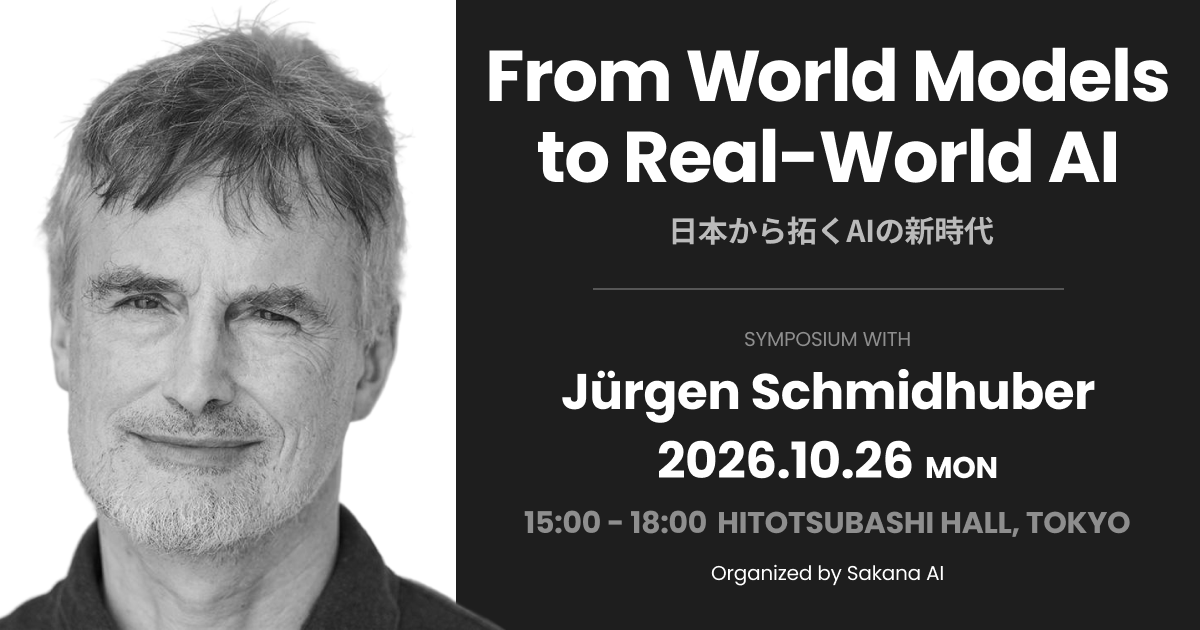
【受付開始】From World Models to Real-World AI — 日本から拓くAIの新時代 Chief Scientific Advisorとして当社に参画したJürgen Schmidhuber博士を迎えるシンポジウムを、10月26日(月)に東京・一橋講堂で開催します。本日より一般申し込みを開始しました。Schmidhuber博士による基調講演とQ&A、 CEO David Haとの対談、Sakana AI研究者によるショート講演を予定しています。 日時:2026年10月26日(月)15:00〜18:00 会場:一橋講堂(東京・千代田区) 言語:英語(通訳なし) 参加費:無料(事前登録制) ※ 席に限りがありますので、お早めにお申し込みください。 お申し込みはこちら: luma.com/kjf0z516 🐟
4
11
190
20,915
Kosuke Nakago retweeted
【Account Executive (GTM) 立ち上げメンバー募集】 sakana.ai/careers/business-r… Sakana Marlin、Namazu、FuguをはじめとするSakana AIプロダクトを、大企業を中心とした顧客に広げていきます。日本のAI企業が世界で勝つための営業の型をゼロから設計していただきます。 求めるのはエンタープライズ 営業を一気通貫で回してきた経験、エンジニアやリサーチャーと対等に話せる技術理解、そして日本語と英語の両方で市場を切り拓けることなどです。 研究・プロダクト開発拠点と同じ場所から、日本発のAIを世界に届ける営業組織を立ち上げます。この立ち上げに関わりたい方、ぜひご応募ください🐡
4
15
1
85
25,697
Kosuke Nakago retweeted
We worked on SAIL, exploring test-time scaling for in-context imitation learning using VLMs as robot trajectory generators last year. We’ll be presenting the work at #IROS2026 on Tuesday afternoon.
Introducing "Scaling In-Context Imitation Learning" (SAIL) to be presented at #IROS2026. This work is a collaboration between Sakana AI and the University of Tokyo. Blog: pub.sakana.ai/sail What does a robot need before it can tackle a new task? Teaching a robot something new usually starts with collecting demonstrations and training a policy. But foundation models have already learned from vast amounts of images, text, and robotics-related data. We wanted to see how much of that knowledge we could draw out for robot control without changing the model itself. Recent demonstrations suggest that GPT-6 Astra can operate physical robots alongside its general language and vision capabilities. Earlier work has also shown that LLMs/VLMs can generate entire sequences of robot movements from a few demonstrations. However, a foundation model does not necessarily produce a reliable robot trajectory in a single generation. Performance depends on the context provided, and a small error in a movement target can cause the entire task to fail. We propose SAIL, a method for more reliable VLM-based robot trajectory generation through test-time scaling. SAIL uses a policy VLM as a robot trajectory generator, conditioned on a few successful demonstrations. It tests the generated trajectory in a simulator and uses an evaluation VLM to review the resulting video and identify where progress stalled. The policy VLM then uses this feedback to revise the trajectory, with Monte Carlo tree search (MCTS) exploring alternatives while refining promising candidates. Only the selected trajectory is sent to the physical robot. Across six manipulation tasks in simulation, increasing the search budget from one candidate to 45 raised the average rate of finding a successful trajectory from 25% to 73%. We also evaluated SAIL on a physical robot. Our results suggest that robot trajectory generation can benefit from test-time scaling, with additional computation enabling the model to test and refine its proposed actions in simulation. We think there is more to learn about what existing models can do with this kind of feedback, and how far those improvements carry over to physical robots. Paper: arxiv.org/abs/2603.08269 🐟
3
50
3,991
Kosuke Nakago retweeted
流行の兆しを見せているJevに相当する機能は、数年前(PLaMo第1世代)から開発&利用していてサービス化までしたのだけど、需要が掘り起こせずサービス終了となってしまったんですよね……。需要がなかったのではなく伝えきれてなかったのだなと反省。 preferred.jp/ja/news/pr20250…
10
234
48
1,122
255,075
Kosuke Nakago retweeted
🐟️ Sakana Marlinがアップデート 🐟️ ブログ:sakana.ai/marlin-update/ Sakana Marlinを試す:sakana.ai/marlin/ 本日、Sakana AIはUltra Deep Research Assistant「Sakana Marlin」をアップデートし、二つの機能を実装しました。 ・レポートと対話する「Interactive Reading」 ・出力スライドのPowerPoint対応
4
36
7
213
28,400
Kosuke Nakago retweeted
Introducing Fugu Max and Fugu Ultra v2: the next evolution of Sakana Fugu’s multi-agent orchestration system. Try: sakana.ai/fugu Blog: sakana.ai/fugu-max-release/ The frontier that actually matters is the Pareto frontier: capability on one axis, cost on the other. But the industry still treats it as a static menu of isolated models. Today we are resolving that with a dynamic architecture: Fugu Max expands the Pareto efficiency frontier. By orchestrating our largest pool of open-weights and specialized models to date, including NVIDIA Nemotron family, it dynamically routes tasks to the leanest capable model. Fugu Max delivers performance within striking distance of elite models at two to six times lower cost. Fugu Ultra v2 pushes the peak capability of orchestration higher than ever before. On Chartography, it outperforms Opus 5 and Fable 5. On DeepSWE, it outperforms models that cost three to five times more per token. Crucially, it does all of this without Fable 5, Fable 5.1, or GPT-6-Astra in its agent pool. The Fugu orchestration system evolved with model resiliency in mind. It does not rely on individual frontier models to deliver frontier output. By orchestrating a swappable pool of open and specialized models, it outperforms closed ecosystems while protecting users from vendor lock-in, API revocations, and sudden service cutoffs. Fugu Max expands the Pareto frontier outward. Fugu Ultra v2 pushes it upward. Orchestration does not force a choice between cost and capability. It advances both simultaneously.
78
178
75
1,037
394,262
Kosuke Nakago retweeted
こちらのポジション、とても面白い環境でLLMの研究開発に取り組めます!意外と小規模なチームで取り組んでおり、様々な能力を持った優秀なメンバーがいるので学びもめちゃくちゃ多いです!最近は論文やProductなどいろいろな形で成果を公開できるのも魅力だと思います!少しでもご興味ある方はぜひ🙌
【採用情報】Member of Technical Staff (LLM Development) の募集を開始しました🐟 sakana.ai/careers/member-of-… Sakana Namazuを起点に拡大しているSakana AIのLLM開発を担うポジションです。下記のような挑戦が待っています。 ・事前学習から事後学習・評価まで、LLM開発の全工程に取り組むチーム に参加 ・LLM開発全体を見渡しながら、担当領域にオーナーシップを持ってリード ・Sakana AIのプロダクト・ソリューションとRSI研究の基盤となるLLMを開発 LLM開発の最前線で挑戦したい方、ぜひご応募ください🚀
6
45
17,934
Kosuke Nakago retweeted
Sakana AIの最新情報を届けるニュースレター「Sakana AI Insider」がスタート🐟 ・プロダクトのリリース情報 ・研究開発のアップデート ・Swagプレゼントやイベントの優先案内 など、盛りだくさんの内容をお届けします(月1〜2回)。 購読はこちらのフォームから forms.gle/vzjVTFQzCVKBNghJ7 🎣
3
19
6
144
24,948
Kosuke Nakago retweeted
インフラエンジニア募集中です!大きいモデルや小さいモデルを高速かつ安定的に動かしてくれるそこのあなたを求めています🫵 sakana.ai/careers/infrastruc…
6
14
1,097
Kosuke Nakago retweeted
Introducing Fugu-Cyber: an update to our Fugu orchestration model. It achieves state-of-the-art performance on real-world security benchmarks, matching cyber-focused frontier models like GPT-5.5-Cyber and Mythos Preview. sakana.ai/fugu-cyber-release 🐡
82
304
120
2,072
594,466
Kosuke Nakago retweeted
Sakana Fugu Technical Report arxiv.org/abs/2606.21228 🐡
8
42
2
246
22,980
Kosuke Nakago retweeted
Member of Technical Staff (RSI Lab) sakana.ai/careers/member-of-… If you are a visionary builder ready to move to Tokyo and engineer the engine of recursive discovery, we invite you to apply.
6
12
69
15,085
Kosuke Nakago retweeted
How do we make LLMs faster and lighter? Don’t force the GPU to adapt to sparsity. Reshape the sparsity to fit the GPU! ⚡️ Excited to share our new #ICML2026 paper in collaboration with @NVIDIA: "Sparser, Faster, Lighter Transformer Language Models". This work introduces new open-source GPU kernels and data formats for faster inference and training of sparse transformer language models: Paper: arxiv.org/abs/2603.23198 Blog: pub.sakana.ai/sparser-faster… Code: github.com/SakanaAI/sparser-… While LLMs are undoubtedly powerful, they are increasingly expensive to train and deploy, with a large part of this cost coming from their feedforward layers. Yet, an interesting phenomenon occurs inside these layers: For any given token, only a small fraction of the hidden activations actually matter. The rest approximate zero, wasting computation. With ReLU and very mild L1 regularization, this sparsity can exceed 95% with little to no impact on downstream performance. So, can we leverage this sparsity to make LLMs faster? The challenge is hardware. Modern GPUs are optimized for dense matrix multiplications. Traditional sparse formats introduce irregular memory access and overheads that cancel out their theoretical savings for GEMM operations. Our contribution is twofold: 1/ We introduce TwELL (Tile-wise ELLPACK), a new sparse packing format designed to integrate directly in the same optimized tiled matmul kernels without disrupting execution. 2/ We develop custom CUDA kernels that fuse multiple sparse matmuls to maximize throughput and compress TwELL to a hybrid representation that minimizes activation sizes. We used our kernels to train and benchmark sparse LLMs at billion-parameter scales, demonstrating >20% speedups and even higher savings in peak memory and energy. This work will be presented at #ICML2026. Please check out our blog and technical paper for a deep dive!
21
117
13
766
438,410
Kosuke Nakago retweeted
NEW paper from Sakana AI (ICLR 2026). A 7B Conductor model just hit SOTA on GPQA-Diamond and LiveCodeBench by orchestrating other LLMs instead of solving problems itself. (great paper! bookmark it!) The Conductor is trained with RL to do two things at once: design communication topologies between worker agents (open or closed source), and prompt-engineer focused instructions to each worker so it leverages their individual strengths. It's like training a special agent to take care of both collaboration and communication. Trained against randomized agent pools, it adapts to arbitrary mixes of agents at inference time. Even more interesting: when allowed to pick itself as a worker, it forms recursive topologies, unlocking a new form of dynamic test-time scaling through online iterative adaptation. The gains over the best individual worker on AIME25 and GPQA-D land in the ~3% range, which the authors note is consistent with entire generational improvements between frontier model versions, except this one comes from coordination, not pretraining. Why it matters? We can start to think of the orchestrator as the model now. Routing decisions aren't just a wrapper, they're a learnable policy. Paper: arxiv.org/abs/2512.04388 Learn to build effective AI agents in our academy: academy.dair.ai/
14
67
7
368
29,631
Kosuke Nakago retweeted
Introducing our new work: “Learning to Orchestrate Agents in Natural Language with the Conductor” accepted at #ICLR2026 arxiv.org/abs/2512.04388 What if we trained an AI not to solve problems directly, but to act as a manager that delegates tasks to a diverse team of other AIs? To solve complex tasks, humans rarely work alone; we form teams, delegate, and communicate. Yet, multi-agent AI systems currently rely heavily on rigid, human-designed workflows or simple routers that just pick a single model. We wanted an AI that could dynamically build its own team. We trained a 7B Conductor model using Reinforcement Learning to orchestrate a pool of frontier models (including GPT-5, Gemini, Claude, and open-source models available during the period leading up to ICLR 2026). Instead of executing code, the Conductor outputs a collaborative workflow in natural language. For any given question, the Conductor specifies: 1/ Which agent to call 2/ What specific subtask to give them (acting as an expert prompt engineer) 3/ What previous messages they can see in their context window Through pure end-to-end reward maximization, amazing behaviors emerged. The Conductor learned to adapt to task difficulty: it 1-shots simple factual questions, but autonomously spins up complex planner-executor-verifier pipelines for hard coding problems. The results are very promising: The 7B Conductor surpasses the performance of every individual worker model in its pool, setting new records on LiveCodeBench (83.9%) and GPQA-Diamond (87.5%) at the time of publication. It also significantly outperforms expensive multi-agent baselines like Mixture-of-Agents at a fraction of the cost. One of our favorite features: Recursive Test-Time Scaling! By allowing the Conductor to select itself as a worker, it reads its own team's prior output, realizes if it failed, and spins up a corrective workflow on the fly. This opens a new axis for scaling compute during inference. This research proves that language models can become elite meta-prompt engineers, dynamically harnessing collective intelligence. Alongside our TRINITY research which we announced a few days earlier, this foundational research powers our new multi-agent system: Sakana Fugu! (sakana.ai/fugu-beta) 🐡 OpenReview: openreview.net/forum?id=U23A… (ICLR 2026)
We’re launching the beta for our new commercial AI product: Sakana Fugu 🐡, a multi-agent orchestration system! Blog: sakana.ai/fugu-beta Fugu hits SOTA on SWE-Pro, GPQA-D, and ALE-Bench, and has been our internal secret weapon. It dynamically coordinates frontier models, autonomously selecting the optimal agent combinations and roles for each task. Available as an OpenAI-compatible API, you can seamlessly integrate Fugu into your existing workflows with minimal changes. 🐟 Fugu Mini: High-speed orchestration optimized for latency 🐡 Fugu Ultra: Full model pool utilization for deep, complex reasoning Apply for the beta test here: forms.gle/BtKkhc2CfLKk1dvNA
16
118
14
640
231,302