





Mahyen retweeted

Indian men, do your blood test today.
1. Complete Blood Count (CBC) with Differential
2. Thyroid Panel: TSH, Free T4, Free T3
3. Liver Function Test (LFT) Panel
4. Kidney Function Test (KFT/RFT) Panel (including eGFR)
5. Lipid Profile (Fasting Required) + APOB ( ask for this specifically)
6. Iron Studies: Serum Iron, Ferritin, TIBC, Transferrin Saturation
7. Blood Sugar Markers: Hemoglobin A1c (HbA1c), Fasting Blood Glucose (FBG - Fasting Required)
8. Fasting Insulin
9. Vitamins: Vitamin D (25-OH), Vitamin B12
10. Hormone Panel
Male: Total Testosterone, Free Testosterone, SHBG
11. Genetic test : Lp (a) done once in life.
Few test more to understand risk of metabolic syndrome:
1. waist circumference > 80 cm in males
2. blood pressure > 130/85
Getting fit ≠ healthy.
I have worked with runner having deranged blood markers, 25% + body fat and family history of heart disease.
Share this max with your friends and family.
In next tweet we learn about stress test, 2d echo, cardiac arrest and genetic heart condition that lead to sudden death.


Mahyen retweeted

This is not normal what is happening in Texas right now, $500B+ in the project pipeline……..
The Texas Mega-Project Pipeline ($500+ Billion)
$100B+ – OpenAI / SoftBank / Oracle "Project Stargate" AI Infrastructure Hub (Planned / Under Construction, Abilene & West TX)
$44B – Samsung Advanced Semiconductor Fab Complex (Under Construction, Taylor)
$40B – Texas Instruments Semiconductor Mega-Site (Under Construction, Sherman)
$40B – Google Data Center & Energy Infrastructure Buildout (Planned / Under Construction, Multi-Site)
$18B – Port Arthur LNG Export Terminal – Phase 1 & 2 (Under Construction, Port Arthur)
$17B – Texas Central High-Speed Rail Project (Planned, Dallas to Houston)
$15B – NextDecade Rio Grande LNG Terminal (Under Construction, Brownsville)
$13B – Energy Transfer Pipeline & Natural Gas Grid Expansion (Under Construction / Planned, Permian-to-Gulf Coast)
$12B – Golden Pass LNG Terminal (Under Construction, Sabine Pass)
$11.6B – Crusoe / Oracle AI Data Center Campus (Under Construction, Abilene)
$10B+ – Meta Hyperion-Scale AI Data Center (Under Construction, El Paso)
$10B – Tesla Gigafactory & Cybercab / Robotaxi Production Expansion (Under Construction, Austin)
$7B – TxDOT I-45 North Houston Highway Improvement Project (Under Construction, Houston)
$6B – Pacifico Energy "GW Ranch" Gas & Solar Energy Center for AI (Planned, Pecos County)
$5B – Enterprise Products Partners Offshore Crude Export Terminal (SPOT) (Planned, Brazoria County)
$4B – Micron Technology R&D & Packaging Expansion (Planned, Central TX)
$3.2B – NRG Energy Dedicated Data Center Power Generation Facilities (Planned, Multi-site)
$3B – Cheniere Corpus Christi LNG Stage 3 Expansion (Under Construction, Corpus Christi)
$2.5B – Microsoft AI Data Center Campus (Under Construction, Pecos / Castroville)

Mahyen retweeted

Stanford CS329Z: Engineering AI Agents is so underrated on YouTube. It literally walks you through everything you need to build your own AI agent, step by step, hands-on.
Skip Netflix and those endless short videos. Pick a topic that interests you and dive in this weekend. It might just help you land your next $500K job.
youtube.com/watch?v=b4y3rjGp…
course website: cs329z.stanford.edu/

Mahyen retweeted

this open trading library is fu*cking insane.
Jane street PM leaked all internal trading strategies and made them public with code.
quants.md
Bookmark rn.
Readers added context they thought people might want to know
Not Jane Street strategies. All 50 are textbook SMA, RSI and momentum templates from QuantJourney, a UAE developer's open-source backtester with $29/mo and $999/yr plans. Its repo calls them "research templates, not production trading systems." None mention Jane Street.
quants.md
github.com/QuantJourneyOr…
github.com/sponsors/jpolec
Mahyen retweeted

INDIAN THRILLER MOVIES with mind bending plots
1. #Ratsasan (2018) ⭐ 8.3/10
2. #Kaithi (2019) ⭐ 8.4/10
3. #AWednesday (2008) ⭐ 8.1/10
4. #Kahaani (2012) ⭐ 8.1/10
5. #Talvar (2015) ⭐ 8.1/10
6. #Thani Oruvan (2015) ⭐ 8.4/10
7. #Ugly (2013) ⭐ 8.1/10
8. #Special 26 (2013) ⭐ 8.0/10
9. #Theeran Adhigaram Ondru (2017) ⭐ 8.2/10
10. #Dhuruvangal Pathinaaru (2016) ⭐ 8.2/10
11. #Agent Sai Srinivasa Athreya (2019) ⭐ 8.3/10
12. #Lucia (2013) ⭐ 8.3/10
13. #Manjummel Boys (2024) ⭐ 8.2/10
14. #Kishkindha Kaandam (2024) ⭐ 8.1/10
15. #Evaru (2019) ⭐ 8.1/10
16. #Section 375 (2019) ⭐ 8.1/10
17. #Memories (2013) ⭐ 8.0/10
18. #Por Thozhil (2023) ⭐ 8.0/10
19. #Mumbai Police (2013) ⭐ 7.9/10
20. #Johnny Gaddaar (2007) ⭐ 7.9/10
Mahyen retweeted

The entire RAG industry is getting challenged by… a single file 🤯
It’s called Memvid. It packages your agent’s data, embeddings, search index and metadata into one portable `.mv2` file.
The original version used MP4. The current version uses a purpose-built binary format.
- No separate database server
- Built-in text and vector search
- Append-only memory with history tracking
- Local, offline retrieval
- Python, Node.js, Rust and CLI support
Your agent’s memory becomes something you can copy, move and search without running a separate database service.
100% open-source.

Mahyen retweeted
Vector databases are officially cooked 🤯
This repo packs 60 million text chunks into 6 GB instead of 201 GB, with no accuracy drop reported in its tests.
- 97% less storage
- No cloud or GPU needed
- Runs on a standard laptop
- Keeps your data local
100% open-source.

Mahyen retweeted

A Stanford professor just explained how ChatGPT and Claude are actually built better than anyone.
most people still think there's some magic inside the model.
Bookmark this before you forget.
> how text gets turned into numbers
> why "predict the next word" is the whole game
> what the loss actually measures
> what the model adjusts during training, step by step
useful whether you've never touched an LLM or you use Claude every day.
after this, every new model release makes sense.
free, full lecture. find it below ↓

Mahyen retweeted

What would Solana’s consensus look like in a post-quantum world?
Meet Quantumglow: a proposed adaptation of Alpenglow that aims to protect consensus while preserving fast finality.
@jacobvcreech and @qkniep explain how it works. Full video below👇
🤖 Made with AI
Mahyen retweeted

Withdraw all funds from CoinDCX if you value your assets.
Its co-founders are clowns running a circus.
They publicly and privately denied a theft of its assets occurred meaning they straight up lied or are negligently incompetent.
Later they disclosed the $16M theft and wasted everyone’s time instead of being transparent with the public initially.
Not the first time CoinDCX has done it.
Indian CEXs like CoinDCX, WazirX, BitBNS are all the same.
(I still helped freeze 6 figures for CoinDCX)


Mahyen retweeted

Effective Immediately, all organizations using PHP for their systems are advised to be prepared for an update addressing two critical vulnerabilities. PHP is widely used for web applications. These vulnerabilities often provide a direct path to the server's file system or database. If an immediate update is not feasible, it is recommend that organizations take the system offline until it can be fully mitigated. NSA will follow up shortly with more specific guidance.
Mahyen retweeted

🚨 China is replacing celebrities and advertisements on giant public screens with scientists.
Something we can emulate.

Mahyen retweeted

SOMEONE LEAKED THE PROMPT TO CREATE TRADING AGENTS. YOU PASTE IT INTO CLAUDE CODE AND IT SETS UP THE BOT WHILE YOU GRAB A COFFEE.
No programming required. Just paste. A single prompt does it all:
Time required: 1 minute
Actions: copy and paste into Claude Code
The mistake that wipes out the accounts of 99% of traders with bots: they use the same strategy for everything.
But the market isn't the same on a quiet Tuesday as it is in the middle of a crash
1. Read the market like a quant: detect if it's calm, sideways, jittery or in freefall and switch strategies for each one
2. Handbrake: maximum drawdown of 15% and a kill switch that's checked before EVERY order
3. Test before touching the money: backtest the strategy period by period with real data and refuse to trade if it doesn't beat the market
4. Night shift: while you sleep, it analyzes what went wrong and leaves ready improvements. You decide if they're applied
5. Zero code: you paste, fill in your data and Claude handles the rest
Before, this meant a team of PhDs, mathematicians, thousands of lines of code and weeks of work.
Now it's just Ctrl+V.
Save it before they delete it.


Mahyen retweeted

wow, this is f***ing wild
SpaceXAI engineer Lauren Tan has shared her own agent setup, with 54 skills
install it in Grok Bot: /add-plugin pstack
Here’s what’s inside:
→ 8 build skills:
/architect maps out the approach
/arena weighs different solutions
/swarm distributes work among agents
→ 6 review skills:
/interrogate questions assumptions,
/create-verification-skill sets out how to verify the app while it runs
→ 8 context + learning skills:
/recall retrieves earlier context
/catchup restores the project status
/teach captures reusable procedures
→ 5 writing + UI skills:
/unslop
/technical-writing
/make-bot-ui handle explanations, documentation and interfaces
along with 3 setup skills and 24 engineering principles for testing, dependencies, error handling and code structure.
The process: investigate → build → verify → save context
go deep with a single agent, then parallelize the work with confidence.
Save this list for your new workflow ↓


Mahyen retweeted

this MIT quant paper is f*cking insane
it shows why AI can make trading research faster
and fake alpha way easier to believe
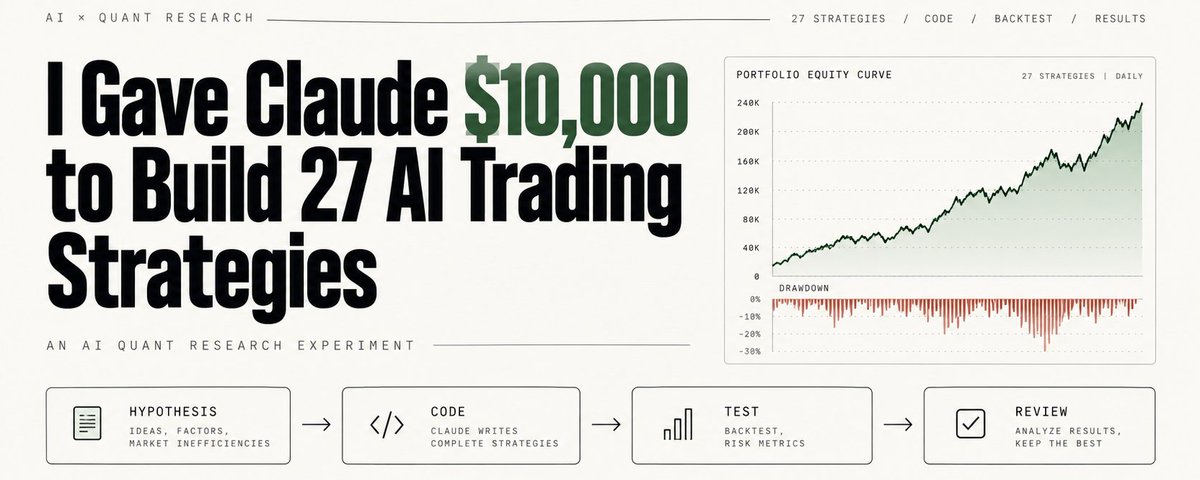
the paper starts with 27 strategy variants
only 6 look profitable in-sample
then the filter gets brutal:
2 survive preliminary out-of-sample checks
approved for real money?
0
that is the whole point.
the more ideas AI can generate, the more important it becomes to kill weak ones fast
so the framework flips the goal:
generate broadly
walk forward
add realistic costs
compare risk-adjusted returns
reject anything fragile
the crazy part is even costs alone can destroy the edge
$1,200 gross profit
$700 after 0.10% costs
$200 after 0.20% costs
and a strategy with lower return can still be better if the Sharpe and drawdown are cleaner
AI should not be your trading oracle
it should be your strategy rejection machine
bookmark before this thread gets buried


Mahyen retweeted

Learn Harness Engineering 🚀
Found this excellent open-source course by Walking Labs, covering 14 lectures and 8 hands-on projects on building more reliable AI coding agents.
What's inside:
→ Agent instructions (AGENTS.md / CLAUDE.md)
→ Context management and persistent memory
→ Multi-session continuity and state tracking
→ Task boundaries and scope control
→ Testing, verification, and observability
→ Automated agent loops and workflows
→ Multi-agent orchestration and graph engineering
The practical projects walk you through building a complete agent harness, comparing prompt-only execution with structured workflows.
Also includes ready-to-use templates, verification scripts, and a harness-creator skill.
Perfect for developers working with Claude Code, Codex, and other AI coding agents who want to understand the engineering behind reliable agent execution.
Completely free.
Here's the GitHub Repo: github.com/walkinglabs/learn…

Mahyen retweeted
Ex-Jane Street quant openly shared on X, how he used free TradingView MCP to build a solo regime-switching bot that's doing $24k/month.
feed this exact prompt into Claude code and you'll have a working chart-reading agent by tonight.
Bookmark before its lost. 52k upvotes

ALT TMCP

Mahyen retweeted
this is the most DANGEROUS thing on internet today
REA (Reverse Engineer Anything) - this open source MCP lets your AI agent reverse engineer any app, down to the binary
i just reverse engineered TradingView, now I am using their premium indicators for FREE - software is cooked
here is how to use REA to reverse engineer TradingView:
1. point REA at TradingView's publicly observable interface and map every major feature, from chart interactions to indicators and alerts
2. trace how the interface behaves when you switch symbols, change timeframes, add indicators, draw levels, and update chart layouts
3. use REA's available MCP tools to investigate authorized software artifacts and trace application logic wherever the evidence allows
4. feed those findings into Claude Opus 5.5, which turns the investigation into a technical specification and an implementation plan
5. rebuild the charting engine independently, with real market data, candlesticks, technical indicators, drawing tools, and persistent watchlists
6. add a quant backtesting engine that tests strategies against historical data, accounting for fees, slippage, and drawdowns
7. test every component, compare its behavior against documented and observable results, fix failures, and keep iterating until the system actually works
8. you end up building your own TradingView-style quant research terminal from scratch, with source code you control and features you can keep extending
i won’t say anything more:

Mahyen retweeted

As an AI Infrastructure Engineer, you must build these projects.
1.) High-Throughput Serving Engine Tuning
Build: Deploy vLLM or SGLang, tuning chunked prefill, continuous batching and max-num-seqs for a specific GPU architecture.
Why: Default configs waste 60% of VRAM. Squeezing the hardware is the baseline job.
2.) KV-Cache Prefix Routing Proxy
Build: A load balancer that hashes incoming system prompts and routes requests to the specific replica holding that KV-cache block in memory.
Why: Reused context is free speed. This alone can slash Time-To-First-Token (TTFT) by 80%.
3.) Custom Fused Triton Kernel
Build: Write a fused RMSNorm or RoPE (Rotary Position Embedding) kernel in Triton and benchmark it against the native PyTorch implementation.
Why: Python overhead and memory reads kill inference. Fused kernels save milliseconds that compound at scale.
4.) Speculative Decoding Pipeline
Build: A serving setup where a local 2B "draft" model generates tokens in parallel and a 70B "target" model verifies them in a single forward pass.
Why: 2x decode speed at zero quality loss is the closest thing to a free lunch in inference.
5.) Disaggregated Prefill/Decode Cluster
Build: Separate GPU pools where compute-heavy prefills and memory-bound decodes are routed to different hardware optimized for each phase.
Why: This is the exact architecture frontier labs use to maximize MFU (Model Flops Utilization) in 2026.
6.) FP8 Quantization & Calibration Harness
Build: A pipeline that calibrates a model for FP8 inference, serves it via TensorRT-LLM and measures the exact perplexity drop against throughput gains.
Why: Quantization is the only way to fit frontier models on edge GPUs and protect your cloud margins.
7.) Queue-Based GPU Autoscaler (KEDA)
Build: An autoscaler that spins up spot GPU nodes based on pending token queue depth and gracefully drains them when the queue empties.
Why: Idle H100s burn $3+/hr. FinOps and scheduling are now core infra responsibilities.
8.) Complexity-Routing AI Gateway
Build: A proxy that analyzes prompt entropy and token length to instantly route simple queries to a quantized local 8B model and complex reasoning to a frontier API.
Why: Unit economics decide if your AI product survives the next API price hike.
9.) Multi-Node Tensor Parallelism Setup
Build: Shard a 70B+ parameter model across 4 nodes using NCCL over RDMA/RoCE v2 and profile the exact network bottleneck between GPUs.
Why: Single-node inference is dead for frontier models. You must master the interconnect.
10.) Semantic Cache Layer
Build: A Redis + Vector DB proxy that intercepts requests, checks for >98% embedding similarity, and returns cached outputs without hitting the GPU.
Why: The cheapest and fastest token is the one you never generate.
11.) DCGM Observability & Throttling Dashboard
Build: A Grafana stack tracking GPU temp, SM occupancy, VRAM OOMs and PCIe TX/RX to catch silent hardware throttling.
Why: You cannot fix an SLO violation if your dashboard only shows HTTP 200s while the GPU is melting.
12.) MoE (Mixture of Experts) Load Profiler
Build: An expert-parallel deployment tracking token-to-expert routing to identify and fix expert load imbalance and communication overhead.
Why: Sparse MoE models are the 2026 standard, and naive routing destroys their latency advantage.
13.) Inference Chaos & Fault Tolerance Suite
Build: A harness that injects network partitions, simulated GPU ECC errors, and OOMs to test the cluster's ability to migrate KV-caches and recover.
Why: At scale, hardware fails daily. Your architecture must heal itself.
14.) Checkpointing & Weight Streaming Engine
Build: A system that streams model weights directly from an S3 bucket to GPU VRAM on cold-start, bypassing local disk bottlenecks.
Why: Cold-start latency kills autoscaling. Streaming weights directly to memory is the ultimate optimization.
15.) Public Inference Benchmark Teardown
Build: 3 published deep-dives with Pareto curves (Cost vs TTFT vs Throughput) comparing vLLM vs SGLang vs TensorRT-LLM on your specific hardware.
Why: Public proof of hardware mastery and methodology gets you hired instantly by top AI labs.
Systems that prove you can serve, optimize & scale when silicon meets intelligence.
Bookmark & Repost.

If you learn AI Infrastructure Engineering, you will never be unemployed again.
Stage 1: Systems & GPU Foundations
- Learn: C++, Rust, CUDA memory hierarchy, PCIe vs NVLink, thread blocks and warp scheduling.
- Practice: Write a custom CUDA kernel for matrix multiplication from scratch and profile it against cuBLAS.
- Why: You cannot optimize what you do not understand at the silicon level.
Stage 2: Transformer Inference Physics
- Learn: Prefill vs Decode phases, arithmetic intensity, memory bandwidth bottlenecks, KV-cache math.
- Practice: Profile a HuggingFace model with Nsight Systems to identify the exact memory bottleneck during token generation.
- Why: LLM inference is almost always memory-bound, not compute-bound.
Stage 3: Modern Serving Engines & Batching
- Learn: vLLM, SGLang, PagedAttention, continuous batching, chunked prefill.
- Practice: Deploy a 70B model and tune chunk sizes to maximize throughput without starving decode requests during long-context prefills.
- Why: Naive batching leaves 60% of GPU VRAM wasted. PagedAttention fixes this.
Stage 4: KV-Cache & Memory Optimization
- Learn: Prefix caching, KV quantization, CPU offloading, multi-turn cache reuse.
- Practice: Build a routing proxy that directs requests with identical system prompts to the same replica to share KV blocks.
- Why: Reused cache is free speed. It can slash Time-To-First-Token (TTFT) by 80%.
Stage 5: Quantization & Compression
- Learn: FP8, INT4, AWQ, GPTQ, Sparsity, TensorRT-LLM calibration.
- Practice: Serve a model in FP8 vs FP16 and benchmark the exact perplexity drop against the latency and VRAM gains.
- Why: Quantization is the only way to fit frontier models on edge GPUs and protect your margins.
Stage 6: Kernel-Level Engineering
- Learn: Triton, FlashAttention, CUDA graphs, operator fusion.
- Practice: Write a fused Triton kernel for RMSNorm or Softmax and benchmark it against the native PyTorch implementation.
- Why: Python overhead kills inference. Fused kernels save milliseconds that compound at scale.
Stage 7: Distributed Inference & Parallelism
- Learn: Tensor parallelism, Pipeline parallelism, Expert parallelism (for MoE models).
- Practice: Shard a 405B parameter model across 8 nodes and measure the communication overhead between GPUs.
- Why: Single-GPU inference is dead for frontier models. You must master the shard.
Stage 8: Speculative Decoding
- Learn: Draft-target models, Medusa heads, acceptance rates, n-gram drafting.
- Practice: Build a pipeline where a local 3B model drafts tokens for a cloud 70B model to verify in parallel.
- Why: 2x decode speed at zero quality cost is the closest thing to a free lunch in inference.
Stage 9: Multi-Node & Hardware Interconnects
- Learn: NCCL, RDMA, InfiniBand, NVLink, Disaggregated Prefill/Decode architectures.
- Practice: Set up a multi-node cluster and profile the network latency of tensor parallelism across nodes vs within a single node.
- Why: Network latency is the new GPU bottleneck. Disaggregating prefill and decode is the 2026 meta.
Stage 10: Cluster Orchestration & GPU Scheduling
- Learn: Kubernetes GPU operators, Ray, Slurm, MIG (Multi-Instance GPU) partitioning, KEDA.
- Practice: Build a queue-based autoscaler that spins up spot GPUs based on pending inference requests and drains them when empty.
- Why: Idle H100s burn $3+/hr. FinOps and scheduling are now core infra responsibilities.
Stage 11: AI Gateways, Routing & Observability
- Learn: TTFT/ITL SLOs, semantic routing, DCGM metrics, OpenTelemetry for LLMs.
- Practice: Build a gateway that routes simple queries to a quantized local model and complex reasoning to a frontier API based on prompt complexity.
- Why: Routing protects your margins and DCGM metrics tell you when your GPUs are silently throttling.
Stage 12: Public Benchmarks & Teardowns
- Learn: Reproducible methodology, latency/throughput Pareto curves, cost-per-token analysis.
- Practice: Publish a teardown comparing vLLM vs SGLang vs TensorRT-LLM on your specific hardware with full configs.
- Why: Public proof of hardware mastery gets you hired instantly by top AI labs.
Wrappers are a commodity. AI Infrastructure is the physics of scale.
The modern AI Infra Engineer builds the silicon nervous system for global intelligence.
Bookmark and Repost!