

Head of Open-Source @OpenZeppelin
Rio de Janeiro, Brazil
Joined January 2021
- Tweets3.2K
- Following1.9K
- Followers1.8K
- Likes16K


Luca retweeted

NEW: @OpenZeppelin, which S&P Global agreed to acquire, embeds Chainlink into its tooling standard used by the vast majority of the industry, including BlackRock, WisdomTree, Franklin Templeton, and more.
Chainlink CCIP, CRE, & ACE are now built into the tools behind $38+ trillion in transferred value.


Today we’re announcing a strategic partnership with @chainlink
Chainlink CCIP and ACE are now natively embedded across OpenZeppelin tooling, giving institutions and developers one trusted foundation for moving assets and operations onchain.

Luca retweeted

Today we’re announcing a strategic partnership with @chainlink
Chainlink CCIP and ACE are now natively embedded across OpenZeppelin tooling, giving institutions and developers one trusted foundation for moving assets and operations onchain.
Luca retweeted

En France, on a inventé le Concorde.
En 1969, il décollait et atteignait Mach 2 symbole de la grandeur gaullienne, conçu pour défier les Américains.
En 1972, le TGV 001 battait le record mondial à turbine (318 km/h).
En 1981, le TGV électrique reliait Paris à Lyon à 260 km/h. En 2007, il pulvérisait encore le record mondial sur rail : 574,8 km/h.
Dans les années 70, le plan Messmer lançait le plus grand programme nucléaire civil de l’Histoire : 58 réacteurs, jusqu’à 70-80 % de notre électricité, une indépendance énergétique que le monde entier nous enviait.
Dassault, Sud-Aviation, EDF, Framatome, la SNCF : nos ingénieurs étaient les meilleurs. On avait dix à vingt ans d’avance sur presque tout le monde.
Puis 1981, Mitterrand. Nationalisations massives (banques, acier, chimie, électronique, aéronautique). Semaine de 39 heures. Lois Auroux. Charges sociales qui explosent. Syndicats tout-puissants. Fiscalité punitive. Droit du travail rigidifié.
En moins de cinquante ans, le socialisme a transformé un pays d’ingénieurs conquérants en un pays de grèves, de délocalisations et de stagnation relative.
L’industrie est passée d’environ 28 % du PIB à 11 %.
Le Concorde a été abandonné. Notre nucléaire a été presque démantelé pendant des décennies faute de choix politique mortifère.
Ce n’est pas le destin, c’est le prix d’une idéologie qui a préféré redistribuer et réglementer plutôt que construire et innover.
A bon entendeur.

Luca retweeted

100M on Zama powered vaults is amazing, confidential vaults taking a meaningful part of the total vault market was not in my bingo cards for 2026!
Vaults are just better with privacy

A confidentiality milestone for onchain credit
$100M+ is now earning yield from Morpho Vaults via @zama, with positions and earnings kept in confidence.

Luca retweeted

Yes, AI is rapidly advancing mathematics (and theoretical physics problems that are essentially mathematical). Like Ramanujan’s notebooks, human mathematicians will spend months (years?) poring over the stream of papers that AI effortlessly generates, hoping to verify and understand them, probably until math itself (via Lean) becomes a branch of computer science like almost everything else.
However, after math and physics, there is still a next scientific frontier: chemistry, and especially biology and medicine.
I mean, it was already the frontier, but it’s the next one too. AI can crush deterministic math problems on the computer, but biomedicine is a highly empirical, noisy, multivariate, and yet often predictable domain.
Thus, AI radically increases our ambitions in biomedicine. All the omics data, all the messy literature, it can all be synthesized and analyzed in a flash. This is what the labs mean when they talk about curing all diseases. The tooling is available to take cracks at biomedical problems previously thought impossible.
Midjourney is doing this, Chan Zuckerberg is doing this, Anthropic is doing this, but there will be so much more.
Luca retweeted

The best way to make cryptography stronger is to try to break it.
AI can actually build confidence in cryptography, argues Stanford cryptographer Dan Boneh.

Luca retweeted
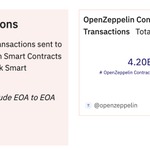
OpenZeppelin Contracts have now powered over $38 trillion in value transferred.
Nearly half of that value moved in the last two years.
The security standard for onchain finance 🔒

Luca retweeted

Energy capacity = economic capacity, in one chart
There are no low electricity, rich countries


"Energy Capacity = Economic Capacity"
Former Intel CEO Pat Gelsinger on why America's power grid is the ceiling on growth:
"We went through 10 to 15 years where essentially I was taking coal offline at the rate I was adding renewables, and essentially the nation was flatlined in terms of overall energy capacity."
"So essentially our economic capacity as a nation, flat for fifteen years."
"Even with that, we've gone to maybe increasing our national energy capacity 4% per year. Going from essentially zero to one."
"Nuclear as base load is a fabulous thing that we want to go build more of. Unfortunately all of our renewables have deep dependencies in China."
"Energy capacity somewhat dampens how euphoric we can get on AI. Why build a new data center and buy the million GPUs if I can't power them?"
@PGelsinger @RaghuRaghuram @appenz
Luca retweeted

The vision, the roadmap, and ETH:
Ethereum as the maximally secure, open, and trusted settlement layer for the global economy
ETH as the maximally secure programmable SoV at the center
Everything in the roadmap drives towards this vision
It's the largest possible prize, delivers the most value to users globally, and results in the strongest possible ETH
If Ethereum stays focused on delivering that roadmap we will inevitably continue to have both a strong L1, and a strong network of other chains building their own successful economies on top.
Luca retweeted

Day 2: post-quantum security
Miden protocol is designed to be PQ-secure from the ground up. The core protocol relies on only two cryptographic primitives:
- Hash functions (discussed in the QT's post).
- zk STARKs - which also rely on just hash functions.

Luca retweeted

Miden does a lot of this already

I don't recommend anyone scramble to move their funds to new wallets today. But we should take the risks to cryptography from AI-accelerated math seriously, and minimize our exposure to not just quantum-vulnerable cryptography, but also potentially AI-vulnerable cryptography.
The core new area of risk from this viewpoint is, unfortunately, ML-DSA / FHE / lattices.
(and it's also another reason, along with quantum, why ECDSA might fall even faster than expected, hence the "fresh address" recommendation)
So far most people have been in the mode of thinking "elliptic curves broken, hashes safe, lattices safe". But there is a good chance that the concrete security of lattices will take serious hits from the next two years of AI math.
The basic threat model is: factoring is something that naively takes 2^(n/2) time, but over decades smart people have found and optimized number field sieves, and degraded that to 2^O(n^(1/3)), which is why RSA keys and signatures need to be ~400 bytes (and not 64 bytes). What if there are skeletons in the closet like that, both for elliptic curves and lattices, that we are simply not smart enough to discover - but bots soon will be?
This is a major part of the reason why for the past year ethereum's lean roadmap has been going in the "hash-only" direction: no lattices, no ML-DSA, no Falcon, no lattice-based commitments inside ZK proofs, etc. Signatures in lean ethereum are all hash-based, either WOTS or SPHINCS-.
For signatures and proofs, we already know how to go hash-only. The bigger challenge is for *public-key encryption* - and this goes far beyond blockchains. Secure communication, anonymizing protocols, lots of things need public-key encryption.
And unfortunately there are long-standing mathematical theorems showing why public-key encryption cannot be done with hashes alone. You have to have some kind of trapdoor object that has at least one form of usable "structure" - either group theory (incl. isogenies) or lattices or code-based or potentially in the future even more newfangled and spooky things (local mixing?). But for anything that has structure, you should assume that AI will make at least some progress in breaking that structure. Here, one reasonable inference is that if you want to make something plausibly long-term secure, multiply the key sizes by 10.
To me that's a very plausible world and something not at all extreme to predict. If AI will bring us 50 years of math in 2 years, then that 50 years of math may very plausibly include a "naive factoring -> GNFS" level of improvement to our ability to break lattices. In that world, lattices will still exist, but they will have to be significantly bigger to guarantee the same level of safety.
And at those new larger sizes, hash-based constructions will beat lattice-based constructions on concrete efficiency in every use case where hash-based constructions are possible at all.
Theoretically, of course it's possible that hashes are broken too (eg. P = NP would imply that). But I think P = NP is very unlikely. And intuitively, it's much more likely that a mathematical object has exactly no exploitable structure (like hashes are intended to), than that a mathematical object has exactly ~3 forms of exploitable structure (for elliptic curves: associativity, Schoof, pairings) and not some secret fourth form of structure we have not yet discovered that greatly degrades its security (for elliptic curves, ECDLP and pairing security). Similar for LWE, SVP, RLWE and the zoo of lattice problems.
For this reason, we do not yet see any reason to worry and start padding the byte size of hashes (if we start to worry more, we would pad the round count first before doing anything to the byte size).
Concrete TLDR, my own personal views:
* Hash-based > lattice-based, in those situations where hash-based is possible at all
* For anything lattice-based, be much more paranoid on param sizes. Remember that blockchains are only a small portion of the cryptography story; this point goes far beyond blockchains and applies to eg. access to websites, secure messaging, Tor / VPNs ...
* For privacy protocols, strongly favor NOT putting encrypted notes onchain. Instead, send them offchain through some third-party mechanism.
* If it's not difficult for you, keeping your funds in addresses which have not yet been used to make a transaction is a good idea. If it's easy for you, do it. **But be careful about migrations; I personally have lost more money in botched migrations than I have lost in all hacks combined**.
* For multisig wallets, doing confirmations offchain is better than onchain, because this way the signatures of signer wallets do not get exposed to the public, so if ECDSA falls to AI much faster than expected, at least the multisig "gracefully degrades" to a 1-of-1 where the 1 is whoever was gathering the signatures - a much better place to be than "anyone can take the money"
firefly.social/post/x/210783…

Luca retweeted

A tell from the Manhattan Project was that scientists who had been publishing about nuclear fission suddenly stopped publishing. As Justin points out here, the lack of cryptographic results in OpenAI's mathematical breakthrough could itself be a tell. Evidence against it would be if they published a few improvements that aren't massive breakthroughs.

Today I call upon the blockchain industry to calmly begin planning for "bunker mode". My personal recommendation is to set in motion a controlled mass migration of assets to fresh addresses, i.e. addresses whose pubkeys remain hidden behind a hash.
Holders, starting with large and sophisticated ones, should consider moving the bulk of their funds to addresses that have never signed a transaction. And when they do sign one, they should also move remaining funds to a new address (possibly generated from the same seed phrase).
Don't rush. While I believe there is cause for action a rushed migration would do more harm than good. Don't panic either. Moving assets to protected addresses is a simple, preventative step which does not require new cryptography or new wallets.
IMO it is now reasonable to brace for the possibility that ECDSA breaks before qday, in the worst case in months not years. By "break" I mean fast private key recovery (e.g. in one week) on available hardware (e.g. a large GPU cluster).
Recent days have been humbling for human mathematical intuition. Long-held, unquestioned hypotheses have fallen. This includes the n log(n) bound for integer multiplication and the 3SUM conjecture. In hindsight, May's unexpected disproof of the Erdős unit distance conjecture was our warning shot.
Yesterday's OpenAI drop made it clear that mathematical superintelligence is upon us. They say there are weeks where decades happen. We are about to live through weeks where centuries of mathematical progress happen. Could our magic 64-byte ECDSA signatures be too good to be true? Was it just security through obscurity all this time?
Elliptic curves feel especially vulnerable to superintelligence. Curves carry rich structure, with room for fancy tricks like Schoof, Frobenius, pairings. (By contrast, hashes are designed to minimise algebraic structure.)
Separately, as Ewin Tang can attest, an efficient quantum algorithm sometimes foreshadows an efficient classical one. We should be open to the possibility of a classical counterpart to Shor that breaks elliptic curves and RSA at once.
Also noteworthy is the striking under-representation of cryptographic breakthroughs among the 722 mathematical results OpenAI published. I've witnessed first-hand the US government censoring academic quantum cryptanalysis results. Backroom interventionism is my base case.
I urge large, sophisticated actors to lead by example. Project11's "risq list" (bitcoin-risq-list.projecteleven[.]com) is a great tracker of exposed BTC pubkeys. Binance, Bitbank, Robinhood, Bitfinex, and Tether have an opportunity to harden their cold storage. Next month I'll address institutions in London in a live Q&A (forum.ethereuminstitutional[.]org/london-2026).
Again, please do not rush. Wallets holding under 50 BTC enjoy partial cover from "Satoshi's shield", i.e. his 20K exposed addresses that hold 50 BTC each. Load-bearing signers like oracles and L2 security councils should consider rotating ECDSA pubkeys with every signed message and/or multi-signing with a hash-based schemes like SPHINCS.
Exiting bunker mode safely will require post-AI cryptography. My inclination is to go all-in on hash-based cryptography and avoid structured mathematical assumptions entirely, whether from curves, lattices, or isogenies. A single battle-tested hash (e.g. from the SHA or BLAKE families) yields plausible post-AI security.
The Ethereum roadmap on strawmap[.]org fully embraces hash-based cryptography with end-to-end formal verification as a response to the quantum threat. Those timelines must now be revisited and accelerated in light of mathematical superintelligence. I'll be pushing for maximum defensive acceleration.
Luca retweeted
This is very serious, and actions need to be taken ASAP. I do hope that we have at least a year or two rather than just a few months.
An interesting thing though: this is not an issue for systems with client-side proving. If a transaction is proven locally (e.g., as we do in Miden), even if ECDSA signature is used, the public key never needs to leave the user's device - and so, the public never learns it. The ZK proof naturally shields the actual signature verification process.
Today I call upon the blockchain industry to calmly begin planning for "bunker mode". My personal recommendation is to set in motion a controlled mass migration of assets to fresh addresses, i.e. addresses whose pubkeys remain hidden behind a hash.
Holders, starting with large and sophisticated ones, should consider moving the bulk of their funds to addresses that have never signed a transaction. And when they do sign one, they should also move remaining funds to a new address (possibly generated from the same seed phrase).
Don't rush. While I believe there is cause for action a rushed migration would do more harm than good. Don't panic either. Moving assets to protected addresses is a simple, preventative step which does not require new cryptography or new wallets.
IMO it is now reasonable to brace for the possibility that ECDSA breaks before qday, in the worst case in months not years. By "break" I mean fast private key recovery (e.g. in one week) on available hardware (e.g. a large GPU cluster).
Recent days have been humbling for human mathematical intuition. Long-held, unquestioned hypotheses have fallen. This includes the n log(n) bound for integer multiplication and the 3SUM conjecture. In hindsight, May's unexpected disproof of the Erdős unit distance conjecture was our warning shot.
Yesterday's OpenAI drop made it clear that mathematical superintelligence is upon us. They say there are weeks where decades happen. We are about to live through weeks where centuries of mathematical progress happen. Could our magic 64-byte ECDSA signatures be too good to be true? Was it just security through obscurity all this time?
Elliptic curves feel especially vulnerable to superintelligence. Curves carry rich structure, with room for fancy tricks like Schoof, Frobenius, pairings. (By contrast, hashes are designed to minimise algebraic structure.)
Separately, as Ewin Tang can attest, an efficient quantum algorithm sometimes foreshadows an efficient classical one. We should be open to the possibility of a classical counterpart to Shor that breaks elliptic curves and RSA at once.
Also noteworthy is the striking under-representation of cryptographic breakthroughs among the 722 mathematical results OpenAI published. I've witnessed first-hand the US government censoring academic quantum cryptanalysis results. Backroom interventionism is my base case.
I urge large, sophisticated actors to lead by example. Project11's "risq list" (bitcoin-risq-list.projecteleven[.]com) is a great tracker of exposed BTC pubkeys. Binance, Bitbank, Robinhood, Bitfinex, and Tether have an opportunity to harden their cold storage. Next month I'll address institutions in London in a live Q&A (forum.ethereuminstitutional[.]org/london-2026).
Again, please do not rush. Wallets holding under 50 BTC enjoy partial cover from "Satoshi's shield", i.e. his 20K exposed addresses that hold 50 BTC each. Load-bearing signers like oracles and L2 security councils should consider rotating ECDSA pubkeys with every signed message and/or multi-signing with a hash-based schemes like SPHINCS.
Exiting bunker mode safely will require post-AI cryptography. My inclination is to go all-in on hash-based cryptography and avoid structured mathematical assumptions entirely, whether from curves, lattices, or isogenies. A single battle-tested hash (e.g. from the SHA or BLAKE families) yields plausible post-AI security.
The Ethereum roadmap on strawmap[.]org fully embraces hash-based cryptography with end-to-end formal verification as a response to the quantum threat. Those timelines must now be revisited and accelerated in light of mathematical superintelligence. I'll be pushing for maximum defensive acceleration.
Luca retweeted

Where are all of the networks?
Most of the great AI companies so far seem to be single player, scale economies businesses.
What are the networks being built right now? OpenRouter a notable exception
Luca retweeted

Day 2, Digital Assets Week.
11:20 - What does it take to build the institutional stack for onchain finance.
Daniel Coheur joined by Thodoris Karakostas (@chainlink), Ghazi Ben Amor (@zama) and Jonathan Alexander (@OpenZeppelin).

Luca retweeted

THE BLOCK: S&P Global Ratings has launched a new risk assessment framework for onchain lending vaults as deposits in the sector reach $10 billion, up from $1.5 billion two years ago.
The framework will assess credit, liquidity, curator, blockchain, protocol, security, and governance risks, with initial vault assessments to follow.


Luca retweeted

I’ve been tracking mathematical conjectures proved, disproved, or advanced with AI and built a site to keep them in one place, with sources and the stories behind each result.
Take a look: conjecture.ai

Following gold-medal-level performance from our AI models across five competitions in mathematics, physics, and chemistry, we asked a harder question: can AI contribute when a problem is genuinely open and without an existing solution path?
Over the past several months, mathematicians worked with Muse Spark 1.1 and Muse Spark 1.2 in Thinking Mode through the regular meta.ai chat interface, with no custom research scaffold, to find solutions to such problems.
Our goal wasn't to mass-produce papers, but empower researchers. Every collaboration followed the same principles: mathematicians guided the research, a second group of mathematicians then reviewed the work, each paper marks which passages were drafted primarily by humans or AI, and each credits the prior research it builds on. Where other teams independently announced solutions to the same problems, we acknowledge their work as well.
Today, we're sharing six papers from that collaboration.
🧵👇

