

Ayudo a profesionales a dominar herramientas de iA para amplificar su visión mientras mantienen el control de su proceso creativo.
Colombia
Joined February 2007
- Tweets7.8K
- Following617
- Followers2.9K
- Likes5.2K




Martín Giraldo retweeted

I left @Apple to build healthcare that listens and acts early. Today, I'm excited to introduce UniqueHuman.
We're building proactive healthcare agents that handle every step of care for people with chronic conditions.
Our mission is to end chronic suffering. Today, we begin with migraines.
Desde hace un par de semanas el internet en Bogotá (por lo menos el mío) está lentoooooo.
O mucha gente conectada al mismo tiempo o el tráfico de internet está siendo “auditado” por estas tierras…
Martín Giraldo retweeted

Software Is Dead. Context Is the Product.
text: carlos.cv/blog/software-is-d…
audio ↓
Si este calor que se está sintiendo en Bogotá, va a durar un par de meses. Espero que estemos todas y todos más conscientes de la importancia de bajar el consumo de agua y electricidad.
Martín Giraldo retweeted

Both OpenAI and Anthropic realized they needed a Space for Docs for teams to collaborate with AI.
@ivanhzhao and @simonlast saw this years ago and rebuilt @NotionHQ into what it is today, and the more AI advances, the more useful Notion becomes if you keep cultivating it.
Esta semana un amigo publicó una columna que me detuvo. @slondonouribe se encontró un libro de 1968 en una estantería de la Fiesta del Libro en Medellín, y terminó escribiendo sobre iA y el futuro de nuestra especie. La leí dos veces. Abro hilo.
Su cierre es la frase más importante de su texto: ante la amenaza generalizada a nuestra especie, tenemos que volver a hablar. Estoy de acuerdo con el fin. Trabajo en el cómo.
La invitación es a leer los dos textos, en orden. Primero su columna: noapto.co/sobreviviremos/ Después mi respuesta: agai.com.co/blog/volver-a-ha… Volver a hablar necesita una mesa. Esta es la nuestra.

Martín Giraldo retweeted

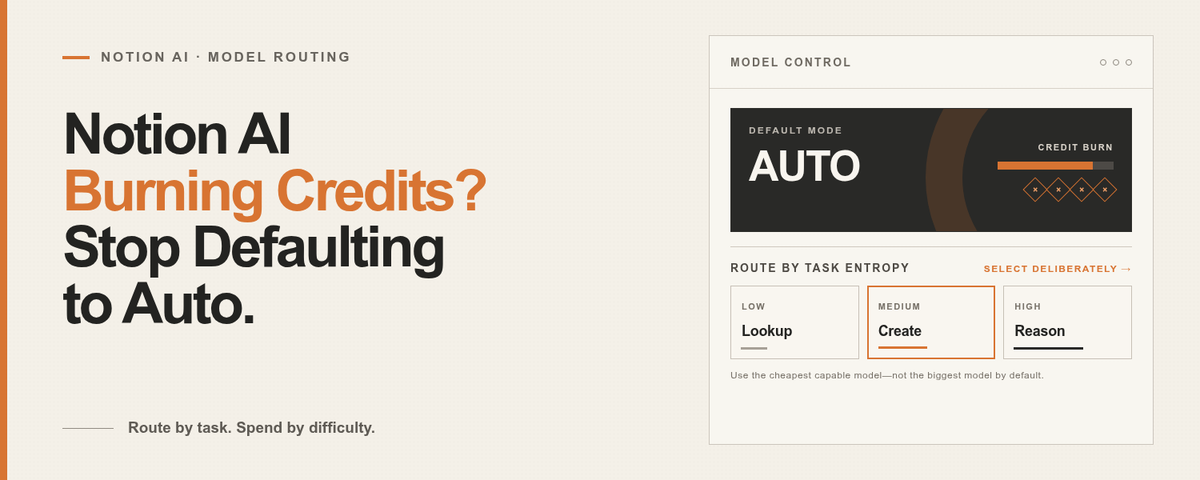
Notion AI feeling tight on limits? Adjust the "Auto" selector.
Full setup + a copy-paste prompt to learn about efficient model selection inside Notion → #NotionAIChallenge
Martín Giraldo retweeted

Most common question I get about Notion is some form of “It’s a blank canvas, so where do we start?” I used to struggle to answer but now it’s simple:
1. Home for company skills
2. Home for meeting notes
It’s the context starter pack that every agent + human needs and requires no complex migration.
wow!

TALES OF GRIMWICKE — Chapter I is 22 minutes of AI fantasy animation inspired by the many anthropomorphic animal stories I read as a kid, with a dark twist:
The model: Seedance 2.5 (@ByteDanceSeed_ ) via @Segmind_ai. 847 takes generated, mostly 30-second multi-shot prompts, over 5 hours of footage. 127 clips made the cut. About $4.5k in generation, four weeks from first take to publish.
Characters and locations came out of @midjourney. Using MJ for the location plates was a revelation: the cinematography and art direction are a level above, and it renders far better as a plate than Nano Banana or GPT Image. Nano Banana (@GoogleDeepMind run on @fal) did the heavy lifting editing those plates, building anchor frames and turning MJ characters into turnaround sheets. Then I let Seedance do as much of the framing and camera operating as possible. That gave the best results.
A lot of what I do in my Unreal Engine films came with me: a handheld, imperfect camera operator instead of smooth moves, focus hunting, and above all weather and atmospherics. The model does water, snow, smoke and rain really well, and leaning into that is what keeps it from looking like a Temu Pixar film.
The tools I built: a portal (Node on @flydotio) that holds the bible, the refs, every prompt and every take, with a Claude agent (@claudeai) that writes the prompts to the house rules. A Premiere Pro (@AdobeVideo) panel that browses the archive, drops selects on the timeline, versions the project, strips music, and sends fixes back to Seedance. Everything is done in 720p with no upscaling, because it looks terrible. Narration is my own voice through @ElevenLabs speech-to-speech. Music from @Artlist_io.
None of this would exist without @PJaccetturo and @Kavanthekid. Their narrative work, Nexus and Chronicles of Bone, proved long-form AI film was possible, and their podcasts, newsletters and X posts, updated constantly as the workflow changes under everyone's feet, showed how to actually do it.
Chapter II is currently in the works and I will release it initially on my YouTube channel, The Darkest Age (@CharlieDriscollAI). Consider subscribing there to see it as soon as it drops!

Martín Giraldo retweeted

In a post-AI world, there are a few remaining ways to build sustained unfair advantages.
1. A monopoly on talent
2. A monopoly on data
3. A monopoly on attention
4. Network effects
5. Customer-obsession (taste, UX, UI)
You'll find experts far smarter than me in 4 of the 5 categories above.
But if you'd like to understand how to think about creating a monopoly on attention (aka content), keep reading...
My bet is that attention is a scarce, valuable resource and it will only get more scarce & valuable as:
1. The cost of digital marketing rises (as platforms increase costs & demand for digital marketing rise).
2. There is greater competition for attention (as the means of creation - content/software - are democratized).
3. In a post-AI world, technology differentiation becomes less and less of a sustainable moat, which makes those that remain even more powerful.
Now, in order to build a modern day media company, you need to understand the rules of the game, what game you want to play, and how to win that game.
Let’s talk about the rules.
Rule #1: Personality-driven content is becoming a bigger and bigger part of consumers’ media diets.
- The democratization of creation & distribution (read: internet & social platforms) means that people can attract as much attention/distribution as institutions & consumers have always longed for content that feels personal/relatable
Rule #2: Brand-driven content isn’t dead.
The expectations of it have just changed & it serves a more important role in media than ever before.
- In an era of personality-driven media, consumers expect relatability & resonance with brands, even if they’re faceless. This just means that even if a person isn’t attached to the brand, consumers want to feel an individual person behind it.
- Personality-driven content is a necessity for most media brands today, but with it comes a lot of risk. One of the ways to derisk personality risk is by having faceless franchises that give you ownership over a healthy % of your audience.
Rule #3: Riches are in the niches.
- Democratization of creation & distribution not only increased consumer appetite for personality-driven content. It also drove a content supply glut, allowing consumers to be pickier than ever before. We went from 12 channels on the original TVs to near unlimited choice. And in a world of unlimited choice, consumers can find great content related to any/all interests from the most mainstream to the most obscure.
Rule #4: Diversifying risk across the audience funnel is key.
- There are three types of audiences: rented audience, owned audience, and monetized audience. Each type of audience offers benefits & trade-offs to a company, so it’s less about targeting a single type and more about maximizing the benefits of each, while mitigating the risks.
- Rented audiences (social media) offer rapid growth, but platform risk.
- Owned audiences (email/podcast/community) put you in control of your audience, but growth is slower.
- And monetized audience (ads/subscription/software) is how you pay the bills, but you can’t monetize your audience without building trust via rented & owned.
Rule #5: Content channels & trends change but human psychology does not.
- Human beings are selfish. We selfishly do things that satisfy our most basic desire: survival. Survival in modern day society boils down to physical safety & psychological safety.
- Physical safety: For the modern day media consumer, that looks like acquiring knowledge that helps you: make money, improve professionally (so you can make more money), or save money.
- Psychological safety: For the modern day media consumer, that means consuming content that makes you feel belonging (i.e. entertainment, hobbies, niches, passion areas) and helps you with courtship (i.e. attracting a partner/procreating).
Rule #6: We are late stage on most content platforms.
- In the early days of Instagram, Tiktok, and Twitter, attention was cheap, and you could amass a large audience simply by being an early adopter and actively creating on-platform. Those days are (mostly) gone. Aside from LLMEO/GEO, you can no longer build distribution simply by taking at-bats.
- As platforms have entered the later innings of their life cycles, content has gone from scarce to abundant, while attention has remained finite. This means that the quality bar for what is “worthy” of a consumer’s time continues to increase.
Rule #7: The tiktokification of media is almost complete.
- Social platforms were built on the social graph. You see the content of the people you follow and your content is seen by people that follow you. Practically speaking, that meant those with big audiences would always get more views than those with small audiences. Interest graphs (made popular by TikTok) flipped intern media on its head. With the advent of For You, you now see content the platform believes you’d be interested in, and your content is seen by people the platform thinks would be interested in your content.
- In practice, this means that every creator/brand is only as successful as its last post, the variance of performance has never been higher, and it’s never been easier for someone with a small audience to get outsized results on a single piece of content.
Rule #8: Software is becoming content.
As the barriers to build software approach 0, software is a new content medium which can be used to build and own audience.
Rule #9: AI is a supporting actor in media.
The question to ask is not how much of this content is AI or human-generated. It’s how well does this content resonate with its audience and accomplish one of the base human needs. Human judgement and taste is still essential in accomplishing that goal no matter how much or little AI is used.
Rule #10: No content is original.
It’s all a remix of prior ideas that came before. Great artists steal, bad artists copy. Media companies should behave in the same manner.
Rule #11: A modern media company serves 3 customers: its audience, its creators, and those who pay the bills.
The product a media company offers to serve each of these customers can be/is likely different.
Rule #12: A media company is like an investor.
Deploying resources based on the risk/return profile of an investment and the amount of resource involved.
- Example: a book should start as a blog. A blog should start as an article. An article should start as a tweet.
Martín Giraldo retweeted

Here's what I'd start doing right now:
1. Talk to AI every day.
2. Do deep dives.
3. Be knowledgable.
4. Plan your distribution.


Martín Giraldo retweeted
Thinking about the future of AI is deeply uncomfortable for people.
It’s because we’re bad at imagining exponential progress. And we’re even worse at picturing life without constraints.
Our brains retreat to lowest common denominator thoughts like “We’re f*cked” and “Jobs go poof.”
But by studying history, you realize it’s the same story just a different day. Highly recommend the read.


Cuando hablamos de inteligencia artificial, la metáfora que usamos define la relación que construimos.
Dos imágenes dominan la conversación: la iA como oráculo infalible y la iA como martillo de fuerza bruta. Ambas nacen del mismo malentendido.
En AGAI cultivamos autores críticos.
El acceso a la iA se universaliza cada semana. Lo que permanece escaso es el criterio para dirigirla. La ventaja competitiva reside en la sofisticación de la capa humana que orquesta el instrumento.