
Making fully delegated payments safe
Joined January 2023
- Tweets45
- Following7
- Followers3K
- Likes68



We’re excited to join the APA as a founding member.
An agent can follow every guardrail and still buy the wrong thing. Agentic commerce needs intent enforcement to prevent errors, and recourse for consumers if things go wrong.
We’ll help APA partners earn consumer trust by making these protections the industry standard.


delta retweeted

Delegate betting to your agent
With delta Mandate it's impossible for it to make a bet you didn't approve
In time for the quarterfinals 🇸🇯


delta retweeted

Today we’re announcing @deltadotnetwork integration with @Google's AP2. Link in the comments below, but here's why we're excited:
AP2 creates a verifiable chain for user authorization, merchant commitment, and payment intent. But it has two significant shortcomings:
1) it does not verify that the agent’s action satisfies the substance of what the user authorized
2) it requires issuers and merchants to blindly trust the platform's attestation without having any way to verify the user's purchasing intent
AP2 with delta Mandate addresses both of these problems.
The user authorizes an intent mandate, the agent discovers a product, and the merchant only signs the checkout after delta has verified the proposed purchase against evidence from the actual product. This check sits outside the agent, so issuers and merchants do not need to blindly trust the platform.
This matters for liability. Issuer banks are not going to underwrite delegated purchases if they cannot independently verify that the agent stayed inside the user’s mandate. They need more than an audit trail showing what happened after the fact. They need a pre-release control that ties authorization, execution, and evidence together before money moves.
AP2 gives agentic commerce a much-needed authorization and transaction artifact chain. delta Mandate adds the enforcement + evidence layer required for issuers, merchants, and wallets to trust that chain at scale.
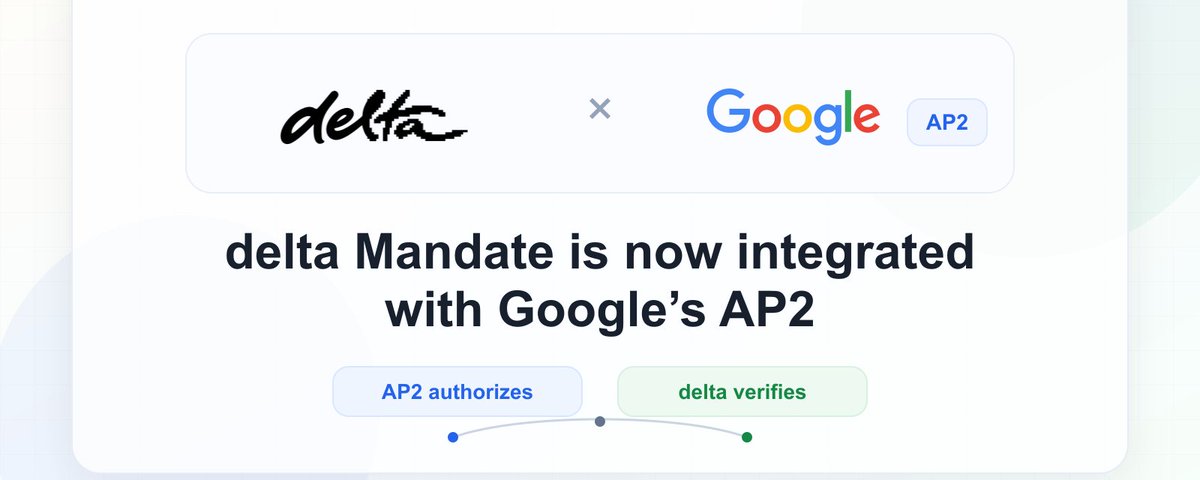


Use delta Mandate with your own agent following: delta-mandate-product.repyhl…
Try out our demo: sonofanton.shop/
delta retweeted
The "checkout inside ChatGPT" semi-autonomous mode of agentic commerce seems destined to never take off
Instead there will be a barbell:
- Where subjective constraints matter (fashion, vacations, toys etc.), the shopping experience will continue to look a lot like it does now.
I will still want to see 50 pairs of sneakers before pulling the trigger, it doesn't matter if AI says "here are the three best alternatives"
- When objective constraints dominate (weekly groceries, business travel, cloud credits), shopping will be fully delegated. You state what you want and the agent's purchases can be deterministically approved or denied before executing.


delta retweeted

Stop Optimizing Blockchains
In this episode of Deeply Intents (🎙️, 🎧), I chat with @spjoleh founder and CEO @deltadotnetwork. This is an amazing conversation that touches on blockchain architecture, design philosophy, and product strategy.
[sponsored by @anoma]
In this episode we discuss:
- verifiability
- shared state
- delta and its domains
- byzantine eventual consistency
- scalability
- product
Timestamps
0:00 - From Math to Delta
2:33 - Category Theory
4:56 - Finding blockchain
9:04 - Levels to B.S.
11:20 - Verifiability and shared state
16:50 - Reducing friction with verifiability
21:08 - Shared state and compossability
27:30 - Delta architecture
32:38 - State diff lists
35:13 - Integrability
41:09 - Domains, network effects, and trust
49:01 - Byzantine eventual consistency
53:34 - Design philosophy
1:01:20 - Scalability is oversold
1:05:07 - Approach to product
1:09:05 - GTM products
1:13:46 - Credible neutrality
1:20:37 - Context switching
1:22:51 - Crypto dogma
1:29:26 - User feedback


delta retweeted
“In a rollup-centric system, the role of the base layer is to act as a decentralized trusted third party between rollups to enable interoperability between them.”
Couldn’t agree more with my friend @0xkrane, and existing base layers in their current form simply don’t do enough for their rollups. Hence, we see the rise of rollup clusters and the vendor lock in that comes with them.
Rollup developers shouldn’t have to compromise between max control and trustless interop. Base layers should not have to compromise between security, scalability, and statefulness.
at @deltadotnetwork, we are dreaming bigger, and rebuilding our base layer to break these tradeoffs for users and developers

Given all the conversation surrounding @drakefjustin's proposal for the ZK era of Ethereum last week and @0xdoug's tweets about a zkevm-ified ETH 3.0, we thought we'd post a sketch of what a "purpose-built" base layer for a rollup-centric ecosystem might look like:
delta retweeted
With native rollups, users actually inherit base layer security and interop can be trustless + fast
But they also strip developers of the control and economics that make independent rollups so attractive!
On @deltadotnetwork, devs and users will get the best of both worlds:


delta retweeted
Our second trilemma is basically what a lot of newer-gen L1s/L2s aim to solve.
Cosmos was ahead of its time, but ultimately does not get around the trade-off of control and connectivity.
Btw not using “sovereignty” because it’s a terrible term in this context

delta retweeted
The real scalability trilemma is laid out in this article.
Obviously the goal should always be to reduce unnecessary complexity.
In practice, this is not the tendency we typically see in the space

There are a ton of high-level similarities between delta and the way git works -- here our CTO @iorulezz succinctly lays out the parallels
Well worth a read 👇

Using git's workflow as an analogy for [delta] 's
@deltadotnetwork
>>>
>>>
>>> git commit -m "delta workflow"
>>>
>>>
Let’s assume there’s a project whose master branch [account state] lives in a monorepo [single state].
A developer [server as domain operator] writes code [operator orders and executes user transactions], resulting in code changes [state diffs]. Alternatively, some devs like to work in groups [decentralized network as a domain operator] and come up with code changes after they have reached consensus.
Subsequently, they create a branch and push these code changes to it [submit SDL; SDL is included in the state as a result].
Once they are ready [have produced a proof for the submitted SDL], they open a PR [submit SDL proof]. The code reviewers [validators] review the changes [verify the submitted proof].
If approved, the code changes receive the required number of approvals per branch protection rules [at least quorum-many validators attest to the proof’s validity]. As a result, the code changes are merged into the codebase [diffs included in the SDL are applied to the account state].
Moreover, let’s assume that, for this repo, merge conflicts must be prevented [double-spending risk must be eliminated]. Thus, each file [vaults registered under the same domain] can only be modified by a single dev [can only spend through their associated domain].
This is [delta].
delta retweeted
If you want to dive deeper, our founder and CEO @spjoleh and Head of Product @MylesOneil recently went on the Bell Curve podcast hosted by @MikeIppolito_
You can see that here: youtu.be/pvo-RgFaXKU?si=QoOv…