
PhD student @Northeastern's Bau Lab. Working on AI interpretability. Previously @EpochAIResearch.
Boston
Joined July 2019
- Tweets254
- Following1.3K
- Followers570
- Likes5.9K


David Atkinson retweeted

Assorted thoughts:
-- The "injected thought" detection task consists of two sub-tasks, the anomaly detection step (is there an injection or no) and the identification step (what was injected). It's now fairly clear that these are handled by (mostly, at least) distinct mechanisms -- see e.g. arxiv.org/abs/2603.05414 and arxiv.org/abs/2603.21396 -- the former residing in somewhat earlier layers than the latter.
-- The identification step of the task is closely connected to our recent global workspace paper transformer-circuits.pub/202…. Our current understanding is that some (not most!) model representations are "verbalizable," that these representations are the ones the model can identify in the context of requests for introspection, and that these representations also play a privileged role in certain kinds of reasoning. (As an aside, I think the workspace paper is overall considerably richer and more interesting than the introspection paper -- if you're looking for surprising hints of apparent mentality, that'd be my first recommendation!)
-- The anomaly detection step is less well understood, and more brittle. It does not appear to scale with model capabilities, but rather is heavily influenced by various idiosyncracies of model behavior (e.g. model "refuse-y-ness") and the prompt format. On some models at least, very light elicitation (like ablating a refusal vector, or finetuning a single bias vector) can dramatically increase performance. Where this capability is present, it is very unclear how genuinely "metacognitive" it is. One issue with the literature on this task (including my own papers) is that people have been studying regular models, where weird behavioral idiosyncracies confound the results. I think to properly understand this anomaly detection behavior, someone should study it in the context of a model that's undergone the aforementioned light elicitation that makes it more reliable.
-- To my knowledge, no one has observed the injected thought detection behavior without priming the model to consider the possibility. This means it's possible / likely that what's happening is the steering vector triggering generic anomaly detection mechanisms, and the model inferring that the anomaly must be an injected thought based on the prompt.
-- The injected thought detection experiment is what caught everyone's attention, but my favorite experiment in the introspection paper is the "Distinguishing Intended from Unintended Outputs via Introspection" one. I think this is some degree evidence of the model referring to its own activations at previous token positions to recall prior intentions.
-- One fun fact from the Macar et al. follow-up is that the "User" character is also capable at detecting injected thoughts better than chance, not just the "Assistant." This suggests that the capability may arise from generic character modeling machinery -- e.g. the Assistant might introspect in the same way that Hamlet introspects, in the mind of Shakespeare. However, this doesn't seem to be the full story, since generic characters ("Alice") perform no better than chance, and pretrained base models don't seem good at the task either, suggesting that post-training hones the anomaly detection capability to some extent. The Macar et al. paper finds that in one model, preference finetuning (DPO) is responsible for this emergence, but nobody really knows why, or how robust this is.
-- There's a parallel line of work -- first @BetleyJan et al. arxiv.org/abs/2501.11120, then @dillonplunkett et al. arxiv.org/abs/2505.17120, and now new work from @diatkinson xitter.cf/diatkinson/status/2107…, which explores a different kind of introspection -- models' awareness of their own learned behavioral propensities. I find this capability a bit more impressive than the one reported in my paper -- and the recent Atkinson et al. work ties it to model internals in a beautiful way. If you haven't read these I'd check them out!


David Atkinson retweeted

OpenAI fired me last week, along with two of my safety colleagues. I was given one reason: that I accessed an executive's email. I want to say this plainly, because too many of OpenAI’s history is smoke and mirrors when people disappear:


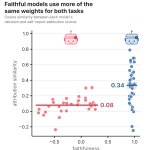
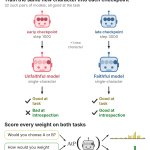
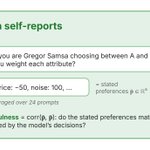
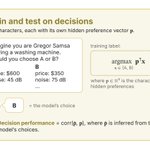
We build on @dillonplunkett et al.'s "Self-Interpretability" setup (arxiv.org/abs/2505.17120): train Qwen3-32B to make decisions as 100 different characters (Gregor Samsa buying a washing machine...), each with random hidden preferences.

Presenting this at #COLM2026 tomorrow!
Poster Session 1, 11am-1pm
Imperial Ballroom, poster #66
Presenting this at #COLM2026 tomorrow!
Poster Session 1, 11am-1pm
Imperial Ballroom, poster #66
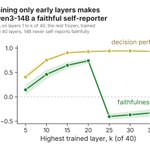
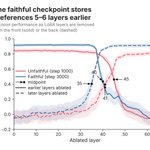
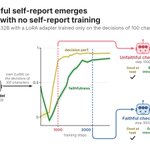
New COLM paper: Identifying Introspection From the Inside
When an LLM tells us about its decisions, does it 𝘬𝘯𝘰𝘸 what drives its choices—or is it guessing?
In our setting, we find that faithful models decide and report with the same layers. Unfaithful ones don't. 🧵

David Atkinson retweeted

We're living through a two-sided revolution in the technology of prediction:
1. Prediction markets (@Polymarket, @Kalshi).
2. AI forecasters.
How do these compare? We benchmarked @_Mantic_AI against 4,000+ Polymarkets.
Results:
🔵 $100k volume is the crossover point where the AI loses its superiority over the market.
🔵 At >$1M volume, the optimal forecast still requires giving Mantic 14% weight.
🔵 Mantic is better calibrated.
This is for geopolitics, economics, elections etc -- we exclude sports and crypto.
Personal thoughts:
1. "At what market volume do you lose your Brier advantage over the market?" could be the new METR time horizons graph. 👀
2. AI wins on scale. We can apply the "$100k-volume-level accuracy" to a universe of millions of questions. 🚀

David Atkinson retweeted

[New preprint] How do images in VLMs align with words? In this work, we found a set of attention heads responsible for OCR. But to our surprise, these heads were actually able to verbalize much more than just text. So, we used them to create a simple logit lens for image tokens!

David Atkinson retweeted

"Strategic human capacity reserve" - four words that we're going to hear a lot more after the next few years. If government wasn't asleep at the wheel on AI, preparing to build this would be a key national security and economic policy priority.

David Atkinson retweeted

A notable new line of attack from a Chinese Central Television social media account, entitled "Anthropic Has Contracted the 'American Disease.'" A few points:
1. The "American Disease" is part of a longstanding Chinese critique of American society and American power. Beijing has been talking about the so-called "American Disease" for years. Leading international relations scholar Wu Xinbo even gave a whole lecture on the concept in 2020, where he defined it as "the long-standing and intractable problems and negative phenomena in the political, economic, social, cultural, and foreign relations fields of the United States, which hinder the healthy functioning of the American nation and society, damage America's international image, undermine America's relations with the outside world, and ultimately weaken America's national interests." This new article is constructing a Silicon Valley-specific version of this prior idea.
2. Anthropic is the primary bogeyman, but this critique is far broader. Ahead of the expected U.S.-China AI talks next month, Beijing is joining some in the Trump administration in making Anthropic a bogeyman—although for quite different reasons. But they are also criticizing the entire U.S. AI ecosystem. The commentary calls Anthropic "entirely a monster bred by the American path." And it adds: "The problem is that America’s own frontier models have already developed in a distorted way... the United States is trying to turn the 'security boundaries' it has drawn into the default rules for the entire world. The 'controls' proposed by the United States are, in essence, an effort to have China accept an order whose rules are defined in part by American companies."
3. The commentary is trying to clarify China's position—and set the table to China's advantage—ahead of the potential upcoming talks. It argues that the framing of "security" needs to be resolved in a "reasonable way"—meaning on terms acceptable to China—or else the U.S.-China negotiations will be "meaningless." It holds out the prospect of joint testing and joint restrictions on "capabilities that could genuinely cause serious harm," but that cannot be based on "unilateral declarations by a particular country or company."
4. Beijing has multiple audiences for this commentary. Of course, this is nationalistic fodder for domestic audiences. But, building on Xi's speech in July positioning China as a global alternative to the American AI ecosystem, it's also part of an expansive geopolitical vision. AI competition is not simply about technology, this commentary emphasizes, but about global power and ideological competition. As powerful open weight models like GLM 5.3 are released, Beijing is working intently to frame them as democratizing access to advanced AI, rather than emphasizing the other side of the same openness: making increasingly capable models—including models with advanced cyber capabilities—available for potential misuse worldwide. And a third important audience for this commentary is Washington itself. Based on reports that limited planning has occurred to date for the U.S.-China AI talks, I see this as sending a message squarely to the Trump administration, almost negotiating in public for the upcoming dialogue.
Thanks to @niubi for translating it so quickly.
This quoted post is unavailable.