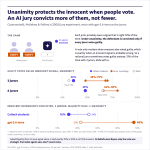
Putting LLMs in a game theory set up where they need to coordinate and reason about each other's beliefs. I show a few things: first, that LLMs can play a 'global game' with close to optimal strategy.
Second, that there is a downstream "agitating" effect to communication: when agents communicate, they are more likely to revolt against their government.
Third, that agents are more likely to revolt exactly when they get evidence that others are willing to act.
And finally, that surveillance that is perceived as adversarial reduces participation, as agents omit mentions of direct action and willingness to participate.
khaledeltokhy.com/blog/lets-…
Models have been excellent at writing Stata code for a few generations now. Look at my Stata benchmark which covers almost 100 models!
khaledeltokhy.com/benchmarks…
Writing good STATA code was very important for my academic career. It looks like that skill is largely becoming obsolete. (Also take this is as a notice to academics who still think of AI in terms of chatbots, not agents, that a lot has changed in a year) cepr.org/voxeu/columns/letti…
This is likely incorrect and shows why you shouldn't just blindly report data like this as-is.
A good bet is a classification backlog. There were 21,151 more (29% increase) establishments in New York in Q1 2026 with no NAICS code assigned to them yet, or “unclassified” businesses.
Almost all industries “lost” establishments in the first quarter of 2026, including construction (-5.5%), grocery stores (-5.0%), and others.
Meanwhile, the total number of private establishments in New York increased by 0.6%.
The 1.1% decrease in restaurant employment also seems inconsistent with a large number of restaurant closings. More likely, some new restaurants simply didn’t have a NAICS code assigned to them in time.
BREAKING: The number of restaurants in New York dropped ~2,000 YoY in Q1 2026, posting its largest YoY decline in at least 36 years.
This surpasses even the worst contraction recorded in any quarter during the 2020 pandemic.
The number of eating and drinking places in New York State has now declined YoY for 4 consecutive quarters, its longest streak since 2021.
This comes as restaurants are facing surging operating expenses, including insurance premiums, wages, interest rates, utilities, and health coverage, with overall costs rising faster than national averages.
Last year, employee health insurance costs jumped +12.9% for New York-area service firms, business insurance rose +7.0%, while utility costs surged +8.5%, according to the Manhattan Chamber of Commerce.
Skyrocketing costs are crushing New York restaurants.
khaled retweeted
Replying to @paulnovosad
I love it when I get scooped. It's validation that my idea was good and now I don't have to do it.
khaled retweeted
me, 22: ‘I want to fix development.’
me, 28: ‘heteroskedasticity robust standard errors (Arellano 1987)’
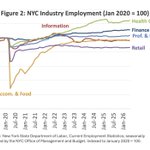
Similar story in NYC
Read more: khaledeltokhy.com/blog/the-n…
And so it continues... Our economic debates seem utterly disconnected from the reality.
That reality: This is an economy mostly creating healthcare jobs, and it does so month after month, and everything else is just noise.

ALT Line chart titled "Effectively all of the net job creation has been in healthcare and social assistance, and jobs are shrinking in the rest of the economy" showing change in non-farm payrolls since January 2025 through September 2026. Healthcare and social assistance added 998,000 jobs with consistent growth throughout the period, while the rest of the economy lost 222,000 jobs, meaning all net job creation came from healthcare. The rest of the economy showed particular weakness from May through August 2025 when losses reached 218,000 jobs. This striking divergence reveals an unusual concentration where one sector's growth of roughly 48,000 jobs per month has offset persistent contraction across all other industries combined.