

Market strategist w/ a corporate finance and technology background, trained by one of the greatest macro traders of all times. 2 exits. No financial advice.
Montreal
Joined June 2009
- Tweets4.9K
- Following879
- Followers629
- Likes7.8K



Pinned Tweet
I launched a new page on Wealth Strategic to share my favorite TradingView indicators developed in-house.
First up: Financial and Technical Highlights + MACD Cross Highlights. More to come!
Free. No paywall. No email signup. #TradingView #TechnicalAnalysis #TradingTools

Mr. Macro retweeted

An influencer is incentivized by attention, so their content must be optimized to be consumed and forgotten (cheap dopamine).
A personal brand is incentivized by money, so their content must be optimized to move you down their sales funnel.
An artisan is incentivized by the satisfaction that comes from the quality of their work. They need attention and money, but for the sole purpose of spending more time on work they enjoy and the impact it has.
Become an artisan.
Mr. Macro retweeted

The market is so negative on AI capex spend that hyperscalers with an average 21% revenue growth are trading at a 20.7x P/E multiple.
Meanwhile, you have companies like Costco and Walmart trading at 40x P/E while growing revenue at a fraction of the rate
If the capex proves to have any reasonable ROI, people are going to deeply regret being this bearish on some of the best companies in the world


Mr. Macro retweeted

In 2014 I went nearly a week without sleep. I was running PayPal and attackers were inside our corporate network. They'd compromised an eBay employee's laptop, got onto the VPN, taken over a domain controller and made themselves domain admins. eBay and PayPal were one company then, on one Windows network. They stole 145M eBay user records, then came for the segregated vault holding PayPal's card credentials. We fought them off. They never got in, but they got close. Too close.
Yesterday Binance lost ~$6.3B in what looks like the same way. A DevOps engineer's laptop, then a service inside the withdrawal stack, then withdrawals the signer approved because they came from a trusted source. Hot wallets emptied in under four hours. No key was stolen.
Nobody broke cryptography or a ledger. They found someone with access and used the trust that came with it. Banks get hit exactly the same way.
2016: attackers inside Bangladesh Bank used its own SWIFT access to send $951M of payment orders to the NY Fed. $81M was lost. The rest was held because an unrelated sanctions filter tripped on the word "Jupiter". That was luck, and it only worked because wires took days to settle.
June 2025: an IT employee at C&M Software, which connects Brazilian banks to Pix, sold his credentials for about $2,700. Attackers used them to send fake Pix transfers out of six institutions' reserve accounts at the central bank. ~$140M in under three hours.
August 2025: stolen vendor credentials at Sinqia, another Pix connector. ~R$710M out of HSBC and one other institution in a single afternoon. The central bank froze most of it, after it had already moved.
Same attack every time. Speed is what changed. When settlement took days, a filter, a correspondent bank or someone in ops could catch a bad payment. Pix, FedNow, SEPA Instant and blockchains settle in seconds. Payment security was mostly built for the slow world.
PayPal's card and user data survived 2014 because domain admin on the corp network couldn't unlock it quickly enough, and our alerting caught the unusual activity on the network. That's the model. Approval policy no laptop or vendor login can reach. Velocity and anomaly limits enforced outside the system that sends. Dynamic caps on what any one wallet, account or service can move per hour. All of it in real time.
About $3B of what left Binance has been frozen, almost all of it stablecoins. The $1.4B in bitcoin is sitting in 19 wallets and nobody can touch it. I don't think that's the problem. For decades the ability to reverse a wire or a card charge let a lot of weak security slide. You either stop the transfer before it's signed or you eat the loss.
Nothing about the technology failed here. The chains processed exactly the transactions they were handed. Binance's own systems handed them the wrong ones because an engineer's laptop was compromised. That's operational security. eBay in 2014, Bangladesh Bank and two Pix connectors all failed at it on their own rails.
In 2014 the attackers never reached the vault. If they had, the fraud losses would have been the small part. PayPal existed so people could pay without handing their card details to every merchant on the internet. We held those details so they didn't have to. Losing them would have broken the one thing the company was built on, and I'm not sure we would have recovered.
I expect blockchains and digital assets to become the standard way money moves. Every custodian of digital assets, or of fiat on a real-time rail, is in that position now. The controls have to adapt to settlement in seconds, crypto or not.
Mr. Macro retweeted

Markets seem tired, tired of the uncertainty.
They gave major RS and resiliency for months on end, but instead of seeing it like some temporary goodwill, it was taken by POTUS as a sign that he was doing everything right.
The rubberband broke, with all that goodwill coming in due.
The market is tired of the lies.
We are now experiencing the market showing the admin enough is enough.
We had the biggest technological revolution of all times, a strong economy and everything lined up for a massive republican win.
Instead they abused markets, abused the economy and now there is absolutely nothing to show for it.
People are struggling, all promises were broken, allies are gone, the AI theme is tanking....
Mr. Macro retweeted

Most people think they know what the VIX is, they think it's the "fear index", that ain't it.
Understanding what the VIX is and isn't puts you in an exclusive private club that most people think they are already a part of, but clearly aren't. It isn't as hard as you think...
Think of the VIX as the price of umbrellas. When everyone expects a storm, umbrellas get expensive. After weeks of sunshine, you can barely give them away.
The price tells you what people are willing to pay to stay dry. Whether it actually rains is another question.
The VIX works along those lines. It uses a basket of S&P 500 options, both puts and calls, to calculate how much volatility the market is pricing over the next 30 days. That number is quoted as an annualized percentage.
So what does VIX 20 actually mean?
A couple of shortcuts make it useful:
Divide by 16: roughly 1.25% daily movement.
Divide by 3.5: roughly 5.7% over the next 30 days.
Those are approximate one standard dev moves, in either direction. They’re neither a daily target nor a limit on how far the market can move.
The “fear gauge” nickname comes from how this usually plays out. Stocks sell off, moves get bigger, and people scramble for protection. Put prices rise and the VIX jumps.
During a quiet grind higher, demand for protection often fades. Option sellers keep supplying it, collecting premium and helping push implied volatility lower.
There’s usually a cost to transferring that risk. Options have historically tended to price in more volatility than the market subsequently delivers. Sellers collect a premium for carrying the risk that things get much worse than expected.
Calling that insurance “overpriced” makes selling it sound easier than it is. You’re still responsible when the claim comes in.
A few things are worth understanding before putting money behind a VIX view.
Big spikes tend to fade as the immediate shock passes. But elevated volatility can persist. VIX above 40 doesn’t come with an expiration date.
Known events matter too. CPI, Fed decisions and elections can make options covering those dates more expensive. Once the event passes, that extra premium often comes out. A bad enough surprise can send it higher instead.
And stocks and VIX can rise together. Heavy demand for upside calls is one possible reason. On its own, that combination tells you very little about when a rally will end.
Then there’s the product you actually trade.
You can’t buy the VIX index itself. You can trade VIX futures and options, or funds that hold exposure to those contracts. Those prices reflect expectations about future volatility, so they can behave very differently from the number on your screen.
Many long-VIX funds also continually roll their futures positions. When later contracts cost more than nearer ones, the curve is in contango. If that curve persists, futures can lose value as they approach expiration, creating a drag on returns. Fees and daily leverage resets can make the results worse.
That’s how a reasonable market view becomes a losing trade. The protection was expensive, the move arrived too late, or the product behaved differently than you expected.
Before buying protection, work out how much trouble is already included in the price.
Also beware Black Monday, again

Mr. Macro retweeted

DO TECHNICALS PREDICT THE FUTURE AND “FRONTRUN” NEWS?
Over the last year or two, I think I’ve done a decent job calling out some pivotal moments in the market with a pretty solid hit rate. The top in BTC, the top in quantum/froth, the DRAM crack, among others.
I don’t delete tweets or cherry-pick my calls, and I’m certainly wrong plenty of times and take losses like everyone else. In my course, there’s a full record of my market thoughts, documented in my weekly market prep videos.
So what exactly does that mean? And perhaps more importantly, what doesn’t it mean?
First, no trader knows what’s going to happen. Everything is probabilistic at best and total noise at worst. But there are specific moments in time when the odds can become meaningfully skewed in one direction.
I don’t believe technicals somehow “frontrun” the news. What I believe is that technicals help reveal the prevailing sentiment of the market, and that sentiment is the lens through which new information gets interpreted.
Think about it.
Why did semis sell off alongside SKHY on its earnings? And why did SKHY respond so poorly to its numbers? To some degree, because sentiment was already rolling over, and that deterioration was showing up in the charts.
Why does the market suddenly sell off so aggressively on a hot inflation print? Because investors have grown increasingly concerned about oil prices, persistent inflation, and what those pressures mean for interest rates.
Why aren’t we seeing the same enthusiastic responses to positive AI headlines that we saw previously? Because investor sentiment has shifted. People are growing increasingly skeptical of the enormous spending and whether the eventual returns will justify it.
As a dumb day trader, it’s impossible for me to fully understand any one of these themes, let alone all of them. But what my experience and expertise in technical analysis allow me to do is read the collective footprints of the market’s largest participants, expressed through price action.
Those footprints can reveal changes in positioning, conviction, and risk appetite well before the underlying narrative becomes obvious to everyone else.
And that’s what makes technical analysis so powerful to me.
Price action can tell you that something is changing, even when you don’t fully understand why it’s changing. It can reveal that buyers are becoming less aggressive, that good news is no longer being rewarded, or that sellers are gaining control.
None of those observations guarantees what happens next. But when multiple pieces of evidence begin pointing in the same direction, the odds can become increasingly favorable.
I don’t believe technicals predict the future. I believe they provide a window into changing market sentiment, which influences how the market responds to whatever comes next.
And if you’re able to recognize those subtle shifts before they become obvious, you can sometimes find moments where the probabilities are meaningfully in your favor.


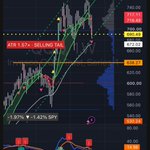
Follow up on my game plan on $SOXX. Looks like the A-B-C correction can lead us to low 400s. Good luck! #Semiconductors

Mr. Macro retweeted

It’s almost incomprehensible how wide the distance is between someone who’s working at the frontier with AI and basically everyone else right now.
The crazy thing is these lines are not converging, but only growing farther apart. If the curve of AI progress had leveled off, it would certainly have given most people and companies time to catch up or implement their workflows in a standardized way. The technology would have neutralized competitive advantage because everyone would be using it the same way.
But what’s happened is the opposite. The curve of AI progress is basically going vertical right now, which means if you had codified your processes 3-6 months ago you’re likely already behind again. Now imagine most companies that kicked into gear a year ago and thought that they were done. Even further behind now.
I’ve never seen a technology in my life and career that improves at this rate, which consequently means you need to upgrade your expectations at a similar rate. Our brains weren’t wired for this, and our organizational change management processes certainly weren’t either.
With any form of recursive self improvement, things just get wilder. It’s a time when you will need to be constantly reevaluating the things that didn’t work just a couple months ago to see if they now can be solved. AI native companies certainly have a strong advantage due to this right now, so now it comes down to can the bigger companies keep up. Wild times.
Mr. Macro retweeted

The Federal Reserve held interest rates steady today, and we think patience is the right approach. Inflation remains high, but the question isn't simply whether rates should go higher. It's whether higher rates would actually address the inflation that remains.
The challenge is that parts of the economy, and of inflation itself, are moving at very different speeds. Growth remains remarkably resilient in aggregate, supported by a powerful investment cycle, but beneath the surface, parts of the economy that are more sensitive to borrowing costs are feeling considerably more restraint. We see a similar divergence in inflation. Many of the cyclical components that respond to higher interest rates appear relatively well controlled. Meanwhile, persistent pressures across energy, insurance, healthcare and education are unlikely to be meaningfully affected by another 25-basis-point rate increase.
In some ways, the Fed is operating a house with one thermostat, but very different temperatures in every room. Turning it down further may make the rooms that are already cool even colder, without doing much to cool those that remain hot.
That doesn't mean the Fed should become complacent. Inflation is still above its 2% objective and the Fed should retain the option to tighten further if the underlying inflation trend deteriorates. But hawkish rhetoric and patient policy can comfortably coexist, particularly when the bond market has already done some tightening of its own through higher Treasury yields.
For investors, we think this environment argues for humility rather than making a heroic directional call on rates. Real yields remain attractive, and there's considerable income available across high-quality fixed income markets. We continue to favor a moderate duration posture, taking advantage of today's income opportunities while remaining patient as this unusually divergent economy evolves.
The Fed doesn't need to ignore the heat. It just needs to be thoughtful about where it's coming from.
Mr. Macro retweeted

Just spoke to the Head of AI at a huge company.
The #1 thing they're struggling with is... what do I do with the AI laggards at our company?
Like most companies, they’ve found that a Super Pareto Principle is true within their org. 10% of their employees are responsible for 90% of the uplift in productivity/token usage from software engineering to non-technical knowledge work.
They’ve spent a lot of time & resources on AI enablement from LLM foundations to function-specific trainings and skill building. And yet, the power law of productivity increases hasn’t budged.
So now they’re left with a few sobering thoughts and hard questions:
1) 90% of people are overpaid and 10% are underpaid
2) We’d be better off allocating tokens proportionally to the power law, but how do we do that without killing culture?
3) Significant layoffs are likely warranted and wouldn’t impact overall output, but cultural backlash is a big concern?
4) How do we hire more power law people as a non technology company?
5) Is all of our efforts on training and enablement ACTUALLY worth it?
6) How do we not experience a brain drain where the top 10% all leave because they want to be surrounded by other AI-native 10x’ers?
Mr. Macro retweeted

Talked to multiple founders yesterday who have been building their products over the last 3 years. Started manual code.
They feel behind and slower than companies that started this year with all code written by agents.
I have never seen such an order of magnitude difference.
Mr. Macro retweeted

Pretty much.
As of the past few weeks, debt markets have almost entirely shut off access to money for any company that doesn’t have substantial revenue independent of AI data centers.
SpaceX closed $40B of debt for GPUs, but we’re investment grade and have Starlink & launch revenue.
That means the 200+ neoclouds are going to see guppy-level death and consolidation. Some will make it through, but not many.


Think about it, it makes AI cybersecurity a necessity for all businesses that are connected to the internet so I guess 99% of them. Quite bullish in my view.

# Black October
For anyone who knows me even somewhat well, it's clear that I am a 99th percentile tech optimist. However, the vibes have shifted for me quite a bit in the last 18 hours, and I feel a moral imperative to share what I'm thinking and feeling with my circles so that everyone can understand, and hopefully take seriously, what's happening right now. I think October 2026 will have many chapters written about it in the history books.
You know those scenes in financial movies like Margin Call where someone realizes that they're all fucked, and no one else sees it yet? And that person feels like they're crazy, and then suddenly everyone is pulling an all-nighter in a boardroom and freaking out? Yeah, that's kind of how this is feeling right now in the SF/Bay Area/AI circles.
We're 48 hours into what is being called Black October. In the last 2 days there have been several dozen cyber attacks which, in isolation, would each have been the worst to happen in an entire calendar year. Every sector from government to education to big tech and banks is being massively affected, and people are starting to freak out.
In a nutshell, what's happened is that frontier AI models have gotten to a point where they are as advanced as the most sophisticated programmers, with one critical difference: they can work 24/7, and you can spin up 10,000 of them with a single command and they'll work together tirelessly until they accomplish their task. The most advanced models today are from companies like Anthropic and OpenAI, whose current best technology is so good that they haven't been able to roll it out to everyone yet because of the national security risks it poses.
Meanwhile, the best open source models (where anyone can just download the model weights and do whatever they want with them, uncensored) are slightly behind the frontier but still 90-95% as capable. These models, developed primarily in China, are being used by black hat hackers to wreak havoc on the Western capitalist structure. Presumably, this has been part of China's plan the entire time, and we're seeing its implications fall out in real time.
In red-pilled AI circles, we've been sharing and reading papers called things like "Situational Awareness" and "AI 2027" for the last year or so, which at the time felt a bit like near-term speculative fiction. They laid out the case for why Artificial General Intelligence (AI smarter than any human at any knowledge task) and Recursive Self-Improvement (models that are able to use themselves to get better) weren't half-baked future ideas anymore, but instead an inevitable outcome of the linear progress that's happening.
These papers would then talk about things like "takeoff scenarios," trying to envision how that moment would come to be and what it would be like when it happened. It would either be a "slow takeoff" that would play out over the course of months and quarters, happening subtly and only obvious to a few. Or, it would be a "fast takeoff" where it would pretty much happen instantly, like a bit flipping from 0 to 1.
From everything that I can see and am feeling, we are currently experiencing the fast takeoff scenario. Beyond the crazy security vulnerabilities that have come out recently, there have also been massive breakthroughs in life sciences, fundamental computer science, materials science, and pure mathematics that have all landed in the same time frame. While I still firmly believe that AI will be a net positive for humanity, it's more clear to me than ever that the societal and individual risk is very real, and is playing out NOW.
For as much conviction as I have that this is happening, the thing that's caused me to lose sleep is that I don't really know what to do about it, or more importantly, what to tell you, reader, to do about it. So, the best I can do is make a few suggestions that have always been a good idea but are more timely now than ever:
Set up 2-factor authentication for everything. I use Duo.
Use a password manager across your devices. I use 1Password.
Get an identity protection app set up. I use Alta.
Move your IoT devices to their own network. Claude helped me do this.
And last, but certainly not least, if you've been avoiding leaning into AI, see this as a catalyst to wake up and start using it. Don't just use the chat mode version of ChatGPT/Claude; click that Code/Work button and see how easily you can have AI write code to help you with your job. One of the biggest vulnerabilities was in a massively popular programming language called PHP, and the prompt that set it off was literally, "Find vulnerabilities in php."
This is an unprecedented time for humanity, but as we've done with many things before, we will prevail so long as we are kind, loving, and open-minded to the world.
Much love.
Mr. Macro retweeted

Dinner with an exec/friend at a large national property management company tonight. This person oversees ~150k apartments; access to an insane amount of data.
Current multifamily market in most of the country is worse than S&L, .com bust, or the GFC. Worst they’ve seen.
Class A mostly fine, decent rent growth. However:
- credit scores at class A have gone down meaningfully over the past 3 years.
- more people are paying rent via credit card.
- average bank account balance noticeably lower than even 2 years ago
- class A tenants stretched thin, living beyond their means. 20k comes in, 20k goes out every month.
- starting to see these renters move down a tier
Class B:
- simply too many apartments, we built too much new stuff. Ripple effect is enormous.
- fewer renters tomorrow than today. Same store foot traffic noticeably down year over year. Some markets down 40-50%
- considering dropping rents below $700 a month on some 1beds in major southern markets.
Class C:
- looking at degrading NOI. Rents aren’t growing for a long time, but expenses keep creeping up
- more renters are one missed paycheck away from disaster than they can remember seeing in decades
- tenants aren’t paying rent because they simply don’t have it
- wage growth has not kept up
Lenders:
- some major investment funds, household names, haven’t paid their mortgages in 2-3 years. Banks won’t foreclose because “X is a big client.” Mexican standoff.
- a roof leak gets ignored, becomes water damage, then mold, then a down building. Buildings are rapidly deteriorating as some owners choose cash preservation over funding losses.
- number of pre-foreclosure and REO deals is the highest as a % of total units they can recall.
- data providers know it’s bad, but they’re paid to sell optimism to owners/lenders. So every forecast is “it will probably get a little better next year maybe” and that gets regurgitated at investment committees all over.
I asked “how do you think this ends?”
“Not sure. My gut says slowly then suddenly, and things will get really bad. Been doing this 40 years, you can feel it in the air. But, there’s a chance it’s just a decade of tolerable pain. I’m praying for that.”
Mr. Macro retweeted

From 1959-2026, there were 12 declines of note in forward-looking leading economic indicators divided by backward-looking lagging indicators. Of the first 11, we witnessed recession in all periods save two (#2 and #8). This has fallen so far since 2021 that, at least optically, you start to wonder if there's something the consensus is missing on 2027 economic output.

Mr. Macro retweeted

This is crazy‼️
The $SPX is ~1% off its highs.
Goldman's High Beta Momentum basket is -41%.
We’ve never seen anything like this.

Mr. Macro retweeted

Biggest two week net selling ever
According to @Goldmansachs PB, global technology stocks saw the largest two-week net selling on record (10+ years) between October 5 and 16, a staggering 3.3 standard deviations below normal.
Selling was driven by both long liquidations and fresh shorting.
