

Sign up for my twice-weekly newsletter, WSJ Economics, here: https://xitter.cf/t.co/EBsOw4LSoO
Washington, D.C.
Joined January 2011
- Tweets16.5K
- Following865
- Followers84.2K
- Likes3.3K




Pinned Tweet
Contra @BillAckman and @johnarnold, the Fed is entirely capable of killing the AI boom and bringing down inflation. My newsletter recalls those in 2000 who wrongly doubted the Fed could deflate the Internet mania. Also this morning: shout outs to @jasonfurman @mtkonczal and @Samfr. Please subscribe! Read today's here: wsj.com/finance/investing/ye…

Greg Ip retweeted

Anthropic will be very surprised to learn that the US government can’t direct a private company to make or not make particular decisions.

Greg Ip retweeted

Peggy Flanagan has said she “graduated Phi Beta Kappa” and with a double major. She did not, however, graduate with honors or a double major.
wsj.com/politics/policy/minn…


Greg Ip retweeted

Picking up a fight with Canada and allying with Russia ahead of the mid-terms seems totally in line with U.S. public opinion.

Greg Ip retweeted

UNITED CEO Scott Kirby: “.. Wealth inequality has become a danger to our society, .. We should have a national wealth tax ..”
@nytimes $UAL
nytimes.com/2026/10/18/busin…


An uproar over a parade in Alberta reflects divisions ahead of a Monday vote weighing the province’s future in Canada by Amanda Coletta wsj.com/world/americas/alber… via @WSJ

Greg Ip retweeted

Obviously there was a ton that people were frustrated with during the Biden years but it's just an uncontroversial fact that real wages were climbing into the Trump presidency and then in March and April of 2025 they stopped climbing. agglomerations.eig.org/p/the…

.@palmerluckey adds his voice to those accusing Europe of hypocrisy for criticizing US sanctions waiver while buying Russian oil or gas. But surely it's relevant how much EU purchases have fallen (see charts). Irrespective of the merit of EU's continued purchases, it bore a lot of economic pain to get to this point and the marginal pain rises with each additional BTU cut off. Recognizing this, Trump himself has issued waivers to European buyers of Russian energy, most notably last year to Viktor Orban of Hungary. Meanwhile, EU pain was U.S. gain: it became a larger supplier to Europe. Indeed, as a net petroleum exporter, U.S. has benefitted from sanctions. But it has such low tolerance for any hit to consumers it is easing sanctions anyway.


I hate qualifying arguments like this, but - everyone knows I am about as pro-Ukraine/anti-Russian as it gets. That regularly leads to friction between me and other Republicans, even ones who otherwise align 99%.
With that said, whining from Europeans and the American left about America buying $1B in diesel fuel from Russia is so out of touch with reality. The EU has spent over $200B on Russian fuel and is on-track to buy hundreds of billions more. Most of that was purchased by wealthy EU members who can absolutely afford alternatives.
xitter.cf/PalmerLuckey/status/20…
The Fed does not target food

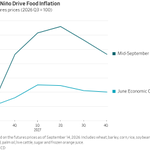
.@SecScottBessent: “Core inflation is down. Food is below the Fed’s targets. Prescription drugs have had the biggest decrease in history. Rents are down. This is an energy shock. We will get to the other side of the Iran conflict, and those prices will come down.”
Greg Ip retweeted

Many people who work closely on AI and are constantly seeing charts like the one on the left (AI capability growth) think that it will translate to the graph on the right (GDP growth). But the economy is much more complicated than that.


Greg Ip retweeted

Some impressions from the Bank-Fund meetings in Bangkok:
1. The words are all negative but the numbers are all positive. Is all about unprecedented waves of shocks and risks while the IMF upgraded the forecast to something even stronger.
2. No one cares about tariffs anymore, they expect them to continue forever and have adjusted and moved on.
3. Everyone cares a lot about high interest rates. They expect them to continue forever but they haven't moved on.
4. Oil prices fall somewhere between these two. Everyone cares some, aren't sure if they'll continue and have partially moved on.
5. Everyone is having exactly the same conversations about AI as they are having here: will the demand boost continue, is it a bubble, will it kill jobs, when will it show up in productivity. I sensed much more optimism than pessimism and finance ministers and central bankers are not particuarly interested in p(doom).
6. No one seemed to mind that Scott Bessent didn't bother to attend.
Greg Ip retweeted
The changing tone of Chinese discourse about Ukraine is remarkable. Obviously splitting Europe from the U.S. has long been a PRC strategic objective, but until Trump it was impossible without sacrificing Beijing’s relationship with Russia.


The West shouldn’t take Ukraine for granted:
“Ukrainians still overwhelmingly want to belong to the West. But many have begun preparing for the possibility that they never will.”
China would stand to benefit.
My latest op-ed in @WSJ:
⬇️

Greg Ip retweeted

Doesn’t *sound* like them…

"Lutnick Throws the Future of U.S.-Mexico Trade Talks Into Further Doubt" share.google/YCB36qc3EcCd3ow…
"A senior Mexican official said that every time both sides get close to a deal, the Trump administration brings up something else that it wants"


Greg Ip retweeted

Important exclusive from @WSJ on Howard Lutnick upending trade talks with Mexico.
wsj.com/economy/trade/lutnic…

Greg Ip retweeted

So…@PhilipWegmann and I happened to be mid-interview with Katie Zacharia when she was called out of her office midday on Friday.
She never returned—to the interview, or the job.
The Five Days of Katie, with @marianne_levine:
wsj.com/politics/policy/kati…

Greg Ip retweeted
Katie Zacharia was in her office with the @WSJ when Jason Miller knocked on the door.
“JD wanted to chat with us real quick."
Outside Trump was telling reporters he asked her to reconsider the role.
She never returned to the interview, or the job.
wsj.com/politics/policy/kati…
Canada had serious problems before Trump came along: stagnant productivity, and an inability to fix it because of regional obstructionism. Those problems come to a head in Alberta's sececession referendum Monday. Carney is using the crisis of Trump to fix the economy and neutralize regional dissent. wsj.com/world/americas/how-t…

