

Asst. Prof. of Finance @uclaanderson AI, Technology, Labor markets, Finance || 🇩🇪 || Substack: https://xitter.cf/t.co/pYJPKjT1HL
Los Angeles, CA
Joined November 2011
- Tweets746
- Following1.5K
- Followers1.5K
- Likes715





Pinned Tweet
🚨 New Working Paper! 🚨
Time to talk about "The Household Impact of GenAI", covered by the @WSJ !
In this paper, we ask what GenAI is doing to productivity outside of work - and find evidence of large impacts.
arxiv.org/pdf/2603.03144
(w/ @rainozhang, Michael Blank)
🧵(1/n)


Gregor Schubert retweeted

if you are building a product using AI, you should be spending >25% of your time making benchmarks and trying to get the model labs to care about said benchmarks
easiest path to accelerate your progress as a company
Because Ed eschews pictures - let me supply some. First, there is sth analogous to the "Jevons Paradox" in AI, but for transport innovation and city center demand: if cheaper transport leads to MORE spending on trips, demand for CBD living increases! 2/4

Ed shows that maybe we should expect demand for trips to be quite elastic, as more of them are discretionary now than they used to be, and it looks like dense city dwellers do not economize on trips as much as in the past. 3/4

Technology is more/less centrifugal for cities depending on economies of density (matching! infrastructure!) in service quality (e.g. for Waymo, car sharing, drone delivery) vs. lower costs of individual trips to the suburbs (EVs, personal AVs). Implies that house price patterns will shift with technology changes that are coming! 4/4

Every year, I challenge my MBA students to think about how new technologies will shape what cities look like. As a result, I was happy to see that Ed Glaeser's new paper formalizing how urban econ models (AMM!) can be useful to think about innovations! 1/4

This sort of public experimentation with agentic AI research pipelines is a great public service!


Much of the conversation around AI is still missing the household benefits! See our paper: arxiv.org/abs/2603.03144
Spreading the word - like Reese Witherspoon - is what's needed to prevent the "GenAI divide" that we document and to help people realize the productivity gains!


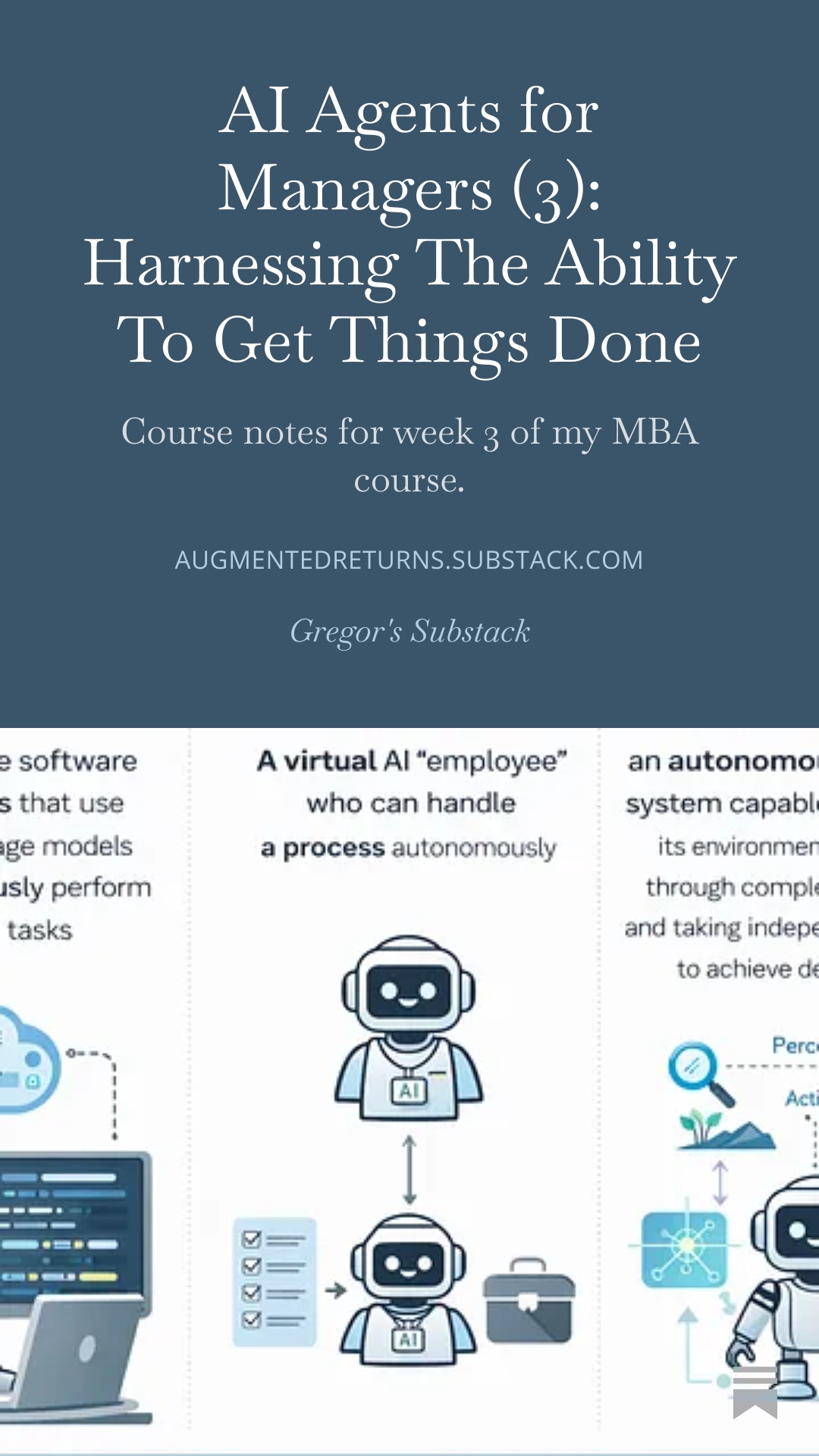
New post on module 3 of my course: "AI Agents for Managers - Harnessing The Ability To Get Things Done"
I talk about agentic systems and what harnesses, tools, and skills are - and how they turn LLMs that take in tokens and output tokens into workers with advanced capabilities.
open.substack.com/pub/augmen…
OF COURSE AI WOULD LIKE OUR PAPER! (but more seriously, creating my own AI-driven review system for the Human x AI finance conference recently makes me paranoid about accidental bias through system prompts - I hope the @KurateOrg models don't know that THEY are AI)

I love what @KurateOrg is doing! Key methodology piece in their approach: ELO style pairwise tournaments have HUGE paper ordering bias which is why I think it's great they flip positions! Will have more thoughts on this soon when we write up our learnings from our conference...

Notes for week 2 of my course on AI Agents for Managers are up! This week we talked about Retrieval-Augmented Generation and where it fits into businesses.
augmentedreturns.substack.co…
@uclaanderson
Gregor Schubert retweeted

Wonderful that scholars are now focusing on a key side effect: novices don't get to participate as much and therefore build less skill. From 2014-2024 I was alone on this.
A trillion-dollar risk looming over us all.
My research shows a way forward: theskillcodebook.com

An increasingly coherent picture of the impact of AI on jobs, by @jburnmurdoch @ft:
1. New Fed paper by Crane and Soto now confirms with official labor force survey data what private payroll analysis was showing: roughly 500,000 fewer coders are working than pre-LLM trends would predict.
2. Argues evidence consistent with my work (with Lin and Wu, link in my pinned post) on weak/strong bundles: junior developers and contractors hold "weak bundles" (their work is mostly standalone coding that AI can substitute directly), senior developers hold "tight bundles" where coding is combined with domain expertise, judgment, and cross-functional responsibilities, making substitution much harder.
3. Freund & Mann and Gans & Goldfarb add a second lens: what matters is the value of the tasks that survive automation. Remove coding from a senior role and you free up time for higher-value work; remove it from a junior role and almost nothing remains.
ft.com/content/b69f8599-eaf1…

As a reference for my students and others, I have started writing up summaries of each week of my MBA course on "AI Agents for Managers" at UCLA. First week's notes on AI use cases are here - subscribe for future issues: augmentedreturns.substack.co…

Full syllabus: github.com/gschubert/website…
(thanks to @arpitrage for inspiring this with his own write-ups)

Gregor Schubert retweeted

Really excited to convene this @OpenAI Forum panel to discuss how AI usage data, like our recently released Signals dataset, can shape our understanding of how AI is transforming work and the job market. The conversation will draw on how people use AI usage data and broader research to explore how AI is already being integrated into work. We'll be joined by @gregorschub and Daniel Rock. forum.openai.com/public/even…

Gregor Schubert retweeted

If automation drives the price of many or most goods to zero, then GDP growth will be a very bad proxy for welfare growth.
Really interesting findings on how AI management knowledge diffuses (and the consequences). These process diagrams by themselves are a great service for MBA students. In the short run, it takes a lot of humans to figure out HOW to restructure work processes with AI...


A minor quibble - but matters for interpretation: lower LFPR is not "fewer jobs" but "fewer people interested in a job". The latter is not always bad, might come from leisure technologies etc. - workers lost their job and are unemployed would still be in the labor force!

We completed the most comprehensive study of how economists and AI experts think AI will affect the U.S. economy.
They predict major AI progress—but no dramatic break from economic trends: GDP growth rates similar to today's and a moderate decline in labor force participation.
However, when asked to consider what would happen in a world with extremely rapid progress in AI capabilities by 2030, they predict significant economic impacts by 2050:
• Annualized GDP growth of 3.5% (compared to 2.4% in 2025)
• A labor force participation rate of 55% (roughly 10 million fewer jobs)
• 80% of wealth held by the top 10% (highest since 1939)
🧵 Here's what we found:


As one of the data points in the sample, I would say that my personal view is that the reason why growth would be lower than what AI experts project is (1) bottlenecks, but also (2) GDP measurement vs consumer surplus, i.e. more stuff != more monetized stuff.

Gregor Schubert retweeted

Every tax season I wasted evening hours looking up the GSA/State rates to everywhere I travelled on business, needed for deductions.
This year it took a few min to plug in my trip dates, and then GPT looked them all up and performed the right calculation. It saved me from a mistake too by flagging one trip as not long enough to deduct. I didn’t remember that part of the rule despite reading in detail.
Gained back sleep and time with kids.

