

hand100b retweeted

😊 I also just uploaded a new version of the lecture notes. cs229.stanford.edu/main_note… (it's still, and perhaps will always be work-in-progress, given the field is moving fast. Any mistakes are mine :) and any feedback is more than welcome :).

Instead of watching 2 hours of Netflix tonight, watch this Stanford lecture. It’s the clearest end-to-end explanation I’ve seen of how ChatGPT and Claude are actually built.
From tokenization and BPE all the way to the transformer architecture, training pipeline, and next-token decoding.
Whether you’ve never written a line of AI code or you’ve been shipping agents every day, this 2h 34min session will click things into place that most people take years to figure out.
Bookmark it and clear the time this weekend, because this might be the single most valuable thing you learn all month.
hand100b retweeted

Claude Academy is now live.
Whether you're figuring out what AI is or already using Claude every day, there's a path that meets you where you are. The courses and tutorials are free and open to anyone at academy.claude.com
hand100b retweeted

we support business privacy!
openai.com/index/offering-ze…


hand100b retweeted

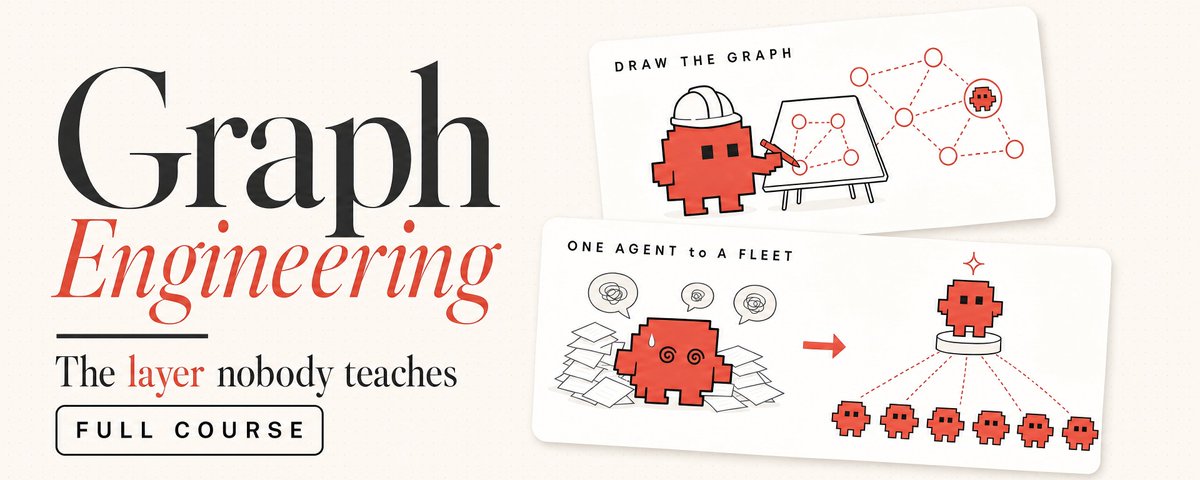
Andrew Ng just released a 2-hour course on full Graph Engineering.
How to go from one prompt to 100 agents that loop, rewrite themselves, and run without you:
09:14 - Build your first AI agent
33:11 - Run agents with loop engineering
1:02:46 - Turn agent loops into graphs
1:30:15 - Build agents that rewrite themselves
1:49:05 - Run the full graph system without you
Most people are still building one agent and calling it done.
Andrew Ng is already teaching everything after:
Prompt → Agents → Loops → Graphs → Self-Improving Systems
Single agents are the old workflow.
Systems that improve and run without you are the new one.
This 2-hour watch is worth more than most $500 agent engineering courses.
Bookmark and watch it before everyone catches up.
Then read how to run 1,000 agents from one prompt below ↓


hand100b retweeted

whoever leaked this has bigger balls than sense
someone gave a fleet of Claude agents shared memory so they would stop contradicting each other, then measured both the bill and the output: the version that talked most made 2.4x the api calls of the version that won, and hallucinated 34% more than doing nothing at all, 0.658 against 0.492
i ran the same question past two of my own agents afterwards and got two different answers about which file owns the config. each one was individually right and the pair was wrong, which is the whole failure in one line
this is Graph Engineering, the layer that decides which agents may talk to each other at all, and it installs into the agent you already pay for:
- decide which agents may share state at all, because every edge you draw is a channel a mistake can travel down
- measure divergence per PAIR instead of as a fleet average, across what they believe about place, time and task history
- gate on that number and stop the pair above your threshold before it reasons, rather than repairing the output afterwards
- let compressed summaries replace whole states: the verified protocol landed 0.463 against 0.658 for full broadcast
- cut the sync frequency until it hurts, since the winning setup used 58% fewer calls than the one that broke it
- never propagate a state nobody checked, because the contamination effect came in at d=1.18, a full standard deviation of extra lying
- keep the shared layer small enough to diff, which is what a written standard does and a running conversation cannot
- re-run the check after every model upgrade, because this was 8 scenarios on one model family at n=30 per condition
- and learn where it does not bite: on plain software tasks every condition converged under 0.2 and the whole effect vanished
turns out the ranking is the uncomfortable part: verified summaries 0.463, no synchronisation at all 0.492, full broadcast 0.658. the middle option is doing nothing, and it beat the thing everyone builds first
the group agreeing is what it looks like when every agent copied the same mistake, which is why a fleet that hallucinates has a replication problem and keeps getting handed a smarter model instead
so the question for your own setup: if you asked two of your agents the same thing right now, would they answer the same way
bookmark this one. the layer underneath it, deciding which arrows between agents exist at all, is built step by step in the piece below ↓


hand100b retweeted

A billionaire went on stage and explained in 42 minutes how the entire economy works. for free. Wall Street spent the next decade pretending nobody saw it.
he didn't sell a course. he didn't plug a fund. he stood at a whiteboard and drew three lines that explain every crash, every recovery, and every rate decision since 1929.
MBA programs charge $200,000 to teach frameworks he covered in the first 15 minutes. six of the models he drew on that board are still classified as proprietary at three major banks. he gave them away on YouTube.
the part nobody talks about: he predicted exactly what happened in 2020, two years before it played out. interest rates hitting zero, the central bank running out of tools, the money printer. he drew it on a whiteboard in 2018 like he was reading tomorrow's newspaper.
a portfolio manager at a top-five firm told me every new analyst on his desk watches this before they're allowed to open a terminal. not the CFA prep. not the internal training. this one lecture.
40 million people have seen it. almost none of them can name the three forces he draws in the first ten minutes.
it is still free.


hand100b retweeted

Google just released free 2-hour course on full Graph engineering: 1 prompt → 100 agents → loops → graphs from 0% to 100%:
10% → 17:44 - build your first agent
30% → 39:30 - Loop engineering: iterate, check, break
60% → 1:12:38 - Graph engineering
75% → 1:34:26 - agents that throttle themselves
100% → 1:55:05 - full graph for multi-agentic systems
everyone builds one agent and calls it done - this is the full system where agents wire themselves into a graph
watch the course, build the graph - then read the full architecture below ↓


hand100b retweeted

MCP 2026-07-28 is live and it's the largest update to the protocol since launch.
MCP is now stateless, making it easier to deploy and scale remote servers.
claude.com/blog/bringing-mcp…

hand100b retweeted
“If you have multiple interests, do not waste the next 2-3 years”
article summary in 4k light & dark


hand100b retweeted

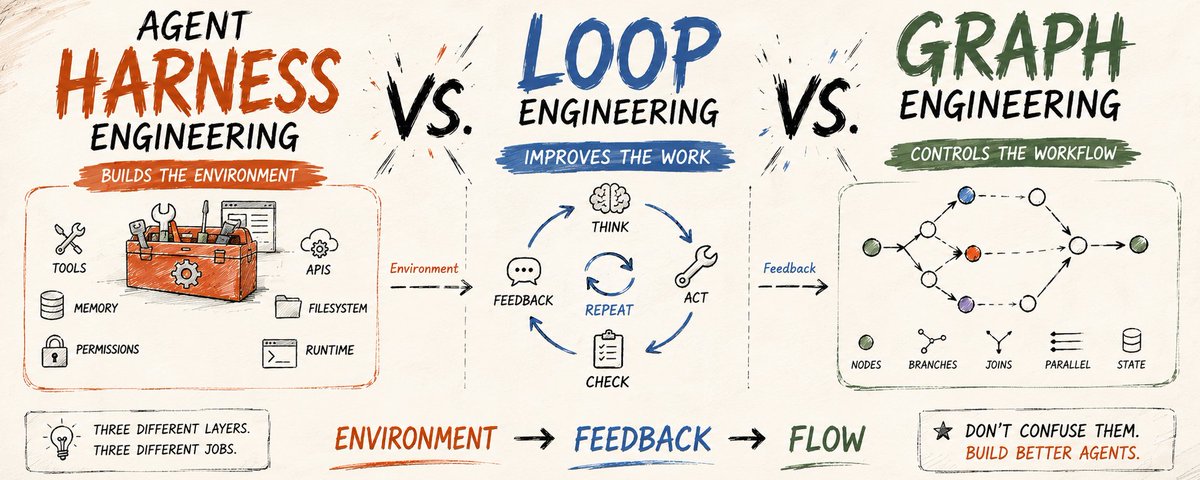
from prompt → context → harness → loop → graph engineering.
the list keeps growing, and every new term gets treated as a replacement for the last one. each layer wraps the one before it, and the cleanest way to tell them apart is to ask what a single unit of work looks like.
𝗽𝗿𝗼𝗺𝗽𝘁 𝗲𝗻𝗴𝗶𝗻𝗲𝗲𝗿𝗶𝗻𝗴 𝗶𝘀 𝘁𝗵𝗲 𝗺𝗲𝘀𝘀𝗮𝗴𝗲.
the model remembers nothing before this call, so the prompt has to carry the full universe of what it needs. a role, the background, the instructions, a few examples, a format.
when the output falls short, the skill is working out which ingredient let you down, not rewriting the instructions every time.
the unit of work is one input.
𝗰𝗼𝗻𝘁𝗲𝘅𝘁 𝗲𝗻𝗴𝗶𝗻𝗲𝗲𝗿𝗶𝗻𝗴 𝗶𝘀 𝘁𝗵𝗲 𝗺𝗲𝗺𝗼𝗿𝘆.
across many steps the window is finite and the available information is not, which forces a curation step. a curator keeps what matters, compresses what is useful but bulky, and drops the rest.
good curation is mostly about knowing what to throw away, not packing more in.
the unit of work is what stays in the window.
𝗵𝗮𝗿𝗻𝗲𝘀𝘀 𝗲𝗻𝗴𝗶𝗻𝗲𝗲𝗿𝗶𝗻𝗴 𝗶𝘀 𝘁𝗵𝗲 𝗺𝗮𝗰𝗵𝗶𝗻𝗲.
on its own a model just generates text. the harness gathers what it needs, runs it, calls tools or sub-agents, and verifies the result with tests or a judge.
that verify step is the entire difference between calling an api and running an agent.
the unit of work is one pass through the machine.
𝗹𝗼𝗼𝗽 𝗲𝗻𝗴𝗶𝗻𝗲𝗲𝗿𝗶𝗻𝗴 𝗶𝘀 𝘁𝗵𝗲 𝗿𝘂𝗻.
one pass rarely finishes the job, so something has to decide whether to run the machine again. that decision needs a goal defined upfront, brakes like max iterations and budget caps, and a completion check that is automated rather than felt.
an agent that stops asking for tools has ended its turn, which is not the same as finishing the task.
the unit of work is the whole run.
the diagram covers those four. here is the fifth.
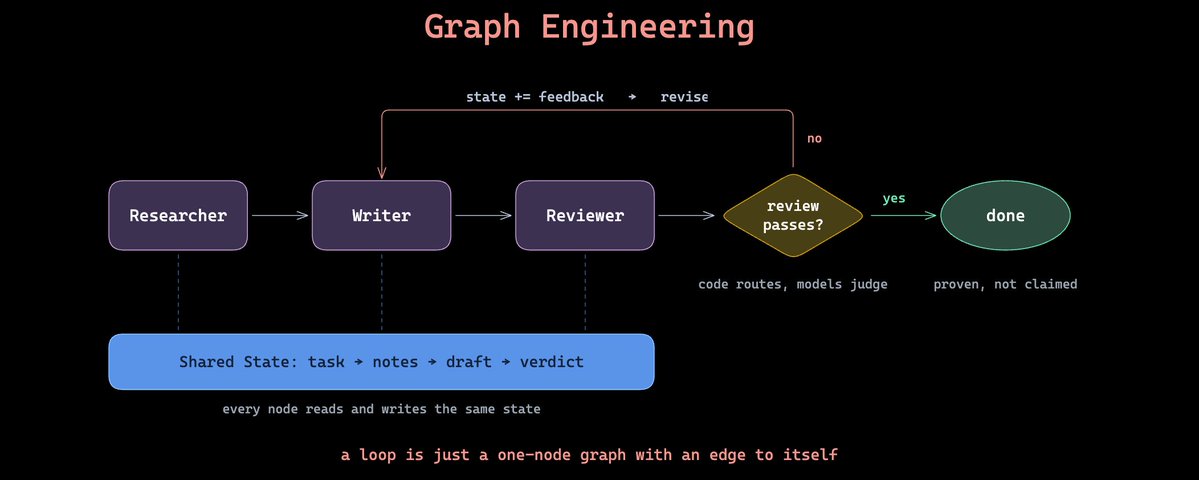
𝗴𝗿𝗮𝗽𝗵 𝗲𝗻𝗴𝗶𝗻𝗲𝗲𝗿𝗶𝗻𝗴 𝗶𝘀 𝘁𝗵𝗲 𝗰𝗼𝗼𝗿𝗱𝗶𝗻𝗮𝘁𝗶𝗼𝗻.
once several loops have to work together, you need to say what runs when, what runs in parallel, and who checks whom. nodes do the work, edges decide what runs next, and shared state flows between them.
a single loop is just a one-node graph with an edge pointing back at itself, which is why graphs govern loops instead of replacing them.
the unit of work is the whole job.
here is the part that ties it together.
prompt and context both live inside the harness gather step. the harness is one pass, the loop decides whether to run that pass again, and the graph decides which loops run at all.
zoom out and the unit of work gets bigger. zoom in and you are back at the prompt.
that also tells you where to debug. find the layer whose unit of work broke, then fix that layer.
the prompt is the easiest layer to edit, which is why it keeps taking the blame for failures that live three layers up.
i also published this deep dive on graph engineering, covering the core idea, how to get started, shared state, routing you can trust, and when a graph is genuinely overkill.
the article is quoted below.

hand100b retweeted

Godfather of AI: "If you sleep well tonight, you may not have understood this lecture."
This 47-minute lecture is the best thing I've seen about AI in the last few months.
Hinton built the neural networks behind every AI alive, then quit Google to warn us it's already ahead of us on most cognitive tasks.
Despite that, most people open Claude, type one thing, close the tab and think they're using AI, but they're using maybe 10%.
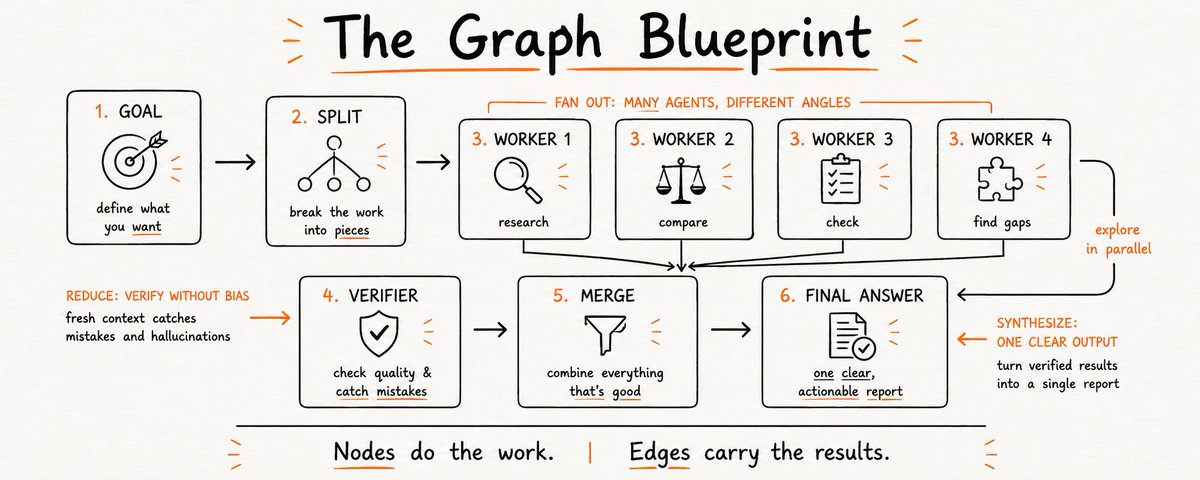
The people using the other 90% aren't typing prompts at all. They're running agents in parallel, wired into graphs that check their own work.
Watch the lecture, then read my step-by-step guide on graph engineering below.

hand100b retweeted

My history career as a trader
I've made my living trading futures contracts since I was 29 years old. I am 80 next year. I love trading. It is why I still do it and write about it. I cannot imagine life without market speculation, but I suppose that day will come.
I was not profitable immediately. I left the advertising agency business in 1975. I worked for one of the largest ad agencies in the world and had serious reasons to believe I would have named VP while still in my 20s.
The story of how I ended up at the Chicago Board of Trade is a two to three chapter story, I won't take it up in this post.
By the way, I hate X because serious engagement no longer happens. If you enjoy my "old stories" please let me know who you are. If there is enough interest I would post some of the book I am writing about my life as a commodity trader.
In 1981 when I started Factor LLC as a self-funded trading firm. It was profitable from the start although the firm has had four losing years. The average of the four was -8%. Minor, but losses nevertheless. Last losing year was 2013 at -15% or so.
But during the first four years I cannot even remember how many accounts I blew. Some blew up quickly. Others lured me into think I was on to something only to have the account bleed to death slowly.
Continental Grain wanted us to open accounts of our own with at least $10,000 to $20,000 -- that way we would take our trading seriously. That was serious money for me at the beginning.
So I would open an account and try trading grains with fundamentals or livestock with cycles.
Back then hardly anyone kept charts except point and figure charts, so when a friend bought me a 5th edition of the Edwards and Magee book in early 1978 my life changed. Suddenly I had a frame of reference with which I could understand price discovery.
So my next account was looking for classical chart patterns. But with this I struggled at first, but at least I did not blow up that account.
Yet it was not until mid-1979 that I became meaningfully profitable. This was five years after my first trade -- and that time spent working for the world's most prominent FCM at its Chicago headquarters.
But slowly I kept solving problems. That is what trading really is -- a huge problem solving game. Those that break even until they figure it out stand a chance.
1980 was hugely profitable
As was the first half of 1981.
That is when I decided it was time. I sold my commercial business to a good broker friend, quite customer business and incorporated Factor Research and Trading as a proprietary self-funded account at the Board of Trade.
There have been struggles along the way. Problem solving never ends. When one is kind of solved the next one pops up. Being a self-funded professional commodity trader is not easy work or everyone would be doing it.
There was about a decade I too a hiatus in the late 1990s/early 2000s to devote myself to charitable non-profit work, including becoming an NGO with the United Nations.
When I came back to trading in 2006 everything had changed. Trades were made on a computer using a computer. I was used to calling my orders into the pits.
I dramatically changed my risk management protocol in
I actually seriously wondered whether I could remember how I traded and whether my style would still work.
2007 was profitable, and 2008 was my last triple digit annual return. My style still worked.
But my challenges were not over. 2013 was the worst of the four losing years I've had in my 46 years of trading.
The why is a whole long story I won't get into here. It's too long a story.
But the episode resulted in the most dramatic changes in risk management I had even taken. This too is another story unto itself.
Anyway, here I am, still trading cause I love it. And because it has been very profitable for me.
I totally disbelieve that us average humans can run $10,000 into $1 million in a few years. I've done and a lot more, but that by trading in six different decades - the 1970s through the 2020s. I hope I can someday claim seven decades.
My main measure of success has not been ROR for years and never was win rate. All the changes I have made since 2014 have been aimed at cutting asset volatility to the nubs. I feel fortunate that I have been able to this, not have but a few small losing months in a decade.
ROR has not been my concern. From the early 1980s I believed that if I sought excellence in the things I could control that the profits would work themselves out.
This has been the case.
My observation of the Z gens is that they have expectations in trading that are 3 to 4 standard deviation affairs. Good luck with that one, Zers.
Thank about it. Renaissance Technology is the single most profitable trading firm in the world with an average ROR in the high 40s, low 50s.
Stan Druckenmiller is the best independent trade alive IMO. He averages in the 40s.
Back when Jack Schwager included me in a Market Wizards book he did extensive verification. I provided something like 18 years of documented performance using monthly statements reconciled with a CFTC performance table and IRS statements. Jack calculated that my average compound ROR was in the low 50s.
I do not accept Jack's numbers. In the first place, prop traders should NEVER use compound growth. We are always taking money out of accounts.
My stats put me in the low to mid 40s. But that is with only millions of AUM. Stan does his 40s with billions. There is a huge difference, some of you understand this, some of you don't, yet.
Why am I telling you all of this? Perhaps I am not talking to you, but to those Z and M gens who aspire to be career speculators.
Tame your expectations. There are massive data that conclusively places the odds of success for an aspiring trader becoming a career trader at 3 in a thousand.
You can be one of those 3 -- but believe me there will be reasons why that you might not yet understand.
There are a few things you need to do to have career trading become you.
I recommend futures, not equities. The leverage is magic, but know it is also dangerous.
Do not expect to be profitable for four or five years. If it is three, then great. Your job in the meanwhile is to learn how to lose. Great traders only become great traders because they became skilled at losing. Lose your capital and game over for you.
Next, get rid of social media. It is a trap. Follow me if you must, but turn your eyes and ears away from anyone claiming big profits of knowing where some markets is going.
You need a starting point. Put together some rules, if that is your thing, and commit to them. Bet far less than 1% of your capital on any given trade. Don't day trade. Learn to hold positions overnight and for days.
The biggest crock I hear from some of you is that you need to day trade to make enough money to become serious hold traders. The faulty logic of this idea is massive.
You don't want to do it the way I suggest? That's fine. Everyone needs to find their own way, so welcome to the landmine.
Trading is a math problem to solve. Price is all that matters. Fundamentals are meant to decisive you. Everything you could possibly know about a market is already reflected in price. Price is king.
When I started at the CBOT there were local traders and pit brokers who had fought on Omaha Beach in WW2. It was my father's generation who owned most of the memberships.
They all had the same advice. Cut your losses really quickly and have some technique that allows you to let profits grow. Small losses and much larger profits is the only math that works. Ignore me on this at your own peril.
Seriously, if I am not boring you to death but instead you find my history as a trader told in story form to be interesting, let me know. If I happen to follow you, DM a message.
I am slowly bringing together so many stories I have as a trader. Being a career trader, especially one that traded at an exchange and for the famed Commodities Corp., my life has been crazy. It has been one interesting event after another.
The people I have known and still know. The crazy trades I have been in. The places I have been. I sometimes ask my wife to pinch me so that I can wake up from this life as a full time commodity futures contracts for my own risk.

hand100b retweeted

Opus 5 is a great model for coding, data analysis, design, biology, knowledge work.
More than any of these eval scores, what is most exciting to me is something else: Opus 5 is our least prompt injectable model yet. It is a bit buried in the system card, but across PI evals and red teaming, Opus 5 is very hard to prompt inject successfully.
And when layering defenses -- strong model alignment, combined with prompt injection probes, combined with Auto Mode in Claude Code -- the success rate for prompt injection attacks drops to ~0. This is new and exciting! More about this soon.
www-cdn.anthropic.com/c5fbac…


hand100b retweeted
Two Anthropic seniors just made Karpathy's loop 1000x better with "Graph Engineering" - dropped 11-page PDF
the shift: the agentic systems got 1000x better the moment you wired agents into a graph
here's the playbook in 6 steps:
step 1 → build one loop: generate, critique, revise - one self-review cycle beats a smarter model with none
step 2 → add tools: search, code execution, database - thinking without tools is hallucinating
step 3 → go parallel: spin up agents in separate worktrees - same repo, different branches, no conflicts
step 4 → add a graph: agents write findings as typed nodes and edges - not transcripts - every claim keeps its source
step 5 → ground your evaluator: it checks claims against graph edges, not vibes - "Triple not found" beats "seems off"
step 6 → the graph survives every session - your agents stop rebuilding context from scratch
the result: Karpathy ran 1 agent in 1 direction - this system runs 1,000 with shared memory - same model, it's the architecture
read this 11-page PDF and paste it into your Claude - you won't regret it
bookmark - then read the article on building graphs from scratch ↓

hand100b retweeted

We removed ~80% of the Claude Code system prompt for our newest models, this is what we've learned about writing system prompts, skills and Claude.MDs for them.

hand100b retweeted
Anthropic engineer:
"You're not supposed to prompt Claude. You're supposed to build a system that prompts itself."
In 45 minutes she shows exactly how Anthropic builds agents that remember, fix their own mistakes and get smarter with every run.
This beats any paid course on agents I've seen.
Watch it, then read the guide on building loops below.
