


Christos retweeted

🚨this broke my brain.
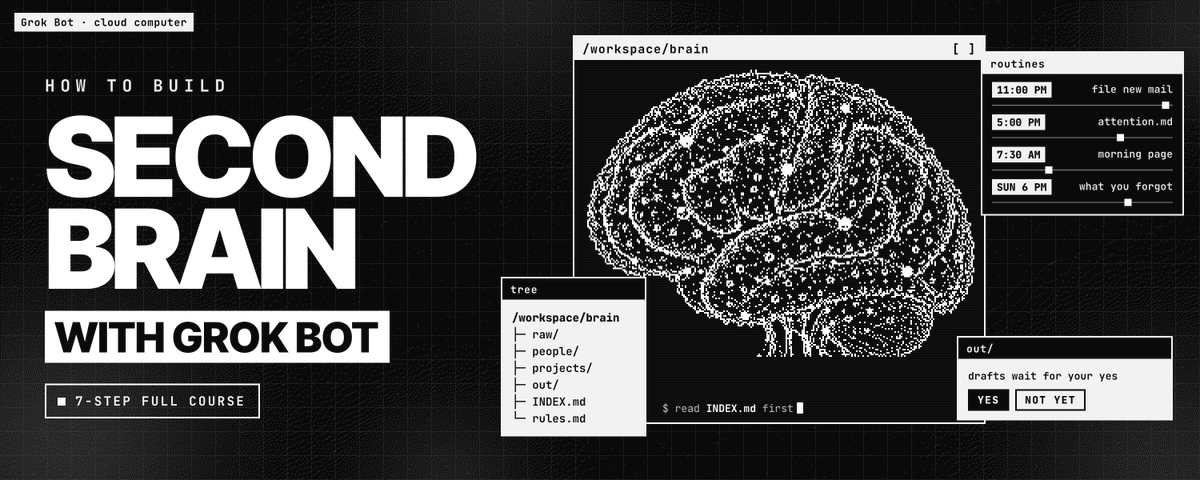
i just watched a 20-something close his laptop, walk home and run his whole second brain from his phone (CEOs pay a chief of staff $135,000+ a year for the same job), while 99% of people still try to keep it all in their own head
a second brain is one folder that knows everything you know, plus an AI that reads it before every task.
Karpathy's post about it hit 22 million views
you can build yours with Grok Bot tonight:
- keep it in files, not chat memory. memory keeps summaries, a file stays exactly as you wrote it
- never edit the originals. every note links back to the email or link it came from
- slow facts like people and how you work live in files, fast facts like dates and amounts get rechecked at the source
- one index file it reads first, then only the files that index points to
- every correction becomes one line in a rules file it rereads before every task
- skip the setup. grab the one-paste prompt from the article below and Grok Bot builds the whole brain for you
it all runs on its own computer in the cloud, laptop shut
at 7:30 every weekday one page is waiting with what came in, what it drafted and what waits for your yes
zero re-explaining
zero lost ideas
zero blank chats
it gets sharper every week you feed it
you're done being your own memory
you're running a second brain for $20 a month
bookmark this. all 7 steps are in the article below

Christos retweeted

The results are in! 🚀 The EIC Pathfinder Open 2026 call has selected 43 projects, each eligible for up to €4M in grant funding.
Bringing together 218 organisations from 30 countries, the selected projects show the power of European research.
More: link.europa.eu/rVyPxH

Christos retweeted

Build your one person company before next year
Build your one person company before next year
Build your one person company before next year
Build your one person company before next year
Build your one person company before next year
One founder
One AI
But make sure you start


Christos retweeted

One of the best renditions of poetry ever recorded.
Actor Michael Sheen delivers a powerful performance of Dylan Thomas’s 1951 poem, "Do not go gentle into that good night.”
Christos retweeted

We'll be spending a lot more time trying to understand the outputs of language models. A few thoughts, tips & tricks:
Writing. Something I've had success with: Ask your LLM to explain something in ASD-STE100, it's a controlled language specification originally developed for aerospace maintenance documentation. LLMs well-versed in this language and it comes with heavy constraints on clean writing style that I often find a lot more readable. Sometimes I've tried to soften it a bit e.g. ask for "80% of the way to ASD-STE100" because the spec is quite stringent. But even better:
Diagrams / images. Instead of writing, ask your LLM to create a diagram. These can be a lot easier to process, parse, and understand. But even better:
Web pages. Ask for output "in HTML" to get a beautiful, interactive webpage. LLMs are getting really good at frontend and can create beautiful experiences, animations, etc. But even better:
Explainer videos. The output format I am most bullish on is fully custom / bespoke explainer videos generated on any arbitrary topic. Experiment with things like "Create a 3b1b style video explainer on X. Use my ElevenLabs API key for audio narration". (you'd need an API key for the latter or you can ask your LLM to find you decent free alternatives that use your local compute). This is actually starting to work!
In summary:
- As LLMs get better, they will do more and more of the legwork autonomously, and a lot more of our work will rise up the abstractions into oversight and understanding.
- Luckily, LLMs can help here too because as intelligence and code are increasingly abundant, you can ask for large, custom, discardable software artifacts (e.g. web apps, video explainers) that would have never made sense to create before. Push the boundaries here and you'll be surprised.


Christos retweeted

GPT image 2 prompt on chatGpt
Prompt 👇
Premium minimalist flat-vector travel poster for [CITY_NAME], 3:4 vertical format.
Design an original, sophisticated travel poster that captures the authentic visual personality of [CITY_NAME]. The composition must feel purpose-built for this city rather than following a reusable template.
CITY IDENTITY
First interpret the unique visual character of [CITY_NAME] and build the scene around these five elements:
1. A recognizable landmark, architectural feature, or skyline element.
2. A distinctive local way of moving through the city.
3. One subtle everyday lifestyle moment.
4. A native plant, landscape, or environmental characteristic.
5. A composition and viewpoint that naturally belongs to the city.
The overall scene structure must change from city to city. Do not repeatedly use the same object positions or visual formula.
Possible compositions include:
harbor viewpoint, narrow historic lane, riverside garden, coastal path, elevated city overlook, lively market passage, tram avenue, ferry terminal, botanical setting, heritage square, beach promenade, cultural plaza, or skyline terrace.
Choose whichever composition best represents [CITY_NAME].
TYPOGRAPHY
Place “[CITY_NAME]” in the upper-left area with generous clean negative space.
Add one short, sophisticated English tagline inspired by the atmosphere of the city.
Typography should feel understated, editorial, spacious, and premium. Never allow text to dominate the artwork.
VISUAL HIERARCHY
Use one iconic landmark or architectural feature as the main focal point.
Support it with only 2–4 carefully selected local elements. Every added detail should strengthen the sense of place.
Avoid landmark collections or postcard-style collages. Keep the scene visually quiet and intentional.
PEOPLE
Include only 3–6 small-scale figures.
Give each person a believable activity connected to local life, such as:
walking through a historic lane, cycling, waiting for public transport, sketching architecture, boarding a ferry, reading outdoors, taking a quiet photograph, carrying beach equipment, browsing a market, or jogging beside the water.
Avoid crowds and avoid making any single person the main character. Figures should integrate naturally into the environment.
LOCAL CHARACTER
Use city-specific elements only when they genuinely fit [CITY_NAME]:
- local transportation
- architecture
- street furniture
- vegetation
- small signs or wayfinding
- local food references
- recreational activities
- pavement markings
- cultural details
Transport and signage should remain subtle. Instead of always using a large signboard, incorporate details naturally through a small transit marker, station clock, ferry information panel, bike symbol, painted road marking, beach flag, or understated metro icon.
ART DIRECTION
Japanese stationery-inspired aesthetic,
luxury sticker illustration,
premium commercial vector artwork,
modern editorial travel branding,
clean delicate outlines,
uniform line weight,
simple geometric forms,
flat-color illustration,
soft shapes,
balanced visual rhythm,
high-end minimalist postcard design.
COLOR SYSTEM
Build the atmosphere primarily with:
pale powder blue, soft sky blue, mist blue, and cool airy blues.
Balance these with:
warm ivory, cream, soft beige, muted sage, gray-green, and understated architectural neutrals.
Use dusty rose or muted blush only for tiny visual accents such as flowers, clothing details, small signs, awnings, or decorative objects.
Colors should remain soft, sophisticated, slightly desaturated, and cohesive.
MOOD
Fresh, airy, peaceful, refined, contemporary, elegant.
The final artwork should feel like a premium boutique travel postcard or luxury lifestyle brand illustration, with generous breathing room and a relaxed sense of place.
IMPORTANT QUALITY RULES
Every city must have its own visual identity.
Change the camera angle, scene structure, landmark placement, foreground treatment, and supporting details according to the city's character.
Do not simply replace [CITY_NAME] inside an existing composition.
NEGATIVE PROMPT
No photorealism.
No realism.
No watercolor.
No painterly brushwork.
No gradients.
No heavy shadows.
No dramatic cinematic lighting.
No paper texture.
No excessive detail.
No cluttered background.
No landmark collage.
No crowded streets.
No oversized characters.
No dominant hero character.
No repetitive café composition.
No fixed signboard position.
No identical foreground treatment.
No generic tourist-poster formula.
No copied layout from another city.
No unnecessary decorative elements.
🤖 Made with AI


Christos retweeted

λοιπον...επειδη χιλιάδες μη πω δεκάδες βαζετε φωτογραφιες μου σαν desktop wallpaper και με κανετε ευτυχισμενο και απο τα σοσιαλ ειναι συμπιεσμενες σε κακο χάλι, σε αυτο το λινκ τις εχω στην σωστη αναλυση. Κατεβαστε, αποθηκευστε μοιραστειτε καντε οτι θελετε
app.box.com/s/o97zpyam6xs94y…


Christos retweeted

Someone finally documented how to actually use Claude Code.
58K+ stars. claude-code-best-practice.
Direct from Boris Cherny and team:
➡️ Always use plan mode, give Claude a way to verify
➡️ Ask Claude to interview you using AskUserQuestion tool
➡️ Use Git Worktrees for parallel development
➡️ /loop - schedule recurring tasks for up to 7 days
➡️ Code Review - fresh context windows catch bugs the original agent missed
➡️ Make phase-wise gated plans with tests for each phase
→ Use cross-model (Claude Code + Codex) to review your plan
➡️ CLAUDE[.]md should target under 200 lines per file
➡️ Use commands for workflows instead of sub-agents
➡️ Have feature-specific sub-agents with skills instead of general QA or backend engineer
➡️ Vanilla Claude Code is better than complex workflows for smaller tasks
→ Take screenshots and share with Claude when stuck
➡️ Use MCP to let Claude see Chrome console logs
➡️ Ask Claude to run terminal as background task for better debugging
➡️ Use cross-model for QA - e.g. Codex for plan and implementation review
➡️ Context rot kicks in around 300-400k tokens, don't let sessions drift past that
➡️ Rewind > correct, /rewind back to before the failed attempt instead of polluting context
➡️ /schedule - cloud-based recurring tasks that run even when your machine is off
➡️ Auto mode instead of dangerously-skip-permissions, a model-based classifier decides if each command is safe
➡️ Build a Gotchas section in every skill, add Claude's failure points over time
The community workflows included:
➡️ Superpowers (234K stars), brainstorming → git worktrees → subagent-driven development → TDD
➡️ Everything Claude Code (219K stars), /ecc:plan → /tdd → /code-review → /security-scan → merge
➡️ Matt Pocock Skills (138K stars), /grill-with-docs → /to-prd → /triage → /tdd → /handoff
➡️ Spec Kit (114K stars), specify → clarify → plan → tasks → implement → analyze
➡️ gstack (112K stars), office-hours → CEO/eng/design reviews → spec → qa → ship → canary
➡️ Cross-Model (Claude Code + Codex) Workflow
➡️ RPI (Research Plan Implement)
➡️ Ralph Wiggum Loop for autonomous tasks
The billion-dollar questions it addresses:
➡️ What exactly should you put inside CLAUDE[.]md, and what should you leave out?
➡️ When should you use command vs agent vs skill?
➡️ Why does Claude still ignore CLAUDE[.]md instructions, even when they say MUST in all caps?
➡️ Can we convert a codebase into specs and have AI regenerate the exact same code from those specs alone?
➡️ Should you rely on Claude Code's built-in plan mode, or build your own planning command?
The daily habits:
➡️ Update Claude Code daily
➡️ Start your day by reading the changelog
➡️ Follow r/ClaudeAI, r/ClaudeCode on Reddit
Repost it. Bookmark it. 👇
Here's the GitHub Repo: github.com/shanraisshan/clau…

Christos retweeted

A group of developers gave away a piece of software for free that does what a $200-a-year premium subscription promises, except it works on every single device you own at once and nobody can ever shut it down.
It is called Pi-hole, and it runs on a computer so small and so cheap it costs less than a single month of most ad-free streaming plans.
Most people fight ads device by device. A blocker on the laptop. A premium account on one app. A different trick for the smart TV that usually fails anyway. It is exhausting and it never fully works.
Pi-hole ends the whole war in one move. It installs in one place and protects everything connected to your home network. Phones, tablets, consoles, speakers, the smart fridge nobody asked for.
The trick is where it sits. Every device on your wifi has to ask for directions before it can load anything, including ads. Pi-hole becomes the thing giving directions. When something asks for the address of an ad server, Pi-hole sends it nowhere.
No app to install on each phone. No login. No company holding your data, because the data never leaves your house.
The ad companies built their entire model on you not understanding the plumbing.
Pi-hole is just someone who understood the plumbing and refused to pay.


Christos retweeted

Pixar hired a chef with three Michelin stars to design the dish in Ratatouille. Then they built the scene around the neuroscience of how taste triggers memory, and got Peter O’Toole to deliver one of the great monologues in animation history.
What you call “taste” is mostly smell. When you eat, molecules rise up the back of your throat into your nose. From there, smell takes a unique route. Every other sense (sight, sound, touch, even the actual taste your tongue picks up) gets filtered through a kind of switchboard in your brain first. Smell skips it. The smell heads straight to the parts of your brain that handle memory and emotion. Which is why one bite of food can drop you back into a moment from 30 years ago.
Ratatouille’s director, Brad Bird, built the entire flashback around this. Anton Ego takes one bite, and Pixar zooms the camera through his pupil into a childhood kitchen. The dish itself was Thomas Keller’s. His restaurant The French Laundry in California has three Michelin stars. He took a 1976 recipe by French chef Michel Guérard called confit byaldi (paper-thin vegetables spiraled over a tomato-pepper sauce) and adapted it for the film. Keller even had Pixar’s producer intern in his kitchen for months to get the look right.
Anton Ego is voiced by Peter O’Toole, the lead in Lawrence of Arabia. He was nominated for Best Actor eight times. Never won. He holds the record (tied with Glenn Close) for most nominations without a win, and once called himself the Academy’s “Biggest Loser.” He was 75 when he recorded the Anton Ego monologue. He died six years later, and it became one of his signature performances.
The speech was Brad Bird’s. In the review he writes the next morning, Anton Ego turns on his own profession. Critics risk almost nothing, he writes. They thrive on tearing strangers apart. The only risk that matters, he writes, is defending new talent when no one else will. He ends with the line everyone still quotes: “a great artist can come from anywhere.”
Ratatouille won Best Animated Feature at the 2008 Oscars, plus a Best Original Screenplay nomination on the strength of Bird’s speech. The film grossed $624 million on a $150 million budget.
In 90 seconds, a cartoon rat and a fictional food critic turn that science into something you can feel. Your best memories live in your stomach.


Christos retweeted

Anthropic loses money on every Claude Design session. That's the entire point.
The newsletter explaining the tool includes one line: "a complete prototype or 10-slide deck costs roughly $2 to $7." A Claude Pro seat is $20 a month. A user hitting Claude Design three times a week is over $20 in compute by week two. Anthropic eats the rest.
This is the WhatsApp playbook.
Facebook paid $19B for WhatsApp in 2014. WhatsApp had $20M in revenue, 55 employees, and 450M monthly users. Facebook was buying the seats. Eleven years later 450M became 3 billion and every conversation runs through Meta's infrastructure.
Anthropic is running the same trade. The Claude Pro seat is a long-duration option. A power user opens Claude in the morning, ships a landing page in 15 minutes, makes a deck after lunch, builds a clickable mockup before EOD. Compute cost that day is $20+. Anthropic ate it. The seat is locked in for another month.
The lock-in compounds. A user who replaces Figma, Canva, Adobe Express, and a freelance designer with one $20 subscription has switching cost approaching infinity. Every additional product Anthropic ships into the seat raises switching cost without raising the price.
OpenAI charges $5 per million input tokens and grows on usage. Anthropic charges $20 a month and grows on engagement. They are running opposite playbooks.
When the dust settles on this AI cycle, the company with the locked-in consumer seat wins. Facebook proved it with WhatsApp. Apple proved it with iCloud. Google proved it with Gmail. Anthropic just opened the trade for design software.

Claude Design will be the tool everyone is using 6 months from now. No wonder it erased $6B in market cap.
Here's how to get ahead: aibyaakash.com/p/claude-desi…
I have been using it every day for a week. The first two sessions produced outputs I would never have shown anyone. The third session produced a landing page I sent to three people who all assumed I had hired a designer.
The thing that changed was not the prompt.
Claude asks four clarifying questions before it builds anything. There is one specific answer in those four questions that moves output quality more than anything else you do. Most people click the safe option and wonder why their first draft looks generic. The deep dive names the question and the answer.
The edit order is the second lever. Tweaks first. Edit second. Comments last. Run them in that order and a complete prototype lands at $2 to $7. Reverse the order and your weekly Pro quota is gone in one session. The cost difference between the three is larger than people expect.
The animated hero workflow is the cheat code most people miss. Free looping video from Kling. Streaming URL from Mux. Pre-built animation prompts from motionsites ai. Claude Design ties them together. The whole stack runs $0 and the output looks like a $5K launch page.
Four ready-to-paste prompts in the post. One for a side-project landing page. One for a presentation that exports to PowerPoint with speaker notes already written. One for a launch page with the animated stack. One for a clickable mockup you send to someone before spending real money on the idea.
The strategic frame underneath: Claude Pro is still $20 a month. Same price as 18 months ago. Artifacts. Skills. Connectors. Memory. Design. Five products in the same seat. Wall Street started pricing the format change this week.
OpenAI shipped a better image generator the same week. Anthropic shipped the share step.

Christos retweeted
Anthropic shipped three automation surfaces in four weeks.
Most PMs are using the wrong one.
Cowork Scheduled Tasks landed in February. Runs on your machine. Reads your local files. Needs your laptop awake. The right answer when the work needs your hard drive: scanning your downloads folder, editing an Excel, parsing months of Granola transcripts in ~/Documents.
Claude Routines landed April 14. Runs on Anthropic's web infrastructure. Trigger from a schedule, a webhook, or a GitHub event. The tradeoff: no local file access. Pro gets 5 runs/day, Max 15, Team and Enterprise 25.
Claude Managed Agents landed April 8. Runs on Anthropic's infrastructure for your whole team. Each teammate gets their own scoped session, audit trail, and permissions. The catch: an engineer wires the initial connection. Notion, Asana, Sentry, and Rakuten are running this in production today.
Three questions, in order, route you to the right tool:
1. Does the work need your local files? Cowork.
2. Does it need to fire while you're offline? Routines.
3. Does it need to serve more than just you? Managed Agents.
Most PMs running into the "my Cowork task didn't fire because my laptop slept" problem should be on Routines. Most PMs trying to make their team faster by running personal Routines should be on Managed Agents.
Same prompt fits any of them. Only one is right for each job.
Rakuten went from quarterly releases to biweekly using Managed Agents. Critical errors dropped 97%. They deployed one specialist agent per department, each live in under a week.
Asana CTO Amritansh Raghav says Managed Agents "dramatically accelerated" their development of AI Teammates.
The teams who pick the right tool for each job are pulling ahead this quarter. Most PMs aren't.
Full playbook: news.aakashg.com/p/claude-au…

Christos retweeted

🚨 GOOGLE, META, OPENAI etc. BIG TECH are REJECTING JOB CANDIDATES BEFORE EVEN THEY FINISH TALKING.
50 LLM QUESTIONS. IF YOU CAN'T ANSWER THEM, THE INTERVIEW ENDS BEFORE IT STARTS.
The people passing these interviews are walking out with $200k+ offers.
Someone just LEAKED THE EXACT LLM INTERVIEW QUESTIONS these companies are asking right now.
And the gap between people who know these answers and people who do not is already costing careers.
Here is every category you need to know:
The Basics they always ask first:
↳ How does tokenization work and why does it matter
↳ How does attention actually work inside a transformer
↳ What is a context window and what breaks when it gets too big
↳ What are embeddings and how do they get initialized
↳ How does the model know word order without reading left to right
The fine-tuning questions that eliminate 80% of candidates:
↳ What is LoRA and why is it better than full fine-tuning
↳ What is QLoRA and when do you use it instead
↳ How do you fine-tune a model without making it forget everything it already knows
↳ What is model distillation and why do companies use it
↳ How do you handle vocabularies with millions of possible words
The generation questions most people guess on:
↳ Beam search vs greedy decoding, which one and when
↳ What temperature actually does to model output
↳ The difference between top-k and top-p sampling
↳ Why autoregressive models work differently from masked models
The advanced concepts that separate good from great:
↳ How RAG works and why it beats fine-tuning for factual accuracy
↳ Why Chain-of-Thought prompting makes models dramatically smarter
↳ What Mixture of Experts is and why every frontier model uses it now
↳ Zero-shot vs few-shot learning and when each one wins
The math questions that make people sweat:
↳ Why softmax is used inside attention and not something simpler
↳ What cross-entropy loss actually measures
↳ What KL divergence is and where it shows up in AI training
↳ Why vanishing gradients were destroying transformers and how they fixed it
If you are applying for any AI role in 2026 and you cannot answer at least 40 of these, you are not ready yet.
The full list of 50 questions is worth printing out and going through one by one.
Save this post. Your next interviewer has almost certainly pulled from this exact list.

Christos retweeted

🚨 In 1979 a 17-year-old was washing dishes to survive. No car. No money. No plan.
Nobody saw it coming.
He had just moved out of his family home to escape chaos.
He was so broke he washed his dishes in the bathtub because his apartment had no kitchen.
Three years later he was earning more than his teachers, his parents, and everyone who told him to be realistic.
Ten years later he was the highest paid speaker on earth.
His name was Tony Robbins. He did not discover a secret.
He discovered that human behavior follows patterns.
And patterns can be changed.
In 50 years he has worked with 4 million people in person.
50 million through his programs.
Presidents. Billionaires. World champions. Broken people rebuilding from nothing.
The patterns he found work every time.
On everyone. Without exception.
I turned Tony Robbins' core human performance principles into 12 Claude prompts.
You describe your situation and it gives you the exact intervention that changes the pattern.
Here are all 12:

Christos retweeted

No Netflix this Sunday, instead
Spend 50 minutes on this Claude tutorial (You’ll learn how to build Claude Skills from scratch)
Chapters:
0:00 - Full Claude Skills Guide
0:41 - What are Claude Skills
10:16 - Using Claude Cowork
11:12 - What are Connectors
12:52 - Claude’s Skill Creator
14:07 - The First Claude Skill Idea
14:55 - Installing DBS Framework
15:51 - Creating a Skill using Claude
20:00 - Testing the Skills on Claude
22:10 - Reviewing Skill Evaluations
23:12 - First Claude Skill Complete
24:00 - Using the Claude Skill
25:35 - Complex Claude Skill Idea
27:00 - Enabling Gamma
27:35 - Creating the Complex Claude Skill
29:14 - Answering Claude’s Questions
30:59 - Adding Brand Guide to References
32:05 - Reviewing Skill Draft
32:46 - Testing New Claude Skill
35:40 - Editing the Claude Skill
36:50 - Reviewing Skill Edits
38:10 - Finalizing the Claude Skill
39:30 - Using the Presentation Skill Live
42:15 - Scheduling a Claude Skill
43:55 - Organizing Skills in Departments
45:28 - The Best Way to Master Claude Skills


Christos retweeted

ANDREJ KARPATHY COULD HAVE CHARGED $2,000 FOR THIS.
he put it on YouTube for free.
3 hours.
the full picture of how LLMs actually work from the ground up.
not "here's how to write better prompts."
not "here's my AI workflow."
tokenization.
neural network internals.
why hallucinations happen.
tool use.
reinforcement learning.
RLHF.
DeepSeek.
AlphaGo.
the engineers who understand this build things the ones who only use the tools cannot even imagine.
most people will scroll past this.
watch the 3 hours.
the gap between you and the people who did is not 3 hours.
it is every single thing those 3 hours quietly unlock for the rest of your career.
follow @cyrilXBT if you want to know which resources actually matter.