

Building @Botanika_sol and the data infrastructure behind AI.
Seoul, Korea
Joined March 2019
- Tweets3.4K
- Following808
- Followers42.9K
- Likes4.5K
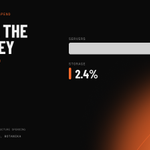




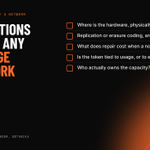


Replication: keep 3 full copies. 3 TB of disk for every 1 TB you store. simple, fast, expensive.
Erasure coding: split data into 6 pieces + 2 parity pieces. ~1.33 TB of disk per useful TB. survives the same 2 dead nodes.
The catch: rebuilding one lost piece means pulling from 6 other nodes. more CPU, more bandwidth, more latency.
P.S. Good systems use both. Replication for hot data, erasure coding for cold.


AI is going to need an enormous amount of physical infrastructure. Whoever owns that layer will shape what gets built on top of it, who gets access and at what price.
I don't think it has to end up concentrated by default. But distributing it is the harder route.
It's slower. I think it's worth it.


People often ask me why Botanika started with hardware instead of a protocol.
My honest answer: demand doesn't care how elegant your token model is. It cares whether the capacity exists, where it sits and what it costs to keep online.
The number in the image isn't a projection or a market-size slide. It's demand already waiting for the network, and it's the number our whole team plans around.
Big week ahead for us.


In 2017, Tesla unveiled the next-generation Roadster and promised deliveries in 2020.
Yesterday, it finally showed a redesigned version that can perform mid-air manoeuvres using SpaceX-developed thrusters. Production is now targeted for 2028.
Nearly nine years between the original reveal and the latest demonstration.
It’s a fascinating case study in technological ambition. The vision stayed alive long enough for the technology around it to evolve, but the timeline also shows how difficult it is to turn a radical concept into a production product.
#Tesla #Roadster #SpaceX #technology


Everyone's building an AI agent rn 👀
The real plot twist? agents are starting to enter the economy.
They need data. compute. APIs. other agents to delegate work to. and eventually, a way to pay for all of it.
That's where crypto gets interesting.
Stablecoins let software pay for services 24/7. wallets give agents a way to transact within defined limits. onchain records make those transactions verifiable.
CoinDesk reported this week that AI agents have made 138M crypto payments.
We're still early, and transaction counts alone don't tell us how much real economic value is being created.

What if we could test a drug on a virtual human cell before entering a laboratory?
Biohub, Google DeepMind, Meta and US research agencies are backing a $1.8B initiative to make this possible.
The goal is to train AI models on massive biological datasets to predict how cells respond to drugs, mutations and environmental changes.
And it all starts with data.
@biohub, @Google, @Meta
10 years of data evolution in 30 seconds.
From 2016 to 2026:
2016 | Cloud storage makes data more accessible.
2018 | Big data becomes mainstream.
2020 | Real-time analytics transforms decision-making.
2022 | Data platforms become essential to AI.
2023 | Vector databases power semantic search.
2024 | Lakehouses unify data storage and analytics.
2025 | AI agents demand reliable, structured data.
2026 | Data becomes the infrastructure behind AI.
2030 → ?
What comes next?

Microsoft and Google are backing Apache Ossie, an open-source project designed to make analytics models portable across different tools.
Could this be the future of data analytics?


3 AI & Data projects on my radar this October 👀
DelosData >> Raised $100M+ to tackle one of AI's biggest bottlenecks: moving data faster.
Golden Analytics >> Building AI-native analytics that could change how we interact with business data.
Norstella >> Using AI agents to turn complex healthcare data into actionable research.
Which one would you keep an eye on?
10 years of AI evolution in 30 seconds.
From 2016 to 2026:
2016 | AI recognizes images and speech.
2018 | GPT-1 introduces generative pretraining.
2020 | GPT-3 generates surprisingly human-like text.
2022 | ChatGPT brings conversational AI to millions.
2023 | GPT-4 makes multimodal AI mainstream.
2024 | AI models become faster, cheaper, and more accessible.
2025 | Reasoning models tackle complex, multi-step problems.
2026 | AI agents increasingly use tools, write code, and execute workflows.
In a decade, we've gone from recognizing patterns to building systems that can take action.
What comes next?
