








Marco retweeted

I had early access to GPT-6. This model will completely shatter your understanding of what's possible, and it will start a new era of creativity.
It's hard to explain how big of a jump this is, so I'll share my tests.
1/6 Made this 3D model and animation in code from an image.

Marco retweeted

If we could turn Hermes agent into this @NousResearch @Teknium . I think agents are next agi.
Marco retweeted

Excited to dive into this - an open source agent designed with memory/continual learning in mind


Marco retweeted

quick one for anyone migrating off Stainless:
we shipped a skill that turns your OpenAPI spec into an MCP server, inside codex/claude code/cursor
> npx skills add mcp-use/mcp-use/skills/openapi-to-mcp
skills.sh/mcp-use/mcp-use/op…

Marco retweeted

Building agents requires lots of infrastructure (tracing, datasets, experiments, deployments, etc...)
we've launched cmd+K global search in LangSmith for finding resources more easily
Marco retweeted

We are hiring deployed engineers at @langchain!
If you are a software engineer, but want to be in more strategic convos, understand how businesses work, work closely with customers building agents, I want to meet you.
Deployed eng at LangChain is ELITE -- absolute animals and good at everything they do. We're hiring in SF, New York and major cities across the US.
If you're curious, reach out or apply --langchain.com/careers?ashby_…

Marco retweeted

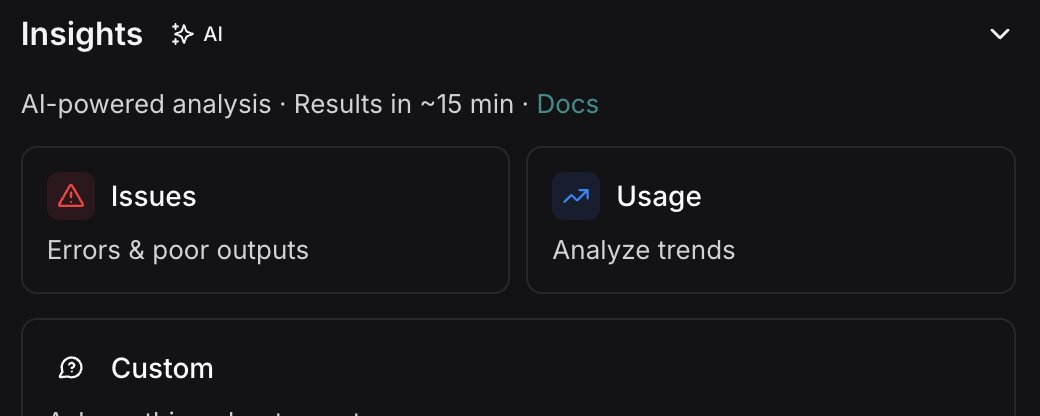
Langchain released a feature that clusters agent traces by behaviour patterns. I just ran it on 500 production traces. Here's what it actually does.
It's an LLM analyzing your LLM traces.
Specifically:
1. Takes your production traces (inputs, outputs, tool calls, intermediate steps)
2. Runs them through clustering based on semantic similarity
3. Uses an LLM-as-judge to categorize and label clusters
4. Generates a hierarchical taxonomy of usage patterns
The interesting part is the clustering methodology. From the UI, you can see that it's extracting intent from the full traced context.
This is applied across all traces, then similar intents get clustered. Each cluster gets labelled both by pattern type and by quality metrics.
What I've found useful here is that each subcategory represents a distinct agent system and context engineering pattern.
RAG retrieval, for example, has different failure modes than web scraping, even though both are "information sourcing."
The system is essentially discovering that your agent has multiple operational modes, each with different context & user requirements.
So now, this means I can fix categories of failures, not just individual bugs.
What I really like about Langsmith and their new Insights Agent is the configuration options.
You can customize clustering dimensions:
- Group by usage patterns: Clusters based on what users are trying to accomplish
- Group by poor interactions: Clusters based on failure signatures (user frustration signals, error patterns)
- Custom attributes: Define your own dimensions for clustering
Some experiments with custom attributes that I'm building now:
- context_switches: Number of topic changes mid-conversation
- tool_chain_length: Number of tool calls in sequence
- retry_rate: How often the agent needs multiple attempts
This is a great feature for strategic analysis (daily/weekly reviews).
My first impression: the categorization is surprisingly good. Clusters are semantically coherent. The metrics are well-chosen for diagnosing agent issues.
Useful for understanding agent behaviour at scale.
Much better than manual review because it finds patterns you wouldn't notice in individual traces.


🔎🤖LangSmith Insights Agent
Really excited to launch our first in-product agent
This agent lives inside LangSmith and combs through traces, giving you insights into:
🧑🤝🧑how users are using your agent
⁉️how your agent may be messing up
🛃{your custom insight here}
The problem we saw was that people were launching agents... and didn't know how their users were actually using them! You put a chat box in front of people, and they may ask it anything - the surface area for agents is often super wide
In addition - agents would fail silently. They could give a bad response - this wouldn't show up in error logs, but its good to know.
If you know what look for, you can set up LLM as a judge evaluators. But what if you don't? (most people don't initially)
The best way to figure this out - as @HamelHusain says - "look at your data". But LLMs are really good at looking at your data! So can they do it for you?
This is exactly what insights agent attempts to do. It's live in LangSmith today. You can read more about it here: blog.langchain.com/insights-…
Marco retweeted

Finally we made it happen!!
Germany's first ever LangChain Meetup in Munich!!!!!
Amazing folks, inspiring devs everywhere. Loved it.
Thanks @amadaecheverria for the support.


Marco retweeted
🥳Announcing LangChain and LangGraph 1.0
LangChain and LangGraph 1.0 versions are now LIVE!!!! For both Python and TypeScript
Some exciting highlights:
- NEW DOCS!!!!
- LangChain Agent: revamped and more flexible with middleware
- LangGraph 1.0: we've been really happy with LangGraph and this is our official stamp of approval
- Standard content blocks: swap seamlessly between models
Read more about it here: blog.langchain.com/langchain…
We hope you love it!
Marco retweeted

We raised $125M to build the platform for agent engineering.
Thank you to our investors (@IVP, @sequoia, @benchmark, @AmplifyPartners, @SapphireVC, @CapitalG, and more) for their belief in us, and to our customers like @Replit, @clay, @TrustVanta, @Cloudflare, @Rippling, @Cisco, @Workday, and many more for their trust.
Read more here about what this means for the future of building agents: blog.langchain.com/series-b/…
Marco retweeted

Such a fun surprise to see @Perinim_98 here!!! Met Marco in SF during his first week at LangChain so it’s so fun to meet again in Europe too♥️

Marco retweeted

🔺 AI SDK 5 🤝 LangSmith 🦜🛠️
We shipped a new way to trace @aisdk v5 with @langchain LangSmith! Just wrap `generate/stream` methods, and use them as normal!
You'll get top-notch observability: detailed token usage, traced tools, time-to-first-token, and more.
Docs below 👇


Marco retweeted

🚀 New docs drop!
LangGraph docs now include guides for building agents — covering memory, human-in-the-loop, streaming, deployment, and more.
🧵 A quick tour of what's covered:
RT @scrapegraphai: We just dropped a new Open Source release 🕷️
⚙️ Ollama new Structured Output
🚀 Phi4, Lllama3.3 models support
🤖 Dosu Bo…
Marco retweeted

💬Chat with your webpage cookbook is out! 💬
It uses @scrapegraphai to extract the webpage content, @lancedb to vector store it and retrieve the most relevant chunks and @DagWorks @burr_framework to orchestrate everything 🚀
Try it out: colab.research.google.com/dr…

Marco retweeted
New API docs website is out 📖
Dashboard overview, available services, cookbook, API reference and more!
Many thanks to the guys at @mintlify for the wonderful platform!
Docs: docs.scrapegraphai.com/
Try out the API here: dashboard.scrapegraphai.com/
Marco retweeted
🚀 ScrapeGraphAI API Integration
ScrapeGraphAI is a web scraping library that uses LLMs to scape websites and local documents (XML, HTML, JSON, Markdown, etc
Just say which information you want to extract and the library will do it for you!
python.langchain.com/docs/in…
