

PhD candidate 🇨🇦 physiotherapist. Sport vascular conditions, performance testing, {mnirs}
- Tweets5.4K
- Following606
- Followers3.7K
- Likes16.9K







ALT HAVE YOU HAD SURGERY FOR FLOW LIMITATIONS IN THE ILIAC ARTERY? HELP IMPROVE FUTURE CARE FOR ATHLETES We want to hear from you for an international research study WHO CAN PARTICIPATE You can participate if you: are 18 years or older have had surgery for flow limitations in the iliac artery (FLIA/endofibrosis) can complete an English questionnaire WHAT DOES PARTICIPATION INVOLVE Online questionnaire Approximately 15–20 minutes Completely voluntary JOIN THE STUDY Scan the QR code or use the following link: [QR code/link not shown] PLEASE SHARE Do you know other athletes who have had iliac artery surgery? Please send them this study information STUDY INFORMATION The study is conducted by the INSITE group: International Study group for Identification and Treatment of Endofibrosis Questions: [email protected]








ALT https://doi.org/10.1007/s40279-026-02528-y. Two-panel figure titled “Dose Response of Exercise Duration on Cardiorespiratory Fitness Following HIIT and MICT”. Left panel shows estimated change in V̇O₂max (mL/kg/min) versus exercise duration (min/week), with overlapping red and blue curves and shaded uncertainty bands for high-intensity interval training (HIIT; red) and moderate intensity continuous training (MICT; blue). HIIT rises rapidly and non-linearly, peaking and plateauing ~5 mL/kg/min near 60 minutes/week, then uncertainty limits expand to the limits of 200 minutes/week. MICT increases more gradually and linearly to ~2 mL/kg/min by 60 minutes/week and ~3 at 200 minutes/week. Right panel shows density distributions of weekly exercise duration in the meta-sample studies: HIIT is concentrated mainly between 30 and 120 minutes/week, whereas MICT spans a broader range of 70–190 minutes/week, indicating where the research has been done.


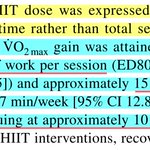
ALT When the HIIT dose was expressed as active high-intensity work time rather than total session time, 80% of the maximal ̇VO2 max gain was attained with approximately 5 min of work per session (ED80 5.2 min/session [95% CI 4.5–7.5]) and approximately 15 min of work per week (ED80 14.7 min/week [95% CI 12.8–19.0]), with the response plateauing at approximately 10 min of work per session.

ALT Whilst future studies are warranted to better understand this relation, our observations suggest that the choice between modalities should be guided not only by physiological adaptation but also by individual preferences and practical considerations [109, 110]. Although exercise enjoyment was not an outcome of this meta-analysis, it is an important determinant of long-term adherence. The evidence is mixed and appears to depend on exercise intensity and protocol structure.
